
WEG – WEG strengthens its partnership with General Motors in Argentina

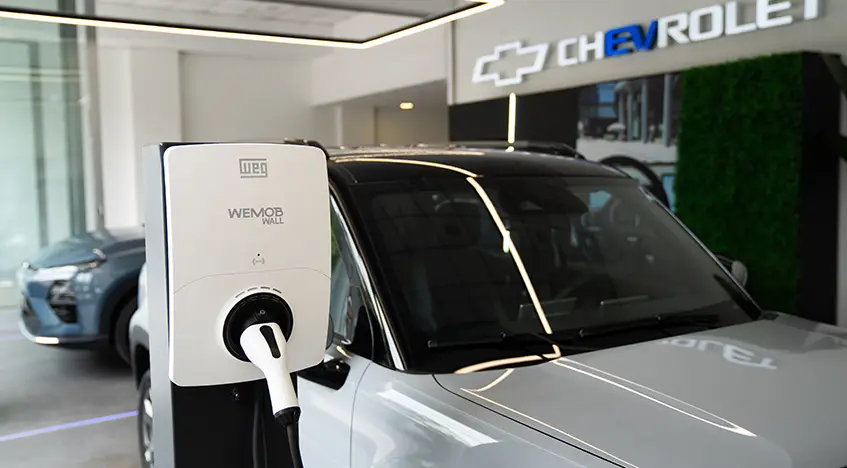
The strategic collaboration between the two companies supports the development of charging infrastructure for Chevrolet electric vehicles across the region.
The partnership between WEG and General Motors South America continues to grow and gain momentum in Argentina. While General Motors provides the vehicles and leads the electrification strategy for its portfolio, WEG contributes its technology and charging infrastructure solutions.
This collaboration has enabled General Motors Argentina to install chargers featuring smart charging, connectivity, remote management, access control and energy consumption monitoring. The equipment is installed at GM’s Automotive Complex in Alvear, in the province of Santa Fe, at its administrative offices in Vicente López, and across the Chevrolet dealership network throughout the country.
The agreement also enables WEMOB Wall Charger units to be sold through the Chevrolet dealership network, along with installation, electrical adaptation and technical support services for Chevrolet Spark EUV and Chevrolet Captiva PHEV customers who request them.
The initiative expands the charging infrastructure available at the company’s facilities and supports the ongoing development of its electrification strategy in Argentina, in collaboration with its nationwide dealership network.
WEG’s charging equipment, with power ratings up to 22 kW, can charge vehicles up to three times faster than a standard 7.4 kW installation, depending on the available electrical supply.
Accessible and efficient charging points are essential to support the growth of these technologies and deliver an increasingly convenient user experience. Through the Chevrolet dealership network, customers have an additional charging option beyond the charging points available at service stations.
“The partnership combines GM’s expertise in developing and commercializing Chevrolet electrified vehicles with WEG’s technology in electrical infrastructure, automation and electric mobility,” said Andrés Carfagna, Commercial Director of General Motors Argentina. “Our goal is to offer customers a simpler, safer and more convenient experience, from charger installation to everyday energy management,” he concluded.
The addition of this equipment supports the evolution of Chevrolet’s electrified portfolio in Argentina, which includes models such as the Spark EUV and Captiva PHEV. It is also part of General Motors’ efforts to prepare its local operations for the advancement of new mobility technologies.
“Electric mobility is a key pillar for WEG as we move toward a more efficient and sustainable transportation model. In Argentina, we are building a safe and reliable charging network that supports the growth of electric vehicles and delivers a high-quality user experience. We want to play an active role in this transition by providing technology, efficiency and solutions that help reduce environmental impact,” said Daniel Fernandes Jardim, Managing Director of WEG Argentina.
Through this regional agreement, WEG and General Motors are taking an important step toward advancing electric mobility in Argentina. The initiative strengthens charging infrastructure and helps support the evolution of Chevrolet’s electrified portfolio and the country’s changing mobility needs.
SourceWEG
EMR Analysis
More information on WEG: See the full profile on EMR Executive Services
More information on Alberto Yoshikazu Kuba (Executive President, WEG Group): See the full profile on EMR Executive Services
More information on André Luís Rodrigues (Vice President, Administrative and Financial, WEG Group): See the full profile on EMR Executive Services
More information on Anderson Fernandes (Vice President, International Division, WEG Group): See the full profile on EMR Executive Services
More information on Daniel Fernandes Jardim (Managing Director, WEG Argentina, WEG Group): See the full profile on EMR Executive Services
More information on WEMOB (WEG Electric Mobility) by WEG: https://www.weg.net/catalog/weg/MC/fr/WDC_CRITICAL_POWER_WEMOB2 + Whether in the Wall model, designed for homes and condominiums, in the Parking model, developed for shopping malls, parking lots and public spaces, or in the Station model, ideal for roads, WEMOB Charging Stations provide greater safety and protection for you and your electric vehicle than a conventional electrical outlet, in addition to charging the batteries rapid and reliably, extending their life cycle.
The WEMOB WALL Charging Station has been especially designed for indoor or outdoor (IP54) operation in garages or parking lots. With a modern, compact and wall-mounted design, Wall is perfect for homes and condos. Compatible with any voltage, single-phase or two-phase, it combines safety with convenience for your daily routine.
More information on General Motors (GM): https://www.gm.com/ + More than 90,000 employees driving global impact. 150+ facilities sparking progress for communities and economies across America. Four iconic vehicle brands providing the one for every drive.
We’ve set the standard for over a century — and yet, we’re only getting started. That’s the commitment it takes to drive the world forward for years to come.
Headquartered in Detroit, Michigan, with employees around the world, General Motors is a company with global scale and capabilities.
General Motors (NYSE:GM) is driving the future of transportation, leveraging advanced technology to build safer, smarter, and lower emission cars, trucks, and SUVs. GM’s Buick, Cadillac, Chevrolet, and GMC brands offer a broad portfolio of innovative gasoline-powered vehicles and the industry’s widest range of EVs, as we move to an allelectric future.
More information on Mary T. Barra (Chair and Chief Executive Officer, GM): https://www.gm.com/company/leadership + https://www.linkedin.com/in/mary-barra/
More information on Thomas Owsianski (President and General Manager, GM South America, GM): https://news.gm.com/home.detail.html/Pages/topic/us/en/2026/mar/0313-cadillac-brazil.html + https://www.linkedin.com/in/thomas-owsianski/
More information on Andrés Carfagna (Commercial Director, GM Argentina, GM South America, GM): https://www.linkedin.com/in/andres-carfagna-52b19114/
EMR Additional Notes:
- Fundamental Electrical Quantities and Units:
- Electric Current:
- Ampere (A): The ampere is the SI unit of electric current. Electric current represents the rate of flow of electric charge through a system. Depending on the medium, charge may be carried by electrons, ions, holes or other charge carriers.
- 1 A = 1 C/s
- In the current SI, the ampere is defined by fixing the elementary charge at exactly 1.602 176 634 × 10⁻¹⁹ C.
- Milliampere (mA): The milliampere is a unit of electric current equal to one-thousandth of an ampere.
- 1 mA = 10⁻³ A
- It is commonly used for small currents in electronic circuits, sensors, control systems and low-power devices.
- Kiloampere (kA): The kiloampere is a unit of electric current equal to 1,000 amperes.
- 1 kA = 10³ A
- It is commonly used to express high electrical currents, such as short-circuit currents, busbar ratings and current ratings of large electrical equipment.
- Ampere (A): The ampere is the SI unit of electric current. Electric current represents the rate of flow of electric charge through a system. Depending on the medium, charge may be carried by electrons, ions, holes or other charge carriers.
- Electrical Potential Difference (Voltage):
- Volt (V): The volt is the SI unit of electric potential difference, commonly called voltage. Voltage represents the difference in electric potential energy per unit electric charge between two points:
- 1 V = 1 J/C
- A potential difference can produce an electric current when an appropriate conductive path and circuit conditions exist.
- Kilovolt (kV): The kilovolt is a unit of electric potential difference equal to 1,000 volts:
- 1 kV = 10³ V
- Volt (V): The volt is the SI unit of electric potential difference, commonly called voltage. Voltage represents the difference in electric potential energy per unit electric charge between two points:
- Electrical Power and Energy:
- Power: Power is the rate at which energy is transferred, converted or delivered. The SI unit of power is the watt (W):
- 1 W = 1 J/s
- Electrical power may be expressed in W, kW, MW, GW or TW.
- Energy: Energy is the amount of energy transferred, converted or stored. Electrical energy is commonly expressed in joules (J) or watt-hours (Wh), including kWh, MWh and GWh.
- For constant power:
- Energy = Power × Time
- For variable power, energy is obtained by integrating power over time.
- Electrical energy consumption is commonly billed in kWh, although electricity tariffs may also include charges based on demand or capacity.
- Power: Power is the rate at which energy is transferred, converted or delivered. The SI unit of power is the watt (W):
- Real or Active Power:
- Real power (P), also called active power, is the average rate of net energy transfer in an electrical system. It represents the portion of electrical power associated with net transfer or conversion of energy, such as mechanical work, heat or light. It is expressed in watts (W) and its multiples.
- Kilowatt (kW): 1 kW = 1,000 W.
- Megawatt (MW): 1 MW = 1,000 kW = 1,000,000 W.
- Gigawatt (GW): 1 GW = 1,000 MW = 1,000,000,000 W.
- Terawatt (TW): 1 TW = 1,000 GW = 10¹² W. It is used for very large power levels, such as aggregated national or global generating capacity or instantaneous electrical demand. Energy consumed or generated over time should instead be expressed in units such as TWh.
- Apparent and Reactive Power:
- Apparent power (S) is a measure of the total RMS voltage-current loading of an AC system and is expressed in volt-amperes (VA). For sinusoidal AC:
- S = V × I
- Apparent power encompasses both active and reactive power. The apparent-power rating of equipment such as transformers, generators and UPS systems is commonly specified in VA, kVA or MVA.
- Kilovolt-ampere (kVA): 1 kVA = 1,000 VA.
- Megavolt-ampere (MVA): 1 MVA = 1,000 kVA = 1,000,000 VA.
- Reactive power (Q) is the component of AC power associated with the periodic exchange of energy between the electrical system and reactive elements such as inductors and capacitors. It is expressed in var (volt-amperes reactive), kVAr or MVAr.
- For sinusoidal AC: S² = P² + Q²
- and:
- P = S × power factor
- Thus, at a power factor below unity, apparent power is greater than active power.
- Apparent power (S) is a measure of the total RMS voltage-current loading of an AC system and is expressed in volt-amperes (VA). For sinusoidal AC:
- Specialized Renewable Energy Unit:
- Kilowatt-peak (kWp):
- kWp is a conventional designation for the rated peak power of a photovoltaic module or system under specified reference test conditions. It is a power rating, not a unit of energy. For conventional crystalline-silicon PV modules, Standard Test Conditions (STC) use an irradiance of 1,000 W/m², a cell temperature of 25°C and a specified reference solar spectrum.
- For example, four 270 W modules have a combined nominal peak rating of: 4 × 270 W = 1.08 kWp
- Actual electricity production depends on solar irradiance, orientation, tilt, shading, temperature, system losses, degradation and other operating conditions. Therefore, a kWp rating does not imply a fixed annual energy yield in kWh.
- Kilowatt-peak (kWp):
- Electric Current: