
WEG – WEG inaugurates R&D center in China

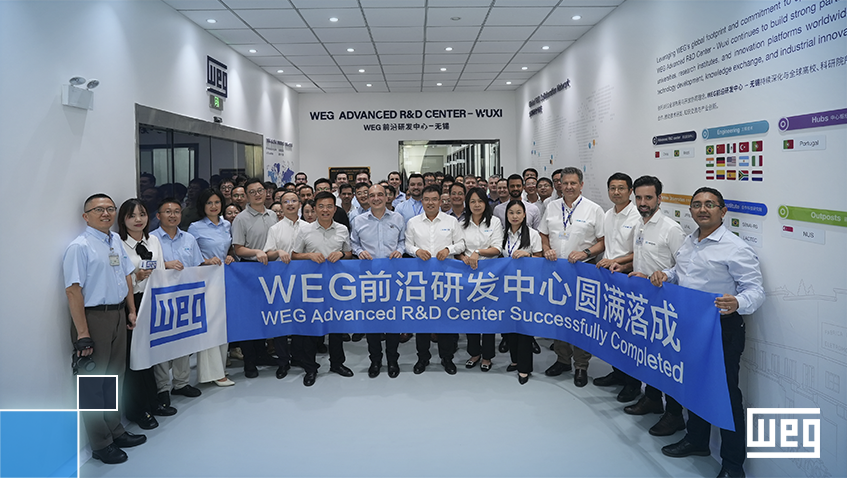
The advanced testing laboratory spans 900 square meters and is dedicated to product research, design, and testing
WEG inaugurated an Advanced Research and Development Center last Wednesday (16), on the company’s 65th anniversary, in Wuxi, Jiangsu Province, China, where the company already operates manufacturing facilities. The facility was built primarily to accelerate the introduction of new technologies into the portfolio of solutions offered to the market.
Initially, the Center will feature a 900-square-meter advanced testing laboratory dedicated to the research, design, and testing of products and components.
The laboratory will support reliability engineering, supplier qualification, customer-witnessed testing, and compliance with international standards.
According to Vice President of Technology Carlos Grillo, “the facility represents a strategic investment in the development of next-generation technologies for electric motors, drives, power electronics, automation, advanced robotics, and digital solutions.” Grillo also stated that “the Center will play a key role in integrating suppliers and scouting for technology within China’s rapidly evolving innovation landscape, as part of our strategy to internationalize the creation and mastery of technology on a global scale.”
For electric motors, for example, the new laboratory’s efforts will focus on the research and development of high-speed motors, permanent magnet motors (low and medium voltage), and integrated motor and electronic drive solutions featuring integrated architectures and functions.
The Wuxi Center is being established as a multidisciplinary environment and becomes one of the pillars of WEG’s innovation strategy in Asia, enabling closer interaction with customers, suppliers, universities, startups, and China’s broad technology ecosystem.
WEG has operated in the Chinese market since 2004, when it acquired its first factory in Nantong. Today, the company has six manufacturing facilities and 3,000 employees in the country.
SourceWEG
EMR Analysis
More information on WEG: See the full profile on EMR Executive Services
More information on Alberto Yoshikazu Kuba (Executive President, WEG Group): See the full profile on EMR Executive Services
More information on André Luís Rodrigues (Vice President, Administrative and Financial, WEG Group): See the full profile on EMR Executive Services
More information on Carlos José Bastos Grillo (Managing Director, WEG Digital & Systems, WEG): See the full profile on EMR Executive Services
More information on Anderson Fernandes (Vice President, International Division, WEG Group): See the full profile on EMR Executive Services
EMR Additional Notes:
- Motors, Generators and Drives:
- Motor:
- A motor is a machine (electromechanical device) that converts electrical energy into mechanical energy, generating rotational or linear motion used to power a machine.
- Electric motors are among the most widely used industrial devices and power equipment such as pumps, fans, compressors, conveyors, machine tools, and robotics.
- NEMA / IEC Motors:
- NEMA motors are commonly made with rolled steel or cast iron frames while IEC motors are commonly made with cast aluminum or cast iron frames.
- North American National Electrical Manufacturers Association (NEMA) and International Electrotechnical Commission (IEC) standards are crucial because they ensure that motors from different manufacturers are standardized and interchangeable in terms of dimensions, mounting, performance, efficiency, safety, and testing.
- The main differences between NEMA and IEC motors are frame dimensions, shaft sizes, mounting standards, enclosure classifications, and regional electrical standards rather than motor operating principles.
- Servo Motor:
- A servo motor is a self-contained electrical device that rotates parts of a machine with high precision and dynamic control.
- The output shaft of this motor can be moved to a particular position, angle, velocity, and torque, which a regular motor does not inherently control.
- It consists of a suitable motor coupled to a feedback device (e.g., encoder or resolver) for position and speed feedback, and requires a dedicated servo drive/controller to operate in a closed-loop control system.
- Servo motors are widely used in robotics, CNC machines, packaging equipment, semiconductor manufacturing, and other high-precision automation systems.
- Shaft Grounded Motor:
- A shaft-grounded motor is an electric motor equipped with a device to safely redirect shaft-induced electrical currents (e.g., caused by variable frequency drives) away from its internal bearings.
- Without this protection, these currents can cause bearing pitting, electrical erosion, and premature motor failure.
- Shaft grounding rings or brushes provide a low-resistance path to ground, preventing damaging bearing currents.
- Synchronous and Asynchronous Motors:
- An AC motor that runs at exactly synchronous speed (the speed of the rotating magnetic field) is known as a synchronous motor.
- An AC motor that runs at slightly less than synchronous speed is known as an asynchronous (induction) motor.
- The advantages of the synchronous motor are the ease with which the power factor can be controlled and the constant rotational speed of the machine, irrespective of the applied load.
- Synchronous motors, however, are generally more expensive and traditionally require DC excitation or permanent magnets at the rotor.
- Synchronous motors are generally not self-starting. The construction of a synchronous motor is more complicated than that of induction motors.
- Synchronous motors are costlier than induction motors.
- Asynchronous (induction) motors are self-starting, rugged, inexpensive, and by far the most common motors used in industrial applications.
- Permanent Magnet Motors:
- A permanent magnet motor (PM motor) is a type of electric motor that uses built-in permanent magnets to generate a constant magnetic field, rather than relying on electromagnets powered by an electric current. Because the motor doesn’t waste energy creating a magnetic field in the rotor, it is exceptionally efficient, lightweight, and powerful for its size.
- NEMA / IEC Motors:
- Generator:
- A generator does the opposite of a motor, converting mechanical energy into electrical energy.
- It does not create electricity; rather, it induces the movement of electric charges (electrons) in a conductor through electromagnetic induction, producing an electric current.
- Generators are commonly driven by turbines (steam, gas, hydro, or wind) or internal combustion engines.
- Drive:
- A drive (also called a motor drive or motor controller) is the electronic power conversion and control system that regulates the electrical energy supplied to a motor.
- By positioning a drive between the electrical supply and the motor, power is fed into the drive, and the drive then modulates voltage, current, and frequency before supplying it to the motor.
- This allows precise control of:
- speed
- direction
- acceleration / deceleration
- torque
- and, in advanced systems, position (when combined with feedback devices)
- Drives are essential for energy efficiency, process control, and equipment protection, especially in modern industrial applications.
- Depending on the motor type, drives include Variable Frequency Drives (VFDs) for AC motors, servo drives for servo motors, and DC drives for DC motors.
- Motor:
- Power Electronics:
- Power electronics is a specialized branch of electrical engineering focused on the conversion, control, and conditioning of electrical energy using power semiconductor devices (such as diodes, thyristors, MOSFETs, and IGBTs) and control systems.
- It enables precise control of:
- voltage
- current
- frequency
- waveform
- to efficiently supply power across applications ranging from consumer electronics to industrial drives, renewable energy systems, electric vehicles (EVs), battery energy storage systems (BESS), and power grids.
- Typical power electronic equipment includes rectifiers, inverters, DC-DC converters, AC-AC converters, variable frequency drives (VFDs), UPS systems, battery chargers, and renewable energy inverters.
- Power Conversion:
- In electrical engineering, power conversion is the process of converting electric energy from one form to another. A power converter is an electrical device for converting electrical energy between alternating current (AC) and direct current (DC). It can also change the voltage, frequency, or level of the current or voltage.
- The four primary categories of power conversion are:
- AC to DC (Rectifier)
- DC to AC (Inverter)
- DC to DC (DC-DC Converter)
- AC to AC (Voltage or Frequency Converter)
- Power conversion is one of the core functions of power electronics and enables electrical systems with different voltage levels, current types, or frequencies to operate together efficiently.
- Extra Low-Voltage (ELV):
- Extra-Low Voltage (ELV) is defined as a voltage of ≤ 50 V AC (RMS) or ≤ 120 V DC (ripple-free).
- ELV systems are typically used where electrical safety is critical (e.g., building automation, control circuits, lighting, telecom).
- Low-Voltage (LV):
- The International Electrotechnical Commission (IEC) defines Low Voltage (LV) for supply systems as voltage in the range > 50–1000 V AC or > 120–1500 V DC.
- Medium-Voltage (MV):
- Medium Voltage (MV) is a voltage class that typically falls between low voltage and high voltage, with a common range being from > 1 kV up to ~30–36 kV (typical IEC practice).
- Some regions (e.g., North America) extend MV up to ~69 kV, depending on utility definitions.
- High-Voltage (HV):
- The International Electrotechnical Commission defines high voltage as above 1000 V AC and above 1500 V DC.
- In practice, HV is often considered from ~36 kV up to ~230 kV in transmission systems.
- Super High-Voltage or Extra High-Voltage (EHV):
- Extra High-Voltage (EHV) is the voltage class used for long-distance bulk power transmission. The range for EHV systems is typically from ~220 kV to ~765–800 kV. “Super High Voltage” is not a standard IEC term.
- Ultra High-Voltage (UHV):
- Ultra High-Voltage (UHV) is the highest voltage class used in electrical transmission, defined as a voltage of ≥ 800 kV (AC) and ≥ 800–1000 kV (DC, depending on classification).