
Siemens Energy – Siemens Energy is starting preparations for business area Transformation of Industry to become a standalone company
- Objective is to create an independent industrial energy solutions company with greater entrepreneurial flexibility and growth opportunities
- Siemens Energy intends to explore new ownership structure of Transformation of Industry as second step with objective to deconsolidate
- The Transformation of Industry business comprises 17,000 employees, €5.7 billion in revenue, 11.3% profit margin (FY 2025)
- Siemens Energy to focus on power generation and power transmission
Siemens Energy is starting preparations for the legal and operational separation of its Transformation of Industry business area. The goal is to establish the business as a standalone entity and create a strong, independent industrial energy solutions company. The future setup is intended to provide Transformation of Industry with greater entrepreneurial flexibility and additional options for further growth – ranging from bringing in external investors to a potential capital markets transaction. Siemens Energy intends to deconsolidate the business while retaining a meaningful minority stake to support the business’s continued development.
Transformation of Industry supports industrial customers around the world to operate their plants and processes more efficiently, more reliably and with lower emissions. The portfolio covers a broad range of technologies including industrial steam turbines, compressors, electrolyzers for hydrogen production, generators and motors, as well as maritime and subsea technologies, among others. In fiscal year 2025, its approximately 17,000 employees generated revenue of €5.7 billion.
Christian Bruch, President and Chief Executive Officer of Siemens Energy:
“Transformation of Industry has developed successfully over the past several years and is now a profitable, high-growth business. We see the potential for further profitable growth if we can accelerate the business’s continued development.”
Transformation of Industry to gain greater strategic flexibility
Within the current Group structure, Transformation of Industry competes for investment against businesses that are growing even faster. In addition, Transformation of Industry largely serves different markets than the rest of Siemens Energy. These markets – industries such as oil & gas, chemicals, process industries, paper, cement and maritime – are often faster-moving, more transactional and shaped by different customer needs. As a standalone entity, the business would be better positioned to respond at the pace these markets require.
Christian Bruch: “If we don’t change our structure, we limit what Transformation of Industry can achieve. Our current investment focus is on power generation and power transmission, with higher immediate payback.”
Transformation of Industry benefits from long-term growth trends such as energy efficiency and affordability, industrial electrification, decarbonization, digitalization and rising demand for security of supply. With strong positions in attractive markets such as oil and gas, process industries, data centers and maritime along with a broad technology and service portfolio, the business is well positioned to benefit from these long-term growth trends. A high service share of around 50% of total revenue provides stable, recurring earnings. With more than 85,000 units installed globally, the future company has a solid foundation for further international growth.
The business to be carved out will initially operate under Siemens Energy’s future brand, Omterra, once launched. It has a network of key manufacturing sites in Germany – including Duisburg (ca. 1,500 employees), Erlangen (ca. 700), Görlitz (ca. 650), Muelheim an der Ruhr (ca. 550), Nuremberg (ca. 550), Erfurt (ca. 550), Hamburg (ca. 250), Leipzig (ca. 200) and Berlin (ca. 150) – as well as in Europe, the United States, India, China, Brazil, Saudi Arabia, and other countries.
SourceSiemens Energy
EMR Analysis
More information on Siemens Energy AG (to be renamed “Omterra”): See the full profile on EMR Executive Services
More information on Dr. -Ing. Christian Bruch (President and Chief Executive Officer, Siemens Energy AG + President and Chief Executive Officer, Siemens Energy Management GmbH + Chief Sustainability Officer, Siemens Energy AG + Export Control, Siemens Energy AG): See the full profile on EMR Executive Services
More information on Maria Ferraro (Chief Financial Officer, Siemens Energy AG): See the full profile on EMR Executive Services
More information on ELEVATE (Our way to drive performance – Three priorities) by Siemens Energy AG: See the full profile on EMR Executive Services
More information on Gas Services by Siemens Energy AG: See the full profile on EMR Executive Services
More information on Karim Amin (Member of the Executive Board – Business Area: Gas Services, Siemens Energy AG + Member of the Executive Board, Siemens Energy Management GmbH): See the full profile on EMR Executive Services
More information on Grid Technologies by Siemens Energy AG: See the full profile on EMR Executive Services
More information on Tim Oliver Holt (Member of the Executive Board – Business Area: Grid Technologies + Labor Director, Siemens Energy AG + Member of the Executive Board and Labor Director, Siemens Energy Management GmbH, Siemens Energy AG + Member of the Executive Committee, ZVEI): See the full profile on EMR Executive Services
More information on Transformation of Industry by Siemens Energy AG (In Preparations for the Legally and Operationally Separated): See the full profile on EMR Executive Services
More information on Anne-Laure Parrical de Chammard (Member of the Executive Board – Business Area: Transformation of Industry, Siemens Energy): See the full profile on EMR Executive Services
More information on Siemens Gamesa by Siemens Energy AG: See the full profile on EMR Executive Services
More information on Vinod Philip (Member of the Executive Board – Business Area: Wind Power, Siemens Energy AG + Member of the Executive Board of Siemens Energy Management GmbH, Siemens Energy AG + Chief Executive Officer, Siemens Gamesa Renewable Energy, Siemens Energy AG): See the full profile on EMR Executive Services
EMR Additional Notes:
- Carbon Dioxide (CO2):
- The primary greenhouse gas emitted through human activities. Carbon dioxide enters the atmosphere through the burning of fossil fuels (coal, natural gas, and oil), solid waste, biomass (e.g. wood), and also as a result of certain industrial chemical reactions (e.g. cement production).
- Carbon dioxide is removed from the atmosphere (or “sequestered”) when it is absorbed by plants as part of the biological carbon cycle and through ocean absorption and geological processes. In climate accounting, however, “carbon sequestration” generally refers to the removal and storage of carbon in a reservoir; natural uptake through the carbon cycle is not necessarily classified as anthropogenic carbon dioxide removal (CDR).
- CO₂ is naturally part of the carbon cycle, but human activities have significantly increased its concentration in the atmosphere.
- Biogenic Carbon Dioxide (CO2):
- Biogenic CO₂ and fossil-derived CO₂ are chemically identical molecules.
- The distinction is not chemical, but source-based:
- Biogenic carbon: CO₂ released from organic materials such as plants, wood, soil, and biomass that were recently part of the natural carbon cycle. Its accounting treatment depends on the applicable carbon-accounting methodology and whether the carbon is considered part of the contemporary biogenic carbon cycle.
- Fossil carbon: CO₂ released from fossil fuels (coal, oil, gas), which were stored underground for millions of years. This introduces additional carbon into the active atmospheric carbon cycle and is therefore generally treated as fossil CO₂ emissions.
- CO2e (Carbon Dioxide Equivalent):
- CO₂e means “carbon dioxide equivalent”.
- It is a standardized climate metric used to express the total climate impact of multiple greenhouse gases in a single standardized unit.
- CO₂e converts all greenhouse gases (such as methane and nitrous oxide) into the amount of CO₂ that would have the same integrated radiative forcing / climate impact over a defined time period using a specified Global Warming Potential (GWP) value.
- Formula: CO₂e = mass of gas × Global Warming Potential (GWP)
- Carbon dioxide equivalents are commonly expressed as million metric tonnes of carbon dioxide equivalents, abbreviated as MtCO₂e or Mt CO₂-eq; “MMTCDE” is used in some datasets but is not the preferred general notation.
- The carbon dioxide equivalent for a gas is derived by multiplying the tonnes of the gas by the associated GWP: CO₂e = mass of gas × GWP.
- For example, the GWP for methane is approximately 27–30 under IPCC AR6 depending on the methane source and accounting convention, while the 100-year GWP for nitrous oxide is 273. This means that emissions of 1 million metric tonnes of methane and nitrous oxide respectively would correspond to approximately 27–30 and 273 million metric tonnes of CO₂e under those GWP assumptions.
- Carbon Footprint:
- There is no universally agreed definition of what a carbon footprint is.
- The most widely used definition (GHG Protocol) describes it as: “The total set of greenhouse gas (GHG) emissions caused directly and indirectly through an organization’s operations and value chain.” The GHG Protocol generally refers to corporate GHG inventories and Scope 1, 2 and 3 emissions rather than prescribing one universal definition of “carbon footprint.”
- A carbon footprint is the total amount of greenhouse gas (GHG) emissions caused directly and indirectly by an individual, organization, product, or activity.
- It is typically measured in CO₂e.
- Decarbonization:
- Reduction of carbon dioxide emissions through the use of low-carbon energy sources and improved efficiency, with the goal of reducing overall greenhouse gas emissions. More broadly, decarbonization refers to reducing the carbon intensity and/or absolute greenhouse-gas emissions of an economy, sector, organization, product, or process, potentially including CO₂ removal for residual emissions.
- Decarbonization typically refers to system-wide transition, not only emission reduction at a single source.
- Carbon Credits or Carbon Offsets:
- Carbon credits are tradable certificates representing the verified reduction or removal of one metric tonne of CO₂e, generally generated by a specific project or activity; terminology and quality criteria vary between carbon markets.
- They are part of cap-and-trade systems, where:
- A cap limits total emissions
- Companies receive or buy emission allowances
- Excess allowances can be traded
- Offsets are often linked to external projects that reduce or remove emissions (e.g. reforestation, renewable energy). A carbon offset is generally a credit representing a reduction or removal outside the entity’s own emissions boundary that may be used to compensate for emissions, subject to the applicable programme or claim rules.
- Carbon credits and emission allowances should not be treated as synonymous: an allowance is a regulated authorization to emit under a cap-and-trade system, whereas a credit/offset generally represents a quantified emission reduction or removal.
- Carbon Capture and Storage (CCS) – Carbon Capture, Utilisation and Storage (CCUS):
- CCS involves capturing CO₂ emissions from industrial processes or other concentrated sources and storing them permanently in geological formations (e.g. underground reservoirs).
- CCUS adds a utilization step, where captured CO₂ is reused as a feedstock (e.g. fuels, chemicals, building materials). More precisely, CCUS refers to carbon capture followed by utilization and/or storage; utilization does not necessarily result in permanent carbon storage.
- CCS = capture + geological storage; CCUS = capture + utilization and/or storage.
- Carbon Dioxide Removal (CDR) or Durable Carbon Removal:
- CDR refers to methods that actively remove CO₂ from the atmosphere and store it for long periods in geological, biological, or mineral form. CDR specifically requires an anthropogenic activity that removes atmospheric CO₂ and durably stores it in geological, terrestrial, ocean, or product reservoirs.
- Examples include:
- Direct Air Capture (DAC)
- Bioenergy with Carbon Capture (BECCS)
- Enhanced Rock Weathering (ERW)
- CDR creates net negative emissions when removal exceeds emissions. A CDR activity itself can provide a net removal only when the total emissions associated with the removal process are lower than the amount of CO₂ durably removed and stored.
- Direct Air Capture (DAC):
- Technologies that extract CO2 directly from the atmosphere at any location, unlike carbon capture which is generally carried out at the point of emissions, such as a steel plant. DAC can capture CO₂ from ambient air regardless of where the original emissions occurred; it is distinct from point-source carbon capture.
- Constraints like costs and energy requirements as well as the potential for pollution make DAC a less desirable option for CO2 reduction. Its larger land footprint when compared to other mitigation strategies like carbon capture and storage systems (CCS) also put it at a disadvantage. However, DAC is a potential carbon-removal technology rather than simply a CO₂-reduction technology, and its climate benefit depends strongly on the energy source, capture efficiency, permanence of storage, and lifecycle emissions.
- Direct Air Capture and Storage (DACCS):
- Climate technology that removes carbon dioxide (CO2) directly from the ambient atmosphere using large fans and chemical processes to bind with the CO2. The captured CO₂ is then transported and durably stored, typically in geological formations.
- DACCS is therefore a specific form of CDR: DAC + durable CO₂ storage.
- Bioenergy with Carbon Capture and Storage (BECCS):
- Technology that generates energy from biomass while capturing and storing the resulting CO₂.
- Because biomass absorbs CO₂ while growing, BECCS can result in net negative emissions. It can result in net negative emissions when the full lifecycle emissions—including biomass production, harvesting, transport, processing, energy use, and capture/storage—are sufficiently lower than the amount of biogenic CO₂ durably removed from the atmosphere.
- Enhanced Rock Weathering (ERW):
- Carbon dioxide removal (CDR) technique that accelerates the natural process of rock weathering by grinding silicate rocks into dust and spreading it on land, typically agricultural fields. This process enhances reactions with water and atmospheric CO₂, converting dissolved carbon into bicarbonate and, ultimately, carbonate minerals or transporting dissolved inorganic carbon to aquatic systems, where it can be stored over long timescales.
- Its effectiveness and permanence depend on rock type, particle size, weathering rates, transport pathways, soil and water chemistry, and the emissions associated with mining, grinding, and transporting the rock.
- Limits of Carbon Dioxide Storage:
- Carbon storage is not endless; the Earth’s capacity for permanently storing vast amounts of captured carbon, particularly in geological formations, is limited, potentially reaching a critical limit of 1,460 gigatonnes at around 2200, though storage durations vary significantly depending on the method, from decades for some biological methods to potentially millions of years for others like mineralization. Estimates of geological storage capacity vary widely and depend on geology, reservoir characteristics, storage efficiency, infrastructure, economics, regulation, monitoring, and permanence.
- While some methods offer very long-term storage, the sheer volume needed to meet climate targets requires scaling up storage significantly beyond current capacity, raising concerns about the available volume over time. The practical constraint is therefore better described as the need to develop sufficient safe, permanent, economically and technically accessible storage capacity rather than a single known global physical limit.
- Carbon Impregnation:
- Carbon impregnation is the process of treating activated carbon with chemical agents (such as metals, acids, or bases) to enhance its ability to adsorb specific, hard-to-remove pollutants. By loading substances like silver, sulfur, or potassium hydroxide into its pores, this material combines physical adsorption with chemical reaction for improved, targeted filtration in water and air. This is a materials engineering process, not a climate accounting concept.
- Global Warming:
- Global warming is the long-term heating of Earth’s climate system observed since the pre-industrial period (between 1850 and 1900) due to human activities, primarily fossil fuel burning, which increases heat-trapping greenhouse gas levels in Earth’s atmosphere. Global warming refers specifically to the long-term increase in Earth’s average surface temperature; climate change is the broader term encompassing associated changes in climate systems, including precipitation, extremes, sea level, and ecosystems.
- Global Warming Potential (GWP):
- A measure of how much heat a greenhouse gas contributes to climate warming relative to CO₂ over a specific time period (commonly 100 years).
- CO₂ has a GWP of 1.
- GWP is the scientific basis for converting gases into CO₂e.
- GWP was developed to allow comparisons of the global warming impacts of different gases. The numerical GWP depends on the selected IPCC assessment, time horizon, and, for some gases such as methane, the emission source and accounting convention.
- Greenhouse Gas (GHG):
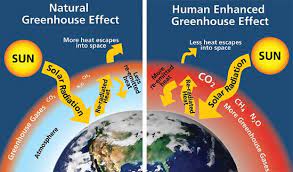
- Any gas that absorbs and emits infrared radiation in the atmosphere, contributing to the greenhouse effect.
- Main GHGs include:
- CO₂
- Methane (CH₄)
- Nitrous oxide (N₂O)
- Fluorinated gases such as HFCs, PFCs, SF₆ and NF₃
- Water vapor is a GHG but is not directly controlled by human emissions at scale. It is primarily a feedback in the climate system rather than a direct target of conventional anthropogenic GHG inventories.
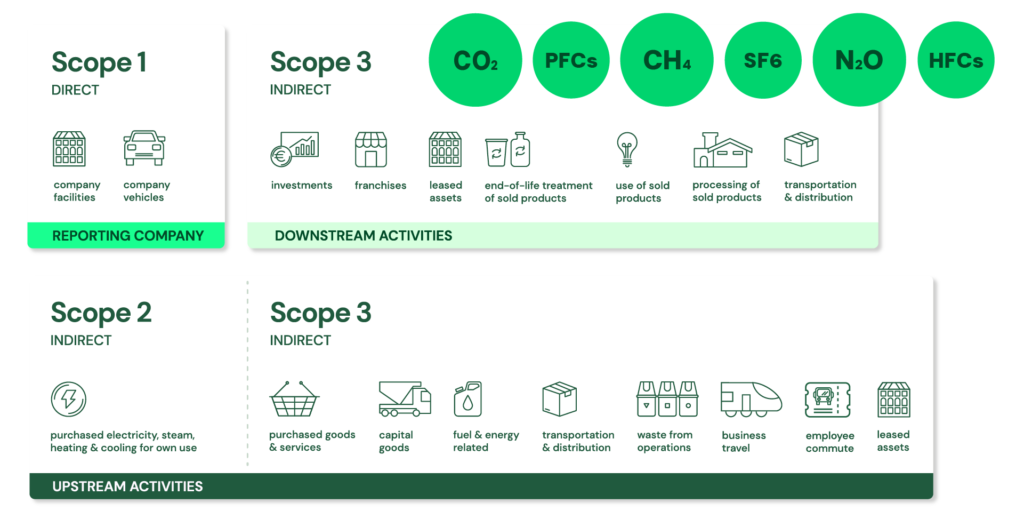
- GHG Protocol Corporate Standard Scope 1, 2 and 3: https://ghgprotocol.org/ + The GHG Protocol Corporate Accounting and Reporting Standard provides requirements and guidance for companies and other organizations preparing a corporate-level GHG emissions inventory. The Corporate Standard itself is voluntary, although companies may be required by applicable legislation or regulation to report using the GHG Protocol or equivalent requirements.
- Scope 1: Direct emissions:
- Direct emissions from company-owned and controlled resources. In other words, emissions are released into the atmosphere as a direct result of a set of activities, at a firm level. More precisely, Scope 1 covers direct GHG emissions from sources that are owned or controlled by the reporting organization.
- It is divided into four categories:
- Stationary combustion (e.g from fuels, heating sources). All fuels that produce GHG emissions must be included in scope 1. This applies when the combustion source is owned or controlled by the reporting organization.
- Mobile combustion is all vehicles owned or controlled by a firm, burning fuel (e.g. cars, vans, trucks). The increasing use of “electric” vehicles (EVs), means that some of the organisation’s fleets could fall into Scope 2 emissions. For example, fuel combustion in an owned/controlled vehicle is Scope 1, whereas electricity purchased to charge an EV is generally Scope 2; an EV itself does not create Scope 2 emissions—the purchased electricity does.
- Fugitive emissions are leaks from greenhouse gases (e.g. refrigeration, air conditioning units). It is important to note that refrigerant gases are not uniformly “a thousand times more dangerous” than CO₂; some refrigerants have GWPs of hundreds or thousands of times that of CO₂, while others have much lower values. Companies are encouraged to report these emissions.
- Process emissions are released during industrial processes, and on-site manufacturing (e.g. production of CO2 during cement manufacturing, factory fumes, chemicals). These are direct emissions resulting from physical or chemical processes other than fuel combustion, such as calcination in cement production..
- Scope 2: Indirect emissions – owned:
- Indirect emissions from the generation of purchased energy, from a utility provider. In other words, all GHG emissions released in the atmosphere, from the consumption of purchased electricity, steam, heat and cooling. Scope 2 covers indirect GHG emissions associated with the generation of purchased or acquired electricity, steam, heat, and cooling consumed by the reporting organization; “owned” is therefore misleading because the emissions source is owned or controlled by another entity.
- For most organisations, electricity will be the unique source of scope 2 emissions. Simply stated, the energy consumed falls into two scopes: Scope 2 covers the electricity consumed by the end-user. Scope 3 covers the energy used by the utilities during transmission and distribution (T&D) losses. More precisely, Scope 2 covers the generation-related emissions associated with purchased electricity, not the physical electricity itself. T&D losses are generally accounted for in Scope 3 Category 3 for an energy consumer that does not own the T&D system, although the treatment can vary depending on ownership and accounting circumstances.
- Scope 3: Indirect emissions – not owned:
- Indirect emissions – not included in scope 2 – that occur in the value chain of the reporting company, including both upstream and downstream emissions. In other words, emissions are linked to the company’s operations. According to the GHG protocol, scope 3 emissions are separated into 15 categories. Scope 3 therefore captures other indirect value-chain emissions, upstream and downstream, across the 15 defined categories of the Scope 3 Standard.
- Scope 1: Direct emissions:
- Turbines (Gas and Steam):
- Gas turbines and steam turbines are rotary engines that convert thermal energy into mechanical power, but they differ fundamentally in their working fluids, thermodynamic cycles, and operational dynamics. Gas turbines use a continuous flow of hot compressed gas, while steam turbines use high-pressure, high-temperature steam.
- The primary difference is that gas turbines utilize the direct combustion of air and fuel to produce hot, high-velocity gases that spin the turbine blades, whereas steam turbines rely on an external heat source to boil water into high-pressure steam, which expands to drive the rotor.
- A gas turbine is a rotary internal combustion engine that uses pressurized gas, typically air, to spin a turbine and generate power. It’s a type of continuous flow combustion engine, meaning it uses a steady stream of gases to produce mechanical energy. This mechanical energy can then be converted into electricity using a generator, or used for other purposes like powering aircraft or industrial machinery.
- A steam turbine is a rotary external combustion engine that converts the energy of high-pressure steam into mechanical power. It operates on the Rankine cycle, where water is heated (often in a boiler) to produce steam, which expands through turbine blades to drive a rotor. The steam is then condensed and recycled in a closed loop.
- Compressors:
- A compressor is a mechanical device that increases the pressure of a gas—most commonly air—by reducing its volume, effectively converting power (electric, diesel, or gasoline) into potential energy stored in pressurized air.
- Compressors are essential in manufacturing, HVAC, and industrial settings for powering tools, cooling systems, and processing gas.
- Hydrogen:
- The atom of hydrogen is the first element in the periodic table, with chemical symbol H and hydrogen was one of the first elements formed in the early universe after the Big Bang. It is the most common element in the universe and the primary fuel for stars like the Sun (via nuclear fusion). It consists of one proton (positive charge) and one electron (negative charge) in its neutral atomic form.
- Hydrogen rarely exists in its pure form (H₂) on Earth. Molecular hydrogen (H₂) is relatively scarce naturally, because it readily forms covalent bonds, and most hydrogen is found in compounds such as:
- Water (H₂O)
- Hydrocarbons (e.g., methane CH₄, oil, and coal)
- Biomass (plants, organic matter)
- Hydrogen can be produced in numerous ways:
- Steam Methane Reforming (SMR) → produces a hydrogen-rich gas mixture and CO₂ as a by-product
- Electrolysis (using electricity) → can have very low lifecycle emissions if powered by low-carbon electricity, including renewable electricity
- Other methods (biomass, thermochemical, etc.)
- Hydrogen is a versatile energy carrier (not a primary energy source) that can be used for:
- Transportation (fuel cells, synthetic fuels)
- Industrial processes (e.g., ammonia, steel)
- Power generation and storage
- Heating (in specific applications)
- Hydrogen is a low-emission energy carrier at the point of use in a fuel cell, producing electricity, heat, and water rather than CO₂ when pure hydrogen is used as the fuel. It is particularly useful in sectors where electrification is difficult (heavy industry, long-distance transport). Its overall climate impact depends on how the hydrogen is produced, transported, stored, and used.
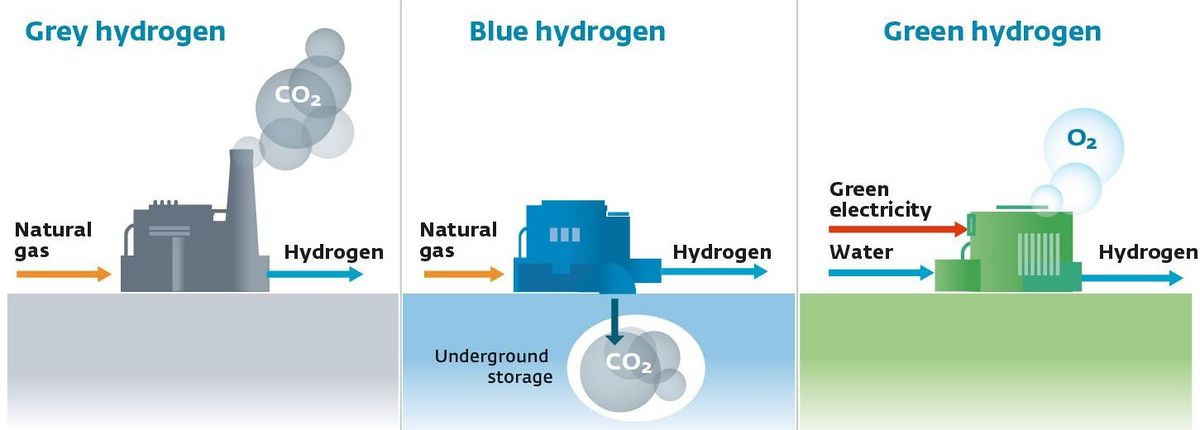
- Grey, Blue or Green Hydrogen:
- Where hydrogen comes from is critical:
- Grey Hydrogen: Produced from fossil fuels (mainly natural gas via SMR) → high CO₂ emissions
- Blue Hydrogen: Same as grey, but with Carbon Capture and Storage (CCS) to capture and permanently store a substantial portion of the CO₂ generated during production; residual and upstream emissions can remain
- Green Hydrogen: Produced via electrolysis using renewable electricity → potentially very low lifecycle greenhouse-gas emissions, depending on the electricity source and the full production system
- There is a growing consensus that hydrogen can play a key role in the energy transition, particularly for:
- Decarbonizing heavy industry
- Long-duration energy storage
- Heavy transport (shipping, aviation fuels, trucking) and other applications where direct electrification is technically difficult or inefficient
- Important: Grey, blue and green are commonly used industry colour classifications rather than universally standardized scientific categories. Other classifications include turquoise hydrogen (methane pyrolysis), pink hydrogen (nuclear-powered electrolysis), yellow hydrogen (electrolysis using grid electricity), and white hydrogen (naturally occurring geological hydrogen).
- Where hydrogen comes from is critical:
- Hydrogen Electrolyzer:
- An electrolyzer is a system that uses electricity to split water into hydrogen and oxygen in a process called electrolysis.
- At the cathode: water gains electrons → hydrogen gas (H₂) is produced
At the anode: water releases electrons → oxygen gas (O₂) is produced
- At the cathode: water gains electrons → hydrogen gas (H₂) is produced
- The cathode is the site of reduction and the anode is the site of oxidation. The exact electrode reactions depend on the electrolyzer technology, such as alkaline or proton-exchange membrane (PEM) electrolysis.
The overall reaction is: 2H₂O → 2H₂ + O₂. - The electrolyzer is therefore essentially the reverse electrochemical process of a fuel cell.
- An electrolyzer is a system that uses electricity to split water into hydrogen and oxygen in a process called electrolysis.
- Fuel Cell Plant:
- A fuel cell plant is a facility that generates electricity through an electrochemical reaction (not combustion).
- It works by combining:
- Hydrogen (fuel)
- Oxygen (from air)
- to produce:
- Electricity
- Heat
- Water
- Fuel cell systems:
- Produce very low emissions (no direct CO₂ emissions when pure hydrogen is used as the fuel; lifecycle emissions depend on hydrogen production and other upstream activities)
- Operate continuously as long as fuel is supplied
- Are used in power generation, backup systems, and mobility
- A fuel cell converts the chemical energy of hydrogen and an oxidant directly into electrical energy through electrochemical reactions, rather than first converting the fuel into heat through combustion.
- Motors, Generators and Drives:
- Motor:
- A motor is a machine (electromechanical device) that converts electrical energy into mechanical energy, generating rotational or linear motion used to power a machine.
- Electric motors are among the most widely used industrial devices and power equipment such as pumps, fans, compressors, conveyors, machine tools, and robotics.
- NEMA / IEC Motors:
- NEMA motors are commonly made with rolled steel or cast iron frames while IEC motors are commonly made with cast aluminum or cast iron frames.
- North American National Electrical Manufacturers Association (NEMA) and International Electrotechnical Commission (IEC) standards are crucial because they ensure that motors from different manufacturers are standardized and interchangeable in terms of dimensions, mounting, performance, efficiency, safety, and testing.
- The main differences between NEMA and IEC motors are frame dimensions, shaft sizes, mounting standards, enclosure classifications, and regional electrical standards rather than motor operating principles.
- Servo Motor:
- A servo motor is a self-contained electrical device that rotates parts of a machine with high precision and dynamic control.
- The output shaft of this motor can be moved to a particular position, angle, velocity, and torque, which a regular motor does not inherently control.
- It consists of a suitable motor coupled to a feedback device (e.g., encoder or resolver) for position and speed feedback, and requires a dedicated servo drive/controller to operate in a closed-loop control system.
- Servo motors are widely used in robotics, CNC machines, packaging equipment, semiconductor manufacturing, and other high-precision automation systems.
- Shaft Grounded Motor:
- A shaft-grounded motor is an electric motor equipped with a device to safely redirect shaft-induced electrical currents (e.g., caused by variable frequency drives) away from its internal bearings.
- Without this protection, these currents can cause bearing pitting, electrical erosion, and premature motor failure.
- Shaft grounding rings or brushes provide a low-resistance path to ground, preventing damaging bearing currents.
- Synchronous and Asynchronous Motors:
- An AC motor that runs at exactly synchronous speed (the speed of the rotating magnetic field) is known as a synchronous motor.
- An AC motor that runs at slightly less than synchronous speed is known as an asynchronous (induction) motor.
- The advantages of the synchronous motor are the ease with which the power factor can be controlled and the constant rotational speed of the machine, irrespective of the applied load.
- Synchronous motors, however, are generally more expensive and traditionally require DC excitation or permanent magnets at the rotor.
- Synchronous motors are generally not self-starting. The construction of a synchronous motor is more complicated than that of induction motors.
- Synchronous motors are costlier than induction motors.
- Asynchronous (induction) motors are self-starting, rugged, inexpensive, and by far the most common motors used in industrial applications.
- NEMA / IEC Motors:
- Generator:
- A generator does the opposite of a motor, converting mechanical energy into electrical energy.
- It does not create electricity; rather, it induces the movement of electric charges (electrons) in a conductor through electromagnetic induction, producing an electric current.
- Generators are commonly driven by turbines (steam, gas, hydro, or wind) or internal combustion engines.
- Drive:
- A drive (also called a motor drive or motor controller) is the electronic power conversion and control system that regulates the electrical energy supplied to a motor.
- By positioning a drive between the electrical supply and the motor, power is fed into the drive, and the drive then modulates voltage, current, and frequency before supplying it to the motor.
- This allows precise control of:
- speed
- direction
- acceleration / deceleration
- torque
- and, in advanced systems, position (when combined with feedback devices)
- Drives are essential for energy efficiency, process control, and equipment protection, especially in modern industrial applications.
- Depending on the motor type, drives include Variable Frequency Drives (VFDs) for AC motors, servo drives for servo motors, and DC drives for DC motors.
- Motor: