
Schneider Electric – Unlocking a new level of strategic intelligence for Industrial AI with Cognite


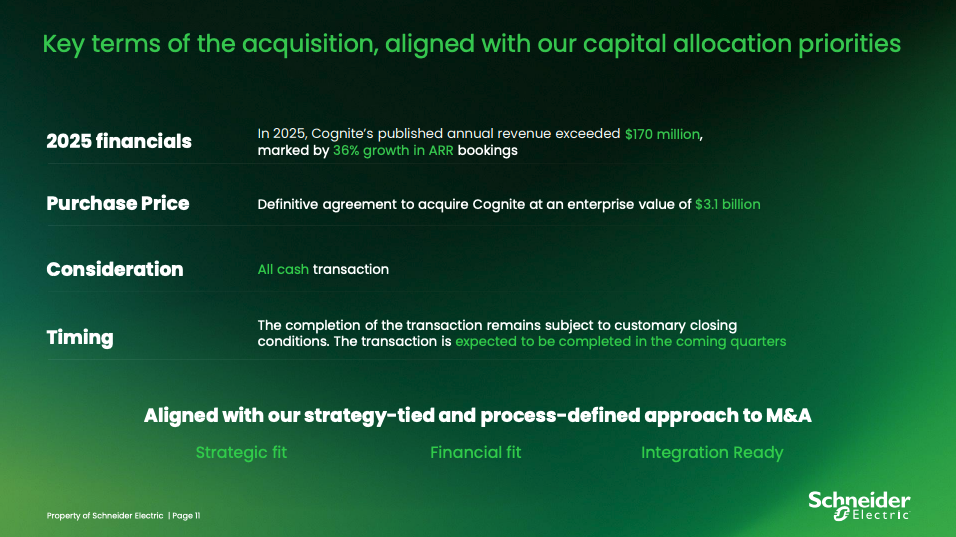
Rueil-Malmaison, France — June 30th, 2026 — Schneider Electric, a global leader in energy management and automation, today announces that it has entered into a definitive agreement to acquire 100% of Cognite Holding B.V. (“Cognite”), a leading provider of industrial data and AI software, in an all cash transaction valued at $3.1 billion.
Strengthening Schneider Electric’s leadership in industrial AI
Industrial AI is shifting from supporting analytics to executing operations, from describing what is happening in industrial infrastructure to deciding and acting on it. Capturing this shift requires more than models: it requires a unified, contextualized foundation of industrial data on which AI can be trusted to operate at scale.
Cognite brings that foundation. Its cloud native platform combines a unified industrial data model with agentic AI capabilities, enabling customers to operationalize AI directly within plant operations, asset management and engineering workflows.
Olivier Blum, Schneider Electric CEO, commented: “Cognite has built something rare, a truly industrial grade AI platform that turns the complexity of operational data into a competitive advantage. This acquisition strengthens AVEVA, Schneider Electric’s wholly owned industrial software company, in the highest‑growth segments of the market and positions Schneider Electric at the centre of the next phase of industrial intelligence.
I have been extremely impressed by the world-class technology team and am convinced their unique AI expertise will be a catalyst in advancing intelligence across Schneider Electric’s portfolio.
At Schneider Electric, we have always believed the energy transition demands intelligence, intelligence demands data, and unlocking its full value requires AI.
By bringing Cognite into Schneider Electric and AVEVA, we unite the world’s most comprehensive energy management and automation infrastructure with the software and AI capabilities to make it natively intelligent. Together, we go beyond connecting systems. We give them the ability to think, adapt, and act. This is what industrial intelligence looks like at scale.”
A leading industrial AI platform with strong growth momentum
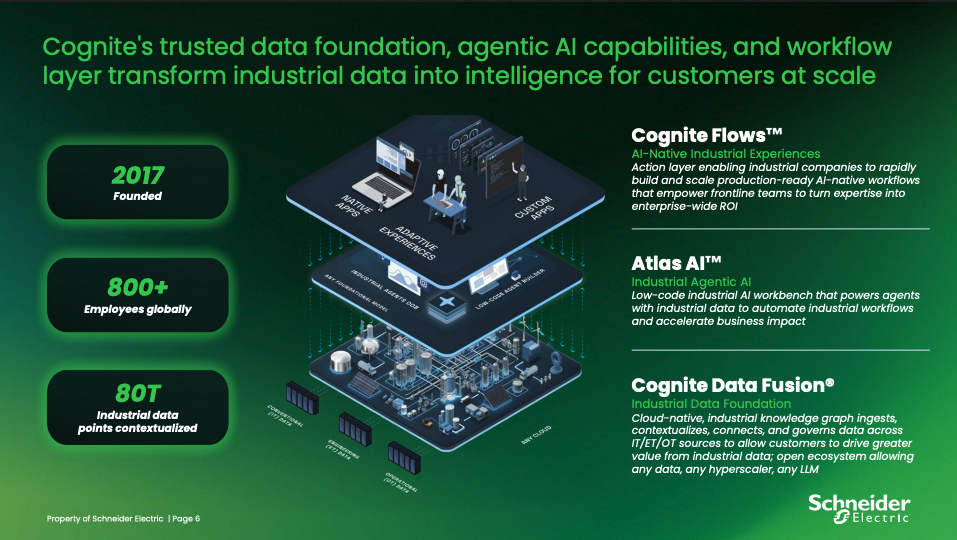
Cognite was founded in 2017 and today employs more than 800 people in the Americas, Europe, Middle East and Asia-Pacific, specializing in cloud‑native data and AI platforms. Its technology enables the integration and contextualization of complex industrial data through a unified data model and knowledge graph, supporting advanced analytics and AI‑driven applications for asset‑intensive industries.
In 2025, the annual revenue exceeded $170 million, marked by 36% growth in ARR bookings and a rapid adoption of the Atlas AI platform. (Cognite’s Moonshot and AI Drive Record-Breaking Year)
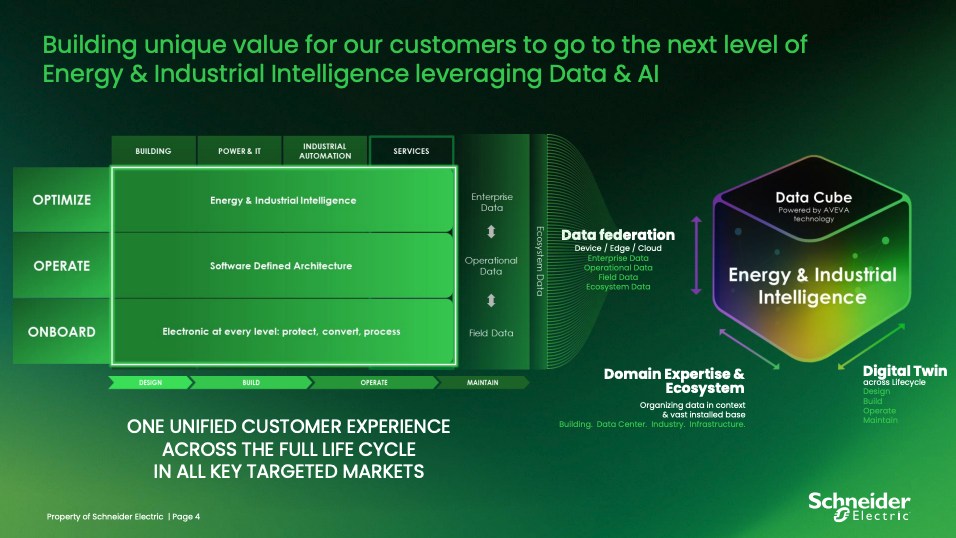
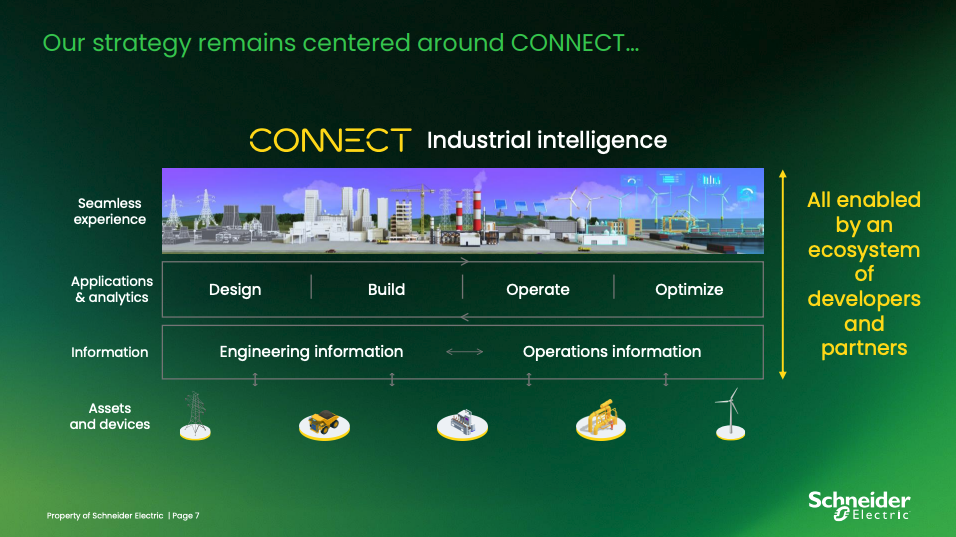
The transaction complements the capabilities of AVEVA’s CONNECT industrial intelligence platform, reinforcing it as a leader for comprehensive industrial intelligence solutions spanning design, build, operation and optimization.
Compelling strategic fit with AVEVA
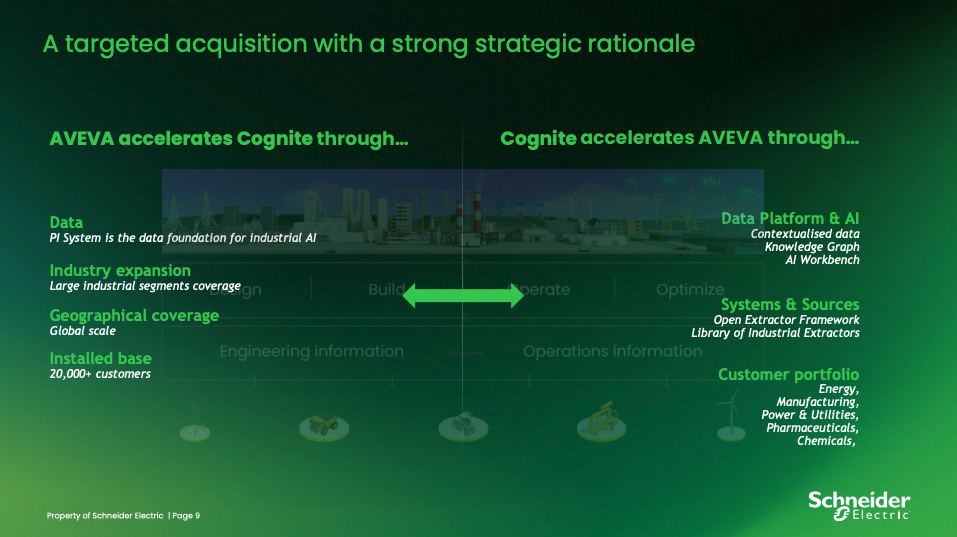
Cognite’s scalable, open architecture combined with the capabilities of CONNECT means that analytics and industrial AI can ingest industrial data across the asset lifecycle and throughout customers’ existing data ecosystems and investments. The combination extends CONNECT with enterprise-wide data contextualization capabilities and leading-edge agentic AI.
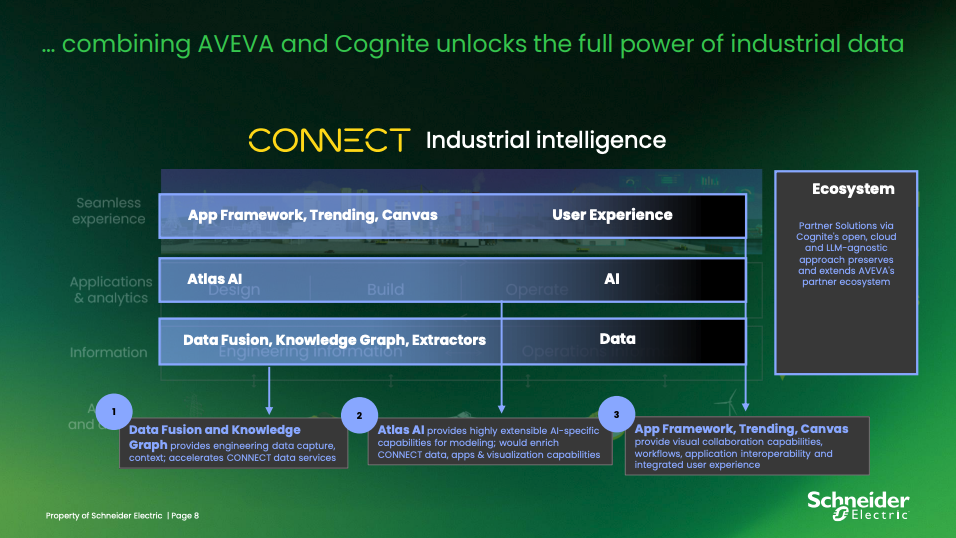
Cognite’s core technologies will act as a powerful data and AI enabler within CONNECT:
- Industrial Data Foundation: Cognite’s Data Fusion and knowledge graph enable the integration, modelling and contextualization of engineering, operational and enterprise data at scale.
- AI Platform: Atlas AI introduces advanced modelling capabilities, generative and agentic AI, enabling automation of industrial workflows combined with accelerated and improved decision‑making.
Together, Cognite and AVEVA will form a unified platform built for the next phase of intelligence for industrial AI.
Transaction terms and next steps
Under the terms of the agreement, Schneider Electric will acquire 100% of Cognite’s share capital in an all-cash transaction. The completion of the transaction remains subject to customary closing conditions, including the receipt of required regulatory approvals. The transaction is expected to be completed in the coming quarters. Upon completion, Cognite will be integrated with AVEVA and will be fully consolidated and financially reported within Schneider Electric’s Industrial Automation business.
Analysts call and further information
Schneider Electric will be hosting a call for analysts and investors at 7:30 am CET on Wednesday July 1st, 2026.
Participants are advised to join the call at least 10-15 minutes prior to the commencement of the call to register. Presentation materials will be available on the Schneider Electric website. Please connect to the call via the following link: Access to the call


SourceSchneider Electric
EMR Analysis
More information on Schneider Electric: See the full profile on EMR Executive Services
More information on Olivier Blum (Chief Executive Officer, Schneider Electric): See the full profile on EMR Executive Services
More information on Nathan Fast ( Member of the Executive Committee and Executive Vice President, Group Chief Financial Officer, Schneider Electric): See the full profile on EMR Executive Services
More information on AVEVA by Schneider Electric: See the full profile on EMR Executive Services
More information on Caspar Herzberg (Member of the Executive Committee, Chief Executive Officer, AVEVA, Schneider Electric): See the full profile on EMR Executive Services
More information on CONNECT by AVEVA by Schneider Electric: https://www.factorysoftware.com/software/connect + CONNECT, the Cloud platform for centralizing all your data. Unlock new capabilities for your business with a Cloud platform specifically designed for your industry. Access industrial information in context to view all your data in one place and make data-driven decisions in real time. Share relevant information with your teams, connect to a network of customers, partners and suppliers, and expand your ecosystem.
More information on Industrial Automation by Schneider Electric: See the full profile on EMR Executive Services
More information on Gwenaelle Avice-Huet (Member of the Executive Committee and Executive Vice President, Industrial Automation, Schneider Electric): See the full profile on EMR Executive Services
More information on Cognite Holding B.V. by AVEVA by Schneider Electric: https://www.cognite.com/en + Cognite makes AI work for industrial companies. Leading energy, manufacturing, and power and renewables enterprises choose Cognite to deliver secure, trustworthy, and real-time data to transform their asset-heavy operations to be safer, more sustainable, and profitable. Cognite provides a user-friendly, secure, and scalable industrial AI & platform that makes it easy for all decision-makers, from the field to remote operations centers, to access and understand complex industrial data, collaborate in real time, and build a better tomorrow.
Since 2016, Cognite has been on a mission to provide a future-proof, secure, and scalable platform that allows industrial experts to collaborate seamlessly and safely to build, deploy, and scale AI solutions.
We’re globally recognized domain experts with an international presence that spans from Oslo, Norway to Austin, Texas to Tokyo, Japan.
Cognite today employs more than 800 people. In 2025, the annual revenue exceeded $170 million, marked by 36% growth in ARR bookings and a rapid adoption of the Atlas AI platform.
More information on Girish Rishi (Chairman of the Board of Directors and Chief Executive Officer, Cognite, AVEVA, Schneider Electric): See the full profile on EMR Executive Services
More information on Cognite Data Fusion® by Cognite Holding B.V. by AVEVA by Schneider Electric: https://www.cognite.com/en/product/cognite_data_fusion_industrial_dataops_platform + Get Simple Access to Complex Industrial Data. Take advantage of unmatched data management and comprehensive AI capabilities to improve operational performance, reduce costs, and unlock opportunities in real-time.
An open, secure Industrial Data and AI platform that enables quick deployment of a contextualized data foundation for rapid scaling of AI-powered digital solutions. Take advantage of pre-built industry solutions or build your own to solve 100s of business-critical challenges and redefine operational efficiency.
More information on Cognite Atlas AI™ by Cognite Holding B.V. by AVEVA by Schneider Electric: https://www.cognite.com/en/product/atlas + fully realize the promise of Agentic AI for Industry.
Cognite Atlas AI™ is the only low-code industrial AI agents workbench that powers agents with AI-ready industrial data to automate your industrial workflows and accelerate business impact across the organization at scale like never before.
EMR Additional Notes:
- AI – Artificial Intelligence:
- Artificial Intelligence (AI) is the broad field of computer science focused on building systems that perform tasks requiring human-like intelligence, such as learning, reasoning, perception, and decision-making.
- AI systems typically:
- ingest large datasets
- identify patterns
- make predictions or decisions
- AI is an umbrella term that includes machine learning, deep learning, and other approaches (rule-based systems, optimization, etc.), not just Machine Learning (ML).
- AI programming focuses on three cognitive skills: learning, reasoning and self-correction.
- The 4 types of artificial intelligence?
- Type 1: Reactive machines. These AI systems have no memory and are task specific. An example is Deep Blue, the IBM chess program that beat Garry Kasparov in the 1990s. Deep Blue can identify pieces on the chessboard and make predictions, but because it has no memory, it cannot use past experiences to inform future ones.
- Type 2: Limited memory. Most modern AI systems. These AI systems have memory, so they can use past experiences to inform future decisions. Some of the decision-making functions in self-driving cars are designed this way.
- Type 3: Theory of mind. Research stage. Theory of mind is a psychology term. When applied to AI, it means that the system would have the social intelligence to understand emotions. This type of AI will be able to infer human intentions and predict behavior, a necessary skill for AI systems to become integral members of human teams.
- Type 4: Self-awareness. Does not yet exist. In this category, AI systems have a sense of self, which gives them consciousness. Machines with self-awareness understand their own current state.
- Machine Learning (ML):
- Subset of AI that enables systems to learn from data without explicit programming.
- ML uses historical data to detect patterns and make predictions.
- ML is the dominant paradigm in modern AI, replacing most rule-based systems.
- ML allows software applications to become more accurate at predicting outcomes without being explicitly programmed to do so.
- Recommendation engines are a common use case for ML. Other uses include fraud detection, spam filtering, business process automation (BPA) and predictive maintenance.
- Classical ML is often categorized by how an algorithm learns to become more accurate in its predictions. There are four basic approaches:
- supervised learning,
- unsupervised learning,
- semi-supervised learning and
- reinforcement learning.
- Deep Learning (DL):
- Subset of ML using multi-layered neural networks to learn complex representations.
- DL is not always “more sophisticated” in all contexts—it is more powerful for unstructured data (images, text, audio), but classical ML can outperform it in structured/tabular data.
- DL makes use of layers of information processing, each gradually learning more and more complex representations of data. The early layers may learn about colors, the next ones about shapes, the following about combinations of those shapes, and finally actual objects. DL demonstrated a breakthrough in object recognition. Face recognition is a good example.
- DL is currently the most sophisticated AI architecture we have developed.
- Generative AI (GenAI):
- AI systems that generate new content (text, images, code, audio, etc.) based on learned patterns.
- GenAI is typically powered by large deep learning models (e.g., transformers), not a separate paradigm.
- Generative AI technology generates outputs based on some kind of input – often a prompt supplied by a person. Some GenAI tools work in one medium, such as turning text inputs into text outputs, for example. With the public release of ChatGPT in late November 2022, the world at large was introduced to an AI app capable of creating text that sounded more authentic and less artificial than any previous generation of computer-crafted text.
- Small Language Models (SLM) and Large Language Models (LLM):
- Small Language Models (SLMs) are artificial intelligence (AI) models capable of processing, understanding and generating natural language content. As their name implies, SLMs are smaller in scale and scope than large language models (LLMs).
- LLM means Large Language Models — a type of machine learning/deep learning model that can perform a variety of natural language processing (NLP) and analysis tasks, including translating, classifying, and generating text; answering questions in a conversational manner; and identifying data patterns.
- For example, virtual assistants like Siri, Alexa, or Google Assistant use LLMs to process natural language queries and provide useful information or execute tasks such as setting reminders or controlling smart home devices.
- Computer Vision (CV) / Vision AI & Machine Vision (MV):
- Broad AI field for interpreting visual data.
- Field of AI that enables computers to interpret and act on visual data (images, videos). It works by using deep learning models trained on large datasets to recognize patterns, objects, and context.
- The most well-known case of this today is Google’s Translate, which can take an image of anything — from menus to signboards — and convert it into text that the program then translates into the user’s native language.
- Machine Vision (MV) :
- lndustrial application of Computer Vision. MV is a subset of CV, not a parallel category.
- Specific application for industrial settings, relying on cameras to analyze tasks in manufacturing, quality control, and worker safety. The key difference is that CV is a broader field for extracting information from various visual inputs, while MV is more focused on specific industrial tasks.
- Machine Vision is the ability of a computer to see; it employs one or more video cameras, analog-to-digital conversion and digital signal processing. The resulting data goes to a computer or robot controller. Machine Vision is similar in complexity to Voice Recognition.
- Multimodal Intelligence and Agents:
- Subset of artificial intelligence that integrates multiple data types (text, image, audio, video).
- Multimodal capabilities allows AI to interact with users in a more natural and intuitive way. It can see, hear and speak, which means that users can provide input and receive responses in a variety of ways.
- An AI agent is a computational entity designed to act independently. It performs specific tasks autonomously by making decisions based on its environment, inputs, and a predefined goal. What separates an AI agent from an AI model is the ability to act. There are many different kinds of agents such as reactive agents and proactive agents. Agents can also act in fixed and dynamic environments. Additionally, more sophisticated applications of agents involve utilizing agents to handle data in various formats, known as multimodal agents and deploying multiple agents to tackle complex problems.
- The defining feature of an agent is not just decision-making, but the ability to take actions toward a goal in an environment.
- Agentic AI:
- Agentic AI is a system that can accomplish a specific goal with limited supervision. It consists of AI agents—machine learning models that mimic human decision-making to solve problems in real time. In a multi-agent system, each agent performs a specific subtask required to reach the goal and their efforts are coordinated through AI orchestration.
- Unlike traditional AI models, which operate within predefined constraints and require human intervention, agentic AI exhibits autonomy, goal-driven behavior and adaptability. The term “agentic” refers to these models’ agency, or, their capacity to act independently and purposefully.
- Agentic AI builds on generative AI (gen AI) techniques by using large language models (LLMs) to function in dynamic environments. While generative models focus on creating content based on learned patterns, agentic AI extends this capability by applying generative outputs toward specific goals.
- Edge AI Technology:
- AI executed locally on devices (IoT, sensors, cameras) instead of centralized cloud.
- Edge AI refers to the deployment of AI algorithms and AI models directly on local edge devices such as sensors or Internet of Things (IoT) devices, which enables real-time data processing and analysis without constant reliance on cloud infrastructure.
- Simply stated, edge AI, or “AI on the edge“, refers to the combination of edge computing and artificial intelligence to execute machine learning tasks directly on interconnected edge devices. Edge computing allows for data to be stored close to the device location, and AI algorithms enable the data to be processed right on the network edge, with or without an internet connection. This facilitates the processing of data within milliseconds, providing real-time feedback.
- Self-driving cars, wearable devices, security cameras, and smart home appliances are among the technologies that leverage edge AI capabilities to promptly deliver users with real-time information when it is most essential.
- High-Density AI:
- High-density AI refers to the concentration of AI computing power and storage within a compact physical space, often found in specialized data centers. It is an infrastructure trend (AI data centers / GPU clusters), not a distinct AI category. This approach allows for increased computational capacity, faster training times, and the ability to handle complex simulations that would be impossible with traditional infrastructure.
- Explainable AI (XAI) and Human-Centered Explainable AI (HCXAI):
- Explainable AI (XAI) refers to methods for making AI model decisions understandable to humans, focusing on how the AI works, whereas Human-Centered Explainable AI (HCXAI) goes further by contextualizing those explanations to a user’s specific task and understanding needs.
- While XAI aims for technical transparency of the model, HCXAI emphasizes the human context, emphasizing user relevance, and the broader implications of explanations, including fairness, trust, and ethical considerations.
- Physical AI & Embodied AI:
- Physical AI refers to a branch of AI that enables machines to perceive, understand, and interact with the physical world by directly processing data from a variety of sensors and actuators.
- Embodied AI, as a subset, focuses on the sensory, decision-making, and interaction capabilities that enable these systems to function effectively in dynamic and unpredictable environments via sensors and actuators.
- Federated Learning and Reinforcement Learning:
- Federated Learning is a machine-learning technique where data stays where it is, and only the learned model updates are shared. “Training AI without sharing your data”.
- Reinforcement Learning is a type of AI where an agent learns by interacting with an environment and receiving rewards or penalties. “Learning by trial and error”
- Federated Learning (FL) and Reinforcement Learning (RL) can be combined into a field called Federated Reinforcement Learning (FRL), where multiple agents learn collaboratively without sharing their raw data. In this approach, each agent trains its own RL policy locally and shares model updates, like parameters or gradients, with a central server. The server aggregates these updates to create a more robust, global model. FRL is used in applications like optimizing resource management in communication networks and enhancing the performance of autonomous systems by learning from diverse, distributed experiences while protecting privacy (still niche and mostly experimental.)
- AI Factories:
- AI Factories are specialized, high-performance computing centers designed to train, tune, and deploy artificial intelligence models at scale.
- Companies and organizations involved in AI factory infrastructure and development include Nvidia, AWS, Microsoft, OpenAI, CoreWeave, Lambda, Nebius, Supermicro, and HPE. The European Union is also establishing AI Factories through its EuroHPC Joint Undertaking to foster regional innovation.
- “AI factory” is a conceptual term (not standardized), referring to industrial-scale AI production systems.
- Hardware vs. Software vs. Firmware:
- Hardware is physical: it’s tangible electronic or mechanical components. It can break, wear out, or be damaged by environmental factors (heat, water, shock, etc.).
- Since hardware is part of the “real” world, it all eventually wears out. Being a physical thing, it’s also possible to break it, drown it, overheat it, and otherwise expose it to the elements.
- Here are some examples of hardware:
- Smartphone
- Tablet
- Laptop
- Desktop computer
- Printer
- Flash drive
- Router
- Software is virtual: it consists of programs and data that run on hardware to perform functions. It can be copied, modified, updated, or deleted.
- Software is everything about your computer that isn’t hardware.
- Here are some examples of software:
- Operating systems like Windows 11 or iOS
- Web browsers
- Antivirus tools
- Adobe Photoshop
- Mobile apps
- Firmware is virtual: is embedded software that is tightly coupled to specific hardware and controls its low-level functions.
- While not as common a term as hardware or software, firmware is everywhere—on your smartphone, your PC’s motherboard, your camera, your headphones, and even your TV remote control.
- Firmware is a specialized type of software that serves a specific control and interface role between hardware and higher-level software.
- Hardware is physical: it’s tangible electronic or mechanical components. It can break, wear out, or be damaged by environmental factors (heat, water, shock, etc.).
- Annual Recurring Revenue (ARR):
- In finance, ARR most commonly stands for Annual Recurring Revenue. It is a vital metric used primarily by subscription-based and SaaS (Software-as-a-Service) companies to measure the predictable, recurring revenue they expect to generate over a 12-month period.