
Schneider Electric – Schneider Electric and Hon Hai Technology Group (Foxconn) announce strategic collaboration to accelerate next-generation AI data centers


Schneider Electric, a global energy technology leader, today announced a strategic collaboration with Hon Hai Technology Group (Foxconn), the world’s largest electronics manufacturer, to help define and scale the next generation of AI data centers.
As AI adoption surges, the demands on digital infrastructure are being fundamentally reshaped. This collaboration brings together Foxconn’s unmatched expertise in advanced compute platforms, AI rack integration, and global manufacturing with Schneider Electric’s leadership in power systems, cooling, and energy management. Together, the companies aim to deliver integrated, ready-to-deploy solutions that enable customers to build and operate AI infrastructure with greater speed, efficiency, and predictability across regions. Production will begin later this year.
“At the pace AI is evolving, the industry requires a new model for how infrastructure is designed, built, and delivered,” said Young Liu, Chairman of Foxconn. “By combining Foxconn’s strength in AI systems and global manufacturing with Schneider Electric’s deep expertise in power and energy, we are creating a path for customers to deploy AI capacity at scale—faster, smarter, and more sustainably.”
“AI demand continues to accelerate, and as compute scales to keep pace, the energy behind it becomes a fundamental enabler,” said Olivier Blum, CEO of Schneider Electric. “If we want to scale AI responsibly, these systems must be connected. This is where energy intelligence becomes essential. At Schneider Electric, we are advancing energy tech to build the most efficient and sustainable AI factories by bringing integrated power, cooling, and digital capabilities into AI data centers. Working with Foxconn, we are helping customers build capacity with real speed, resilience, and efficiency, as energy technology partners to an industry that is firmly entering the era of intelligence.”
Through this collaboration, Foxconn and Schneider Electric will co-develop next-generation reference architectures for AI data centers. The partnership will also explore innovations in closed-loop energy optimization, modular power and cooling skids, and standardized design frameworks, creating repeatable, high-performance blueprints for AI factories worldwide. By aligning manufacturing excellence with energy intelligence, the two companies are setting the foundation for a new class of AI infrastructure that is scalable by design, efficient by default, and ready to meet the accelerating demands of the AI era.
SourceSchneider Electric
EMR Analysis
More information on Schneider Electric: See the full profile on EMR Executive Services
More information on Olivier Blum (Chief Executive Officer, Schneider Electric): See the full profile on EMR Executive Services
More information on Nathan Fast ( Member of the Executive Committee and Executive Vice President, Group Chief Financial Officer, Schneider Electric): See the full profile on EMR Executive Services
More information on Energy Management by Schneider Electric: See the full profile on EMR Executive Services
More information on Frédéric Godémél (Member of the Executive Committee and Executive Vice President, Energy Management, Schneider Electric): See the full profile on EMR Executive Services
More information on One Digital Grid Platform by Schneider Electric: https://www.se.com/us/en/work/campaign/energy-intelligence/ + The One Digital Grid Platform connects energy management, climate risk modeling, customer service, and more—all in a secure, scalable ecosystem that brings reliability and sustainability into the present. In addition to being ABI Research’s #1 Grid Digitalization vendor, our team of experts are on standby to consult with you on your grid modernization journey.
Work with specialists who are fully committed to your success—focused exclusively on your project to ensure priority, responsiveness, and results. From education and consulting to system health checks, cybersecurity analysis, and digitalization journey support, we’re here to help you unlock the full potential of your grid.
The One Digital Grid Platform is more than technology—it’s a commitment to helping you achieve a grid that’s intelligent, resilient, and ready for what’s next. Make confident, future-ready decisions with the support of trusted advisors who understand your challenges and help you navigate them with clarity and precision.
More information on EcoStruxure™ by Schneider Electric: https://www.se.com/ww/en/work/campaign/innovation/overview.jsp + EcoStruxure is Schneider Electric’s IoT-enabled, plug-and-play, open, interoperable architecture and platform, in Homes, Buildings, Data Centers, Infrastructure and Industries. Innovation at Every Level from Connected Products to Edge Control, and Apps, Analytics and Services.
- 45,000 + Developers and system integrators
- 650,000+ Service providers and partners
- 480,000 Sites deployed
More information on EcoStruxure™ Distributed Energy Resource (DERMS): https://smartgrid.schneider-electric.com/smartgrid/s/derms-overview + Schneider Electric’s EcoStruxure DERMS is designed for energy companies with high penetration of distributed generation, or the ones with strong vision of achieving greater grid flexibility. DERMS provides visibility, monitoring, control and optimization capabilities, to help utilities to meet renewable and clean energy targets. It helps utilities provide reliable and high-quality power supply, operate the grid safely and optimally, and at the same time provide customer comfortable usage of the power grid.
More information on Hon Hai Technology Group (Foxconn): https://www.foxconn.com/en-gb + https://www.honhai.com/en-gb + Hon Hai Precision Industry Co., Ltd. (Taiwan Stock Exchange code: 2317), founded in Taiwan in 1974, started with mold making and has gradually developed into a high-tech service company. It ranks first globally in the Electronic Manufacturing Services (EMS) sector, with a market share exceeding 40%, covering four major product areas: consumer electronics, cloud networking products, computer terminal products, and components and others. The company’s global workforce peaks at approximately 900,000, and its consolidated revenue is projected to reach NT$8.1 trillion by 2025.
Foxconn’s business footprint spans the globe, across three continents. Centered in Taiwan, it extends to regions including mainland China, India, Japan, Vietnam, Malaysia, Singapore, Czech Republic, Hungary, Slovakia, the United States, Brazil, and Mexico, with production and service locations in more than 20 countries and regions.
In 2025, it will rank 28th on Fortune magazine’s Global 500 list. In 2019, Foxconn was ranked 25th on Forbes magazine’s list of the world’s top 100 digital companies. Furthermore, Foxconn is the only privately owned Taiwanese company to have been named one of Clarivate Analytics’ “Top 100 Global Innovators” for nine consecutive years (2018-2026).
In recent years, the group has actively invested in three emerging industries: electric vehicles, digital health, and robotics, as well as three new technology fields: artificial intelligence, semiconductors, and next-generation communication technologies. The “three plus three” approach is an important long-term development strategy for the group, providing complete solutions to benchmark customers around the world and becoming a comprehensive provider of smart living solutions.
More information on Liu Young (Chairman and Chief Executive Officer, Hon Hai Technology Group (Foxconn)): https://www.honhai.com/en-us/about/group-profile/chairman-of-the-board
EMR Additional Notes:
- AI – Artificial Intelligence:
- Artificial Intelligence (AI) is the broad field of computer science focused on building systems that perform tasks requiring human-like intelligence, such as learning, reasoning, perception, and decision-making.
- AI systems typically:
- ingest large datasets
- identify patterns
- make predictions or decisions
- AI is an umbrella term that includes machine learning, deep learning, and other approaches (rule-based systems, optimization, etc.), not just Machine Learning (ML).
- AI programming focuses on three cognitive skills: learning, reasoning and self-correction.
- The 4 types of artificial intelligence?
- Type 1: Reactive machines. These AI systems have no memory and are task specific. An example is Deep Blue, the IBM chess program that beat Garry Kasparov in the 1990s. Deep Blue can identify pieces on the chessboard and make predictions, but because it has no memory, it cannot use past experiences to inform future ones.
- Type 2: Limited memory. Most modern AI systems. These AI systems have memory, so they can use past experiences to inform future decisions. Some of the decision-making functions in self-driving cars are designed this way.
- Type 3: Theory of mind. Research stage. Theory of mind is a psychology term. When applied to AI, it means that the system would have the social intelligence to understand emotions. This type of AI will be able to infer human intentions and predict behavior, a necessary skill for AI systems to become integral members of human teams.
- Type 4: Self-awareness. Does not yet exist. In this category, AI systems have a sense of self, which gives them consciousness. Machines with self-awareness understand their own current state.
- Machine Learning (ML):
- Subset of AI that enables systems to learn from data without explicit programming.
- ML uses historical data to detect patterns and make predictions.
- ML is the dominant paradigm in modern AI, replacing most rule-based systems.
- ML allows software applications to become more accurate at predicting outcomes without being explicitly programmed to do so.
- Recommendation engines are a common use case for ML. Other uses include fraud detection, spam filtering, business process automation (BPA) and predictive maintenance.
- Classical ML is often categorized by how an algorithm learns to become more accurate in its predictions. There are four basic approaches:
- supervised learning,
- unsupervised learning,
- semi-supervised learning and
- reinforcement learning.
- Deep Learning (DL):
- Subset of ML using multi-layered neural networks to learn complex representations.
- DL is not always “more sophisticated” in all contexts—it is more powerful for unstructured data (images, text, audio), but classical ML can outperform it in structured/tabular data.
- DL makes use of layers of information processing, each gradually learning more and more complex representations of data. The early layers may learn about colors, the next ones about shapes, the following about combinations of those shapes, and finally actual objects. DL demonstrated a breakthrough in object recognition. Face recognition is a good example.
- DL is currently the most sophisticated AI architecture we have developed.
- Generative AI (GenAI):
- AI systems that generate new content (text, images, code, audio, etc.) based on learned patterns.
- GenAI is typically powered by large deep learning models (e.g., transformers), not a separate paradigm.
- Generative AI technology generates outputs based on some kind of input – often a prompt supplied by a person. Some GenAI tools work in one medium, such as turning text inputs into text outputs, for example. With the public release of ChatGPT in late November 2022, the world at large was introduced to an AI app capable of creating text that sounded more authentic and less artificial than any previous generation of computer-crafted text.
- Small Language Models (SLM) and Large Language Models (LLM):
- Small Language Models (SLMs) are artificial intelligence (AI) models capable of processing, understanding and generating natural language content. As their name implies, SLMs are smaller in scale and scope than large language models (LLMs).
- LLM means Large Language Models — a type of machine learning/deep learning model that can perform a variety of natural language processing (NLP) and analysis tasks, including translating, classifying, and generating text; answering questions in a conversational manner; and identifying data patterns.
- For example, virtual assistants like Siri, Alexa, or Google Assistant use LLMs to process natural language queries and provide useful information or execute tasks such as setting reminders or controlling smart home devices.
- Computer Vision (CV) / Vision AI & Machine Vision (MV):
- Broad AI field for interpreting visual data.
- Field of AI that enables computers to interpret and act on visual data (images, videos). It works by using deep learning models trained on large datasets to recognize patterns, objects, and context.
- The most well-known case of this today is Google’s Translate, which can take an image of anything — from menus to signboards — and convert it into text that the program then translates into the user’s native language.
- Machine Vision (MV) :
- lndustrial application of Computer Vision. MV is a subset of CV, not a parallel category.
- Specific application for industrial settings, relying on cameras to analyze tasks in manufacturing, quality control, and worker safety. The key difference is that CV is a broader field for extracting information from various visual inputs, while MV is more focused on specific industrial tasks.
- Machine Vision is the ability of a computer to see; it employs one or more video cameras, analog-to-digital conversion and digital signal processing. The resulting data goes to a computer or robot controller. Machine Vision is similar in complexity to Voice Recognition.
- Multimodal Intelligence and Agents:
- Subset of artificial intelligence that integrates multiple data types (text, image, audio, video).
- Multimodal capabilities allows AI to interact with users in a more natural and intuitive way. It can see, hear and speak, which means that users can provide input and receive responses in a variety of ways.
- An AI agent is a computational entity designed to act independently. It performs specific tasks autonomously by making decisions based on its environment, inputs, and a predefined goal. What separates an AI agent from an AI model is the ability to act. There are many different kinds of agents such as reactive agents and proactive agents. Agents can also act in fixed and dynamic environments. Additionally, more sophisticated applications of agents involve utilizing agents to handle data in various formats, known as multimodal agents and deploying multiple agents to tackle complex problems.
- The defining feature of an agent is not just decision-making, but the ability to take actions toward a goal in an environment.
- Agentic AI:
- Agentic AI is a system that can accomplish a specific goal with limited supervision. It consists of AI agents—machine learning models that mimic human decision-making to solve problems in real time. In a multi-agent system, each agent performs a specific subtask required to reach the goal and their efforts are coordinated through AI orchestration.
- Unlike traditional AI models, which operate within predefined constraints and require human intervention, agentic AI exhibits autonomy, goal-driven behavior and adaptability. The term “agentic” refers to these models’ agency, or, their capacity to act independently and purposefully.
- Agentic AI builds on generative AI (gen AI) techniques by using large language models (LLMs) to function in dynamic environments. While generative models focus on creating content based on learned patterns, agentic AI extends this capability by applying generative outputs toward specific goals.
- Edge AI Technology:
- AI executed locally on devices (IoT, sensors, cameras) instead of centralized cloud.
- Edge AI refers to the deployment of AI algorithms and AI models directly on local edge devices such as sensors or Internet of Things (IoT) devices, which enables real-time data processing and analysis without constant reliance on cloud infrastructure.
- Simply stated, edge AI, or “AI on the edge“, refers to the combination of edge computing and artificial intelligence to execute machine learning tasks directly on interconnected edge devices. Edge computing allows for data to be stored close to the device location, and AI algorithms enable the data to be processed right on the network edge, with or without an internet connection. This facilitates the processing of data within milliseconds, providing real-time feedback.
- Self-driving cars, wearable devices, security cameras, and smart home appliances are among the technologies that leverage edge AI capabilities to promptly deliver users with real-time information when it is most essential.
- High-Density AI:
- High-density AI refers to the concentration of AI computing power and storage within a compact physical space, often found in specialized data centers. It is an infrastructure trend (AI data centers / GPU clusters), not a distinct AI category. This approach allows for increased computational capacity, faster training times, and the ability to handle complex simulations that would be impossible with traditional infrastructure.
- Explainable AI (XAI) and Human-Centered Explainable AI (HCXAI):
- Explainable AI (XAI) refers to methods for making AI model decisions understandable to humans, focusing on how the AI works, whereas Human-Centered Explainable AI (HCXAI) goes further by contextualizing those explanations to a user’s specific task and understanding needs.
- While XAI aims for technical transparency of the model, HCXAI emphasizes the human context, emphasizing user relevance, and the broader implications of explanations, including fairness, trust, and ethical considerations.
- Physical AI & Embodied AI:
- Physical AI refers to a branch of AI that enables machines to perceive, understand, and interact with the physical world by directly processing data from a variety of sensors and actuators.
- Embodied AI, as a subset, focuses on the sensory, decision-making, and interaction capabilities that enable these systems to function effectively in dynamic and unpredictable environments via sensors and actuators.
- Federated Learning and Reinforcement Learning:
- Federated Learning is a machine-learning technique where data stays where it is, and only the learned model updates are shared. “Training AI without sharing your data”.
- Reinforcement Learning is a type of AI where an agent learns by interacting with an environment and receiving rewards or penalties. “Learning by trial and error”
- Federated Learning (FL) and Reinforcement Learning (RL) can be combined into a field called Federated Reinforcement Learning (FRL), where multiple agents learn collaboratively without sharing their raw data. In this approach, each agent trains its own RL policy locally and shares model updates, like parameters or gradients, with a central server. The server aggregates these updates to create a more robust, global model. FRL is used in applications like optimizing resource management in communication networks and enhancing the performance of autonomous systems by learning from diverse, distributed experiences while protecting privacy (still niche and mostly experimental.)
- AI Factories:
- AI Factories are specialized, high-performance computing centers designed to train, tune, and deploy artificial intelligence models at scale.
- Companies and organizations involved in AI factory infrastructure and development include Nvidia, AWS, Microsoft, OpenAI, CoreWeave, Lambda, Nebius, Supermicro, and HPE. The European Union is also establishing AI Factories through its EuroHPC Joint Undertaking to foster regional innovation.
- “AI factory” is a conceptual term (not standardized), referring to industrial-scale AI production systems.
- Cloud Computing:
- Cloud computing is a general term for anything that involves delivering hosted services over the internet. It is the on-demand availability of computer system resources, especially data storage and computing power, without direct active management by the user. Large clouds often have functions distributed over multiple locations, each location being a data center. Cloud services typically include IaaS, PaaS, and SaaS service models.
- Edge Computing:
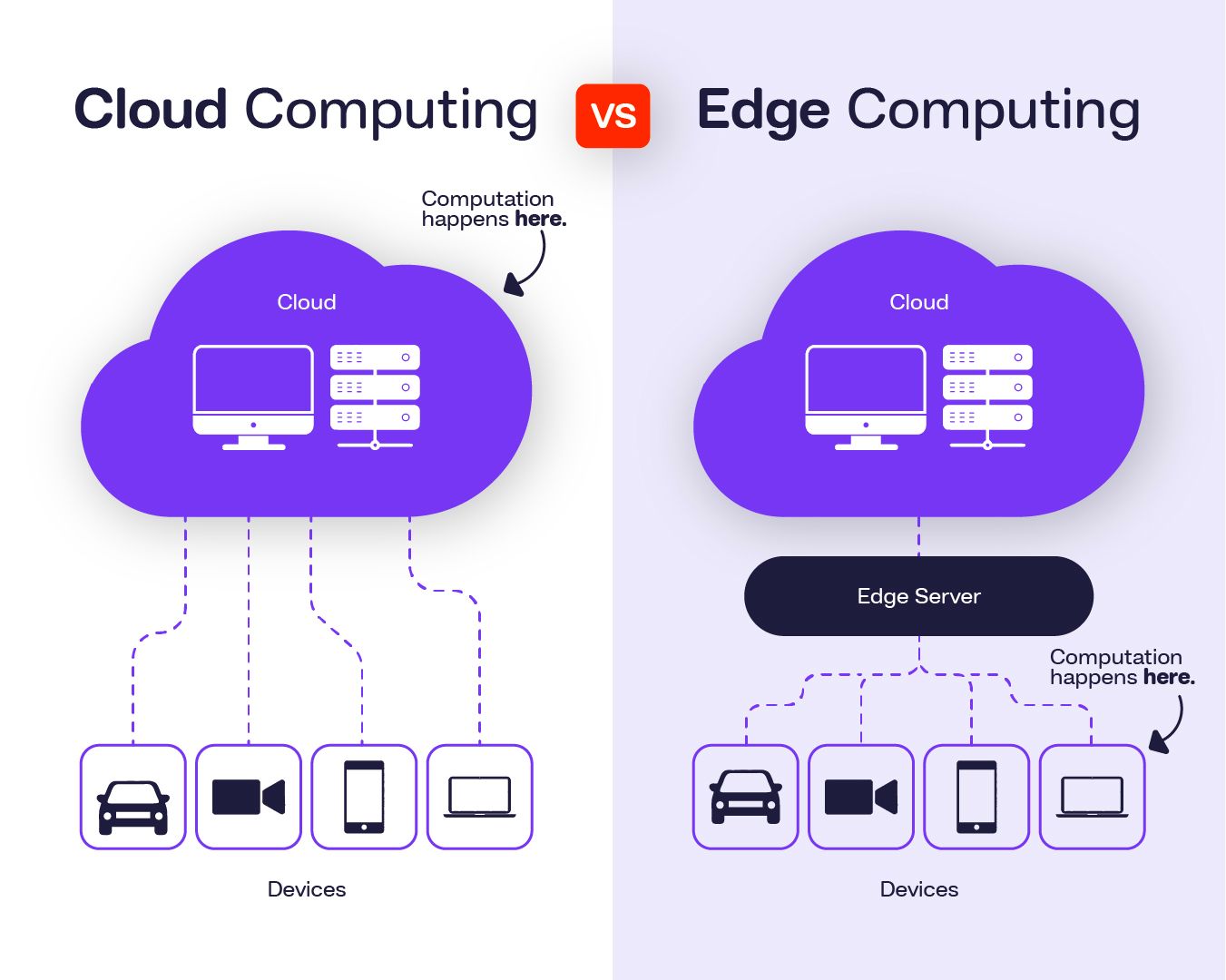
- Edge computing is a form of computing that is done on site or near a particular data source, minimizing the need for data to be processed in a remote data center.
- Edge computing can enable more effective city traffic management. Examples of this include optimising bus frequency given fluctuations in demand, managing the opening and closing of extra lanes, and, in future, managing autonomous car flows.
- An edge device is any piece of hardware that controls data flow at the boundary between two networks. Edge devices fulfill a variety of roles, depending on what type of device they are, but they essentially serve as network entry — or exit — points.
- There are five main types of edge computing devices: IoT sensors, smart cameras, uCPE equipment, servers and processors. IoT sensors, smart cameras and uCPE equipment will reside on the customer premises, whereas servers and processors will reside in an edge computing data centre.
- In service-based industries such as the finance and e-commerce sector, edge computing devices also have roles to play. In this case, a smart phone, laptop, or tablet becomes the edge computing device.
- Edge Devices:
- Edge devices encompass a broad range of device types, including sensors, actuators and other endpoints, as well as IoT gateways. Within a local area network (LAN), switches in the access layer — that is, those connecting end-user devices to the aggregation layer — are sometimes called edge switches.
- Edge devices act as the interface between the physical world (data generation) and digital networks.
- Hybrid Computing:
- A hybrid cloud integrates private, on-premises infrastructure with public cloud services, offering flexibility to distribute workloads between these environments. Hybrid models often incorporate edge computing, allowing organizations to run critical workloads locally at the edge while using the cloud for other tasks, thereby optimizing performance, cost, and data management for various business needs.
- HPC (Hight-Performance Computing):
- Practice of aggregating computing resources to gain performance greater than that of a single workstation, server, or computer. HPC can take the form of custom-built supercomputers or groups of individual computers called clusters.
- HPC is typically used for simulation, scientific computing, AI training, and complex modeling.
- Data Centers – Physical Infrastructure:
- A data center is a facility that centralizes an organization’s shared IT operations and equipment for the purposes of storing, processing, and disseminating data and applications. Because they house an organization’s most critical and proprietary assets, data centers are vital to the continuity of daily operations.
- Hyperscale Data Centers – Physical Infrastructure:
- The clue is in the name: hyperscale data centers are massive facilities built by companies with vast data processing and storage needs. These firms may derive their income directly from the applications or websites the equipment supports, or sell technology management services to third parties.
- Hyperscale Data Centers are typically operated by large cloud providers (e.g., hyperscalers) and designed for horizontal scalability.
- White Space and Grey Space in Data Centers – Physical Infrastructure:
- White space in a data center refers to the area where IT equipment is placed. It typically houses servers, storage, network gear, and racks.
- Gray space, on the other hand, is the area where the back-end infrastructure is located. This space is essential for supporting the IT equipment and includes areas for switchgear, UPS, transformers, chillers, and generators.
- Colocation in Data Centers – Physical Infrastructure:
- A colocation data center is a facility where businesses rent space, power, and cooling to house their own servers and networking hardware, rather than maintaining them in-house. It offers a cost-effective way to access high-level security, internet connectivity, and 24/7 technical support while retaining control of the equipment.
- Edge & Cloud Services – Integrated Architecture (Edge-to-Cloud):
- Edge services perform data processing on local devices and servers near the data source, reducing latency for time-sensitive operations, while cloud services centralize large computations and storage in remote datacenters, offering massive scalability and flexibility for general workloads.
- Most organizations use both, creating an “edge-to-cloud” architecture where edge devices handle immediate tasks, and the cloud manages large-scale data processing and complex applications, providing a seamless and efficient experience.
- Data Center Cooling Technologies:
- Air Cooling:
- Uses Computer Room Air Conditioners (CRAC) or Air Handlers (CRAH) combined with hot aisle / cold aisle containment to circulate cold air through the facility and manage airflow separation to improve cooling efficiency.
- It is widely used and cost-effective, but becomes inefficient at very high rack power densities (typically >20–30 kW per rack) due to the low heat capacity and thermal conductivity of air.
- Liquid Cooling:
- Liquid cooling uses water or dielectric fluids to remove heat more efficiently than air, enabling higher power densities required for AI and HPC workloads because liquids have significantly higher heat transfer capacity than air.
- It can be implemented at different levels: chip-level (DTC), rack-level (RDHx), or full immersion cooling.
- Direct-to-Chip (DTC) Cooling:
- A Direct-to-Chip (DTC) cooling system is a liquid-cooling technology used to cool high-performance computer chips—such as CPUs, GPUs, and accelerators—by bringing a liquid coolant directly to the chip surface through a cold plate (heat exchanger attached to the chip).
- It is one of the most efficient and fastest-growing cooling methods in modern data centers, especially in AI, HPC (High-Performance Computing), and high-density server environments because it removes heat at the source before it enters the air stream.
- RDHX (Rear Door Heat Exchanger) – Rack-level Heat Exchange:
- A Rear Door Heat Exchanger (RDHx) is a rack-mounted liquid-to-air heat exchanger installed on the rear of an IT rack.
- Chilled water flows through the door, and hot air from servers passes through it, removing heat before it enters the data center room (air-neutral or near-zero heat rejection to white space) thereby significantly reducing the load on room-level cooling systems.
- Can be passive (no fans) or active (with fans)
- Enables high-density racks without requiring full liquid cooling at the chip level (intermediate solution between air cooling and DTC).
- HDU (Heat Dissipation Unit):
- Unlike a CDU that transfers heat to the facility water loop, a Heat Dissipation Unit (HDU) rejects heat from the server rack to the data center air (white space) using a liquid-to-air heat exchanger.
- This means heat is ultimately removed by room-level cooling systems (CRAC/CRAH), making it a hybrid approach between air and liquid cooling (liquid used locally, air used for final heat rejection).
- CDU (Coolant Distribution Unit):
- A coolant distribution unit contains pumps, heat exchangers, valves, and control systems that circulate coolant through a network of pipes, distributing it to servers or racks in a secondary (IT) cooling loop.
- Coolant Distribution Units are essential in liquid-cooled data centers, providing:
- flow control
- pressure regulation
- temperature management
- hydraulic separation between facility loop and IT loop.
- They interface between facility water (building loop) and IT cooling loops, ensuring safe and controlled heat transfer and preventing contamination or pressure mismatch between loops.
- Chillers:
- Mechanical systems that remove heat from a building’s liquid coolant (typically water) and transfer it to the outside environment (via air or water loops).
- Unlike systems that cool air directly, chillers generate chilled water that circulates through cooling systems such as CDUs, CRAH/CRAC units, or heat exchangers.
- They are essential for cooling large-scale data centers and industrial facilities, especially where free cooling is not sufficient or ambient conditions are too warm.
- Condensors:
- A condenser is a heat exchanger that cools a gas or vapor, causing it to condense into a liquid, releasing latent heat.
- In cooling systems, condensers are typically part of chiller or refrigeration cycles, where they reject heat to ambient air or water (e.g., cooling towers or dry coolers) and represent the final heat rejection stage of the refrigeration cycle.
- Technology Cooling System (TCS):
- Non-standard / umbrella term that refers to an integrated cooling architecture used to manage heat in technology environments (e.g., data centers, industrial systems).
- A TCS may include:
- Chillers
- CDUs
- Pumps and piping
- Heat exchangers
- Control systems
- It effectively represents the complete thermal management system from IT equipment to final heat rejection.
- Cooling Skids:
- Cooling skids are self-contained, pre-engineered industrial systems mounted on a structural steel frame (skid) used to manage temperature by circulating chilled fluids.
- They integrate all necessary components—including heat exchangers, pumps, piping, valves, and controls—into a single mobile or modular unit to enable rapid deployment and standardized installation.
- Main Types of Cooling Skids
- Chiller Skids: Include active refrigeration compressors to drop temperatures below ambient levels.
- Fluid Cooler Skids: Use ambient air or tower water to cool process fluids without active refrigeration (often used for free cooling).
- Heat Exchanger Skids: Separate two fluid loops to transfer heat safely between closed and open systems (similar function to CDU at system scale).
- Air Cooling:
- Blueprint:
- A blueprint is a detailed technical drawing or plan used to design and construct something, serving as a guide that can be followed during implementation. Want to build the best tree house ever? Draw up a blueprint and follow the design carefully.
- The literal meaning of a blueprint refers to a historical reproduction process in which technical drawings were printed as white lines on a blue background. After the paper was washed and dried to fix the image, the result was a negative image of white lines against a dark blue background—hence the name “blueprint.”
- By definition, a blueprint is a detailed plan, design, or model that specifies all necessary components and their relationships before execution.
- The blueprint perspective allows you to see how all elements fit together structurally and functionally before building or implementation begins (not only “what pieces are needed”).