
HARTING – HARTING goes for hydrogen technology

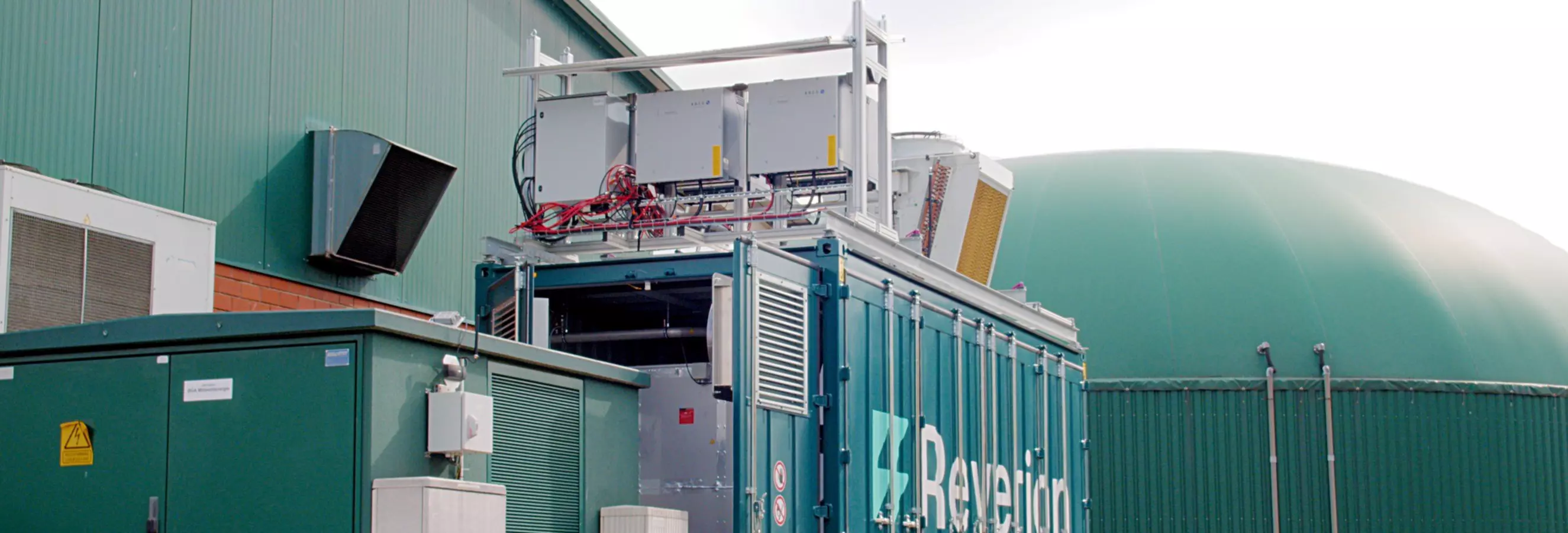
The HARTING Technology Group has commissioned a new fuel cell plant in Espelkamp.
The pilot plant from the Bavarian manufacturer Reverion complements the existing biogas and photovoltaic plants. Initially, the plant will convert locally produced biogas directly into electricity, thereby making the energy supply at the Espelkamp site even more efficient and climate-neutral.
“The plant complements our energy management perfectly,” says Philip Harting, CEO of the HARTING Technology Group. “It is not just another building block in climate-neutral production. It also enables us to maintain a sustainable and resilient energy supply during shortages or at times of peak demand.”
In future, the fuel cell plant is also set to temporarily store the renewable energy generated in the form of green hydrogen and convert it back into usable energy when needed. The particular advantage of Reverion technology lies in its exceptionally high efficiency across the entire energy cycle. Whilst many conventional solutions with separate electrolysers, gas storage and reverse power output recover only 40 to 50 per cent of the energy used, Reverion achieves a significantly higher electrical efficiency when reconverting hydrogen back into electricity. The so-called round-trip efficiency – that is, the path from electricity to hydrogen and back to electricity – is up to 75 per cent. An additional highlight: energy that is not converted into electricity can be used as process heat in the biogas plant to maintain fermentation.
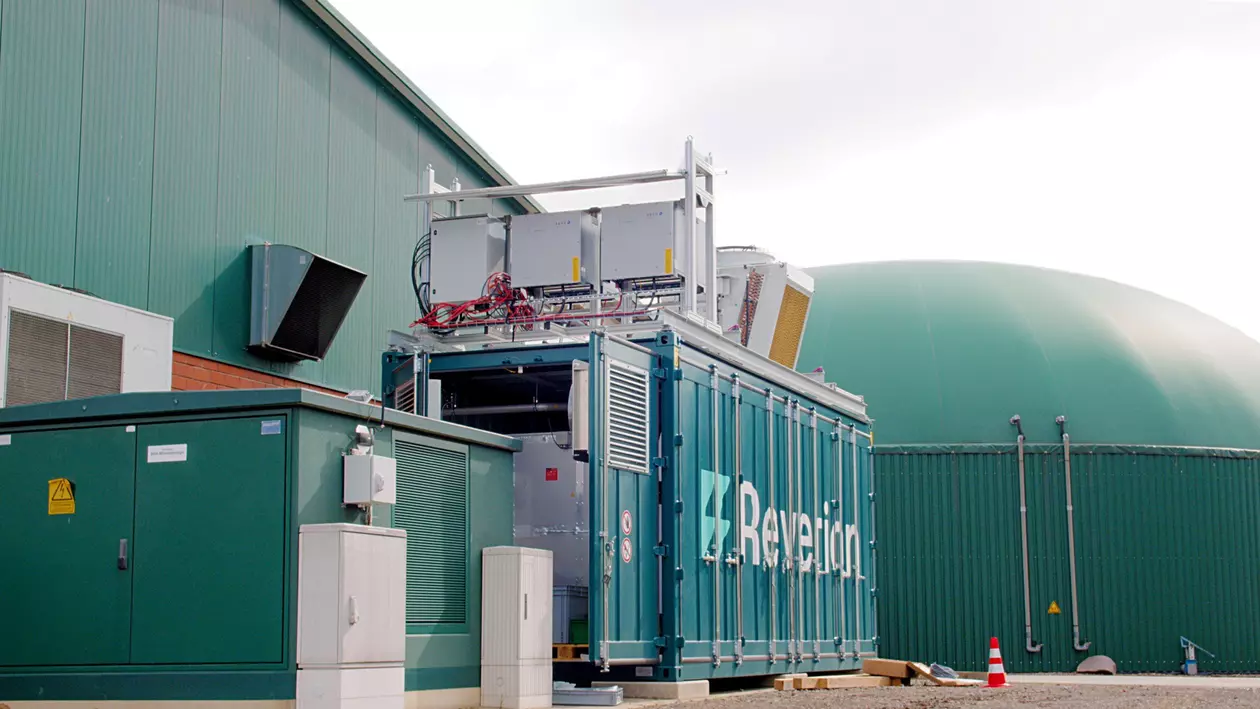
Another building block for climate-neutral production: The Reverion plant makes renewable energy more flexible at HARTING.
This is made possible by reversible high-temperature technology, the elimination of combustion, and the integration of all conversion steps into a single plant, thereby significantly reducing energy losses.
Sven Oßenbrink, Vice President of Corporate Real Estate Management & Facility Management at HARTING, emphasises: “The Reverion plant is ideally integrated into our existing infrastructure and can be incorporated into energy and load management via defined interfaces. It is precisely this transparency and controllability – from power input to return feed-in – that is of central importance for the safety of our operation and further development of our energy system.”
In the current phase of development, HARTING is testing various system configurations to determine the appropriate storage capacity and application for future scaling. Technically, the system is designed for a power input of up to 250 kilowatts in electrolysis mode and a reverse power output of up to 100 kilowatts in fuel cell mode. It currently covers around 3 per cent of the energy demand at the Espelkamp site, thereby complementing the existing energy infrastructure. The electricity generated is used in production and administration at plants 2, 3a, 3b and 7.
The plant currently plays a minor role in addressing bottlenecks or peak loads. However, looking ahead, the technology opens up new possibilities for flexible and fail-safe load management, particularly when scaled up.
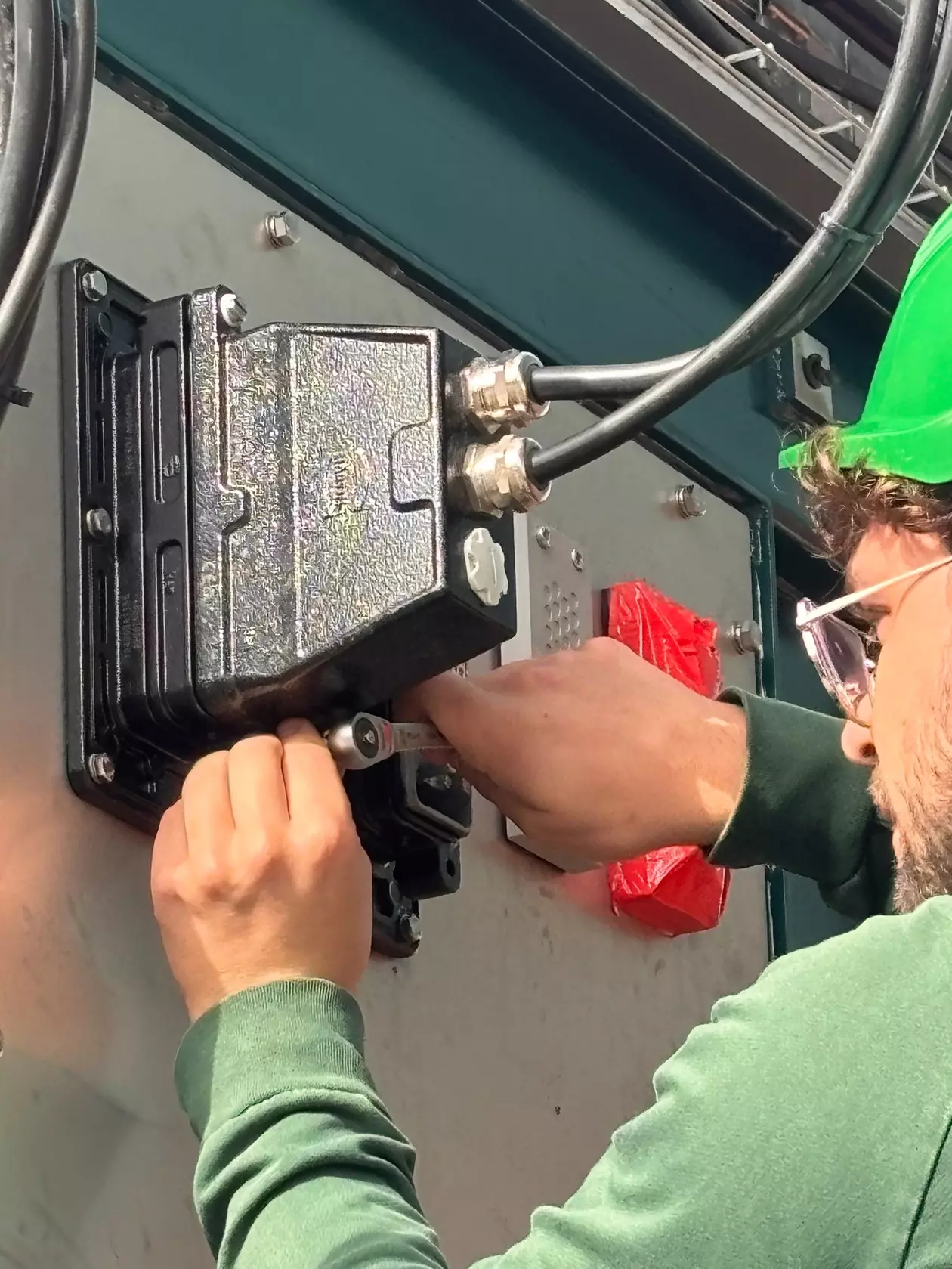
Reliable interfaces: HARTING connectors enable flexible and robust connections between the system components.
HARTING technology in action
The Reverion plant utilises HARTING connectors from the Han® portfolio – specifically Han® HPR housings and Han-Modular® inserts. These provide high-performance, robust yet flexible interfaces for signals, data and power within the plant. Thanks to the modular design, different transmission media can be combined within a single connector and securely integrated. This reliably ensures the seamless interaction of all systems.
“We are delighted that HARTING is convinced by our technology and is using it in its own energy system,” says Maximilian Schmitt, Head of Sales & Marketing at Reverion. “The project in Espelkamp demonstrates that our reversible technology not only achieves high efficiency levels but can also be integrated into existing industrial infrastructures in a practical and reliable manner. The collaboration with HARTING is a strong reference project for us and provides an important impetus for the further scaling of our technology.”
SourceHARTING
EMR Analysis
More information on HARTING: See the full profile on EMR Executive Services
More information on Philip F.W. Harting (Chairman of the Board of Management, HARTING Technology Group + Chairman, AUMA + Member of the Executive Committee, ZVEI): See the full profile on EMR Executive Services
More information on Dipl.-Kfm. Björn Lahm (Member of the Board of Management, Chief Financial Officer, HARTING Technology Group): See the full profile on EMR Executive Services
More information on Sven Ossenbrink (Vice President, Corporate Real Estate Management & Facility Management, HARTING Technology Group): See the full profile on EMR Executive Services
More information on Han® by HARTING: https://www.harting.com/US/en/heavy-duty-electrical-connectors + Industrial connectors Han®. Quick and easy handling, robustness, flexibility in use, a long life cycle and, ideally, a tool-free assembly – whatever you expect from a connector – Han® rectangular connectors and industrial circular connectors won’t disappoint you.
More information on Reverion GmbH: https://reverion.com/en/ + Reverion develops and manufactures high-efficiency, reversible power plants that convert gas into electricity with unprecedented efficiency while also enabling energy storage through reversible operation. By combining power generation and storage in a single system, Reverion contributes to a more flexible, reliable, and low-emission energy system.
The company is headquartered in Eresing near Munich, Germany, and currently employs around 200 people.
More information on Stephan Herrmann (Co-founder and Chief Executive Officer, Reverion GmbH): https://reverion.com/team/ + https://www.linkedin.com/in/stephan-herrmann-b76338217/
More information on Maximilian Schmitt (Head of Sales & Marketing, Reverion GmbH): https://www.linkedin.com/in/schmitt-max/
EMR Additional Notes:
- Hydrogen:
- The atom of hydrogen is the first element in the periodic table, with chemical symbol H and the first element created after the Big Bang. It is the most common substance in the universe and the richest energy source for stars like the sun. It consists of one proton (a core unit of positive charge) and one electron (negative charge).
- Hydrogen doesn’t exist naturally on Earth. Since it forms covalent compounds with most non-metallic elements, most of the hydrogen on Earth exists in molecular forms such as water or organic compounds. Combined with oxygen, it is water (H2O). Combined with carbon, it forms methane (CH4), coal, and petroleum. It is found in all growing things (biomass).
- Hydrogen (H2) is the most abundant element on earth but it rarely exists alone, therefore it is produced by extracting it from its compound.
- Hydrogen can be produced in numerous ways. Some methods produce CO2 while others are carbon free.
- H2 can be renewable or decarbonized if produced using renewable or carbon free electricity.
- Hydrogen has the highest energy content of any common fuel by weight.
- Hydrogen is a high efficiency, low polluting fuel that can be used for transportation, heating, and power generation in places where it is difficult to use electricity or as a CO2 neutral feedstock for chemical processes (ammonia-fertilizers).
- Grey, Blue or Green Hydrogen:
- There is a growing international consensus that clean hydrogen will play a key role in the world’s transition to a sustainable energy future. It is crucial to help reduce carbon emissions from industry and heavy transport, and also to provide long-term energy storage at scale.
- Researchers have found that clean hydrogen still costs too much to enable it to be widely deployed. Prices may not come down sufficiently until the 2030s, according to some estimates. But despite the uncertainty surrounding the future of clean hydrogen, there are promising signs that it could become more affordable sooner than expected.
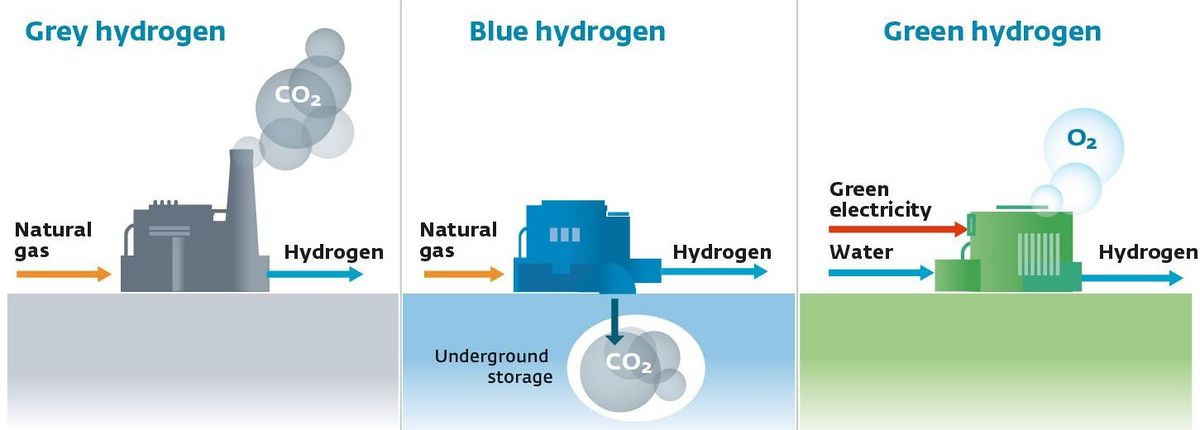
- Where the hydrogen comes from is important. At the moment, it’s mainly produced industrially from natural gas, which generates significant carbon emissions. That type is known as “grey” hydrogen.
- A cleaner version is “blue” hydrogen, for which the carbon emissions are captured and stored, or reused.
- The cleanest one of all is “green” hydrogen, which is generated by renewable energy sources without producing carbon emissions in the first place.
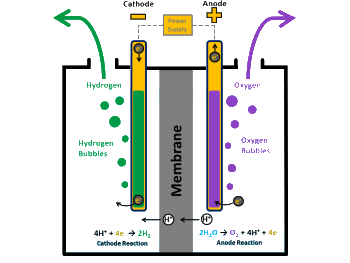
- Hydrogen Electrolyzer:
- An electrolyzer is a system that uses electricity to break water into hydrogen and oxygen in a process called electrolysis. Through electrolysis, the electrolyzer system creates hydrogen gas.
- Steam at the cathode combines with electrons from the external circuit to form hydrogen gas and negatively charged oxygen ions. The oxygen ions pass through the solid ceramic membrane and react at the anode to form oxygen gas and generate electrons for the external circuit.
- Fuel Cell Plant:
- A fuel cell plant is a facility that generates electricity through an electrochemical process rather than by burning fossil fuels. By combining a fuel—like hydrogen, natural gas, or biogas—with oxygen from the air, it produces continuous power, heat, and water with almost zero harmful emissions.
- Biomass:
- Biomass is renewable organic material that comes from plants and animals. Biomass contains stored chemical energy from the sun that is produced by plants through photosynthesis.
- Biomass is a renewable energy source. The term “clean” is often used, but its carbon neutrality depends on whether the carbon dioxide released from burning is balanced by the carbon absorbed by new plant growth. Its initial energy comes from the sun, and plants or algae biomass can regrow in a relatively short amount of time. Trees, crops, and municipal solid waste are consistently available and can be managed sustainably.
- Bioenergy:
- It is a form of renewable energy that is derived from recently living organic materials known as biomass, which can be used to produce transportation fuels, heat, electricity, and products.
- Bioenergy is renewable energy produced from organic matter (called “biomass”) such as plants, which contain energy from sunlight stored as chemical energy. Bioenergy producers can convert this energy into liquid transportation fuel—called “biofuel”—through a chemical conversion process at a biorefinery.
- Types of bioenergy include biogas, bioethanol, and biodiesel which may be sourced from plants (corn, sugarcane), wood, agricultural wastes, and bagasse. Bioenergy is considered renewable because its source is inexhaustible, as plants obtain their energy from the sun through photosynthesis which can be replenished.
- Biogas and Biomethane:
- Biogas is a mixture of gases, primarily methane and carbon dioxide, produced from the breakdown of organic matter through a process called anaerobic digestion.
- Biomethane is the purified version of biogas that has undergone a treatment known as “upgrading.” Through this process, which removes certain impurities like CO2, the gas is brought to a methane ratio of around 95%. Biomethane, also called renewable natural gas, is one of the main renewable gases of the future and is available today to help decarbonize.
- Energy and Load Management:
- Energy and load management refers to automated strategies that monitor and optimize electricity consumption to prevent grid overloads, avoid costly peak demand charges, and protect existing electrical infrastructure. It is widely used across homes, commercial buildings, and utility grids to match power demand with available supply.
- Fundamental Units of Electricity:
- Ampere – Amp (A):
- Amperes measure the flow of electrical current (charge) through a circuit. Ampere (A) is the unit of measure for the rate of electron flow, or current, in an electrical conductor.
- One ampere is defined as one coulomb of electric charge moving past a point in one second. The ampere is named after the French physicist André-Marie Ampère, who made significant contributions to the study of electromagnetism.
- Milliampere (mA) is a unit of electric current equal to one-thousandth of an ampere (1mA=10−3A). The prefix “milli” signifies 10−3 in the metric system. This unit is commonly used to measure small currents in electronic circuits and consumer devices.
- Volts measure the force or potential difference that drives the flow of electrons through a circuit.
- Kilovolt (kV) is a unit of potential difference equal to 1,000 volts.
- Watts measure the rate of energy consumption or generation, also known as power.
- Amperes measure the flow of electrical current (charge) through a circuit. Ampere (A) is the unit of measure for the rate of electron flow, or current, in an electrical conductor.
- Power vs. Energy: how electricity is measured and billed.
- Power (measured in kW, MW, GW, TW): Rate at which energy is used or generated at a given moment.
- Energy (measured in kWh, MWh, GWh, TWh): Total amount of power consumed or generated over a period of time (i.e., Power x Time).
- Real Power Units: actual power that performs work.
- Kilowatt (KW):
- A kilowatt is simply a measure of how much power an electric appliance consumes—it’s 1,000 watts to be exact. You can quickly convert watts (W) to kilowatts (kW) by dividing your wattage by 1,000: 1,000W 1,000 = 1 kW.
- Megawatt (MW):
- One megawatt equals one million watts or 1,000 kilowatts, roughly enough electricity for the instantaneous demand of 750 homes at once.
- Gigawatt (GW):
- A gigawatt (GW) is a unit of power, and it is equal to one billion watts.
- According to the Department of Energy, generating one GW of power takes over three million solar panels or 310 utility-scale wind turbines
- Terawatt (TW):
- One terawatt is equal to one trillion watts (1,000,000,000,000 watts). The main use of terawatts is found in the electric power industry, particularly for measuring very large-scale power generation or consumption.
- According to the United States Energy Information Administration, America is one of the largest electricity consumers in the world, using about 4,146.2 terawatt-hours (TWh) of energy per year.
- Kilowatt (KW):
- Apparent Power Units: measures the total power in a circuit, including power that does not perform useful work.
- Kilovolt-Amperes (kVA):
- Kilovolt-Amperes (kVA) stands for Kilo-volt-amperes, a term used for the rating of an electrical circuit. A kVA is a unit of apparent power, which is the product of the circuit’s maximum voltage and current rating.
- The difference between real power (kW) and apparent power (kVA) is crucial. Real power (kW) is the actual power that performs work, while apparent power (kVA) is the total power delivered to a circuit, including the real power and the reactive power (kVAR) that doesn’t do useful work. The relationship between them is defined by the power factor. Since the power factor is typically less than 1, the kVA value will always be higher than the kW value.
- Megavolt-Amperes (MVA):
- Megavolt-Amperes (MVA) is a unit used to measure the apparent power in a circuit, primarily for very large electrical systems like power plants and substations. It’s a product of the voltage and current in a circuit.
- 1 MVA is equivalent to 1,000 kVA, or 1,000,000 volt-amperes.
- Kilovolt-Amperes (kVA):
- Specialized Power Units: used specifically for renewable energy, especially solar.
- KiloWatt ‘peak’ (KWp):
- kWp stands for kilowatt ‘peak’ power output of a system. It is most commonly applied to solar arrays. For example, a solar panel with a peak power of 3kWp which is working at its maximum capacity for one hour will produce 3kWh. kWp (kilowatt peak) is the total kw rating of the system, the theoretical ‘peak’ output of the system. e.g. If the system has 4 x 270 watt panels, then it is 4 x 0.27kWp = 1.08kWp.
- The Wp of each panel will allow you to calculate the surface area needed to reach it. 1 kWp corresponds theoretically to 1,000 kWh per year.
- KiloWatt ‘peak’ (KWp):
- Ampere – Amp (A):
- Industrial Connectors:
- Specialized electrical connectors designed for reliable and robust connections in demanding industrial environments. They are crucial for connecting machinery, automation systems, and other industrial equipment, ensuring secure power, data, and control signal transmission.
- Industrial Circular Connectors:
- Robust, cylindrical, multi-pin electrical connectors used in harsh environments for data and power transmission in industrial settings. They are designed for applications requiring reliability and durability, such as automation, manufacturing, and harsh environments like oil and gas.