Danfoss – Danfoss supports France’s ambition to ramp up heat pump production and installation with €10 million investment in local production facility
The facility in Reyrieux produces essential heat pump components for multi-family buildings, and commercial and industrial applications
Danfoss today announced an additional €10 million investment in its Reyrieux, France production site, where Danfoss manufactures essential components for heat pumps. The investment builds on €61 million invested in the site between 2015 and 2025.
The announcement comes as France accelerates its national electrification strategy. In response to recent global energy shocks, the French government has reaffirmed its ambition to install more than one million heat pumps per year by 2030, alongside plans to triple domestic heat pump production by 2027 and train 30,000 installers. This strategy positions France as a potential European leader in heat pump manufacturing and deployment.
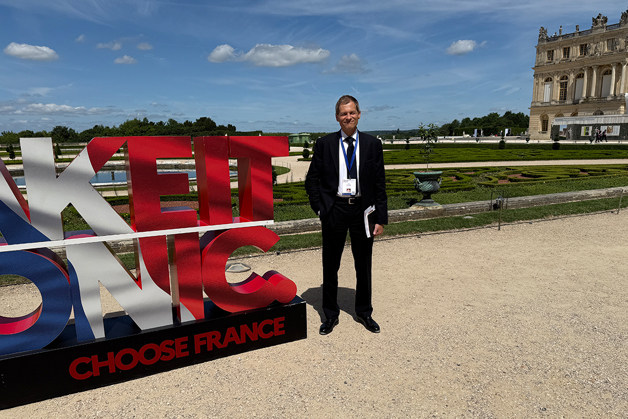
Announced at the Choose France Summit hosted by President Emmanuel Macron, Danfoss’ new €10 million investment will upgrade the Reyrieux facility with on-site renewable power generation, enhanced energy efficiency measures, and modernized workspaces that strengthen both sustainability performance and workplace attractiveness.
Speaking from the Choose France Summit, Kim Fausing, President and CEO of Danfoss, said: “As a global technology leader, we are investing to strengthen our production capacity and our test and development centers to better serve our customers globally. This is a central part of our LEAP 2030 strategy. The investment in Reyrieux supports the growing demand we see for electrification and heat pump solutions. At the same time, investment in factories like Reyrieux strengthens our global footprint, brings us closer to our customers, and increases service levels, competitiveness, and resilience.”
The Danfoss Reyrieux site, comprising two facilities of 12,000 m² and 4,500 m² and employing around 410 people, reinforces Danfoss’ position as a leading player in the heat pump compressor industry through its strong manufacturing footprint globally. The upcoming refurbishment will modernize approximately 4,000 m² of office space and 600 m² of shop-floor areas.
As part of the €10 million investment, €1 million will fund solar canopies covering 4,000 m² of parking areas which is expected to supply around 7% of the site’s total electricity consumption. The full façade renewal will significantly improve insulation and reduce energy use. The remaining funding will support a comprehensive upgrade of workspaces.
These upgrades are in line with Danfoss’ commitment to decarbonize its own operations by 2030. They come in addition to an already planned €6 million investment for 2026 which includes ongoing investments in R&D, including new laboratory and prototype equipment, as well as new production machinery, procurement improvements, and building modernization.
This latest commitment builds on a long track record of strategic investment in the Reyrieux site. Between 2015 and 2025, Danfoss invested significantly to establish one of Europe’s largest ATEX-certified laboratories, expanding Danfoss’ capacity to develop and test new products that meet stringent European safety standards and help accelerate the refrigerant transition. These capabilities have also been central to supporting Europe’s growing heat pump market.
President Macron’s plan to triple domestic heat pump production signals a strategic investment in vital European technologies. I am here to support that ambition, and I urge other leaders across Europe to follow suit and double down on all critical technologies where Europe already leads. This is the fastest route to energy resilience and industrial competitiveness. Ultimately, this will also contribute to our shared climate goals.
Kim Fausing
President and CEO, Danfoss

SourceDanfoss
EMR Analysis
More information on Danfoss: See the full profile on EMR Executive Services
More information on Kim Fausing (President and Chief Executive Officer, Danfoss): See the full profile on EMR Executive Services
More information on Jesper V. Christensen (Executive Vice President & Chief Financial Officer, Danfoss): See the full profile on EMR Executive Services
More information on LEAP 2030 by Danfoss: See the full profile on EMR Executive Services
More information on the Sustainable Strategy, Goals, ESG Reporting and Climate Transition Plan 2026 by Danfoss: See the full profile on EMR Executive Services
More information on Thomas M. Auerbach (Senior Vice President, Chief Sustainability Officer, Danfoss + Head of Danfoss Finance Functions, Danfoss): See the full profile on EMR Executive Services
More information on Choose France Summit (May 29, 30 & 31, 2026 – France): https://www.elysee.fr/emmanuel-macron/choose-france + https://choosefrance.fr/fr/ + For the past 7 years, the Choose France Summit has become the event dedicated to the attractiveness of France.
Established by President Emmanuel Macron, Choose France aims to present and explain to major international companies the reforms undertaken to promote the economic activity of our territory.
It also highlights the importance of international investment in supporting growth, innovation and employment throughout France.
Each year, nearly 400 bilateral meetings are organized between the President of the Republic, ministers and leaders of foreign and French companies to discuss their plans to establish themselves in France.
More information on Emmanuel Macron (Eighth President of the Fifth Republic, France): https://www.elysee.fr/en/emmanuel-macron + https://www.linkedin.com/in/emmanuelmacron/?locale=en_US
More information on The European Union: https://european-union.europa.eu/index_en + The European Union’s institutional set-up is unique and its decision-making system is constantly evolving. The 7 European institutions, 7 EU bodies and over 30 decentralized agencies are spread across the EU. They work together to address the common interests of the EU and European people.
In terms of administration, there are a further 20 EU agencies and organisations which carry out specific legal functions and 4 interinstitutional services which support the institutions.
All of these establishments have specific roles – from developing EU laws and policy-making to implementing policies and working on specialist areas, such as health, medicine, transport and the environment.
There are 4 main decision-making institutions which lead the EU’s administration. These institutions collectively provide the EU with policy direction and play different roles in the law-making process:
- The European Parliament (Brussels/Strasbourg/Luxembourg)
- The European Council (Brussels)
- The Council of the European Union (Brussels/Luxembourg)
- The European Commission (Brussels/Luxembourg/Representations across the EU)
Their work is complemented by other institutions and bodies, which include:
- The Court of Justice of the European Union (Luxembourg)
- The European Central Bank (Frankfurt)
- The European Court of Auditors (Luxembourg)
The EU institutions and bodies cooperate extensively with the network of EU agencies and organisations across the European Union. The primary function of these bodies and agencies is to translate policies into realities on the ground.
Around 60,000 EU civil servants and other staff serve the 450 million Europeans (and countless others around the world).
Currently, 27 countries are part of the EU: https://european-union.europa.eu/principles-countries-history/country-profiles_en
More information on The European Commission by The European Union: https://ec.europa.eu/info/index_en + The Commission helps to shape the EU’s overall strategy, proposes new EU laws and policies, monitors their implementation and manages the EU budget. It also plays a significant role in supporting international development and delivering aid.
The Commission is steered by a group of 27 Commissioners, known as ‘the college’. Together they take decisions on the Commission’s political and strategic direction.
A new college of Commissioners is appointed every 5 years.
The Commission is organised into policy departments, known as Directorates-General (DGs), which are responsible for different policy areas. DGs develop, implement and manage EU policy, law, and funding programmes. In addition, service departments deal with particular administrative issues. Executive agencies manage programmes set up by the Commission.
Principal roles in law: The Commission proposes and implements laws which are in keeping with the objectives of the EU treaties. It encourages input from business and citizens in the law-making process and ensures laws are correctly implemented, evaluated and updated when needed.
More information on Ursula von der Leyen (President, The European Commission, The European Union): https://ec.europa.eu/commission/commissioners/2019-2024/president_en + https://www.linkedin.com/in/ursula-von-der-leyen/
EMR Additional Notes:
- Heat Exchangers, Heat Pumps, Air Source Heat Pump (ASHP), Hydronics, Geothermal Heating – Cooling & Chillers:
- Heat Exchangers – Heat Transfer Foundation:
- Used to transfer heat from one medium to another. These media may be a gas, liquid, or a combination of both. The media may be separated by a solid wall to prevent mixing or may be in direct contact. Heat exchangers are required to provide heating and/or cooling to meet a process requirement.
- In HVAC, heat exchangers are used to transfer heat between the indoor and outdoor air streams while keeping them physically separated as a means of cooling or heating indoor air. heat exchangers are components; systems performing heating/cooling cycles are heat pumps, not the heat exchangers themselves.
- Gasketed heat exchangers are compact, highly efficient devices used to transfer heat between two fluids without mixing them. They consist of a series of corrugated metal plates fitted with elastomeric gaskets that seal the channels and direct the fluids into alternate pathways. This design creates high turbulence, maximizing heat transfer efficiency while maintaining a significantly smaller footprint than traditional shell-and-tube units.
- Heat Pumps – Thermodynamic Systems (Energy Transfer Devices):
- Use electricity to transfer heat from a cool space to a warm space, making the cool space cooler and the warm space warmer. During the heating season, heat pumps move heat from the cool outdoors into your warm house. During the cooling season, heat pumps move heat from your house into the outdoors. Because they transfer heat rather than generate heat, heat pumps can efficiently provide comfortable temperatures for your home. They operate on a vapor-compression refrigeration cycle (similar to air conditioners and chillers).
- Air Source Heat Pump (ASHP) – Thermodynamic Systems (Energy Transfer Devices):
- Heating and cooling system that extracts heat from the outside air and transfers it to a building’s interior for heating, or reverses the process to cool the building. ASHPs are a low-carbon alternative to traditional heating systems like gas boilers or oil furnaces. They are efficient because they transfer heat rather than generating it, typically providing a coefficient of performance (COP) of ~2–4 under typical conditions (can vary significantly with temperature).
- The only difference between a heat pump and a chiller is that one is designed to remove heat from a space or process stream, making it cooler and rejecting heat to the environment, while the other is designed to extract heat from the environment and use it to provide useful heat.
- Chillers – Cooling Systems (Heat Removal Focus):
- Mechanical systems that remove heat from a building’s liquid coolant, typically water, and transfer it to another location to cool the air and maintain comfort. Unlike traditional systems that might cool air directly, chillers generate chilled water that circulates through air handling units (AHUs) within the space to absorb heat, making them essential for cooling large commercial or industrial buildings.
- Chillers and heat pumps use similar thermodynamic cycles, but are designed and optimized for different applications (process/central cooling vs reversible heating/cooling).
- The only difference between a heat pump and a chiller is not strictly the function, but primarily the design intent and system integration:
- A chiller is typically designed to remove heat from a space or process (cooling-focused).
- A heat pump is designed to provide useful heating (and often reversible cooling).
- Hydronics – Distribution Systems (Energy Transport):
- Systems of heating or cooling that involves transfer of heat by a circulating fluid (such as water or vapor) in a closed system of pipes. Hydronic systems distribute thermal energy (heating or cooling) but do not generate it themselves.
- Geothermal Heating and Cooling Systems – Renewable / Ground-Based Systems:
- Take advantage of the relatively stable temperature underground using a piping system, commonly referred to as a “loop.” Water or a water-antifreeze mixture circulates in the loop to exchange heat between your home, the ground source heat pump, and the earth, providing geothermal heating, cooling, and hot water at very high efficiencies (often higher than ASHPs).
- Heat Exchangers – Heat Transfer Foundation:
- ATEX and IEC Ex:
- ATEX zones are defined areas where an explosive atmosphere, created by flammable gases, vapors, mists, or dusts, can pose a risk of explosion. Equipment used in these environments must be certified to meet ATEX safety requirements.
- The term ATEX is from the French Atmosphères Explosibles, referring to a European directive that sets safety requirements for such environments. Zones are classified (0, 1, 2 for gases/vapors and 20, 21, 22 for dusts) based on the likelihood of an explosive atmosphere being present, with lower numbers indicating a higher risk.
- Gas/Vapor Zones (Zones 0, 1, 2)
- Zone 0: A high-risk area where an explosive atmosphere is present continuously, or for long periods or frequently.
- Zone 1: A moderate-risk area where an explosive atmosphere is likely to occur occasionally during normal operation.
- Zone 2: A low-risk area where an explosive atmosphere is unlikely to occur in normal operation, and if it does, it will only be for a short period.
- Dust Zones (Zones 20, 21, 22)
- Zone 20: A high-risk area where combustible dust is present continuously, over long periods, or frequently.
- Zone 21: A moderate-risk area where combustible dust may form occasionally during normal operation.
- Zone 22: A low-risk area where combustible dust does not usually occur in normal operation, or only rarely and for a short time.
- Gas/Vapor Zones (Zones 0, 1, 2)
- The ATEX Directive from the European Union (https://eur-lex.europa.eu/eli/dir/2014/34/oj/eng) covers equipment and protective systems intended for use in potentially explosive atmospheres.
- While ATEX and IEC Ex certifications are very similar in their technical requirements, the main difference is geographical acceptance:
- ATEX is a mandatory requirement in Europe.
- IEC Ex is an international scheme that is accepted across several countries globally + https://www.iecex.com/