
Belden – Belden and OptiCool partner to offer high-density AI infrastructure for data center environments

With the integration of Belden racks and cabinets with OptiCool rear-door heat exchangers, enterprises and colocation operators can bring advanced cooling straight to the rack to support AI workloads
St. Louis, Missouri – April 16, 2026 – Belden Inc. (NYSE: BDC), a leading global provider of complete connection solutions, is proud to announce its partnership with OptiCool, a provider of advanced two-phase rear-door heat exchanger (RDHx) cooling solutions. Together, Belden and OptiCool are making it possible for enterprises and colocation operators to host AI workloads inside new and existing facilities.
As AI workloads drive up rack densities, data center teams need practical, scalable ways to support growth . By integrating OptiCool’s rear-door heat exchangers with Belden’s racks and cabinets, advanced cooling can now be brought straight to the rack to deliver reliable, scalable, AI-ready data center operations.
With this high-density, rack-level cooling option, teams don’t have to dedicate time or expertise to designing and integrating their own AI-ready infrastructure—or commit capital to building a new facility to accommodate demanding workloads. Because these solutions are delivered as a package (racks, power, connectivity and cooling), they can be deployed quickly, without the complexity associated with traditional design and integration. The integrated solution can support up to 120 kW per rack.
“AI is changing what data centers need to deliver, but it shouldn’t always require a ground-up rebuild,” says Belden Global Vertical Leader for Data Centers Brian Kennedy. “By pairing our racks, power and connectivity with OptiCool’s rear‑door heat exchangers, we give operators a practical way to turn existing white space into AI‑ready capacity, without disrupting their current environment. These solutions are designed to work with any server, storage and networking approach operators choose.”
“Our partnership with Belden is a foundational step in delivering the more complete solutions customers need as they plan for higher-density AI workloads,” says OptiCool VP of Sales, Matt Roberts. “By combining Belden’s rack infrastructure with OptiCool’s two-phase rear-door cooling technology, we can help simplify deployment, reduce integration challenges and support the next generation of data center environments.”
Available through familiar channel partners, including OptiCool’s agent network and key distributors, as well as Belden’s channel ecosystem, data center teams can source, configure and deploy these solutions through the same trusted providers they already use for critical infrastructure.
Learn more about the Belden-OptiCool partnership at Data Center World, April 20-23, in Washington, DC. At Booth #437, Belden will showcase a rack fitted with an OptiCool 60 kW reardoor heat exchanger, in addition to other data center solutions.
To learn more about the partnership between Belden and OptiCool, visit solutions.belden.com/DCW-2026 . To learn more about Belden, visit www.belden.com. To learn more about OptiCool’s two-phase liquid cooling technology, visit www.opticooltechnologies.com.
SourceBelden
EMR Analysis
More information on Belden: See the full profile on EMR Executive services
More information on Dr. Ashish Chand (President and Chief Executive Officer, Belden): See the full profile on EMR Executive services
More information on Jeremy Parks (Executive Vice President, Chief Financial Officer, Belden): See the full profile on EMR Executive Services
More information on Brian Kennedy (Global Vertical Leader, Data Centers, Belden): See the full profile on EMR Executive Services
More information on OptiCool: https://opticooltechnologies.com/ + OptiCool Technologies is the sole industry supplier of two-phase pumped refrigerant cooling systems, supporting a wide variety of data center applications.
We are dedicated to American-made technology and in-house manufacturing and assembly, backed by hands-on installation and support. We design, develop, manufacture, market and support our products in our headquarters and 450,000 ft2 manufacturing facility in Webster, New York.
OptiCool is privately held and part of an industrial and mechanical engineering group of companies that includes Calvary Robotics and CGS Precision Technologies.
More information on Mark Chaney (Founder and Chief Executive Officer, OptiCool): https://opticooltechnologies.com/leadership/ + https://www.linkedin.com/in/mark-chaney-b7054914/
More information on Matt Roberts (Vice President, Sales, OptiCool): https://opticooltechnologies.com/leadership/ + https://www.linkedin.com/in/mark-chaney-b7054914/ + https://www.linkedin.com/in/matthew-roberts-83955324/
More information on Data Centre World 2026 (April, 20th to 23rd, 2026 – Walter E. Washington Convention Center Washington, D.C., United States): https://datacenterworld.com/ + The AI revolution has ignited the fastest infrastructure expansion in human history. But in the race to build capacity, the winners won’t be those who build the biggest — they’ll be those who innovate the smartest.
From megawatt to gigawatt, from 10 kW to 100 kW racks, the data center industry is scaling at speeds once unimaginable. Every decision — in design, power, cooling, and people — must now serve an era defined by artificial intelligence.
Data Center World 2026 is where that future takes shape. This is the premier gathering of the world’s leading operators, technologists, utilities, and innovators, coming together to tackle the challenges and opportunities that will define the next decade. To support this mission, we’re expanding and enhancing the conference experience to provide broader access to the trends, solutions, and connections driving the industry forward.
EMR Additional Notes:
- Cloud Computing:
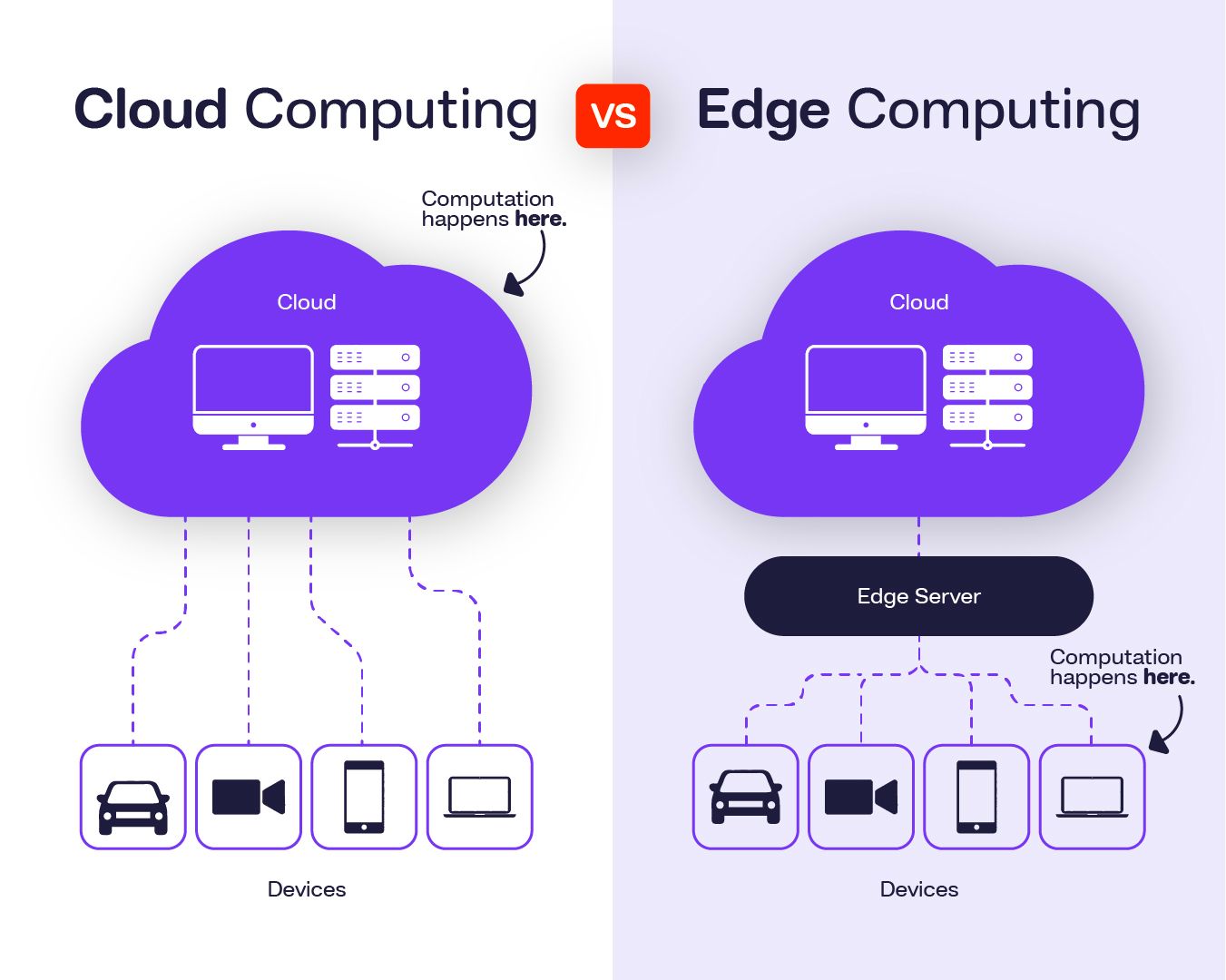
- Cloud computing is a general term for anything that involves delivering hosted services over the internet. It is the on-demand availability of computer system resources, especially data storage and computing power, without direct active management by the user. Large clouds often have functions distributed over multiple locations, each location being a data center.
- Edge Computing:
- Edge computing is a form of computing that is done on site or near a particular data source, minimizing the need for data to be processed in a remote data center.
- Edge computing can enable more effective city traffic management. Examples of this include optimising bus frequency given fluctuations in demand, managing the opening and closing of extra lanes, and, in future, managing autonomous car flows.
- An edge device is any piece of hardware that controls data flow at the boundary between two networks. Edge devices fulfill a variety of roles, depending on what type of device they are, but they essentially serve as network entry — or exit — points.
- There are five main types of edge computing devices: IoT sensors, smart cameras, uCPE equipment, servers and processors. IoT sensors, smart cameras and uCPE equipment will reside on the customer premises, whereas servers and processors will reside in an edge computing data centre.
- In service-based industries such as the finance and e-commerce sector, edge computing devices also have roles to play. In this case, a smart phone, laptop, or tablet becomes the edge computing device.
- Edge Devices:
- Edge devices encompass a broad range of device types, including sensors, actuators and other endpoints, as well as IoT gateways. Within a local area network (LAN), switches in the access layer — that is, those connecting end-user devices to the aggregation layer — are sometimes called edge switches.
- Hybrid Computing:
- A hybrid cloud integrates private, on-premises infrastructure with public cloud services, offering flexibility to distribute workloads between these environments. Hybrid models often incorporate edge computing, allowing organizations to run critical workloads locally at the edge while using the cloud for other tasks, thereby optimizing performance, cost, and data management for various business needs.
- HPC (Hight-Performance Computing):
- Practice of aggregating computing resources to gain performance greater than that of a single workstation, server, or computer. HPC can take the form of custom-built supercomputers or groups of individual computers called clusters.
- Data Centers:
- A data center is a facility that centralizes an organization’s shared IT operations and equipment for the purposes of storing, processing, and disseminating data and applications. Because they house an organization’s most critical and proprietary assets, data centers are vital to the continuity of daily operations.
- Hyperscale Data Centers:
- The clue is in the name: hyperscale data centers are massive facilities built by companies with vast data processing and storage needs. These firms may derive their income directly from the applications or websites the equipment supports, or sell technology management services to third parties.
- White Space and Grey Space in Data Centers:
- White space in a data center refers to the area where IT equipment is placed. It typically houses servers, storage, network gear, and racks.
- Gray space, on the other hand, is the area where the back-end infrastructure is located. This space is essential for supporting the IT equipment and includes areas for switchgear, UPS, transformers, chillers, and generators.
- Edge & Cloud Services:
- Edge services perform data processing on local devices and servers near the data source, reducing latency for time-sensitive operations, while cloud services centralize large computations and storage in remote datacenters, offering massive scalability and flexibility for general workloads.
- Most organizations use both, creating an “edge-to-cloud” architecture where edge devices handle immediate tasks, and the cloud manages large-scale data processing and complex applications, providing a seamless and efficient experience.
- AI – Artificial Intelligence:
- Artificial intelligence is the simulation of human intelligence processes by machines, especially computer systems.
- As the hype around AI has accelerated, vendors have been scrambling to promote how their products and services use AI. Often what they refer to as AI is simply one component of AI, such as machine learning. AI requires a foundation of specialized hardware and software for writing and training machine learning algorithms. No one programming language is synonymous with AI, but several, including Python, R and Java, are popular.
- In general, AI systems work by ingesting large amounts of labeled training data, analyzing the data for correlations and patterns, and using these patterns to make predictions about future states. In this way, a chatbot that is fed examples of text chats can learn to produce lifelike exchanges with people, or an image recognition tool can learn to identify and describe objects in images by reviewing millions of examples.
- AI programming focuses on three cognitive skills: learning, reasoning and self-correction.
- The 4 types of artificial intelligence?
- Type 1: Reactive machines. These AI systems have no memory and are task specific. An example is Deep Blue, the IBM chess program that beat Garry Kasparov in the 1990s. Deep Blue can identify pieces on the chessboard and make predictions, but because it has no memory, it cannot use past experiences to inform future ones.
- Type 2: Limited memory. These AI systems have memory, so they can use past experiences to inform future decisions. Some of the decision-making functions in self-driving cars are designed this way.
- Type 3: Theory of mind. Theory of mind is a psychology term. When applied to AI, it means that the system would have the social intelligence to understand emotions. This type of AI will be able to infer human intentions and predict behavior, a necessary skill for AI systems to become integral members of human teams.
- Type 4: Self-awareness. In this category, AI systems have a sense of self, which gives them consciousness. Machines with self-awareness understand their own current state. This type of AI does not yet exist.
- Machine Learning (ML):
- Developed to mimic human intelligence, it lets the machines learn independently by ingesting vast amounts of data, statistics formulas and detecting patterns.
- ML allows software applications to become more accurate at predicting outcomes without being explicitly programmed to do so.
- ML algorithms use historical data as input to predict new output values.
- Recommendation engines are a common use case for ML. Other uses include fraud detection, spam filtering, business process automation (BPA) and predictive maintenance.
- Classical ML is often categorized by how an algorithm learns to become more accurate in its predictions. There are four basic approaches: supervised learning, unsupervised learning, semi-supervised learning and reinforcement learning.
- Deep Learning (DL):
- Subset of machine learning, Deep Learning enabled much smarter results than were originally possible with ML. Face recognition is a good example.
- DL makes use of layers of information processing, each gradually learning more and more complex representations of data. The early layers may learn about colors, the next ones about shapes, the following about combinations of those shapes, and finally actual objects. DL demonstrated a breakthrough in object recognition.
- DL is currently the most sophisticated AI architecture we have developed.
- Generative AI (GenAI):
- Generative AI technology generates outputs based on some kind of input – often a prompt supplied by a person. Some GenAI tools work in one medium, such as turning text inputs into text outputs, for example. With the public release of ChatGPT in late November 2022, the world at large was introduced to an AI app capable of creating text that sounded more authentic and less artificial than any previous generation of computer-crafted text.
- Small Language Models (SLM) and Large Language Models (LLM):
- Small Language Models (SLMs) are artificial intelligence (AI) models capable of processing, understanding and generating natural language content. As their name implies, SLMs are smaller in scale and scope than large language models (LLMs).
- LLM means Large Language Models — a type of machine learning/deep learning model that can perform a variety of natural language processing (NLP) and analysis tasks, including translating, classifying, and generating text; answering questions in a conversational manner; and identifying data patterns.
- For example, virtual assistants like Siri, Alexa, or Google Assistant use LLMs to process natural language queries and provide useful information or execute tasks such as setting reminders or controlling smart home devices.
- Computer Vision (CV) / Vision AI & Machine Vision (MV):
- Field of AI that enables computers to interpret and act on visual data (images, videos). It works by using deep learning models trained on large datasets to recognize patterns, objects, and context.
- The most well-known case of this today is Google’s Translate, which can take an image of anything — from menus to signboards — and convert it into text that the program then translates into the user’s native language.
- Machine Vision (MV) :
- Specific application for industrial settings, relying on cameras to analyze tasks in manufacturing, quality control, and worker safety. The key difference is that CV is a broader field for extracting information from various visual inputs, while MV is more focused on specific industrial tasks.
- Machine Vision is the ability of a computer to see; it employs one or more video cameras, analog-to-digital conversion and digital signal processing. The resulting data goes to a computer or robot controller. Machine Vision is similar in complexity to Voice Recognition.
- MV uses the latest AI technologies to give industrial equipment the ability to see and analyze tasks in smart manufacturing, quality control, and worker safety.
- Multimodal Intelligence and Agents:
- Subset of artificial intelligence that integrates information from various modalities, such as text, images, audio, and video, to build more accurate and comprehensive AI models.
- Multimodal capabilities allows AI to interact with users in a more natural and intuitive way. It can see, hear and speak, which means that users can provide input and receive responses in a variety of ways.
- An AI agent is a computational entity designed to act independently. It performs specific tasks autonomously by making decisions based on its environment, inputs, and a predefined goal. What separates an AI agent from an AI model is the ability to act. There are many different kinds of agents such as reactive agents and proactive agents. Agents can also act in fixed and dynamic environments. Additionally, more sophisticated applications of agents involve utilizing agents to handle data in various formats, known as multimodal agents and deploying multiple agents to tackle complex problems.
- Agentic AI:
- Agentic AI is an artificial intelligence system that can accomplish a specific goal with limited supervision. It consists of AI agents—machine learning models that mimic human decision-making to solve problems in real time. In a multiagent system, each agent performs a specific subtask required to reach the goal and their efforts are coordinated through AI orchestration.
- Unlike traditional AI models, which operate within predefined constraints and require human intervention, agentic AI exhibits autonomy, goal-driven behavior and adaptability. The term “agentic” refers to these models’ agency, or, their capacity to act independently and purposefully.
- Agentic AI builds on generative AI (gen AI) techniques by using large language models (LLMs) to function in dynamic environments. While generative models focus on creating content based on learned patterns, agentic AI extends this capability by applying generative outputs toward specific goals.
- Edge AI Technology:
- Edge artificial intelligence refers to the deployment of AI algorithms and AI models directly on local edge devices such as sensors or Internet of Things (IoT) devices, which enables real-time data processing and analysis without constant reliance on cloud infrastructure.
- Simply stated, edge AI, or “AI on the edge“, refers to the combination of edge computing and artificial intelligence to execute machine learning tasks directly on interconnected edge devices. Edge computing allows for data to be stored close to the device location, and AI algorithms enable the data to be processed right on the network edge, with or without an internet connection. This facilitates the processing of data within milliseconds, providing real-time feedback.
- Self-driving cars, wearable devices, security cameras, and smart home appliances are among the technologies that leverage edge AI capabilities to promptly deliver users with real-time information when it is most essential.
- High-Density AI:
- High-density AI refers to the concentration of AI computing power and storage within a compact physical space, often found in specialized data centers. This approach allows for increased computational capacity, faster training times, and the ability to handle complex simulations that would be impossible with traditional infrastructure.
- Explainable AI (XAI) and Human-Centered Explainable AI (HCXAI):
- Explainable AI (XAI) refers to methods for making AI model decisions understandable to humans, focusing on how the AI works, whereas Human-Centered Explainable AI (HCXAI) goes further by contextualizing those explanations to a user’s specific task and understanding needs. While XAI aims for technical transparency of the model, HCXAI emphasizes the human context, emphasizing user relevance, and the broader implications of explanations, including fairness, trust, and ethical considerations.
- Physical AI & Embodied AI:
- Physical AI refers to a branch of artificial intelligence that enables machines to perceive, understand, and interact with the physical world by directly processing data from a variety of sensors and actuators.
- Physical AI provides the overarching framework for creating autonomous systems that act intelligently in real-world settings. Embodied AI, as a subset, focuses on the sensory, decision-making, and interaction capabilities that enable these systems to function effectively in dynamic and unpredictable environments.
- Federated Learning and Reinforcement Learning:
- Federated Learning is a machine-learning technique where data stays where it is, and only the learned model updates are shared. “Training AI without sharing your data”.
- Reinforcement Learning is a type of AI where an agent learns by interacting with an environment and receiving rewards or penalties. “Learning by trial and error”
- Federated Learning (FL) and Reinforcement Learning (RL) can be combined into a field called Federated Reinforcement Learning (FRL), where multiple agents learn collaboratively without sharing their raw data. In this approach, each agent trains its own RL policy locally and shares model updates, like parameters or gradients, with a central server. The server aggregates these updates to create a more robust, global model. FRL is used in applications like optimizing resource management in communication networks and enhancing the performance of autonomous systems by learning from diverse, distributed experiences while protecting privacy.
- AI Factories:
- AI Factories are specialized, high-performance computing centers designed to train, tune, and deploy artificial intelligence models at scale.
- Companies and organizations involved in AI factory infrastructure and development include Nvidia, AWS, Microsoft, OpenAI, CoreWeave, Lambda, Nebius, Supermicro, and HPE. The European Union is also establishing AI Factories through its EuroHPC Joint Undertaking to foster regional innovation.
- Liquid Cooling Components:
- Direct-to-Chip (DTC) Cooling:
- A Direct-to-Chip (DTC) cooling system is a liquid-cooling technology used to cool high-performance computer chips—such as CPUs, GPUs, and accelerators—by bringing a liquid coolant directly to the chip surface through a cold plate.
- It is one of the most efficient cooling methods used in data centers, HPC clusters, and AI server farms.
- Chillers:
- Mechanical systems that remove heat from a building’s liquid coolant, typically water, and transfer it to another location to cool the air and maintain comfort. Unlike traditional systems that might cool air directly, chillers generate chilled water that circulates through air handling units (AHUs) within the space to absorb heat, making them essential for cooling large commercial or industrial buildings.
- Technology Cooling System (TCS):
- Broad, non-standard term that generally refers to any integrated system, including chillers, designed to manage heat in technological applications, like data centers or industrial processes, to prevent overheating
- Condensors:
- A condenser is a heat exchanger that cools a gas or vapor, causing it to condense into a liquid, a process that releases latent heat. These devices are critical in many systems, such as air conditioning, refrigeration, and power plants, where they use air or water to absorb heat from the vapor, transforming it back into a liquid state.
- CDU (Coolant Distribution Unit):
- A coolant distribution unit contains a pump that circulates coolant through a network of pipes or channels, distributing it to various components like servers, processors, or other high heat components in large, high power devices that need cooling.
- Coolant Distribution Units are essential in data centers with high-density applications providing close controlled coolant delivery and precise control of the liquid cooling system. They help manage heat loads, reduce power consumption, and increase efficiency and reliability through redundancy.
- HDU (Heat Dissipation Unit):
- Unlike a Coolant Distribution Unit (CDU) that rejects heat from the server rack to the chilled water loop of the building, a Heat Dissipation Unit (HDU™) rejects the server heat from the server rack to the white space where building air conditioning would then remove that heat.
- RDHX (Rear Door Heat Exchanger) – Rack-level Heat Exchange:
- Chilled water cooling doors that fit onto a IT rack. The air is pulled through the rack by the fans or pushed through by the server fans for the passive rear door (no fans).
- Direct-to-Chip (DTC) Cooling:
- Switchgears:
- Broad term that describes a wide variety of switching devices that all fulfill a common need: controlling, protecting, and isolating power systems. This definition can be extended to include devices to regulate and meter a power system, circuit breakers, and similar technology.
- Switchgear contains fuses, switches, and other power conductors. However, circuit breakers are the most common component found in switchgear.
- It performs the function of controlling and metering the flow of electrical power in addiction to acting as an interrupting and switching device that protects the equipment from damage arising out of electrical fluctuations.
- There are three types of switchgear, namely LV (Low voltage), MV (Medium voltage) and HV (High voltage) Switchgear.
- Fuses:
- A fuse is a single time mechanical circuit interruption in an over-current situation through the fusion of a graded electrical conductor. It is employed in the 30KV to 100KV range.
- It is an electrical safety device that operates to provide overcurrent protection of an electrical circuit. Its essential component is a metal wire or strip that melts when too much current flows through it, thereby stopping or interrupting the current.
- Fuse Switch-Disconnectors:
- A fuse switch-disconnector combines the functions of a fuse and a switch disconnector; it provides overcurrent protection like a fuse, and it also allows for manual disconnection of the circuit for isolation purposes.
- Reducer Fuses:
- A reducer fuse is not a fuse itself, but rather an adapter that allows a physically smaller fuse to be installed into a fuse holder designed for a larger fuse size. A fuse reducer typically consists of a non-conductive, insulating body that encases the smaller fuse. This body is then designed with metal contacts or blades that match the dimensions of the larger fuse holder, allowing it to snap or bolt into place.
- Electrified Vehicle (EV) Fuses:
- EV fuses are specialized safety devices designed to protect the high-voltage DC systems in electric vehicles, featuring much higher voltage ratings (500-1000Vdc), specialized materials to withstand extreme temperatures and vibrations, and fast-acting clearing mechanisms for high-power DC fault currents, unlike normal electrical fuses found in household circuits. Normal electrical fuses are for lower-voltage AC systems and have lower voltage ratings, standard materials, and designs suited for less extreme, more controlled environments.
- Circuit Breakers:
- A circuit breaker is a mechanical electrical switch designed to protect an electrical circuit from damage caused by overcurrent/overload or short circuit. Its basic function is to interrupt current flow after protective relays detect a fault.
- By definition, a circuit breaker is an electrical safety device, a switch that automatically interrupts the current of an overloaded electric circuit, ground faults, or short circuits.
- Disconnectors:
- It is an Automatic switching device that offers specific isolating distance on the basis of specific requirements.
- Disconnectors (also known as Isolators) are devices which are generally operated off-load to provide isolation of main plant items for maintenance, or to isolate faulted equipment from other live equipment.
- Contactors:
- It works like a high-current switching system but at higher voltage rates. Contactors can however not be utilized as disconnecting switches. They are employed in the 30KV to 100KV range.
- A Contactor is a special type of relay used for switching an electrical circuit on or off.
- It is an electrical device that is widely used for switching circuits on and off. As such, electrical contactors form a subcategory of electromagnetic switches known as relays. A relay is an electrically operated switching device that uses an electromagnetic coil to open and close a set of contacts.
- MCB (Miniature Circuit Breakers):
- They are employed in domestic households to safeguard against overload. Rated current is max. 100 A.
- It is an electrical switch that automatically switches off the electrical circuit during an abnormal condition of the network such as an overload condition as well as a faulty condition. Nowadays we use an MCB in a low-voltage electrical network instead of a fuse.
- Circuit breakers have a tripping relay mechanism, while an MCB has a tripping release mechanism. Circuit breakers have a high rupturing capacity, but the MCB has a low rupturing capacity. Circuit breakers are used in High Voltage systems, while MCBs are used in Low Voltage systems.
- MCCB (Molded Case Circuit Breakers):
- Ii incorporates an insulating material in the form of molded casing within the circuit breaker. Rated current is up to 2,500 A.
- An MCCB has a higher interrupting capacity, meaning it can handle larger loads than a conventional breaker. Generally, a standard breaker is used for residential and light commercial applications, while an MCCB is suitable for industrial and heavy commercial applications.
- PTCB eFuse Circuit Breaker:
- An Electronic eFuse Circuit Breaker (PTCB) is an electronic micro fuse for DIN rail protecting electronically nominal currents below 1A to facilitate the clear detection of faults and supports precise fault localization and fast recovery. Response times are shorter compared to conventional fuse protection and the exact current value can be adjusted at any time
- RCCB (Residual Current Circuit Breakers):
- To safeguard against electrical shock arising out of indirect contact and includes the detection of residual current such as earth leakage.
- It is a current sensing device, which can automatically measure and disconnect the circuit whenever a fault occurs in the connected circuit or the current exceeds the rated sensitivity.
- RCD (Residual Current Devices):
- It is a sensitive safety device that switches off the electricity within 10 to 50 milliseconds if there is an electrical fault. An RCD is is designed to protect against the risks of electrocution and fire caused by earth faults.
- The difference between a circuit breaker and an RCD switch is the purpose of a circuit breaker is to protect the electrical systems and wiring in a home while the purpose of an RCD switch is to protect people from electrocution.
- RCBO (Residual Current Breakers with Over-Current):
- An RCBO can protect against electric shocks, residual currents, and earth faults. On the other hand, an RCBO can do what an RCD can do and protect a circuit from short circuits and overload. RCBOs are essentially a combination of MCB and RCCB.
- An RCBO protects electrical equipment from two types of faults; residual current and over current. Residual current, or Earth leakage as it can sometimes be referred to, is when there is a break in the circuit that could be caused by faulty electrical wiring or if the wire is accidentally cut.
- Solid-State Circuit Breakers:
- Solid-state device, electronic device in which electricity flows through solid semiconductor crystals (silicon, gallium arsenide, germanium) rather than through vacuum tubes.
- The solid-state breaker concept replaces the traditional moving parts of an electromechanical circuit breaker with semiconductors and advanced software algorithms that control the power and can interrupt extreme currents faster than ever before.
- ACB (Air Circuit Breakers):
- An Air Circuit Breaker (ACB) uses air as the insulating medium.
- An Air Circuit Breaker (ACB) is a circuit breaker for the purpose of protecting low voltage circuit, mainly for energizing and cutting off high current
- VCB (Vacuum Circuit Breakers):
- Vacuum is used as the means to protect circuit breakers.
- A Circuit breaker where the arc quenching takes place in a vacuum medium. The operation of switching on and closing of current carrying contacts and the interrelated arc interruption takes place in a vacuum chamber in the breaker which is called a vacuum interrupter.
- OCB (Oil Circuit Breakers):
- It uses a portion of oil to blast a jet of oil through the arc.
- A Circuit breaker which uses insulating oil as an arc quenching medium
- Hybrid Circuit Breakers:
- Combines Air-insulated and SF6 Gas-insulated technologies.
- AIS (Air Insulated Switchgears):
- Air is used for insulation in a metal-clad system
- It is a secondary power distribution device and medium voltage switchgear that helps redistribute the power of a primary power distributor powered by a high voltage distribution transformer. AIS controls, protects and isolates electrical equipment in power transmission and distribution systems.
- GIS (Gas Insulated Switchgears):
- All working components assembled under SF6 (Sulfur Hexafluoride High-Voltage Switchgears) gas-tight casing.
- It is a compact metal encapsulated switchgear consisting of high-voltage components such as circuit-breakers and disconnectors, which can be safely operated in confined spaces.
- Pad-mount Switchgears:
- The pad-mount switchgear is made from the same modular switch and interrupter components as the vault switchgear. This means all components are sealed, submersible and protected, so you don’t have to worry about tracking, animal infestation, corrosion or the effects of condensation inside the enclosure.
- Ring Main Unit (RMU):
- A ring Main Unit (RMU) is a Medium-Voltage, gas-insulated, fully sealed cabinet used to measure, connect, and integrate transformer protection functions with a fixed type breaker. Ring Main Units are safe, reliable, low-maintenance, and easy to replace switchgear.
- A Ring Main Unit (RMU) is a factory assembled, metal enclosed set of switchgear used at the load connection points of a ring-type distribution network.
- Load Center – Panel Board – Switch Board – Distribution Cabinet – Distribution Box – Distribution Enclosure:
- A Load Center is used in residential and light commercial applications to distribute electricity supplied by the utility company throughout the home or building to feed all the branch circuits. Each branch circuit is protected by the circuit breaker housed in the load center. In the event of a short circuit or an overload on a branch circuit, the circuit breaker will cut the power before any potential property damage or personal injury can occur.
- A Load Center provides similar functionality in a power distribution system as a Switchboard and a Panelboard. As far as UL and the NEC standards are concerned, there is no difference between a Panelboard and a Load Center. The term Panel Board is more used in commercial and industrial applications.
- However, Panelboards are typically deeper than Load Centers and can accommodate both bolt-on circuit breakers as well as plug-in breakers, whereas a load center is limited to plug-in breakers.
- Switchboards are often the typical choice for large commercial and industrial establishments. These Panelboards generally house circuit breakers that can manage and supply electricity for machines with high-voltage demands.
- Panelboards are only accessible from the front (as mentioned above), but Switchboards allow rear access as well.
- Distribution Cabinet is used as a general term for an enclosure that houses electrical distribution components. It can refer to enclosures containing Panelboards, Switchboards, or other distribution equipment.
- In terms of use, distribution boxes are generally used for households (smaller enclosures), and distribution cabinets are mostly used for centralized power supply. Distribution boxes and cabinets are complete sets of equipment. Distribution boxes are low-voltage complete sets of equipment. Cabinets have both high and low voltages.
- An enclosure or distribution enclosure in a general term for any type of protective housing for electrical distribution components. It’s essentially a cabinet or box designed to safeguard components from environmental factors, prevent electrical shock, and potentially shield against electromagnetic interference.

- Main Distribution Boards (MDB):
- An MDB is a panel or enclosure that houses the fuses, circuit breakers and ground leakage protection units where the electrical energy, which is used to distribute electrical power to numerous individual circuits or consumer points, is taken in from the transformer or an upstream panel.
- MDBs receive power from the utility source or generator and distribute it to various sub-circuits within the establishment.
- The MDB is the primary source of power distribution in an electrical system.
- Sub-Distribution Boards (SDB):
- Subsidiary from Main Distribution Board that distribute electricity to a selected section of a building.
- A sub-distribution board or sub-board is usually a smaller breaker panel acting as a subsidiary to a larger Distribution Panel. This enables greater control and isolation of a subset of smaller circuits and breakers.
- Final Distribution Boards (FDB):
- Distribution Boards that received from the Sub-Distribution Boards and supply to the final switches that connect electrical devices and appliances.
- Fundamental Units of Electricity:
- Ampere – Amp (A):
- Amperes measure the flow of electrical current (charge) through a circuit. Ampere (A) is the unit of measure for the rate of electron flow, or current, in an electrical conductor.
- One ampere is defined as one coulomb of electric charge moving past a point in one second. The ampere is named after the French physicist André-Marie Ampère, who made significant contributions to the study of electromagnetism.
- Milliampere (mA) is a unit of electric current equal to one-thousandth of an ampere (1mA=10−3A). The prefix “milli” signifies 10−3 in the metric system. This unit is commonly used to measure small currents in electronic circuits and consumer devices.
- Volts measure the force or potential difference that drives the flow of electrons through a circuit.
- Kilovolt (kV) is a unit of potential difference equal to 1,000 volts.
- Watts measure the rate of energy consumption or generation, also known as power.
- Amperes measure the flow of electrical current (charge) through a circuit. Ampere (A) is the unit of measure for the rate of electron flow, or current, in an electrical conductor.
- Power vs. Energy: how electricity is measured and billed.
- Power (measured in kW, MW, GW, TW): Rate at which energy is used or generated at a given moment.
- Energy (measured in kWh, MWh, GWh, TWh): Total amount of power consumed or generated over a period of time (i.e., Power x Time).
- Real Power Units: actual power that performs work.
- Kilowatt (KW):
- A kilowatt is simply a measure of how much power an electric appliance consumes—it’s 1,000 watts to be exact. You can quickly convert watts (W) to kilowatts (kW) by dividing your wattage by 1,000: 1,000W 1,000 = 1 kW.
- Megawatt (MW):
- One megawatt equals one million watts or 1,000 kilowatts, roughly enough electricity for the instantaneous demand of 750 homes at once.
- Gigawatt (GW):
- A gigawatt (GW) is a unit of power, and it is equal to one billion watts.
- According to the Department of Energy, generating one GW of power takes over three million solar panels or 310 utility-scale wind turbines
- Terawatt (TW):
- One terawatt is equal to one trillion watts (1,000,000,000,000 watts). The main use of terawatts is found in the electric power industry, particularly for measuring very large-scale power generation or consumption.
- According to the United States Energy Information Administration, America is one of the largest electricity consumers in the world, using about 4,146.2 terawatt-hours (TWh) of energy per year.
- Kilowatt (KW):
- Apparent Power Units: measures the total power in a circuit, including power that does not perform useful work.
- Kilovolt-Amperes (kVA):
- Kilovolt-Amperes (kVA) stands for Kilo-volt-amperes, a term used for the rating of an electrical circuit. A kVA is a unit of apparent power, which is the product of the circuit’s maximum voltage and current rating.
- The difference between real power (kW) and apparent power (kVA) is crucial. Real power (kW) is the actual power that performs work, while apparent power (kVA) is the total power delivered to a circuit, including the real power and the reactive power (kVAR) that doesn’t do useful work. The relationship between them is defined by the power factor. Since the power factor is typically less than 1, the kVA value will always be higher than the kW value.
- Megavolt-Amperes (MVA):
- Megavolt-Amperes (MVA) is a unit used to measure the apparent power in a circuit, primarily for very large electrical systems like power plants and substations. It’s a product of the voltage and current in a circuit.
- 1 MVA is equivalent to 1,000 kVA, or 1,000,000 volt-amperes.
- Kilovolt-Amperes (kVA):
- Specialized Power Units: used specifically for renewable energy, especially solar.
- KiloWatt ‘peak’ (KWp):
- kWp stands for kilowatt ‘peak’ power output of a system. It is most commonly applied to solar arrays. For example, a solar panel with a peak power of 3kWp which is working at its maximum capacity for one hour will produce 3kWh. kWp (kilowatt peak) is the total kw rating of the system, the theoretical ‘peak’ output of the system. e.g. If the system has 4 x 270 watt panels, then it is 4 x 0.27kWp = 1.08kWp.
- The Wp of each panel will allow you to calculate the surface area needed to reach it. 1 kWp corresponds theoretically to 1,000 kWh per year.
- KiloWatt ‘peak’ (KWp):
- Ampere – Amp (A):