ABB – Power orchestration the future of industrial competitiveness, says new ABB whitepaper


- Rising energy costs, grid constraints and $1.4 trillion of unplanned downtime are forcing organizations to rethink how they manage electrical infrastructure
- ABB predicts that electrical systems will evolve from connected to orchestrated infrastructure, with assets, energy flows and expertise coordinated dynamically in real time
- Companies that start treating electrical infrastructure as a strategic asset now, rather than a maintenance cost, will gain a massive competitive advantage
The role of electrical infrastructure needs to be fundamentally rethought due to growing energy demand, grid constraints and the cost of downtime, according to a new whitepaper from ABB.
There is huge commercial gain to be had in doing so. Future of Electrification Service 2026-2035+ report suggests that companies can gain a competitive edge if they stop thinking of electrical infrastructure as a background utility or a maintenance expense, but rather an emerging strategic asset that directly influences resilience, productivity, sustainability and growth.
The whitepaper finds that energy now makes up 25.4 percent of industrial operating costs, while 59 percent of organizations identify rising energy costs as a major threat. At the same time, unplanned downtime costs the world’s largest companies around $1.4 trillion annually, and 69 percent of industrial plants experience outages at least monthly.
Although most organizations recognize the need to act, they struggle to translate that into investment decisions. Critically, while 81 percent of senior decision-makers say total cost of ownership (TCO) should guide capital decisions, only 37 percent apply it in practice.
It concludes that, as power systems become increasingly intelligent, distributed and interconnected, organizations will move beyond simply consuming electricity to actively managing, storing, optimizing and orchestrating it. In parallel, resilience, affordability and sustainability will cease to be separate objectives and become different outcomes of the same operational strategy.
“The boundary between energy producer and energy consumer is beginning to disappear.” said Stuart Thompson, President of Electrification Service at ABB. “For decades, organizations have treated electrical infrastructure as something they connect to and maintain. But the next decade will fundamentally change that relationship. Businesses will increasingly become active participants in the energy system, generating, storing, optimizing and orchestrating energy in real time.”
“At the same time, resilience, affordability and sustainability are no longer separate objectives that can be managed independently. They are becoming different outcomes of the same strategy. The organizations that succeed will be those that can balance all three simultaneously, and they will get there much faster if they start now”.
The report goes on to outline how electrification service is expected to evolve through to 2035 and beyond, driven by AI, automation, energy storage, digital asset management and new service models. Among the key shifts identified:
Electrical infrastructure evolving from a passive network of assets into an intelligent operating system that continuously anticipates risk, optimizes performance and supports operational certainty.
Data centers, industrial sites, battery storage systems and utilities are expected to operate as part of a far more dynamic and coordinated ecosystem, where energy is generated, stored, optimized and shared according to changing operational and grid requirements.
Service models shifting from maintenance and equipment ownership toward outcome-based partnerships focused on uptime, resilience and performance.
To help organizations prepare for the next 10 years, the report outlines five practical pathways to action today:
- Strategic asset management
- AI and digital solutions
- Energy storage
- Energy and carbon services
- Advisory services.
The full whitepaper is available here.
Explore additional insights through ABB’s Mastering Operational Certainty hub.
SourceABB
EMR Analysis
More information on ABB: See full profile on EMR Executive Services
More information on Morten Wierod (Chief Executive Officer and Member of the Group Executive Committee, ABB): See full profile on EMR Executive Services
More information on Christian Nilsson (Chief Financial Officer and Member of the Executive Committee, ABB): See full profile on EMR Executive Services
More information on the ABB Way: See full profile on EMR Executive Services
More information on Electrification Business Area by ABB: See the full profile on EMR Executive Services
More information on Giampiero Frisio (President, Electrification Business Area and Member of the Executive Committee, ABB): See full profile on EMR Executive Services
More information on Stuart Thompson (President, Electrification Service Division, Electrification Business Area, ABB): See full profile on EMR Executive Services
EMR Additional Notes:
- Grid, Microgrids, DERs and DERM’s:
- Grid / Power Grid:
- The power grid is a network for delivering electricity to consumers. The power grid includes power generation facilities, substations, transmission lines and towers, distribution networks, protection and control equipment, and associated communication and monitoring infrastructure.
- The grid continuously balances electricity generation and consumption while maintaining system stability and power quality, supplying electricity for applications ranging from industry to household appliances.
- Electric grids perform three major functions or stages of electricity supply: power generation, transmission, and distribution. Grid operation also includes functions such as system balancing, protection, control, monitoring, and, increasingly, energy storage and demand-side management.
- The power grid is a network for delivering electricity to consumers. The power grid includes power generation facilities, substations, transmission lines and towers, distribution networks, protection and control equipment, and associated communication and monitoring infrastructure.
- Microgrid:
- A microgrid is a group of interconnected loads and distributed energy resources (DERs) within clearly defined electrical boundaries that acts as a single controllable entity with respect to the main grid and can operate either connected to the main grid or, when appropriately designed, intentionally and controllably in an islanded mode.
- Microgrids can integrate local generation, energy storage, controllable loads, and other DERs to improve resilience, flexibility, efficiency, or local energy management.
- A microgrid is a group of interconnected loads and distributed energy resources (DERs) within clearly defined electrical boundaries that acts as a single controllable entity with respect to the main grid and can operate either connected to the main grid or, when appropriately designed, intentionally and controllably in an islanded mode.
- Smart Grid:
- A smart grid is an electrical grid enhanced with digital communications, sensing, automation, control, and data/analytics technologies across generation, transmission, distribution, and/or customer-side systems to improve the monitoring, operation, efficiency, reliability, resilience, and flexibility of the power system.
- Distributed Energy Resources (DERs):
- Distributed energy resources (DERs) are relatively small-scale electricity generation, storage, and flexible demand resources, located at or near the distribution system or customer premises, that can supply, store, or modify electricity consumption and are interconnected to the electric grid. They are often located close to load centers and can be used individually or in aggregate to provide value to the grid.
- Common examples of DERs include rooftop solar PV units, small wind turbines, small gas-fired generators or engines/turbines, microturbines, biomass generators, fuel cells, combined heat and power (CHP) or tri-generation systems with electrical generation, battery storage, electric vehicles and controllable EV charging or discharging where they can provide grid flexibility, and demand response applications.
- Distributed energy resources (DERs) are relatively small-scale electricity generation, storage, and flexible demand resources, located at or near the distribution system or customer premises, that can supply, store, or modify electricity consumption and are interconnected to the electric grid. They are often located close to load centers and can be used individually or in aggregate to provide value to the grid.
- Distributed Energy Resources Management Systems (DERMS):
- Distributed Energy Resources Management Systems (DERMS) are software platforms that help utilities, distribution system operators (DSOs), aggregators, and other energy-sector organizations monitor, provide visibility into, forecast, coordinate, optimize, and, where supported, control distributed energy resources (DERs).
- DERMS can be used to aggregate and coordinate large numbers of DERs and flexible loads for grid services, including voltage and power-flow management, congestion and constraint management, balancing, flexibility services, resilience, and participation in demand-response or other electricity markets. DERMS can be defined in many ways, depending on the use case, the types of DERs being managed, the responsibilities of the organization using the system, and the architecture of the power system.
- Distributed Energy Resources Management Systems (DERMS) are software platforms that help utilities, distribution system operators (DSOs), aggregators, and other energy-sector organizations monitor, provide visibility into, forecast, coordinate, optimize, and, where supported, control distributed energy resources (DERs).
- Grid / Power Grid:
- TCO (Total Cost of Ownership):
- The purchase price of an asset plus the costs of operation. Assessing the total cost of ownership means taking a bigger picture look at what the product is and what its value is over time.
- Estimation of the expenses associated with purchasing, deploying, using and retiring a product or piece of equipment. TCO, or actual cost, quantifies the cost of the purchase across the product’s entire lifecycle.
- ROI (Return On Investment):
- An approximate measure of an investment’s profitability. ROI is calculated by subtracting the initial cost of the investment from its final value, then dividing this new number by the cost of the investment, and finally, multiplying it by 100.
- According to conventional wisdom, an annual ROI of approximately 7% or greater is considered a good ROI for an investment in stocks. This is also about the average annual return of the S&P 500, accounting for inflation.
- AI – Artificial Intelligence:
- Artificial Intelligence (AI) is the broad field of computer science focused on developing systems that can perform tasks that typically require capabilities associated with human or other forms of intelligent behavior, such as learning, reasoning, perception, language understanding, planning, and decision-making.
- AI systems may:
- Process data or information from various sources;
- Identify patterns, relationships, or relevant features;
- Make predictions, classifications, decisions, or recommendations;
- Reason, plan, generate content, or take actions toward defined goals.
- AI is an umbrella term that includes machine learning, deep learning, generative AI, and other approaches such as rule-based systems, search, planning, knowledge representation, probabilistic methods, and optimization. Not all AI systems learn from data.
- A popular but non-standard conceptual taxonomy describes AI as reactive machines, limited-memory systems, theory-of-mind AI, and self-aware AI. This taxonomy is useful for explaining different hypothetical levels of capability, but it is not a formal scientific classification of AI systems.
- Main types of AI:
- Type 1: Reactive machines. These AI systems do not use persistent memory of previous experiences to inform their decisions and generally respond only to the current input or state. An example is Deep Blue, the IBM chess-playing system that defeated Garry Kasparov in the 1990s. Deep Blue used chess-specific search and evaluation techniques to select moves rather than learning from previous games in the manner of modern machine-learning systems.
- Type 2: Limited memory. These AI systems can use information from previous observations, stored data, or recent states when making decisions. Many modern AI systems use forms of memory or contextual information, although the term “limited memory” is a broad conceptual category rather than a precise technical classification.
- Type 3: Theory of mind. A hypothetical form of AI capable of modeling aspects of other people’s beliefs, intentions, knowledge, emotions, or perspectives and using this understanding in interaction. Such capabilities remain an active area of research rather than an established category of deployed AI.
- Type 4: Self-awareness. A hypothetical form of AI possessing a subjective sense of self or consciousness. No generally accepted evidence demonstrates the existence of genuinely self-aware or conscious AI systems.
- AI programming therefore does not have a universally accepted set of “three cognitive skills”; learning, reasoning, perception, planning, language processing, and decision-making are among the capabilities commonly associated with AI.
- Machine Learning (ML):
- Machine Learning (ML) is a subset of AI in which algorithms learn patterns or relationships from data to perform tasks such as prediction, classification, generation, or decision-making, rather than relying solely on manually specified rules for every case.
- ML uses historical or newly collected data to learn statistical patterns and improve performance on a defined task or objective.
- ML is the dominant approach underlying many modern AI systems, but rule-based, optimization-based, search-based, and other non-ML approaches remain important in many applications.
- ML allows software applications to learn from data and improve their performance on a defined task without requiring every decision rule to be explicitly programmed.
- Recommendation engines are a common use case for ML. Other uses include fraud detection, spam filtering, image and speech recognition, forecasting, business process automation (BPA), and predictive maintenance.
- Classical ML is often categorized according to how an algorithm learns from data. Common approaches include:
- Supervised learning,
- Unsupervised learning,
- Semi-supervised learning,
- Self-supervised learning, and
- Reinforcement learning.
- Deep Learning (DL):
- Deep Learning (DL) is a subset of ML that uses neural networks with multiple computational layers to learn complex representations and relationships from data.
- DL can be particularly effective for high-dimensional and unstructured or complex data such as images, audio, video, and natural language, although classical ML methods can outperform deep learning on some structured or tabular datasets.
- DL uses multiple layers of information processing that can learn increasingly complex representations of input data. In some image-recognition systems, for example, earlier layers may learn lower-level visual features while later layers combine these features into more complex representations.
- DL has enabled major advances in computer vision, speech recognition, natural language processing, generative AI, and other fields, but it is not inherently the “most sophisticated” AI architecture; different architectures and approaches are better suited to different tasks.
- Generative AI (GenAI):
- Generative AI (GenAI) refers to AI systems that generate new content or other outputs, such as text, images, code, audio, video, or structured data, based on patterns learned during training and on subsequent inputs or instructions.
- GenAI is typically powered by machine-learning and deep-learning models, including large language models and other foundation models, rather than constituting a completely separate AI paradigm.
- Generative AI can generate outputs based on prompts, structured inputs, multimodal inputs, tool calls, or instructions provided by people or software systems.
- The public release of ChatGPT in November 2022 significantly increased public awareness and adoption of generative AI capable of producing natural-language responses and other forms of content.
- Small Language Models (SLM) and Large Language Models (LLM):
- Small Language Models (SLMs) are relatively compact language models designed to process and generate natural-language content, often with lower computational, memory, or deployment requirements than larger models.
- Large Language Models (LLMs) are machine-learning models trained on large amounts of data to process and generate natural language and perform tasks such as text generation, summarization, translation, classification, question answering, reasoning, and information extraction.
- “Small” and “large” are relative terms rather than universally defined categories based on a fixed number of parameters.
- Modern LLMs are commonly based on transformer or related neural-network architectures.
- Virtual assistants such as Siri, Alexa, and Google Assistant can incorporate language models, speech-recognition systems, search, rules, APIs, and other technologies; whether and to what extent they use LLMs depends on the specific version and implementation.
- Computer Vision (CV) / Vision AI & Machine Vision (MV):
- Computer Vision (CV) is a broad field of AI and computer science concerned with enabling computers to acquire, process, analyze, and interpret visual information from images, video, and other visual sensors.
- CV can use deep learning, classical image-processing techniques, geometric methods, machine learning, and other computational approaches to recognize objects, detect patterns, estimate properties, understand scenes, or extract information from visual data.
- Applications include object detection, image classification, optical character recognition (OCR), facial recognition, medical imaging, autonomous systems, visual search, and image-based measurement and inspection.
- Machine Vision (MV) is an application of computer vision focused particularly on automated visual inspection, measurement, identification, guidance, and control, especially in industrial and manufacturing environments.
- Machine Vision commonly uses cameras, lighting, image-processing software, AI or other vision algorithms, and interfaces to industrial control systems, robots, or other equipment.
- The key difference is that CV is the broader technical field, while MV generally refers to application-oriented vision systems used to perform defined automated tasks.
- Multimodal Intelligence and Agents:
- Multimodal AI refers to AI systems that can process and/or generate information across multiple modalities, such as text, images, audio, video, and other sensor or structured data.
- Multimodal capabilities allow AI systems to combine information from different types of input and output, enabling applications such as visual question answering, speech interaction, document understanding, and systems that can see, hear, speak, and generate visual or textual content.
- An AI agent is a software system that perceives information from an environment, maintains or uses relevant state or context, and selects and takes actions toward a defined goal. An agent may incorporate one or more AI models, tools, memory, planning mechanisms, and orchestration components.
- What distinguishes an AI agent from a conventional AI model is not simply decision-making, but the ability to take actions in an environment toward a goal, often through tools or external systems.
- Agents can be classified or implemented in different ways, including reactive or planning-oriented agents, single-agent or multi-agent systems, and agents operating in static or dynamic environments. Multimodal agents can process multiple forms of information.
- Agentic AI:
- Agentic AI is an emerging term for AI systems designed to pursue defined goals by planning, making decisions, using tools, interacting with their environment, and taking actions with a degree of autonomy and limited human intervention.
- Agentic AI systems may use large language models, other machine-learning models, planning mechanisms, memory or state, tools, external data sources, and orchestration components.
- Unlike conventional AI models that primarily produce an output in response to an input, agentic systems extend model capabilities into action-oriented workflows, potentially executing multiple steps and adapting their actions based on intermediate results or changes in the environment.
- Multi-agent systems are one implementation approach in which multiple specialized agents coordinate their activities to achieve a broader goal.
- Agentic AI can build on generative AI, particularly LLMs, but agentic AI is not synonymous with generative AI or LLMs.
- Agentic Enterprise:
- An agentic enterprise is an emerging business operating model in which people, AI agents, enterprise applications, data, and automation systems work together to execute or coordinate business processes and workflows.
- Compared with conventional automation, agentic systems can interpret information, make decisions within defined boundaries, use enterprise tools, and take actions across multiple workflow steps, while appropriate governance, security, permissions, monitoring, and human oversight can constrain or supervise those actions.
- The term is increasingly used by technology companies and analysts to describe an evolution toward more autonomous AI-enabled enterprise operations, but it is not a standardized technical or organizational category.
- Edge AI Technology:
- Edge AI refers to the deployment and execution of AI models or inference workloads on or close to the devices and systems where data is generated, such as cameras, sensors, industrial controllers, vehicles, smartphones, and other IoT devices, rather than relying entirely on centralized cloud infrastructure.
- Edge AI combines edge computing with AI/ML to process data locally or near its source, potentially reducing latency, bandwidth requirements, cloud dependence, or exposure of sensitive data.
- Edge AI can operate with intermittent or no internet connectivity for some functions, although many systems continue to communicate with cloud or other centralized systems.
- Applications include autonomous vehicles, industrial inspection, wearable devices, security cameras, robotics, and smart-home equipment.
- High-Density AI:
- High-density AI refers to the concentration of AI computing capacity—particularly GPUs or other accelerators, memory, networking, power delivery, and cooling—in a relatively small physical or data-center footprint.
- It is an AI infrastructure and data-center design trend, not a distinct category of AI. High-density infrastructure can provide greater computing capacity per rack, room, or unit of floor space, but also creates significant requirements for power distribution, thermal management, networking, and physical infrastructure.
- Explainable AI (XAI) and Human-Centered Explainable AI (HCXAI):
- Explainable AI (XAI) refers to methods, techniques, and system designs intended to make AI model behavior, predictions, decisions, or outputs understandable to people.
- Human-Centered Explainable AI (HCXAI) goes further by designing explanations around the needs, context, goals, knowledge, and capabilities of the people who use or are affected by the AI system.
- While XAI focuses on understanding and communicating aspects of model behavior, HCXAI emphasizes whether explanations are relevant, comprehensible, useful, and appropriate for their human context. Related considerations can include fairness, accountability, trust, safety, and ethical use, although these are not themselves defining features of explainability.
- Physical AI & Embodied AI:
- Physical AI refers to AI systems designed to perceive, reason about, predict, and/or act in the physical world, often using data from sensors and controlling physical devices or actuators.
- Embodied AI refers to AI systems whose intelligence is situated within or coupled to a physical or simulated body or agent, emphasizing the interaction between perception, decision-making, action, and the environment.
- Physical AI and Embodied AI overlap substantially, and the terms are not universally defined as a strict hierarchy. They are commonly associated with robotics, autonomous vehicles, industrial systems, and other applications in which AI interacts with a physical environment.
- Federated Learning and Reinforcement Learning:
- Federated Learning (FL) is a machine-learning technique in which models are trained across multiple decentralized devices or organizations while the raw training data generally remains at its original location; model parameters, gradients, or other training information are communicated to an aggregation or coordination system. In simple terms: “Train AI without centrally collecting the raw data.”
- Federated learning can improve data governance and reduce the need to centralize sensitive data, but it does not by itself guarantee privacy or security. Additional techniques such as secure aggregation or differential privacy may be used.
- Reinforcement Learning (RL) is a type of machine learning in which an agent learns to select actions by interacting with an environment and receiving rewards or penalties, with the objective of improving its policy or long-term expected reward. In simple terms: “Learning through interaction and feedback.”
- Federated Learning and Reinforcement Learning can be combined as Federated Reinforcement Learning (FRL), in which multiple agents or devices learn policies locally and share selected model information or updates to improve a common or coordinated policy without centrally sharing their raw experience data.
- FRL is an active research area with applications being investigated in areas such as distributed resource management, communications networks, robotics, and autonomous systems.
- AI Factories:
- AI Factories are industrial-scale computing and operational infrastructures designed to transform data and computing resources into AI models, inference services, and other AI outputs at scale.
- AI factories can encompass data preparation, model training, fine-tuning, inference, serving, storage, high-speed networking, accelerated computing, power, cooling, and associated software and operational systems.
- “AI factory” is a conceptual and industry term rather than a standardized technical category. It can refer to a dedicated AI data center or, more broadly, an integrated infrastructure and operating model for producing and deploying AI capabilities at scale.
- Companies and organizations use the term in different ways, including in connection with hyperscale and specialized data-center infrastructure, accelerated computing, and public-sector AI infrastructure initiatives.
- Energy Storage System (ESS):
- An Energy Storage System (ESS) is a system or group of components capable of storing energy in one form and delivering it later in the same or another usable form, including electrical energy.
- An ESS may include three main functional components:
- A Power Conversion System (PCS), which converts electrical power between different electrical forms, such as AC and DC, where required
- A storage unit, which stores the energy
- A control system, which manages energy flow, operating conditions, protection, and system operation
- ESS is a broad concept that includes multiple storage technologies (including electrochemical, mechanical, thermal, chemical, and electrical storage), not only electrical-to-electrical systems. Not every ESS necessarily contains a PCS or all of these components; the architecture depends on the storage technology and application.
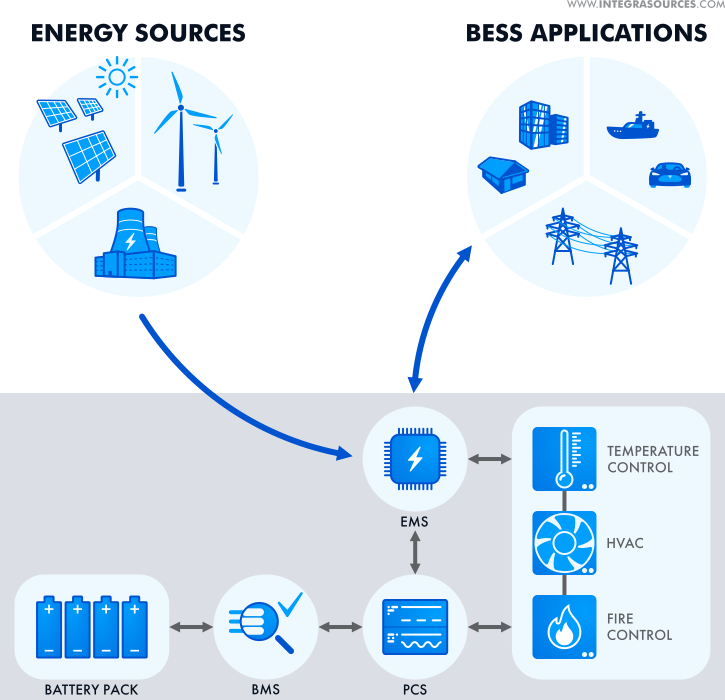
- Battery Energy Storage System (BESS):
- A BESS is a type of ESS that stores energy specifically in rechargeable electrochemical batteries. It captures energy from sources such as the electrical grid or renewable generation, stores it, and releases it when needed.
- A BESS typically includes:
- battery cells assembled into modules, packs/racks, or other battery assemblies (e.g., lithium-ion)
- a Battery Management System (BMS)
- a bidirectional Power Conversion System (PCS), typically an inverter/rectifier for AC-grid applications
- an Energy Management System (EMS) and/or higher-level control system
- protection and, depending on the design, thermal-management, monitoring, switching, and auxiliary systems
- “Battery energy storage system architecture” refers to the structural and functional integration of these subsystems into a complete, controllable solution, not just the batteries themselves.
- Hybridized Energy Storage System (HESS):
- A Hybrid Energy Storage System (HESS) combines two or more different energy-storage technologies or storage subsystems to leverage their complementary characteristics.
- This can improve overall system performance, power/energy capability, efficiency, operating range, or lifetime when appropriately designed and controlled, compared to a single storage technology.
- High-power components (e.g., supercapacitors) handle rapid, short-duration power demands or peaks
- High-energy components (e.g., batteries) handle longer-duration energy storage and supply
- Distributed Energy Storage Systems (DESS):
- Distributed Energy Storage Systems (DESS) are energy-storage resources deployed across multiple geographically distributed locations rather than in a single centralized facility.
- These systems can range from residential batteries to commercial, industrial, community, and utility-scale installations and are used to:
- store excess energy (e.g., from solar or wind)
- supply energy during peak demand
- provide grid services such as flexibility, voltage support, frequency regulation, or congestion management, where applicable
- improve grid resilience and operational flexibility
- DESS is a deployment/distribution model (where storage is located), not a specific storage technology.
- Carbon Dioxide (CO2):
- The primary greenhouse gas emitted through human activities. Carbon dioxide enters the atmosphere through the burning of fossil fuels (coal, natural gas, and oil), solid waste, biomass (e.g. wood), and also as a result of certain industrial chemical reactions (e.g. cement production).
- Carbon dioxide is removed from the atmosphere (or “sequestered”) when it is absorbed by plants as part of the biological carbon cycle and through ocean absorption and geological processes. In climate accounting, however, “carbon sequestration” generally refers to the removal and storage of carbon in a reservoir; natural uptake through the carbon cycle is not necessarily classified as anthropogenic carbon dioxide removal (CDR).
- CO₂ is naturally part of the carbon cycle, but human activities have significantly increased its concentration in the atmosphere.
- Biogenic Carbon Dioxide (CO2):
- Biogenic CO₂ and fossil-derived CO₂ are chemically identical molecules.
- The distinction is not chemical, but source-based:
- Biogenic carbon: CO₂ released from organic materials such as plants, wood, soil, and biomass that were recently part of the natural carbon cycle. Its accounting treatment depends on the applicable carbon-accounting methodology and whether the carbon is considered part of the contemporary biogenic carbon cycle.
- Fossil carbon: CO₂ released from fossil fuels (coal, oil, gas), which were stored underground for millions of years. This introduces additional carbon into the active atmospheric carbon cycle and is therefore generally treated as fossil CO₂ emissions.
- CO2e (Carbon Dioxide Equivalent):
- CO₂e means “carbon dioxide equivalent”.
- It is a standardized climate metric used to express the total climate impact of multiple greenhouse gases in a single standardized unit.
- CO₂e converts all greenhouse gases (such as methane and nitrous oxide) into the amount of CO₂ that would have the same integrated radiative forcing / climate impact over a defined time period using a specified Global Warming Potential (GWP) value.
- Formula: CO₂e = mass of gas × Global Warming Potential (GWP)
- Carbon dioxide equivalents are commonly expressed as million metric tonnes of carbon dioxide equivalents, abbreviated as MtCO₂e or Mt CO₂-eq; “MMTCDE” is used in some datasets but is not the preferred general notation.
- The carbon dioxide equivalent for a gas is derived by multiplying the tonnes of the gas by the associated GWP: CO₂e = mass of gas × GWP.
- For example, the GWP for methane is approximately 27–30 under IPCC AR6 depending on the methane source and accounting convention, while the 100-year GWP for nitrous oxide is 273. This means that emissions of 1 million metric tonnes of methane and nitrous oxide respectively would correspond to approximately 27–30 and 273 million metric tonnes of CO₂e under those GWP assumptions.
- Carbon Footprint:
- There is no universally agreed definition of what a carbon footprint is.
- The most widely used definition (GHG Protocol) describes it as: “The total set of greenhouse gas (GHG) emissions caused directly and indirectly through an organization’s operations and value chain.” The GHG Protocol generally refers to corporate GHG inventories and Scope 1, 2 and 3 emissions rather than prescribing one universal definition of “carbon footprint.”
- A carbon footprint is the total amount of greenhouse gas (GHG) emissions caused directly and indirectly by an individual, organization, product, or activity.
- It is typically measured in CO₂e.
- Decarbonization:
- Reduction of carbon dioxide emissions through the use of low-carbon energy sources and improved efficiency, with the goal of reducing overall greenhouse gas emissions. More broadly, decarbonization refers to reducing the carbon intensity and/or absolute greenhouse-gas emissions of an economy, sector, organization, product, or process, potentially including CO₂ removal for residual emissions.
- Decarbonization typically refers to system-wide transition, not only emission reduction at a single source.
- Carbon Credits or Carbon Offsets:
- Carbon credits are tradable certificates representing the verified reduction or removal of one metric tonne of CO₂e, generally generated by a specific project or activity; terminology and quality criteria vary between carbon markets.
- They are part of cap-and-trade systems, where:
- A cap limits total emissions
- Companies receive or buy emission allowances
- Excess allowances can be traded
- Offsets are often linked to external projects that reduce or remove emissions (e.g. reforestation, renewable energy). A carbon offset is generally a credit representing a reduction or removal outside the entity’s own emissions boundary that may be used to compensate for emissions, subject to the applicable programme or claim rules.
- Carbon credits and emission allowances should not be treated as synonymous: an allowance is a regulated authorization to emit under a cap-and-trade system, whereas a credit/offset generally represents a quantified emission reduction or removal.
- Carbon Capture and Storage (CCS) – Carbon Capture, Utilisation and Storage (CCUS):
- CCS involves capturing CO₂ emissions from industrial processes or other concentrated sources and storing them permanently in geological formations (e.g. underground reservoirs).
- CCUS adds a utilization step, where captured CO₂ is reused as a feedstock (e.g. fuels, chemicals, building materials). More precisely, CCUS refers to carbon capture followed by utilization and/or storage; utilization does not necessarily result in permanent carbon storage.
- CCS = capture + geological storage; CCUS = capture + utilization and/or storage.
- Carbon Dioxide Removal (CDR) or Durable Carbon Removal:
- CDR refers to methods that actively remove CO₂ from the atmosphere and store it for long periods in geological, biological, or mineral form. CDR specifically requires an anthropogenic activity that removes atmospheric CO₂ and durably stores it in geological, terrestrial, ocean, or product reservoirs.
- Examples include:
- Direct Air Capture (DAC)
- Bioenergy with Carbon Capture (BECCS)
- Enhanced Rock Weathering (ERW)
- CDR creates net negative emissions when removal exceeds emissions. A CDR activity itself can provide a net removal only when the total emissions associated with the removal process are lower than the amount of CO₂ durably removed and stored.
- Direct Air Capture (DAC):
- Technologies that extract CO2 directly from the atmosphere at any location, unlike carbon capture which is generally carried out at the point of emissions, such as a steel plant. DAC can capture CO₂ from ambient air regardless of where the original emissions occurred; it is distinct from point-source carbon capture.
- Constraints like costs and energy requirements as well as the potential for pollution make DAC a less desirable option for CO2 reduction. Its larger land footprint when compared to other mitigation strategies like carbon capture and storage systems (CCS) also put it at a disadvantage. However, DAC is a potential carbon-removal technology rather than simply a CO₂-reduction technology, and its climate benefit depends strongly on the energy source, capture efficiency, permanence of storage, and lifecycle emissions.
- Direct Air Capture and Storage (DACCS):
- Climate technology that removes carbon dioxide (CO2) directly from the ambient atmosphere using large fans and chemical processes to bind with the CO2. The captured CO₂ is then transported and durably stored, typically in geological formations.
- DACCS is therefore a specific form of CDR: DAC + durable CO₂ storage.
- Bioenergy with Carbon Capture and Storage (BECCS):
- Technology that generates energy from biomass while capturing and storing the resulting CO₂.
- Because biomass absorbs CO₂ while growing, BECCS can result in net negative emissions. It can result in net negative emissions when the full lifecycle emissions—including biomass production, harvesting, transport, processing, energy use, and capture/storage—are sufficiently lower than the amount of biogenic CO₂ durably removed from the atmosphere.
- Enhanced Rock Weathering (ERW):
- Carbon dioxide removal (CDR) technique that accelerates the natural process of rock weathering by grinding silicate rocks into dust and spreading it on land, typically agricultural fields. This process enhances reactions with water and atmospheric CO₂, converting dissolved carbon into bicarbonate and, ultimately, carbonate minerals or transporting dissolved inorganic carbon to aquatic systems, where it can be stored over long timescales.
- Its effectiveness and permanence depend on rock type, particle size, weathering rates, transport pathways, soil and water chemistry, and the emissions associated with mining, grinding, and transporting the rock.
- Limits of Carbon Dioxide Storage:
- Carbon storage is not endless; the Earth’s capacity for permanently storing vast amounts of captured carbon, particularly in geological formations, is limited, potentially reaching a critical limit of 1,460 gigatonnes at around 2200, though storage durations vary significantly depending on the method, from decades for some biological methods to potentially millions of years for others like mineralization. Estimates of geological storage capacity vary widely and depend on geology, reservoir characteristics, storage efficiency, infrastructure, economics, regulation, monitoring, and permanence.
- While some methods offer very long-term storage, the sheer volume needed to meet climate targets requires scaling up storage significantly beyond current capacity, raising concerns about the available volume over time. The practical constraint is therefore better described as the need to develop sufficient safe, permanent, economically and technically accessible storage capacity rather than a single known global physical limit.
- Carbon Impregnation:
- Carbon impregnation is the process of treating activated carbon with chemical agents (such as metals, acids, or bases) to enhance its ability to adsorb specific, hard-to-remove pollutants. By loading substances like silver, sulfur, or potassium hydroxide into its pores, this material combines physical adsorption with chemical reaction for improved, targeted filtration in water and air. This is a materials engineering process, not a climate accounting concept.
- Global Warming:
- Global warming is the long-term heating of Earth’s climate system observed since the pre-industrial period (between 1850 and 1900) due to human activities, primarily fossil fuel burning, which increases heat-trapping greenhouse gas levels in Earth’s atmosphere. Global warming refers specifically to the long-term increase in Earth’s average surface temperature; climate change is the broader term encompassing associated changes in climate systems, including precipitation, extremes, sea level, and ecosystems.
- Global Warming Potential (GWP):
- A measure of how much heat a greenhouse gas contributes to climate warming relative to CO₂ over a specific time period (commonly 100 years).
- CO₂ has a GWP of 1.
- GWP is the scientific basis for converting gases into CO₂e.
- GWP was developed to allow comparisons of the global warming impacts of different gases. The numerical GWP depends on the selected IPCC assessment, time horizon, and, for some gases such as methane, the emission source and accounting convention.
- Greenhouse Gas (GHG):
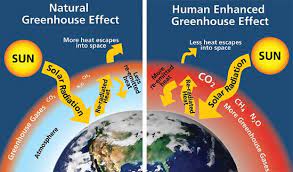
- Any gas that absorbs and emits infrared radiation in the atmosphere, contributing to the greenhouse effect.
- Main GHGs include:
- CO₂
- Methane (CH₄)
- Nitrous oxide (N₂O)
- Fluorinated gases such as HFCs, PFCs, SF₆ and NF₃
- Water vapor is a GHG but is not directly controlled by human emissions at scale. It is primarily a feedback in the climate system rather than a direct target of conventional anthropogenic GHG inventories.
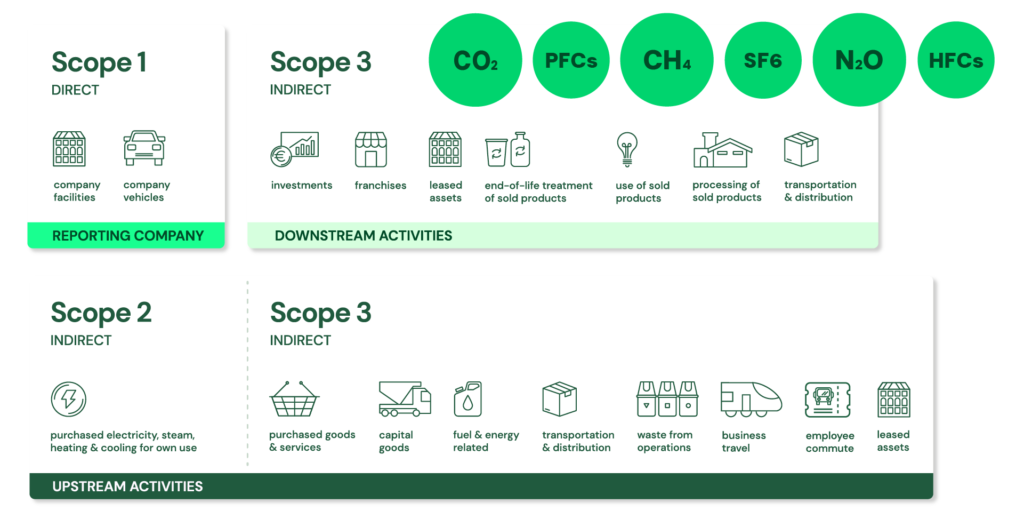
- GHG Protocol Corporate Standard Scope 1, 2 and 3: https://ghgprotocol.org/ + The GHG Protocol Corporate Accounting and Reporting Standard provides requirements and guidance for companies and other organizations preparing a corporate-level GHG emissions inventory. The Corporate Standard itself is voluntary, although companies may be required by applicable legislation or regulation to report using the GHG Protocol or equivalent requirements.
- Scope 1: Direct emissions:
- Direct emissions from company-owned and controlled resources. In other words, emissions are released into the atmosphere as a direct result of a set of activities, at a firm level. More precisely, Scope 1 covers direct GHG emissions from sources that are owned or controlled by the reporting organization.
- It is divided into four categories:
- Stationary combustion (e.g from fuels, heating sources). All fuels that produce GHG emissions must be included in scope 1. This applies when the combustion source is owned or controlled by the reporting organization.
- Mobile combustion is all vehicles owned or controlled by a firm, burning fuel (e.g. cars, vans, trucks). The increasing use of “electric” vehicles (EVs), means that some of the organisation’s fleets could fall into Scope 2 emissions. For example, fuel combustion in an owned/controlled vehicle is Scope 1, whereas electricity purchased to charge an EV is generally Scope 2; an EV itself does not create Scope 2 emissions—the purchased electricity does.
- Fugitive emissions are leaks from greenhouse gases (e.g. refrigeration, air conditioning units). It is important to note that refrigerant gases are not uniformly “a thousand times more dangerous” than CO₂; some refrigerants have GWPs of hundreds or thousands of times that of CO₂, while others have much lower values. Companies are encouraged to report these emissions.
- Process emissions are released during industrial processes, and on-site manufacturing (e.g. production of CO2 during cement manufacturing, factory fumes, chemicals). These are direct emissions resulting from physical or chemical processes other than fuel combustion, such as calcination in cement production..
- Scope 2: Indirect emissions – owned:
- Indirect emissions from the generation of purchased energy, from a utility provider. In other words, all GHG emissions released in the atmosphere, from the consumption of purchased electricity, steam, heat and cooling. Scope 2 covers indirect GHG emissions associated with the generation of purchased or acquired electricity, steam, heat, and cooling consumed by the reporting organization; “owned” is therefore misleading because the emissions source is owned or controlled by another entity.
- For most organisations, electricity will be the unique source of scope 2 emissions. Simply stated, the energy consumed falls into two scopes: Scope 2 covers the electricity consumed by the end-user. Scope 3 covers the energy used by the utilities during transmission and distribution (T&D) losses. More precisely, Scope 2 covers the generation-related emissions associated with purchased electricity, not the physical electricity itself. T&D losses are generally accounted for in Scope 3 Category 3 for an energy consumer that does not own the T&D system, although the treatment can vary depending on ownership and accounting circumstances.
- Scope 3: Indirect emissions – not owned:
- Indirect emissions – not included in scope 2 – that occur in the value chain of the reporting company, including both upstream and downstream emissions. In other words, emissions are linked to the company’s operations. According to the GHG protocol, scope 3 emissions are separated into 15 categories. Scope 3 therefore captures other indirect value-chain emissions, upstream and downstream, across the 15 defined categories of the Scope 3 Standard.
- Scope 1: Direct emissions: