Siemens – Siemens generates strong momentum toward 2030 sustainability commitments

- Customer Avoided Emissions rise to 694 million metric tons
- Robust Eco Design approach covers over two-thirds of relevant Siemens portfolio
- Siemens’ external learning offerings already empowering more than one million people globally
- More than half of Siemens’ eligible revenue meets EU taxonomy standards
- Updated DEGREE sustainability targets translate ambition into measurable results and point the way toward 2030
Siemens is accelerating toward its 2030 sustainability targets, delivering strong, measurable progress across all 14 DEGREE targets in fiscal 2025 – underscoring its unwavering commitment to sustainability. In fiscal 2025, for the second consecutive year, Siemens has enabled its customers to avoid more emissions over the lifetime of the offerings it sold than the company generated along its entire value chain. With its ecodesign approach (Robust Eco Design), Siemens is reinforcing its role as a technology partner for a more sustainable future. The company is also embracing its responsibility to society by training over one million people in its ecosystem, while continuing to drive an increase in annual learning hours within the company itself.
“When sustainability and business strategies converge and are executed with speed and scale, organizations are best positioned for growth and resilience”, emphasized Judith Wiese, Chief People and Sustainability Officer and member of the Managing Board of Siemens AG. “At Siemens, we empower our customers to do exactly that – accelerate their digital and sustainability transformations by combining the real and digital worlds. Yet technology only reaches its full potential when it’s accessible to everyone, and that starts with empowering people to master the skills of tomorrow. That’s why we are committed to driving continuous learning and aim to empower three million people globally by 2030 through our learning offerings, with a focus on sustainability and digitalization.”
Sustainability impact across three impact areas
DEGREE, with its 14 flagship targets for 2030, is Siemens’ approach for measuring its impact. It is also guiding its sustainability-related performance in order to ensure meaningful progress. In the face of rapid global changes such as the energy transition, Siemens is taking a steady, evidence-based approach – grounded in a long-term commitment and real-world experience.
DEGREE is structured in terms of the three impact areas of decarbonization & energy efficiency, resource efficiency & circularity, people centricity & society – all of which are built on a foundation of ethical principles and good corporate governance.
“With more than 90 percent of our business enabling customers to achieve a positive sustainability impact in our three key impact areas, we’re uniquely positioned to empower them to become more competitive, resilient and sustainable,” said Eva Riesenhuber, Global Head of Sustainability at Siemens. “Even further, our Sustainability Statement 2025 provides measurable proof that our impact on societal infrastructure goes beyond our customers and our own business transformation to reach, ultimately, our planet and society.”
Decarbonization and energy efficiency – Driving the shift to a low-carbon economy
Siemens is accelerating the decarbonization of products, operations and supply chains via dedicated software and hardware to enable renewables integration, energy efficiency and electrification. Harnessing AI, data and domain know-how are key to delivering faster insights and greater efficiency to combine the real and the digital worlds. Industrial AI, for example, enables up to 30 percent energy savings in infrastructure platforms and a 24 percent CO₂ reduction in manufacturing.
Siemens’ innovative offerings sold over the past three fiscal years are projected to avoid 694 million metric tons of emissions over their lifetime. This is equivalent to Germany’s overall emissions in 2024. For the second consecutive year, Siemens has enabled its customers to avoid more emissions than it generated across its entire value chain. Since 2019, Siemens has also reduced its own operational footprint by cutting CO₂e[1] emissions by 66 percent (without carbon credits), marking another step toward its target of a 90 percent reduction in Scope 1 and 2 emissions by 2030. [1] carbon dioxide equivalent, a common unit for comparing the warming impact of different greenhouse gases to an equivalent amount of CO₂.
Resource efficiency and circularity – Doing more with less for the benefit of customers, the planet and society
For a circular economy, decoupling growth from resource consumption is of paramount importance, and Siemens’ Robust Eco Design (RED) approach is central to that effort. In fiscal 2025, 67 percent of the relevant Siemens’ portfolio was already covered by RED, guiding design decisions that reduce environmental impacts across hardware, software and services.
To protect biodiversity, Siemens has increased the implementation rate of its conservation program at all relevant locations from 18 percent in fiscal 2024 to 55 percent in fiscal 2025. Siemens is also pursuing a zero waste to landfill approach and has surpassed its 2025 interim DEGREE target of a 50 percent reduction compared to the fiscal 2021 baseline.
People centricity and society – Life-long learning to remain resilient and relevant in fast changing environments
In a rapidly changing world, people have to be empowered to develop the skills they need to grow and innovate. Siemens continues to empower its people to build skills for life, support diverse teams, foster equitable opportunities and an inclusive workplace, and support work well-being to ensure that people and businesses remain resilient and relevant in ever-evolving environments. With a record of 36.6 total annual learning hours per person, Siemens’ people boosted their yearly average by 2.4 hours compared to fiscal 2024, with a strong focus on AI & machine learning.
A high Work Well-being Score in fiscal 2025 indicated a significant level of job satisfaction, a strong sense of purpose, balanced stress levels and overall happiness, thus empowering Siemens’ people to thrive and exceed customer expectations. Beyond its own organization, Siemens empowered more than one million people through learning opportunities in the fields of sustainability and digitalization – a remarkable step toward its target of reaching three million people by 2030.
Ethics and governance – Building trust in a digital world
Siemens’ performance across its three impact areas is built on a foundation of ethical principles and good corporate governance – the upholding of robust ethical standards, transparent governance practices and regulatory compliance in order to ensure responsible and sustainable growth.
Cybersecurity and data protection are essential for a secure digital transformation. Siemens Zero Trust principles play a key role in safeguarding Siemens’ applications and systems with a coverage of 62 percent across all relevant applications and a substantial increase from 16 percent in fiscal 2024.
Siemens’ role in leading the world’s sustainable transformation is also demonstrated by its strong EU taxonomy revenue alignment rate, with more than half of its eligible revenue meeting high standards for climate change mitigation and circularity.
This year marks an important milestone: it is the first time that Siemens’ Sustainability Statement is in full accordance with the Corporate Sustainability Reporting Directive (CSRD) and published as an audited part of the Siemens Annual Reports. The Statement brings together strategy, governance, operational execution and performance management to offer a clear and comparable insight into how sustainability is embedded across the organization – and into how Siemens is turning strategic priorities into measurable actions.
SourceSiemens
EMR Analysis
More information on Siemens AG: See full profile on EMR Executive Services
More information on Dr. Roland Busch (President and Chief Executive Officer, Siemens AG): See full profile on EMR Executive Services
More information on Judith Wiese (Chief People and Sustainability Officer, Member of the Managing Board and Labor Director, Siemens AG): See the full profile on EMR Executive Services
More information on the Sustainability Strategy, Performance, Sustainability Report 2024, Statements 2025 and Siemens Impact 2025 by Siemens AG: See full profile on EMR Executive Services
More information on Dr. Eva Riesenhuber (Global Head of Sustainability, Siemens AG): See full profile on EMR Executive Services
More information on Robust Eco Design (RED) and EcoTech Label by Siemens: https://www.siemens.com/global/en/company/sustainability/siemens-ecotech.html + Siemens’ Robust Eco Design (RED) is a systematic, lifecycle-based methodology for integrating sustainability into product development, focusing on reducing environmental impact from raw materials to end-of-life (reuse/recycle). It involves detailed environmental assessments (LCAs), transparency via Environmental Product Declarations (EPDs), and aims for dematerialization and resource efficiency, supporting Siemens’ broader EcoTech framework and commitment to climate neutrality and circularity.
To help make your buying decision easier, Siemens introduces the new label: Siemens EcoTech. It is an environmental declaration for our products based on product-specific evaluations of sustainability relevant KPIs.
Siemens EcoTech is an environmental product performance label designed to drive the sustainable transformation of industry and infrastructure. The label gives you transparency ovn the performance of our certified products across environmental relevant criteria, enabling you to make informed choices to support your sustainability goals.
The foundation for our Siemens EcoTech assessment is the Robust Eco Design approach. The framework provides a comprehensive set of criteria across three dimensions covering the entire product lifecycle. Products must meet mandatory requirements and fulfill at least one criterion in each dimension. They must also provide a transparent validation statement in the external accessible Siemens EcoTech Profile. This ensures maximum transparency for you regarding the materials, design, use phase, and end of lifecycle of our products.
More information on the Siemens DEGREE Framework for Sustainability: https://new.siemens.com/global/en/company/sustainability/sustainability-figures.html#DEGREE + Siemens commitment to sustainability framework: Decarbonization, Ethics, Governance, Resource efficiency, Equity and Employability. This new framework will apply to all activities across the company’s businesses worldwide. It constitutes a 360-degree approach for all stakeholders – our customers, our suppliers, our investors, our people, the societies we serve, and our planet.
More information on the EU Taxonomy Regulation: https://eu-taxonomy.info/info/eu-taxonomy-overview + The EU taxonomy regulation describes a framework to classify “green” or “sustainable” economic activities executed in the EU. Previously, there was no clear definition of green, sustainable or environmentally friendly economic activity. The EU taxonomy regulation creates a clear framework for the concept of sustainability, exactly defining when a company or enterprise is operating sustainably or environmentally friendly. Compared to their competitors, these companies stand out positively and thus should benefit from higher investments. Thereby, the legislation aims to reward and promote environmentally friendly business practices and technologies. The focus lays on the following six environmental objectives:
- Climate change mitigation
- Climate change adaptation
- Sustainable use and protection of water and marine resources
- Transition to a circular economy
- Pollution prevention and control
- Protection and restoration of biodiversity and ecosystems
By passing the Green Deal in 2019, the European Union (EU) set the course for more sustainable investments, for example in areas like renewable energy, biodiversity or circular economy. The goal is to reach a climate-neutral economy in the EU by 2050, with a reduction of 55% already implemented in 2030. To achieve these climate goals, the Green Deal includes an investment plan of 1 trillion euros over the next 10 years. Despite this huge investment, the EU depends also on the support of the private sector to achieve the Paris climate agreement.
The EU Taxonomy regulation and the Sustainable Finance Disclosure Regulation (SFDR) are implemented to ensure equal competition and legal certainty for all companies operating within the EU. Both regulations follow the objective of the Green Deal and have the following key goals:
- Reorientation of capital flows with a focus on sustainable investments
- Establishing sustainability as a component of risk management
- Promoting/encouraging long-term investment and economic activity
More information on The European Union: https://european-union.europa.eu/index_en + The European Union’s institutional set-up is unique and its decision-making system is constantly evolving. The 7 European institutions, 7 EU bodies and over 30 decentralized agencies are spread across the EU. They work together to address the common interests of the EU and European people.
In terms of administration, there are a further 20 EU agencies and organisations which carry out specific legal functions and 4 interinstitutional services which support the institutions.
All of these establishments have specific roles – from developing EU laws and policy-making to implementing policies and working on specialist areas, such as health, medicine, transport and the environment.
There are 4 main decision-making institutions which lead the EU’s administration. These institutions collectively provide the EU with policy direction and play different roles in the law-making process:
- The European Parliament (Brussels/Strasbourg/Luxembourg)
- The European Council (Brussels)
- The Council of the European Union (Brussels/Luxembourg)
- The European Commission (Brussels/Luxembourg/Representations across the EU)
Their work is complemented by other institutions and bodies, which include:
- The Court of Justice of the European Union (Luxembourg)
- The European Central Bank (Frankfurt)
- The European Court of Auditors (Luxembourg)
The EU institutions and bodies cooperate extensively with the network of EU agencies and organisations across the European Union. The primary function of these bodies and agencies is to translate policies into realities on the ground.
Around 60,000 EU civil servants and other staff serve the 450 million Europeans (and countless others around the world).
Currently, 27 countries are part of the EU: https://european-union.europa.eu/principles-countries-history/country-profiles_en
More information on The European Commission by The European Union: https://ec.europa.eu/info/index_en + The Commission helps to shape the EU’s overall strategy, proposes new EU laws and policies, monitors their implementation and manages the EU budget. It also plays a significant role in supporting international development and delivering aid.
The Commission is steered by a group of 27 Commissioners, known as ‘the college’. Together they take decisions on the Commission’s political and strategic direction.
A new college of Commissioners is appointed every 5 years.
The Commission is organised into policy departments, known as Directorates-General (DGs), which are responsible for different policy areas. DGs develop, implement and manage EU policy, law, and funding programmes. In addition, service departments deal with particular administrative issues. Executive agencies manage programmes set up by the Commission.
Principal roles in law: The Commission proposes and implements laws which are in keeping with the objectives of the EU treaties. It encourages input from business and citizens in the law-making process and ensures laws are correctly implemented, evaluated and updated when needed.
More information on Ursula von der Leyen (President, The European Commission, The European Union): https://ec.europa.eu/commission/commissioners/2019-2024/president_en + https://www.linkedin.com/in/ursula-von-der-leyen/
More information on the European Corporate Sustainability Reporting Directive (CSRD) by The European Commission by The European Union: https://finance.ec.europa.eu/capital-markets-union-and-financial-markets/company-reporting-and-auditing/company-reporting/corporate-sustainability-reporting_en + EU law requires all large companies and all listed companies (except listed micro-enterprises) to disclose information on what they see as the risks and opportunities arising from social and environmental issues, and on the impact of their activities on people and the environment.
This helps investors, civil society organisations, consumers and other stakeholders to evaluate the sustainability performance of companies, as part of the European green deal.
On 5 January 2023, the Corporate Sustainability Reporting Directive (CSRD) entered into force. This new directive modernises and strengthens the rules concerning the social and environmental information that companies have to report. A broader set of large companies, as well as listed SMEs, will now be required to report on sustainability.
The new rules will ensure that investors and other stakeholders have access to the information they need to assess the impact of companies on people and the environment and for investors to assess financial risks and opportunities arising from climate change and other sustainability issues. Finally, reporting costs will be reduced for companies over the medium to long term by harmonising the information to be provided.
The first companies will have to apply the new rules for the first time in the 2024 financial year, for reports published in 2025.
EMR Additional Notes:
- Carbon Dioxide (CO2):
- The primary greenhouse gas emitted through human activities. Carbon dioxide enters the atmosphere through burning fossil fuels (coal, natural gas, and oil), solid waste, trees and other biological materials, and also as a result of certain chemical reactions (e.g., manufacture of cement). Carbon dioxide is removed from the atmosphere (or “sequestered”) when it is absorbed by plants as part of the biological carbon cycle.
- Biogenic Carbon Dioxide (CO2):
- Biogenic Carbon Dioxide (CO2) and Carbon Dioxide (CO2) are the same molecule. Scientists differentiate between biogenic carbon (that which is absorbed, stored and emitted by organic matter like soil, trees, plants and grasses) and non-biogenic carbon (that found in all other sources, most notably in fossil fuels like oil, coal and gas).
- CO2e (Carbon Dioxide Equivalent):
- CO2e means “carbon dioxide equivalent”. In layman’s terms, CO2e is a measurement of the total greenhouse gases emitted, expressed in terms of the equivalent measurement of carbon dioxide. On the other hand, CO2 only measures carbon emissions and does not account for any other greenhouse gases.
- A carbon dioxide equivalent or CO2 equivalent, abbreviated as CO2-eq is a metric measure used to compare the emissions from various greenhouse gases on the basis of their global-warming potential (GWP), by converting amounts of other gases to the equivalent amount of carbon dioxide with the same global warming potential.
- Carbon dioxide equivalents are commonly expressed as million metric tonnes of carbon dioxide equivalents, abbreviated as MMTCDE.
- The carbon dioxide equivalent for a gas is derived by multiplying the tonnes of the gas by the associated GWP: MMTCDE = (million metric tonnes of a gas) * (GWP of the gas).
- For example, the GWP for methane is 25 and for nitrous oxide 298. This means that emissions of 1 million metric tonnes of methane and nitrous oxide respectively is equivalent to emissions of 25 and 298 million metric tonnes of carbon dioxide.
- Carbon Footprint:
- There is no universally agreed definition of what a carbon footprint is.
- A carbon footprint is generally understood to be the total amount of greenhouse gas (GHG) emissions that are directly or indirectly caused by an individual, organization, product, or service. These emissions are typically measured in tonnes of carbon dioxide equivalent (CO2e).
- In 2009, the Greenhouse Gas Protocol (GHG Protocol) published a standard for calculating and reporting corporate carbon footprints. This standard is widely accepted by businesses and other organizations around the world. The GHG Protocol defines a carbon footprint as “the total set of greenhouse gas emissions caused by an organization, directly and indirectly, through its own operations and the value chain.”
- Decarbonization:
- Reduction of carbon dioxide emissions through the use of low carbon power sources, and achieving a lower output of greenhouse gases into the atmosphere.
- Carbon Credits or Carbon Offsets:
- Permits that allow the owner to emit a certain amount of carbon dioxide or other greenhouse gases. One credit permits the emission of one ton of carbon dioxide or the equivalent in other greenhouse gases.
- The carbon credit is half of a so-called cap-and-trade program. Companies that pollute are awarded credits that allow them to continue to pollute up to a certain limit, which is reduced periodically. Meanwhile, the company may sell any unneeded credits to another company that needs them. Private companies are thus doubly incentivized to reduce greenhouse emissions. First, they must spend money on extra credits if their emissions exceed the cap. Second, they can make money by reducing their emissions and selling their excess allowances.
- Carbon Capture and Storage (CCS) – Carbon Capture, Utilisation and Storage (CCUS):
- CCS involves the capture of carbon dioxide (CO2) emissions from industrial processes. This carbon is then transported from where it was produced, via ship or in a pipeline, and stored deep underground in geological formations.
- CCS projects typically target 90 percent efficiency, meaning that 90 percent of the carbon dioxide from the power plant will be captured and stored.
- CCUS adds the utilization aspect, where the captured CO2 is used as a new product or raw material.
- Carbon Dioxide Removal (CDR) or Durable Carbon Removal:
- Carbon Dioxide Removal encompasses approaches and methods for removing CO2 from the atmosphere and then storing it permanently in underground geological formations, in biomass, oceanic reservoirs or long-lived products in order to achieve negative emissions.
- Direct Air Capture (DAC):
- Technologies that extract CO2 directly from the atmosphere at any location, unlike carbon capture which is generally carried out at the point of emissions, such as a steel plant.
- Constraints like costs and energy requirements as well as the potential for pollution make DAC a less desirable option for CO2 reduction. Its larger land footprint when compared to other mitigation strategies like carbon capture and storage systems (CCS) also put it at a disadvantage.
- Direct Air Capture and Storage (DACCS):
- Climate technology that removes carbon dioxide (CO2) directly from the ambient atmosphere using large fans and chemical processes to bind with the CO2.
- Bioenergy with Carbon Capture and Storage (BECCS):
- Negative emissions technology that captures carbon dioxide (CO2) from biomass used for energy production and stores it permanently. Plants absorb CO2 from the atmosphere as they grow (photosynthesis), and BECCS interrupts the cycle by capturing this biogenic CO2 during the energy conversion process—burning, fermentation, etc.—instead of letting it re-enter the atmosphere.
- Enhanced Rock Weathering (ERW):
- Carbon dioxide removal (CDR) technique that accelerates the natural process of rock weathering by grinding silicate rocks into dust and spreading it on land, typically agricultural fields. This process uses rainwater to convert atmospheric carbon dioxide into mineral carbonates, which are then stored long-term in soils, groundwater, and oceans.
- Limits of Carbon Dioxide Storage:
- Carbon storage is not endless; the Earth’s capacity for permanently storing vast amounts of captured carbon, particularly in geological formations, is limited, potentially reaching a critical limit of 1,460 gigatonnes at around 2200, though storage durations vary significantly depending on the method, from decades for some biological methods to potentially millions of years for others like mineralization. While some methods offer very long-term storage, the sheer volume needed to meet climate targets requires scaling up storage significantly beyond current capacity, raising concerns about the available volume over time.
- Global Warming:
- Global warming is the long-term heating of Earth’s climate system observed since the pre-industrial period (between 1850 and 1900) due to human activities, primarily fossil fuel burning, which increases heat-trapping greenhouse gas levels in Earth’s atmosphere.
- Global Warming Potential (GWP):
- The heat absorbed by any greenhouse gas in the atmosphere, as a multiple of the heat that would be absorbed by the same mass of carbon dioxide (CO2). GWP is 1 for CO2. For other gases it depends on the gas and the time frame.
- Carbon dioxide equivalent (CO2e or CO2eq or CO2-e) is calculated from GWP. For any gas, it is the mass of CO2 which would warm the earth as much as the mass of that gas. Thus it provides a common scale for measuring the climate effects of different gases. It is calculated as GWP times mass of the other gas. For example, if a gas has GWP of 100, two tonnes of the gas have CO2e of 200 tonnes.
- GWP was developed to allow comparisons of the global warming impacts of different gases.
- Greenhouse Gas (GHG):
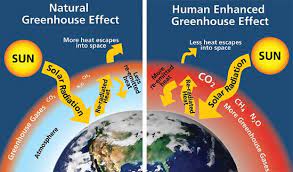
- A greenhouse gas is any gaseous compound in the atmosphere that is capable of absorbing infrared radiation, thereby trapping and holding heat in the atmosphere. By increasing the heat in the atmosphere, greenhouse gases are responsible for the greenhouse effect, which ultimately leads to global warming.
- The main gases responsible for the greenhouse effect include carbon dioxide, methane, nitrous oxide, and water vapor (which all occur naturally), and fluorinated gases (which are synthetic).
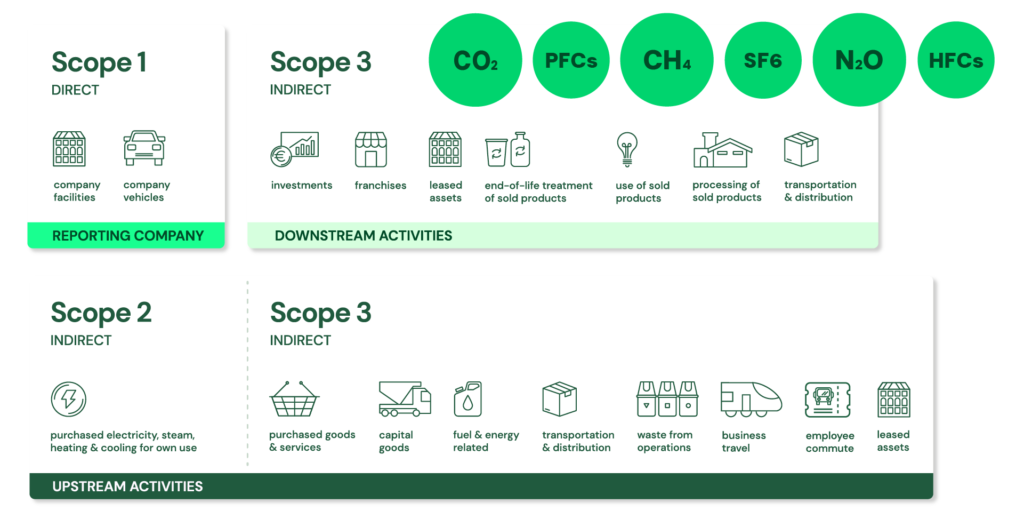
- GHG Protocol Corporate Standard Scope 1, 2 and 3: https://ghgprotocol.org/ + The GHG Protocol Corporate Accounting and Reporting Standard provides requirements and guidance for companies and other organizations preparing a corporate-level GHG emissions inventory. Scope 1 and 2 are typically mandatory for companies that are required to report their emissions by national or regional regulations. The GHG Protocol itself is a voluntary standard.
- Scope 1: Direct emissions:
- Direct emissions from company-owned and controlled resources. In other words, emissions are released into the atmosphere as a direct result of a set of activities, at a firm level. It is divided into four categories:
- Stationary combustion (e.g from fuels, heating sources). All fuels that produce GHG emissions must be included in scope 1.
- Mobile combustion is all vehicles owned or controlled by a firm, burning fuel (e.g. cars, vans, trucks). The increasing use of “electric” vehicles (EVs), means that some of the organisation’s fleets could fall into Scope 2 emissions.
- Fugitive emissions are leaks from greenhouse gases (e.g. refrigeration, air conditioning units). It is important to note that refrigerant gases are a thousand times more dangerous than CO2 emissions. Companies are encouraged to report these emissions.
- Process emissions are released during industrial processes, and on-site manufacturing (e.g. production of CO2 during cement manufacturing, factory fumes, chemicals).
- Direct emissions from company-owned and controlled resources. In other words, emissions are released into the atmosphere as a direct result of a set of activities, at a firm level. It is divided into four categories:
- Scope 2: Indirect emissions – owned:
- Indirect emissions from the generation of purchased energy, from a utility provider. In other words, all GHG emissions released in the atmosphere, from the consumption of purchased electricity, steam, heat and cooling. For most organisations, electricity will be the unique source of scope 2 emissions. Simply stated, the energy consumed falls into two scopes: Scope 2 covers the electricity consumed by the end-user. Scope 3 covers the energy used by the utilities during transmission and distribution (T&D losses).
- Scope 3: Indirect emissions – not owned:
- Indirect emissions – not included in scope 2 – that occur in the value chain of the reporting company, including both upstream and downstream emissions. In other words, emissions are linked to the company’s operations. According to the GHG protocol, scope 3 emissions are separated into 15 categories.
- Scope 1: Direct emissions:
- Circular Economy:
- A circular economy is a systemic approach to economic development designed to benefit businesses, society, and the environment. In contrast to the ‘take-make-waste’ linear model, a circular economy is regenerative by design and aims to gradually decouple growth from the consumption of finite resources.
- In such an economy, all forms of waste, such as clothes, scrap metal and obsolete electronics, are returned to the economy or used more efficiently.
- The aim of a circular economy is hence to create a closed-loop system where waste and pollution are minimized and resources are conserved, reducing the environmental impact of production and consumption.
- Sustainability Vs. Circular Economy:
- Circularity focuses on resource cycles, while sustainability is more broadly related to people, the planet and the economy. Circularity and sustainability stand in a long tradition of related visions, models and theories.
- A sustainable circular economy involves designing and promoting products that last and that can be reused, repaired and remanufactured. This retains the functional value of products, rather than just recovering the energy or materials they contain and continuously making products anew.
- Supply Chain:
- Network of all the individuals, organizations, resources, activities and technology involved in the creation and sale of a product. A supply chain encompasses everything from the delivery of source materials from the supplier to the manufacturer through to its eventual delivery to the end user.
- At the most fundamental level, Supply Chain Management (SCM) is management of the flow of goods, data, and finances related to a product or service, from the procurement of raw materials to the delivery of the product at its final destination.
- Hardware vs. Software vs. Firmware:
- Hardware is physical: It’s “real,” sometimes breaks, and eventually wears out.
- Since hardware is part of the “real” world, it all eventually wears out. Being a physical thing, it’s also possible to break it, drown it, overheat it, and otherwise expose it to the elements.
- Here are some examples of hardware:
- Smartphone
- Tablet
- Laptop
- Desktop computer
- Printer
- Flash drive
- Router
- Software is virtual: It can be copied, changed, and destroyed.
- Software is everything about your computer that isn’t hardware.
- Here are some examples of software:
- Operating systems like Windows 11 or iOS
- Web browsers
- Antivirus tools
- Adobe Photoshop
- Mobile apps
- Firmware is virtual: It’s software specifically designed for a piece of hardware
- While not as common a term as hardware or software, firmware is everywhere—on your smartphone, your PC’s motherboard, your camera, your headphones, and even your TV remote control.
- Firmware is just a special kind of software that serves a very narrow purpose for a piece of hardware. While you might install and uninstall software on your computer or smartphone on a regular basis, you might only rarely, if ever, update the firmware on a device, and you’d probably only do so if asked by the manufacturer, probably to fix a problem.
- Hardware is physical: It’s “real,” sometimes breaks, and eventually wears out.
- AI – Artificial Intelligence:
- Artificial intelligence is the simulation of human intelligence processes by machines, especially computer systems.
- As the hype around AI has accelerated, vendors have been scrambling to promote how their products and services use AI. Often what they refer to as AI is simply one component of AI, such as machine learning. AI requires a foundation of specialized hardware and software for writing and training machine learning algorithms. No one programming language is synonymous with AI, but several, including Python, R and Java, are popular.
- In general, AI systems work by ingesting large amounts of labeled training data, analyzing the data for correlations and patterns, and using these patterns to make predictions about future states. In this way, a chatbot that is fed examples of text chats can learn to produce lifelike exchanges with people, or an image recognition tool can learn to identify and describe objects in images by reviewing millions of examples.
- AI programming focuses on three cognitive skills: learning, reasoning and self-correction.
- The 4 types of artificial intelligence?
- Type 1: Reactive machines. These AI systems have no memory and are task specific. An example is Deep Blue, the IBM chess program that beat Garry Kasparov in the 1990s. Deep Blue can identify pieces on the chessboard and make predictions, but because it has no memory, it cannot use past experiences to inform future ones.
- Type 2: Limited memory. These AI systems have memory, so they can use past experiences to inform future decisions. Some of the decision-making functions in self-driving cars are designed this way.
- Type 3: Theory of mind. Theory of mind is a psychology term. When applied to AI, it means that the system would have the social intelligence to understand emotions. This type of AI will be able to infer human intentions and predict behavior, a necessary skill for AI systems to become integral members of human teams.
- Type 4: Self-awareness. In this category, AI systems have a sense of self, which gives them consciousness. Machines with self-awareness understand their own current state. This type of AI does not yet exist.
- Machine Learning (ML):
- Developed to mimic human intelligence, it lets the machines learn independently by ingesting vast amounts of data, statistics formulas and detecting patterns.
- ML allows software applications to become more accurate at predicting outcomes without being explicitly programmed to do so.
- ML algorithms use historical data as input to predict new output values.
- Recommendation engines are a common use case for ML. Other uses include fraud detection, spam filtering, business process automation (BPA) and predictive maintenance.
- Classical ML is often categorized by how an algorithm learns to become more accurate in its predictions. There are four basic approaches: supervised learning, unsupervised learning, semi-supervised learning and reinforcement learning.
- Deep Learning (DL):
- Subset of machine learning, Deep Learning enabled much smarter results than were originally possible with ML. Face recognition is a good example.
- DL makes use of layers of information processing, each gradually learning more and more complex representations of data. The early layers may learn about colors, the next ones about shapes, the following about combinations of those shapes, and finally actual objects. DL demonstrated a breakthrough in object recognition.
- DL is currently the most sophisticated AI architecture we have developed.
- Generative AI (GenAI):
- Generative AI technology generates outputs based on some kind of input – often a prompt supplied by a person. Some GenAI tools work in one medium, such as turning text inputs into text outputs, for example. With the public release of ChatGPT in late November 2022, the world at large was introduced to an AI app capable of creating text that sounded more authentic and less artificial than any previous generation of computer-crafted text.
- Small Language Models (SLM) and Large Language Models (LLM):
- Small Language Models (SLMs) are artificial intelligence (AI) models capable of processing, understanding and generating natural language content. As their name implies, SLMs are smaller in scale and scope than large language models (LLMs).
- LLM means Large Language Models — a type of machine learning/deep learning model that can perform a variety of natural language processing (NLP) and analysis tasks, including translating, classifying, and generating text; answering questions in a conversational manner; and identifying data patterns.
- For example, virtual assistants like Siri, Alexa, or Google Assistant use LLMs to process natural language queries and provide useful information or execute tasks such as setting reminders or controlling smart home devices.
- Computer Vision (CV) / Vision AI & Machine Vision (MV):
- Field of AI that enables computers to interpret and act on visual data (images, videos). It works by using deep learning models trained on large datasets to recognize patterns, objects, and context.
- The most well-known case of this today is Google’s Translate, which can take an image of anything — from menus to signboards — and convert it into text that the program then translates into the user’s native language.
- Machine Vision (MV) :
- Specific application for industrial settings, relying on cameras to analyze tasks in manufacturing, quality control, and worker safety. The key difference is that CV is a broader field for extracting information from various visual inputs, while MV is more focused on specific industrial tasks.
- Machine Vision is the ability of a computer to see; it employs one or more video cameras, analog-to-digital conversion and digital signal processing. The resulting data goes to a computer or robot controller. Machine Vision is similar in complexity to Voice Recognition.
- MV uses the latest AI technologies to give industrial equipment the ability to see and analyze tasks in smart manufacturing, quality control, and worker safety.
- Multimodal Intelligence and Agents:
- Subset of artificial intelligence that integrates information from various modalities, such as text, images, audio, and video, to build more accurate and comprehensive AI models.
- Multimodal capabilities allows AI to interact with users in a more natural and intuitive way. It can see, hear and speak, which means that users can provide input and receive responses in a variety of ways.
- An AI agent is a computational entity designed to act independently. It performs specific tasks autonomously by making decisions based on its environment, inputs, and a predefined goal. What separates an AI agent from an AI model is the ability to act. There are many different kinds of agents such as reactive agents and proactive agents. Agents can also act in fixed and dynamic environments. Additionally, more sophisticated applications of agents involve utilizing agents to handle data in various formats, known as multimodal agents and deploying multiple agents to tackle complex problems.
- Agentic AI:
- Agentic AI is an artificial intelligence system that can accomplish a specific goal with limited supervision. It consists of AI agents—machine learning models that mimic human decision-making to solve problems in real time. In a multiagent system, each agent performs a specific subtask required to reach the goal and their efforts are coordinated through AI orchestration.
- Unlike traditional AI models, which operate within predefined constraints and require human intervention, agentic AI exhibits autonomy, goal-driven behavior and adaptability. The term “agentic” refers to these models’ agency, or, their capacity to act independently and purposefully.
- Agentic AI builds on generative AI (gen AI) techniques by using large language models (LLMs) to function in dynamic environments. While generative models focus on creating content based on learned patterns, agentic AI extends this capability by applying generative outputs toward specific goals.
- Edge AI Technology:
- Edge artificial intelligence refers to the deployment of AI algorithms and AI models directly on local edge devices such as sensors or Internet of Things (IoT) devices, which enables real-time data processing and analysis without constant reliance on cloud infrastructure.
- Simply stated, edge AI, or “AI on the edge“, refers to the combination of edge computing and artificial intelligence to execute machine learning tasks directly on interconnected edge devices. Edge computing allows for data to be stored close to the device location, and AI algorithms enable the data to be processed right on the network edge, with or without an internet connection. This facilitates the processing of data within milliseconds, providing real-time feedback.
- Self-driving cars, wearable devices, security cameras, and smart home appliances are among the technologies that leverage edge AI capabilities to promptly deliver users with real-time information when it is most essential.
- High-Density AI:
- High-density AI refers to the concentration of AI computing power and storage within a compact physical space, often found in specialized data centers. This approach allows for increased computational capacity, faster training times, and the ability to handle complex simulations that would be impossible with traditional infrastructure.
- Explainable AI (XAI) and Human-Centered Explainable AI (HCXAI):
- Explainable AI (XAI) refers to methods for making AI model decisions understandable to humans, focusing on how the AI works, whereas Human-Centered Explainable AI (HCXAI) goes further by contextualizing those explanations to a user’s specific task and understanding needs. While XAI aims for technical transparency of the model, HCXAI emphasizes the human context, emphasizing user relevance, and the broader implications of explanations, including fairness, trust, and ethical considerations.
- Physical AI & Embodied AI:
- Physical AI refers to a branch of artificial intelligence that enables machines to perceive, understand, and interact with the physical world by directly processing data from a variety of sensors and actuators.
- Physical AI provides the overarching framework for creating autonomous systems that act intelligently in real-world settings. Embodied AI, as a subset, focuses on the sensory, decision-making, and interaction capabilities that enable these systems to function effectively in dynamic and unpredictable environments.
- Federated Learning and Reinforcement Learning:
- Federated Learning is a machine-learning technique where data stays where it is, and only the learned model updates are shared. “Training AI without sharing your data”.
- Reinforcement Learning is a type of AI where an agent learns by interacting with an environment and receiving rewards or penalties. “Learning by trial and error”
- Federated Learning (FL) and Reinforcement Learning (RL) can be combined into a field called Federated Reinforcement Learning (FRL), where multiple agents learn collaboratively without sharing their raw data. In this approach, each agent trains its own RL policy locally and shares model updates, like parameters or gradients, with a central server. The server aggregates these updates to create a more robust, global model. FRL is used in applications like optimizing resource management in communication networks and enhancing the performance of autonomous systems by learning from diverse, distributed experiences while protecting privacy.
- Cybersecurity:
- Computer security, cybersecurity, or information technology security is the protection of computer systems and networks from information disclosure, theft of or damage to their hardware, software, or electronic data, as well as from the disruption or misdirection of the services they provide.