
Orsted – Revolution Wind begins delivering power to New England
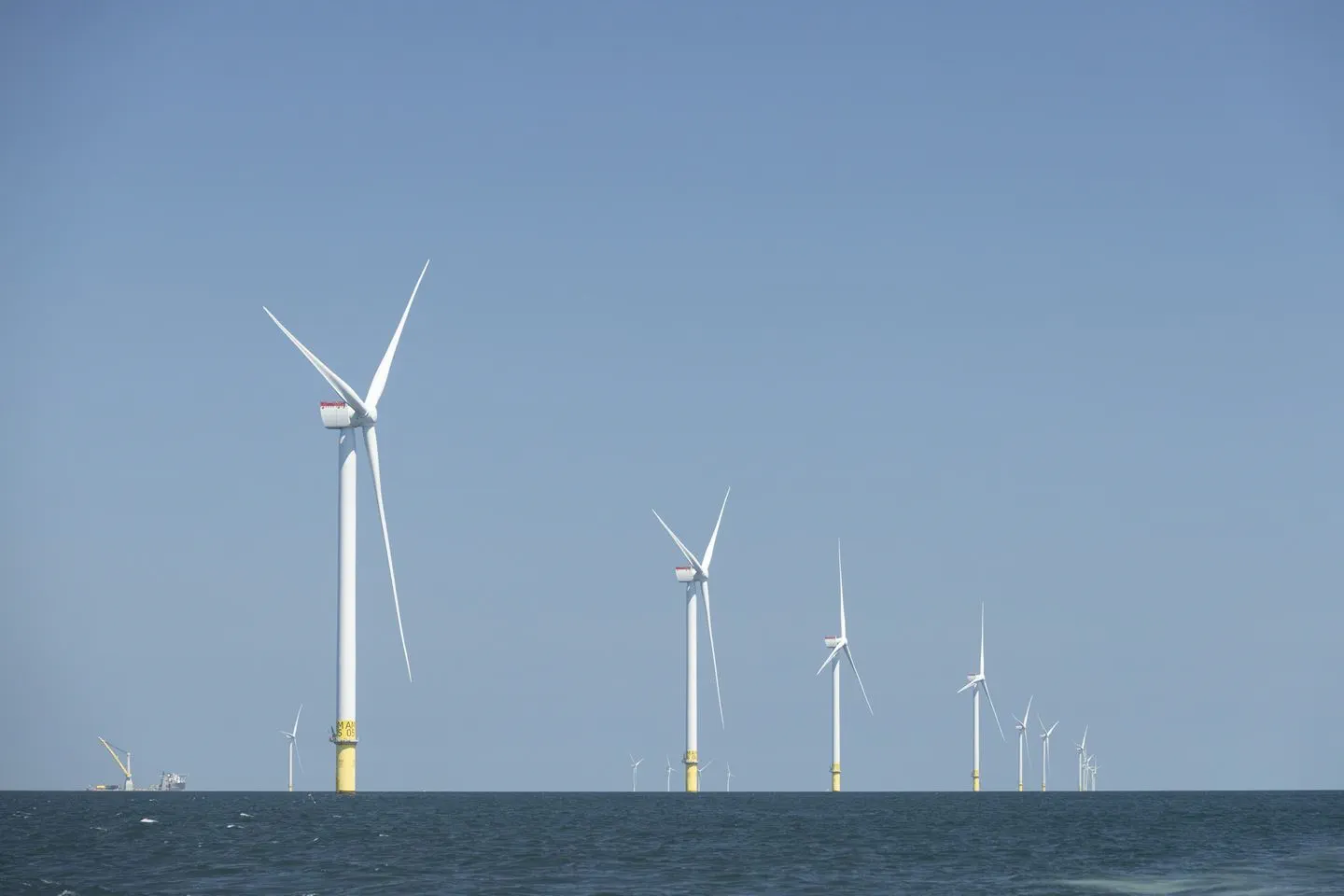
Built by more than 1,000 local union workers, the project is expected to power 350,000+ homes with affordable, reliable electricity.
Revolution Wind, LLC, a 50/50 joint venture between Global Infrastructure Partners’ Skyborn Renewables and Ørsted, announced today that the Revolution Wind project has started delivering power to New England’s electric grid, strengthening the region’s power supply and helping reduce costs for consumers.
Revolution Wind, a 704 MW offshore wind energy project, is expected to supply enough electricity to power more than 350,000 homes and businesses. The project will deliver power under fixed-price, 20-year agreements with energy utilities in Rhode Island and Connecticut, providing price certainty and stability for consumers.
At a time of rising electricity demand, Revolution Wind supports a growing regional economy, including energy-intensive industries such as manufacturing and data centers. Once the project reaches full commercial operations, analysis from the State of Connecticut’s Department of Energy and Environmental Protection finds that Revolution Wind will save New England ratepayers as much as $500 million per year in wholesale energy costs.
Revolution Wind is expected to generate energy year-round, with particularly strong output expected in the winter months, when energy supplies into New England can be constrained and prices can spike. ISO New England, the entity responsible for operating the electric grid, has noted the importance of offshore wind energy projects including Revolution Wind to the region’s grid reliability, particularly in winter.
Revolution Wind has supported more than 2,000 workers across U.S. construction, operations, shipping, and manufacturing, including more than 1,000 local union labor workers logging more than 2 million hours on the project. Across its U.S. offshore projects, Ørsted is investing nearly $700 million into domestic shipbuilding and vessel contracts, catalyzing construction of 14 new, American-made vessels.
“Revolution Wind is adding affordable, reliable American-made energy to New England’s grid, helping to meet growing energy demand and lower consumer costs,” said Amanda Dasch, Chief Development Officer at Ørsted.
She continued: “Built by local, highly skilled union workers, Revolution Wind is a testament to states tapping their energy resources to strengthen regional energy security. We’re grateful to the leadership of Rhode Island and Connecticut, our labor partners, utility customers, and the many other stakeholders whose collaboration has made this milestone possible.”
SourceØrsted
EMR Analysis
More information on Ørsted: See the full profile on EMR Executive Services
More information on Rasmus Errboe (Group President and Chief Executive Officer, Ørsted): See the full profile on EMR Executive Services
More information on Trond Westlie (Group Executive Team – Executive Vice President, Chief Financial Officer, Ørsted): See the full profile on EMR Executive Services
More information on Amanda Dasch (Group Executive Team – Executive Vice President, Chief Development Officer (Heading up Ørsted Commercial, which covers commercial development activities across Ørsted’s three regions (Europe, Americas, and APAC) as well as Trading & Revenue, Group Strategy & Innovation, and Group Stakeholder Relations), Ørsted): See the full profile on EMR Executive Services
More information on Revolution Wind LLC. by Ørsted (50%) and Skyborn Renewables (50%): https://revolution-wind.com/ + Revolution Wind brings unparalleled experience to Connecticut and Rhode Island. This project will help both states meet their ambitious clean energy goals in an affordable way by providing 304 MW to Connecticut and 400 MW to Rhode Island.
More information on Skyborn Renewables: www.skybornrenewables.com + Skyborn is an accomplished offshore wind developer and operator with more than 20 years’ experience, headquartered in Germany. The company’s capabilities cover the entire offshore wind value chain, including greenfield development, project engineering and design, procurement, financing, corporate power purchase agreements, construction management and asset management. Skyborn is a portfolio company of New York based Global Infrastructure Partners (GIP), a leading infrastructure investor and part of Blackrock.
Skyborn Renewables is one of the world’s leading offshore wind platforms. As a pioneer of global decarbonisation, we have been accelerating offshore wind energy since 2000.
Skyborn Renewables is an agile global offshore wind partner. We believe in a world powered by the forces of nature and make offshore wind power available to communities and businesses across the globe, securing a sustainable clean energy supply for future generations.
Our ~ 400 employees cover the entire offshore wind power value chain, and are currently working on a global pipeline of more than 20 GW in various stages of development.
More information on Patrick Lammers (Chief Executive Officer, Skyborn Renewables): https://www.skybornrenewables.com/company/management-team + https://www.linkedin.com/in/patrick-lammers-0b109519/
More information on ISO-NE: https://www.iso-ne.com/ + Created in 1997, ISO New England is the independent, nonprofit corporation responsible for the reliable operation of New England’s electric power generation and transmission system, overseeing and ensuring the fair administration of the region’s wholesale electricity markets, and managing comprehensive regional electric power planning.
More information on Vamsi Chadalavada (President and Chief Executive Officer, ISO-NE): https://www.iso-ne.com/about/corporate-governance/officers + https://www.linkedin.com/in/vamsi-chadalavada-4017437/
EMR Additional Notes:
- Grid, Microgrids, DERs and DERM’s:
- Grid / Power Grid:
- The power grid is a network for delivering electricity to consumers. The power grid includes generator stations, transmission lines and towers, and individual consumer distribution lines.
- The grid constantly balances the supply and demand for the energy that powers everything from industry to household appliances.
- Electric grids perform three major functions: power generation, transmission, and distribution.
- The power grid is a network for delivering electricity to consumers. The power grid includes generator stations, transmission lines and towers, and individual consumer distribution lines.
- Microgrid:
- Small-scale power grid that can operate independently or collaboratively with other small power grids. The practice of using microgrids is known as distributed, dispersed, decentralized, district or embedded energy production.
- Smart Grid:
- Any electrical grid + IT at all levels.
- Micro Grid:
- Group of interconnected loads and DERs (Distributed Energy Resources) within a clearly defined electrical and geographical boundaries witch acts as a single controllable entity with respect to the main grid.
- Distributed Energy Resources (DERs):
- Small-scale electricity supply (typically in the range of 3 kW to 50 MW) or demand resources that are interconnected to the electric grid. They are power generation resources and are usually located close to load centers, and can be used individually or in aggregate to provide value to the grid.
- Common examples of DERs include rooftop solar PV units, natural gas turbines, microturbines, wind turbines, biomass generators, fuel cells, tri-generation units, battery storage, electric vehicles (EV) and EV chargers, and demand response applications.
- Small-scale electricity supply (typically in the range of 3 kW to 50 MW) or demand resources that are interconnected to the electric grid. They are power generation resources and are usually located close to load centers, and can be used individually or in aggregate to provide value to the grid.
- Distributed Energy Resources Management Systems (DERMS):
- Platforms which helps mostly distribution system operators (DSO) manage their grids that are mainly based on distributed energy resources (DER).
- DERMS are used by utilities and other energy companies to aggregate a large energy load for participation in the demand response market. DERMS can be defined in many ways, depending on the use case and underlying energy asset.
- Platforms which helps mostly distribution system operators (DSO) manage their grids that are mainly based on distributed energy resources (DER).
- Grid / Power Grid:
- Fundamental Units of Electricity:
- Ampere – Amp (A):
- Amperes measure the flow of electrical current (charge) through a circuit. Ampere (A) is the unit of measure for the rate of electron flow, or current, in an electrical conductor.
- One ampere is defined as one coulomb of electric charge moving past a point in one second. The ampere is named after the French physicist André-Marie Ampère, who made significant contributions to the study of electromagnetism.
- Milliampere (mA) is a unit of electric current equal to one-thousandth of an ampere (1mA=10−3A). The prefix “milli” signifies 10−3 in the metric system. This unit is commonly used to measure small currents in electronic circuits and consumer devices.
- Volts measure the force or potential difference that drives the flow of electrons through a circuit.
- Kilovolt (kV) is a unit of potential difference equal to 1,000 volts.
- Watts measure the rate of energy consumption or generation, also known as power.
- Amperes measure the flow of electrical current (charge) through a circuit. Ampere (A) is the unit of measure for the rate of electron flow, or current, in an electrical conductor.
- Power vs. Energy: how electricity is measured and billed.
- Power (measured in kW, MW, GW, TW): Rate at which energy is used or generated at a given moment.
- Energy (measured in kWh, MWh, GWh, TWh): Total amount of power consumed or generated over a period of time (i.e., Power x Time).
- Real Power Units: actual power that performs work.
- Kilowatt (KW):
- A kilowatt is simply a measure of how much power an electric appliance consumes—it’s 1,000 watts to be exact. You can quickly convert watts (W) to kilowatts (kW) by dividing your wattage by 1,000: 1,000W 1,000 = 1 kW.
- Megawatt (MW):
- One megawatt equals one million watts or 1,000 kilowatts, roughly enough electricity for the instantaneous demand of 750 homes at once.
- Gigawatt (GW):
- A gigawatt (GW) is a unit of power, and it is equal to one billion watts.
- According to the Department of Energy, generating one GW of power takes over three million solar panels or 310 utility-scale wind turbines
- Terawatt (TW):
- One terawatt is equal to one trillion watts (1,000,000,000,000 watts). The main use of terawatts is found in the electric power industry, particularly for measuring very large-scale power generation or consumption.
- According to the United States Energy Information Administration, America is one of the largest electricity consumers in the world, using about 4,146.2 terawatt-hours (TWh) of energy per year.
- Kilowatt (KW):
- Apparent Power Units: measures the total power in a circuit, including power that does not perform useful work.
- Kilovolt-Amperes (kVA):
- Kilovolt-Amperes (kVA) stands for Kilo-volt-amperes, a term used for the rating of an electrical circuit. A kVA is a unit of apparent power, which is the product of the circuit’s maximum voltage and current rating.
- The difference between real power (kW) and apparent power (kVA) is crucial. Real power (kW) is the actual power that performs work, while apparent power (kVA) is the total power delivered to a circuit, including the real power and the reactive power (kVAR) that doesn’t do useful work. The relationship between them is defined by the power factor. Since the power factor is typically less than 1, the kVA value will always be higher than the kW value.
- Megavolt-Amperes (MVA):
- Megavolt-Amperes (MVA) is a unit used to measure the apparent power in a circuit, primarily for very large electrical systems like power plants and substations. It’s a product of the voltage and current in a circuit.
- 1 MVA is equivalent to 1,000 kVA, or 1,000,000 volt-amperes.
- Kilovolt-Amperes (kVA):
- Specialized Power Units: used specifically for renewable energy, especially solar.
- KiloWatt ‘peak’ (KWp):
- kWp stands for kilowatt ‘peak’ power output of a system. It is most commonly applied to solar arrays. For example, a solar panel with a peak power of 3kWp which is working at its maximum capacity for one hour will produce 3kWh. kWp (kilowatt peak) is the total kw rating of the system, the theoretical ‘peak’ output of the system. e.g. If the system has 4 x 270 watt panels, then it is 4 x 0.27kWp = 1.08kWp.
- The Wp of each panel will allow you to calculate the surface area needed to reach it. 1 kWp corresponds theoretically to 1,000 kWh per year.
- KiloWatt ‘peak’ (KWp):
- Ampere – Amp (A):
- Labor Unions and Union Workers (in the U.S.):
- A labor union is a group of two or more employees who join together to advance common interests such as wages, benefits, schedules and other employment terms and conditions. Joining together – or “acting collectively” – workers represented by unions have a powerful voice that strengthens their ability to negotiate with their employer about their concerns. Higher wages, health insurance, vacation days, paid sick leave and retirement benefits are a few examples of what workers achieve through their unions. Workers may also pursue other enhancements – such as flexible scheduling, protections against harassment and safer working conditions – that improve the quality of jobs and workers’ well-being.
- Unions are membership-driven, democratic organizations governed by laws that require financial transparency and integrity, fair elections and other democratic standards, and fair representation of all workers.
- Union workers in the U.S. are employees who join together to form a union to negotiate collectively with employers for better wages, benefits, safer conditions, and job security. They are represented by elected union officials in bargaining for legally binding contracts, typically achieving higher pay and better benefits than non-union counterparts.