
Orsted – Ørsted brings in Cathay as investor in Greater Changhua 2 offshore wind farm in Taiwan


Ørsted has signed an agreement with Cathay Life Insurance, the leading life insurance company in Taiwan, and its affiliate Cathay Power (together ’Cathay‘), under which Cathay will acquire a 55 % ownership stake of Ørsted’s 632 MW Greater Changhua 2 Offshore Wind Farm.
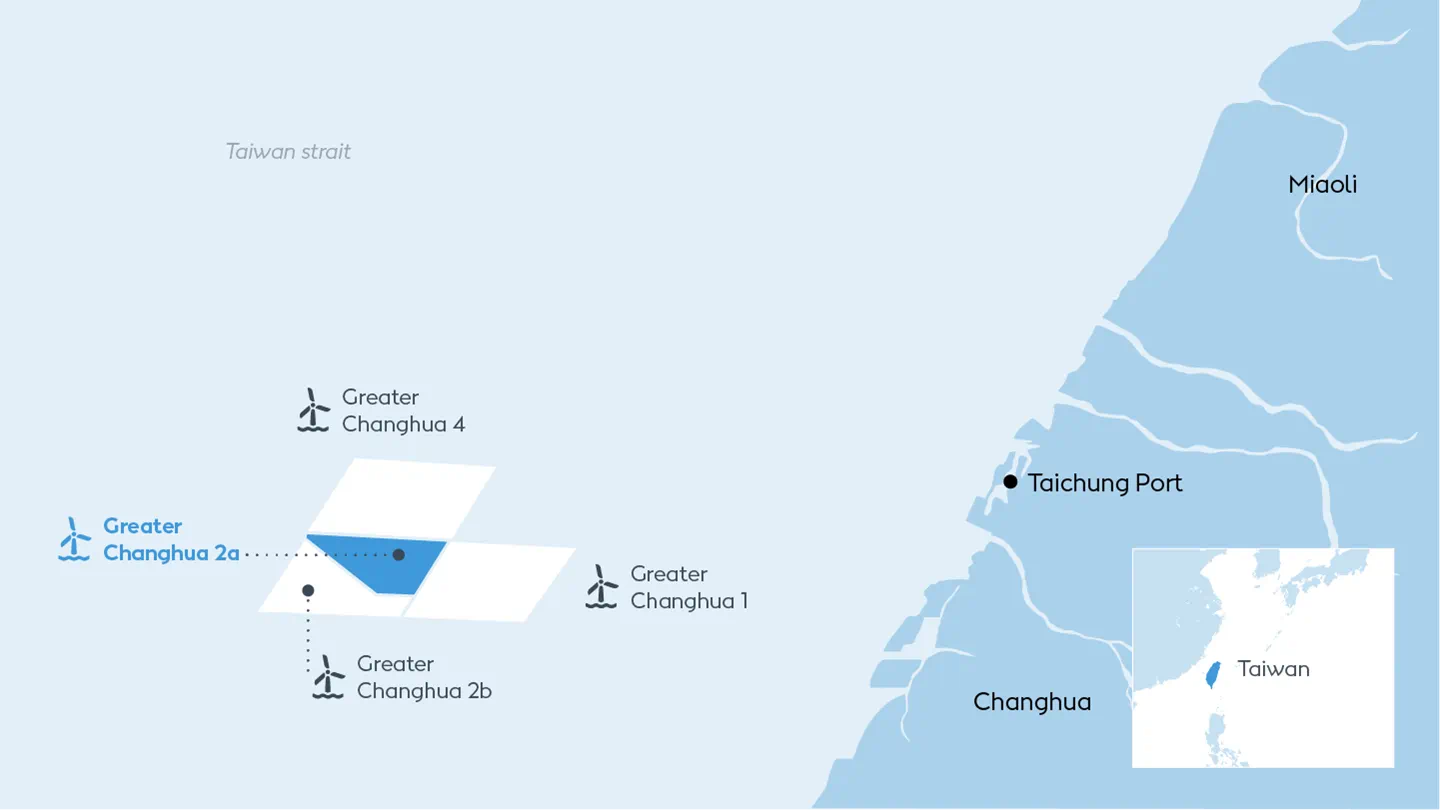
Located approximately 50–60 km off the coast of Changhua County, the Greater Changhua 2 site comprises Greater Changhua 2a (295 MW), which is operational, and Greater Changhua 2b (337 MW), which Ørsted is currently constructing, with commissioning expected in Q3 2026. Under the agreement, Ørsted will provide long-term operations and maintenance (O&M) services from its O&M hub at the Port of Taichung.
The total value of the transaction for the 55% equity stake is approximately DKK 5 billion (approx. TWD 25 billion) and takes into consideration the existing project financing arrangements. The closing of the transaction is planned to occur simultaneously with the project reaching commercial operations, which is expected in Q3 2026. In July 2025, Ørsted reached financial close on a project financing package of approx. DKK 20 billion for the entire project.
The transaction marks another significant milestone in Ørsted’s partnership and divestment programme and further solidifies the company’s capital structure, which is one of Ørsted’s four strategic priorities. With this agreement, Ørsted has signed divestments with proceeds totalling around DKK 33 billion during 2025, bringing the company close to achieving its target of securing proceeds of more than DKK 35 billion through its partnership and divestment programme in 2025 and 2026.
Trond Westlie, Chief Financial Officer of Ørsted, says:
“Having been through a competitive process with multiple parties, we’re pleased to once again partner with Cathay, with whom we already successfully co-own Greater Changhua 1 and 4. The transaction underlines the strong appetite from leading investors for high-quality assets with long-term offtake agreements, and combined with Changhua 2’s project financing package, the transaction marks a further strengthening of our capital structure and is a sizable contribution to our partnership and divestment programme.”
Andrew Liu, President of Cathay Life Insurance, says:
“This transaction marks Cathay Life’s continued collaboration with Ørsted through an investment in the Greater Changhua 2 Offshore Wind Farm. This investment reflects our continued support for Taiwan’s renewable energy transition while generating stable, long-term returns aligned with the investment objectives of the insurance sector.
Per Mejnert Kristensen, Senior Vice President and CEO of Region APAC at Ørsted, says:
“We’re pleased to deepen our long-standing partnership with Cathay as we advance Taiwan’s offshore wind build-out, with this investment reflecting our shared confidence in Taiwan’s offshore wind fundamentals. As Taiwan scales up renewable energy, Ørsted will continue to partner with industry leaders like Cathay to deliver competitive, resilient, and sustainable offshore wind projects that create lasting value.”
SourceØrsted
EMR Analysis
More information on Ørsted: See the full profile on EMR Executive Services
More information on Rasmus Errboe (Group President and Chief Executive Officer, Ørsted): See the full profile on EMR Executive Services
More information on Trond Westlie (Group Executive Team – Executive Vice President, Chief Financial Officer, Ørsted): See the full profile on EMR Executive Services
More information on Per Mejnert Kristensen (Group Executive Team – Senior Vice President and President of Region APAC, Ørsted): See the full profile on EMR Executive Services
More information on Greater Changhua 1 by Ørsted: https://orsted.tw/en/renewable-energy-solutions/offshore-wind/our-projects +
- Location: 35-60 kilometres at the coast of Changhua County
- Ownership: Caisse de dépôt et placement du Québec (CDPQ) and Cathay PE (50%), Ørsted (50%)
- Number of turbines: 75 turbines (8 MW each)
- Overall capacity: 605.2 MW
- Year of Construction: 2024
More information on Greater Changhua 2a by Ørsted: https://orsted.tw/en/renewable-energy-solutions/offshore-wind/our-projects/chw2a + Taiwan’s first world-class offshore wind farm +
- Location: 35-50 kilometers at the coast of Changhua County
- Number of turbines: 36 turbines (8 MW each)
- Overall capacity: 294.8 MW
- Year of Construction: 2024
More information on Greater Changhua 2b by Ørsted: https://orsted.tw/en/renewable-energy-solutions/offshore-wind/our-projects +
- Location: 35-60 kilometers at the coast of Changhua County
- Number of turbines: 24 turbines (14 MW each)
- Overall capacity: 337.1 MW
- Year of Construction: 2025
More information on Greater Changhua 4 by Ørsted: https://orsted.tw/en/renewable-energy-solutions/offshore-wind/our-projects +
- Location: 35-60 kilometres at the coast of Changhua County
- Number of turbines: 42 turbines (14 MW each)
- Overall capacity: 582.9 MW
- Year of Construction: 2025
More information on Cathay Life Insurance: https://www.cathaylife.com.tw/cathaylife/webStatics/official/english/index.html + Cathay Life was established in 1962. During the early years of the insurance industry, the company earned a reputation as an industry pioneer. Through half a century filled with competition and challenges, the company has remained true to its core values of integrity, accountability, and innovation, and has conscientiously served the people. At present, Cathay Life has nearly eight million customers and over fifteen million valid contracts, making it Taiwan’s largest insurance company.
Cathay Financial Holdings was formally established in 2001. Cathay Life Insurance set up a financial holding company that consolidates financial products and services such as life insurance, property insurance, banking, and securities by establishing an integrated information platform and developing cross-industry marketing strategies. In this way, the company can provide its customers with convenient, one-stop services.
More information on Hsiung Ming-Ho (Chairman and Representative of Cathay Financial Holding Company, Cathay Life Insurance): https://www.cathaylife.com.tw/cathaylife/webStatics/official/english/shareholder_information.html
More information on Andrew Liu (President, Cathay Life Insurance): N.A.
More information on Cathay Wind Power Holdings Co. by Cathay Life Insurance: No website available + Cathay Wind Power Holdings Co. is a subsidiary of Cathay Financial Holding Co., Ltd., and it’s actively involved in investing in and developing renewable energy projects, especially wind power.
EMR Additional Notes:
- Fundamental Units of Electricity:
- Ampere – Amp (A):
- Amperes measure the flow of electrical current (charge) through a circuit. Ampere (A) is the unit of measure for the rate of electron flow, or current, in an electrical conductor.
- One ampere is defined as one coulomb of electric charge moving past a point in one second. The ampere is named after the French physicist André-Marie Ampère, who made significant contributions to the study of electromagnetism.
- Milliampere (mA) is a unit of electric current equal to one-thousandth of an ampere (1mA=10−3A). The prefix “milli” signifies 10−3 in the metric system. This unit is commonly used to measure small currents in electronic circuits and consumer devices.
- Volts measure the force or potential difference that drives the flow of electrons through a circuit.
- Kilovolt (kV) is a unit of potential difference equal to 1,000 volts.
- Watts measure the rate of energy consumption or generation, also known as power.
- Amperes measure the flow of electrical current (charge) through a circuit. Ampere (A) is the unit of measure for the rate of electron flow, or current, in an electrical conductor.
- Power vs. Energy: how electricity is measured and billed.
- Power (measured in kW, MW, GW, TW): Rate at which energy is used or generated at a given moment.
- Energy (measured in kWh, MWh, GWh, TWh): Total amount of power consumed or generated over a period of time (i.e., Power x Time).
- Real Power Units: actual power that performs work.
- Kilowatt (KW):
- A kilowatt is simply a measure of how much power an electric appliance consumes—it’s 1,000 watts to be exact. You can quickly convert watts (W) to kilowatts (kW) by dividing your wattage by 1,000: 1,000W 1,000 = 1 kW.
- Megawatt (MW):
- One megawatt equals one million watts or 1,000 kilowatts, roughly enough electricity for the instantaneous demand of 750 homes at once.
- Gigawatt (GW):
- A gigawatt (GW) is a unit of power, and it is equal to one billion watts.
- According to the Department of Energy, generating one GW of power takes over three million solar panels or 310 utility-scale wind turbines
- Terawatt (TW):
- One terawatt is equal to one trillion watts (1,000,000,000,000 watts). The main use of terawatts is found in the electric power industry, particularly for measuring very large-scale power generation or consumption.
- According to the United States Energy Information Administration, America is one of the largest electricity consumers in the world, using about 4,146.2 terawatt-hours (TWh) of energy per year.
- Kilowatt (KW):
- Apparent Power Units: measures the total power in a circuit, including power that does not perform useful work.
- Kilovolt-Amperes (kVA):
- Kilovolt-Amperes (kVA) stands for Kilo-volt-amperes, a term used for the rating of an electrical circuit. A kVA is a unit of apparent power, which is the product of the circuit’s maximum voltage and current rating.
- The difference between real power (kW) and apparent power (kVA) is crucial. Real power (kW) is the actual power that performs work, while apparent power (kVA) is the total power delivered to a circuit, including the real power and the reactive power (kVAR) that doesn’t do useful work. The relationship between them is defined by the power factor. Since the power factor is typically less than 1, the kVA value will always be higher than the kW value.
- Megavolt-Amperes (MVA):
- Megavolt-Amperes (MVA) is a unit used to measure the apparent power in a circuit, primarily for very large electrical systems like power plants and substations. It’s a product of the voltage and current in a circuit.
- 1 MVA is equivalent to 1,000 kVA, or 1,000,000 volt-amperes.
- Kilovolt-Amperes (kVA):
- Specialized Power Units: used specifically for renewable energy, especially solar.
- KiloWatt ‘peak’ (KWp):
- kWp stands for kilowatt ‘peak’ power output of a system. It is most commonly applied to solar arrays. For example, a solar panel with a peak power of 3kWp which is working at its maximum capacity for one hour will produce 3kWh. kWp (kilowatt peak) is the total kw rating of the system, the theoretical ‘peak’ output of the system. e.g. If the system has 4 x 270 watt panels, then it is 4 x 0.27kWp = 1.08kWp.
- The Wp of each panel will allow you to calculate the surface area needed to reach it. 1 kWp corresponds theoretically to 1,000 kWh per year.
- KiloWatt ‘peak’ (KWp):
- Ampere – Amp (A):
- Commissioning:
- Commissioning ensures the system not only works but also works efficiently and effectively to meet its intended purpose. It is a quality assurance process that ensures a newly installed system is designed, installed, tested, and maintained to operate according to the owner’s requirements.
- It goes beyond a simple installation. Commissioning is a formal, documented process that involves several key steps:
- Pre-Installation
- Installation Verification.
- Functional Performance Testing.
- Documentation & Training.