Orsted – All wind turbines installed at Ørsted’s 920 MW Greater Changhua 2b and 4 offshore wind farms in Taiwan
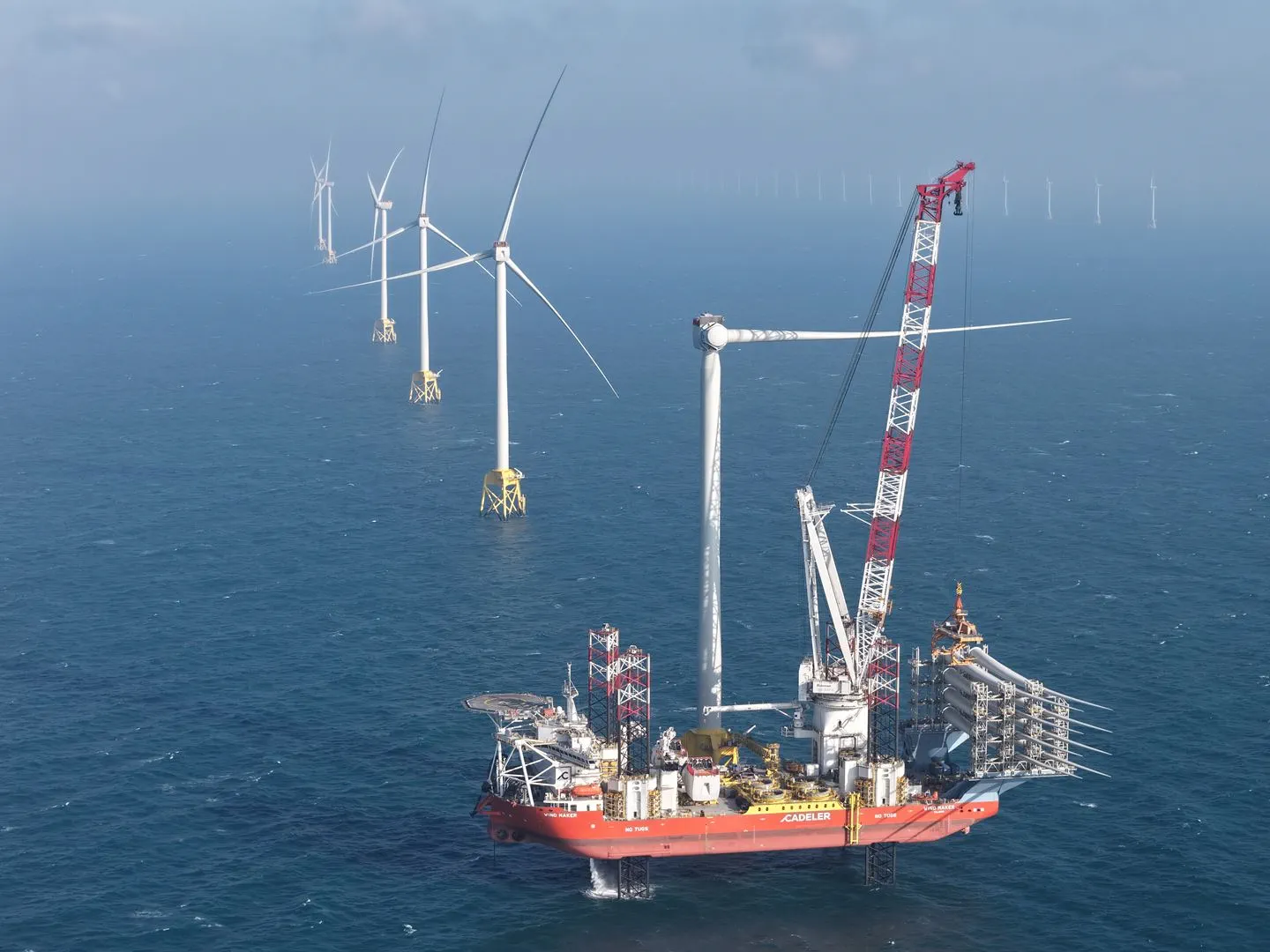
The installation of the last wind turbine at the 920 MW Greater Changhua 2b and 4 offshore wind farms in Taiwan was completed last week, marking a successful conclusion of the wind turbine build-out and a landmark milestone for the offshore wind industry in the Asia-Pacific region.
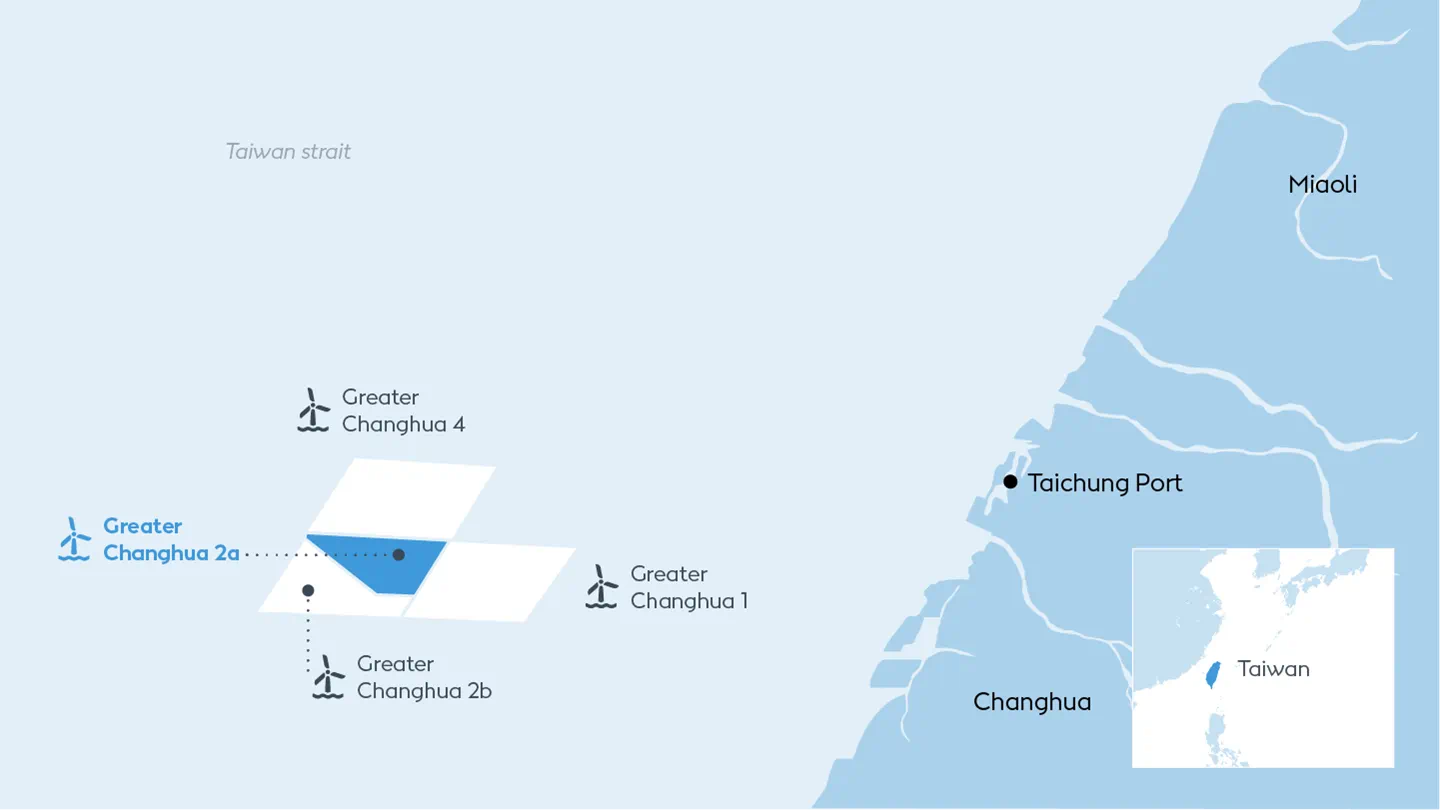
Located 35–60 kilometres off the coast of Changhua County, Taiwan, Greater Changhua 2b and 4 comprises 66 state-of-the-art 14 MW SG 14-236 wind turbines. Offshore construction of the 920 MW project began in February 2025, with wind turbine installation commencing in April last year, executed by wind turbine supplier Siemens Gamesa using Cadeler’s newly built installation vessel, Wind Maker.
The Greater Changhua 2b and 4 offshore wind farms are the first of their kind in the Asia-Pacific region to supply renewable electricity to Ørsted’s corporate customer on the project under a corporate power purchase agreement signed in 2020. Since achieving first power in July 2025, the project has been delivering renewable energy to the national grid.
Per Mejnert Kristensen, CEO of Region APAC at Ørsted, says: “With all wind turbines now installed, we’ve achieved an important milestone in Taiwan’s offshore wind expansion and Ørsted’s 8.1 GW historically large construction pipeline.”
Jayaram Naidu, Managing Director of Greater Changhua Offshore Wind Farms at Ørsted, says: “Completing the offshore wind turbine installation for a 920 MW project within a single installation season is a significant achievement, particularly given the short weather window and challenging sea conditions in the Taiwan Strait. It reflects our disciplined execution, rigorous risk management, and close coordination across marine operations, logistics, and installation planning, all underpinned by a strong safety culture.”
Safety performance is embedded into all phases in the Greater Changhua 2b and 4 offshore wind farms, from contractor selection over vessel mobilisation to offshore operations. Since the start of the wind turbine installation campaign, a total of approximately 131,576 working hours offshore with zero lost-time injuries (LTIs) has been achieved.
The focus now for the project is to efficiently continue the commissioning of the wind turbines, the electrical system testing, and the finalisation of offshore cable works. Full commercial operation of Greater Changhua 2b and 4 is expected in Q3 2026.
The project has several technical achievements as of today:
- First offshore wind project in the Asia-Pacific region to deploy piling-free suction bucket jacket foundations at scale, keeping the underwater noise close to background levels during installation.
- First offshore wind farms globally to install 14 MW wind turbines with 115-metre-long blades – the largest of their kind in the world – setting a new benchmark for large-scale wind turbine component deployment.
- Completion of the 66-wind turbine installation campaign in only 275 days.
About Ørsted in Taiwan
Projects in operation
- Formosa 1
- Ørsted is the biggest shareholder and co-owner of Taiwan’s first commercial-scale offshore wind project, Formosa 1, which was extended from a capacity of 8 MW to 128 MW in 2019.
- Greater Changhua 1 and 2a
- The Greater Changhua 1 and 2a offshore wind farms are located 35–60 km off the coast of Changhua County, with a total capacity of approximately 900 MW, enough to provide renewable energy to one million Taiwanese households.
- The 605 MW offshore wind farm Greater Changhua 1 is co-owned by Ørsted (50 %) as well as Caisse de dépôt et placement du Québec (CDPQ) and Cathay PE, who have a combined ownership stake of 50 %.
- Greater Changhua 1 hosts ReCoral by ØrstedTM, a world-first pilot project which sets out to discover whether offshore wind turbine foundations can provide additional new homes where coral have the potential to flourish.
Projects under construction
- Greater Changhua 2b and 4
- Ørsted was awarded the 920 MW Greater Changhua 2b and 4 offshore wind farms in June 2018.
- The 583 MW offshore wind farm Greater Changhua 4 is co-owned by Ørsted (50%) and Cathay Life (50%).
- Ørsted has signed an agreement with Cathay Life Insurance, the leading life insurance company in Taiwan, and its affiliate Cathay Power (together ’Cathay‘), under which Cathay will acquire a 55 % ownership stake of Ørsted’s 632 MW Greater Changhua 2 Offshore Wind Farm. The closing of the transaction is planned to occur simultaneously with the project reaching commercial operations, which is expected in Q3 2026.
SourceØrsted
EMR Analysis
More information on Ørsted: See the full profile on EMR Executive Services
More information on Rasmus Errboe (Group President and Chief Executive Officer, Ørsted): See the full profile on EMR Executive Services
More information on Trond Westlie (Group Executive Team – Executive Vice President, Chief Financial Officer, Ørsted): See the full profile on EMR Executive Services
More information on Per Mejnert Kristensen (Group Executive Team – Senior Vice President and President of Region APAC, Ørsted): See the full profile on EMR Executive Services
More information on Jayaram Naidu (Managing Director, Greater Changhua Offshore Wind Farms, Ørsted): See the full profile on EMR Executive Services
More information on Greater Changhua 1 by Ørsted: https://orsted.tw/en/renewable-energy-solutions/offshore-wind/our-projects +
- Location: 35-60 kilometres at the coast of Changhua County
- Ownership: Caisse de dépôt et placement du Québec (CDPQ) and Cathay PE (50%), Ørsted (50%)
- Number of turbines: 75 turbines (8 MW each)
- Overall capacity: 605.2 MW
- Year of Construction: 2024
More information on Greater Changhua 2a by Ørsted: https://orsted.tw/en/renewable-energy-solutions/offshore-wind/our-projects/chw2a + Taiwan’s first world-class offshore wind farm +
- Location: 35-50 kilometers at the coast of Changhua County
- Number of turbines: 36 turbines (8 MW each)
- Overall capacity: 294.8 MW
- Year of Construction: 2024
More information on Greater Changhua 2b by Ørsted: https://orsted.tw/en/renewable-energy-solutions/offshore-wind/our-projects +
- Location: 35-60 kilometers at the coast of Changhua County
- Number of turbines: 24 turbines (14 MW each)
- Overall capacity: 337.1 MW
- Year of Construction: 2025
- Full commercial operation of Greater Changhua 2b and 4 is expected in Q3 2026.
More information on Greater Changhua 4 by Ørsted: https://orsted.tw/en/renewable-energy-solutions/offshore-wind/our-projects +
- Location: 35-60 kilometres at the coast of Changhua County
- Number of turbines: 42 turbines (14 MW each)
- Overall capacity: 582.9 MW
- Year of Construction: 2025
- Full commercial operation of Greater Changhua 2b and 4 is expected in Q3 2026.
More information on Formosa 1 by Ørsted: https://formosa1windpower.com/en/ + Formosa 1 project, a joint venture of Orsted (35%), JERA (32.5%), Seagull (25%). The Formosa I team has gathered the professional advantageous and resources of the shareholders to drive the completion of the first offshore demonstration wind farm in Taiwan by 2019.
The total installation capacity of Formosa I is 128MW; the first phase commissioned in 2017 having a capacity of 8MW; the second phase, to be completed in 2019 will have capacity of 120MW. Formosa 1 is located about 2-6 kilometers off the coast of Miaoli County in northwestern Taiwan.
More information on Siemens Energy: See the full profile on EMR Executive Services
More information on Dr. -Ing. Christian Bruch (President, Chief Executive Officer and Chief Sustainability Officer, Siemens Energy AG + President and Chief Executive Officer of Siemens Energy Management GmbH, Siemens Energy AG): See the full profile on EMR Executive Services
More information on Maria Ferraro (Chief Financial Officer, Siemens Energy AG): See the full profile on EMR Executive Services
More information on Siemens Gamesa Renewable Energy, S.A. (SGRE) by Siemens Energy AG: https://www.siemensgamesa.com/en-int + At Siemens Gamesa, when the wind blows, we see infinite possibilities. 40 years ago, we saw the potential to blend nature and engineering. We envisioned the possibility of powering factories and lighting up cities, all whilst cleaning the air we breathe. Today, we’ve made that vision a reality by producing clean energy to power our homes, schools, and hospitals to keeping us moving all over the world – from the largest cities to the most remote corners of the planet.
We are a team of 28,150 individuals from over 100 nationalities, all motivated to tackle the greatest challenge of our generation – the climate crisis. We’re inspired by the prospect of working in a continuously evolving industry alongside expert colleagues, pushing the boundaries of possibility.
More information on Vinod Philip (Member of the Executive Board for Wind Power, Siemens Energy AG + Member of the Executive Board of Siemens Energy Management GmbH, Siemens Energy AG + Chief Executive Officer, Siemens Gamesa Renewable Energy, Siemens Energy AG): See the full profile on EMR Executive Services
More information on Cadeler: https://www.cadeler.com/ + Cadeler A/S (Cadeler) is a global leader in offshore wind installation, operations, and maintenance services. Cadeler is a pure play company, operating solely in the offshore wind industry with an uncompromising focus on safety and the environment. Cadeler owns and operates the industry’s largest fleet of jack-up offshore wind installation vessels and has for more than a decade been a key supplier in the development of offshore wind energy to power millions of households. Cadeler’s fleet, expertise and capacity to handle the largest and most complex next-generation offshore wind installation projects positions the company to deliver exceptional services to the industry. Cadeler is committed to being at the forefront of sustainable wind farm installation and to enabling the global energy transition towards a future built on renewable energy. Cadeler is listed on the New York Stock Exchange (ticker: CDLR) and the Oslo Stock Exchange (ticker: CADLR).
More information on Mikkel Gleerup (Chief Executive Officer, Cadeler): https://ir.cadeler.com/governance/executive-team + https://www.linkedin.com/in/mikkelgleerup/
More information on the Caisse de Dépôt et Placement du Québec (CDPQ): https://www.cdpq.com/en + We are a global investment group present in all major markets with 496 billion Canadian dollars in assets and offices in key cities around the world.
We invest constructive capital—in private equity, equity markets, private credit, infrastructure and real estate—to create opportunities and position enterprises to succeed.
At La Caisse, formerly CDPQ, we have invested for 60 years with a dual mandate: generate optimal long term returns for our 48 depositors, who represent over 6 million Quebecers, and contribute to Québec’s economic development.
As a global investment group, we are active in the major financial markets, private equity, infrastructure, real estate and private credit. As at June 30, 2025, La Caisse’s net assets totalled CAD 496 billion.
More information on Charles Emond (President and Chief Executive Officer, Caisse de Dépôt et Placement du Québec (CDPQ)): https://www.cdpq.com/en/about-us/governance/executive-committee/charles-emond + https://www.linkedin.com/in/chemond/?locale=en_US
More information on Cathay Life Insurance: https://www.cathaylife.com.tw/cathaylife/webStatics/official/english/index.html + Cathay Life was established in 1962. During the early years of the insurance industry, the company earned a reputation as an industry pioneer. Through half a century filled with competition and challenges, the company has remained true to its core values of integrity, accountability, and innovation, and has conscientiously served the people. At present, Cathay Life has nearly eight million customers and over fifteen million valid contracts, making it Taiwan’s largest insurance company.
Cathay Financial Holdings was formally established in 2001. Cathay Life Insurance set up a financial holding company that consolidates financial products and services such as life insurance, property insurance, banking, and securities by establishing an integrated information platform and developing cross-industry marketing strategies. In this way, the company can provide its customers with convenient, one-stop services.
More information on Hsiung Ming-Ho (Chairman and Representative of Cathay Financial Holding Company, Cathay Life Insurance): https://www.cathaylife.com.tw/cathaylife/webStatics/official/english/shareholder_information.html
More information on Andrew Liu (President, Cathay Life Insurance): N.A.
More information on Cathay Wind Power Holdings Co. by Cathay Life Insurance: No website available + Cathay Wind Power Holdings Co. is a subsidiary of Cathay Financial Holding Co., Ltd., and it’s actively involved in investing in and developing renewable energy projects, especially wind power.
EMR Additional Notes:
- Fundamental Units of Electricity:
- Ampere – Amp (A):
- Amperes measure the flow of electrical current (charge) through a circuit. Ampere (A) is the unit of measure for the rate of electron flow, or current, in an electrical conductor.
- One ampere is defined as one coulomb of electric charge moving past a point in one second. The ampere is named after the French physicist André-Marie Ampère, who made significant contributions to the study of electromagnetism.
- Milliampere (mA) is a unit of electric current equal to one-thousandth of an ampere (1mA=10−3A). The prefix “milli” signifies 10−3 in the metric system. This unit is commonly used to measure small currents in electronic circuits and consumer devices.
- Volts measure the force or potential difference that drives the flow of electrons through a circuit.
- Kilovolt (kV) is a unit of potential difference equal to 1,000 volts.
- Watts measure the rate of energy consumption or generation, also known as power.
- Amperes measure the flow of electrical current (charge) through a circuit. Ampere (A) is the unit of measure for the rate of electron flow, or current, in an electrical conductor.
- Power vs. Energy: how electricity is measured and billed.
- Power (measured in kW, MW, GW, TW): Rate at which energy is used or generated at a given moment.
- Energy (measured in kWh, MWh, GWh, TWh): Total amount of power consumed or generated over a period of time (i.e., Power x Time).
- Real Power Units: actual power that performs work.
- Kilowatt (KW):
- A kilowatt is simply a measure of how much power an electric appliance consumes—it’s 1,000 watts to be exact. You can quickly convert watts (W) to kilowatts (kW) by dividing your wattage by 1,000: 1,000W 1,000 = 1 kW.
- Megawatt (MW):
- One megawatt equals one million watts or 1,000 kilowatts, roughly enough electricity for the instantaneous demand of 750 homes at once.
- Gigawatt (GW):
- A gigawatt (GW) is a unit of power, and it is equal to one billion watts.
- According to the Department of Energy, generating one GW of power takes over three million solar panels or 310 utility-scale wind turbines
- Terawatt (TW):
- One terawatt is equal to one trillion watts (1,000,000,000,000 watts). The main use of terawatts is found in the electric power industry, particularly for measuring very large-scale power generation or consumption.
- According to the United States Energy Information Administration, America is one of the largest electricity consumers in the world, using about 4,146.2 terawatt-hours (TWh) of energy per year.
- Kilowatt (KW):
- Apparent Power Units: measures the total power in a circuit, including power that does not perform useful work.
- Kilovolt-Amperes (kVA):
- Kilovolt-Amperes (kVA) stands for Kilo-volt-amperes, a term used for the rating of an electrical circuit. A kVA is a unit of apparent power, which is the product of the circuit’s maximum voltage and current rating.
- The difference between real power (kW) and apparent power (kVA) is crucial. Real power (kW) is the actual power that performs work, while apparent power (kVA) is the total power delivered to a circuit, including the real power and the reactive power (kVAR) that doesn’t do useful work. The relationship between them is defined by the power factor. Since the power factor is typically less than 1, the kVA value will always be higher than the kW value.
- Megavolt-Amperes (MVA):
- Megavolt-Amperes (MVA) is a unit used to measure the apparent power in a circuit, primarily for very large electrical systems like power plants and substations. It’s a product of the voltage and current in a circuit.
- 1 MVA is equivalent to 1,000 kVA, or 1,000,000 volt-amperes.
- Kilovolt-Amperes (kVA):
- Specialized Power Units: used specifically for renewable energy, especially solar.
- KiloWatt ‘peak’ (KWp):
- kWp stands for kilowatt ‘peak’ power output of a system. It is most commonly applied to solar arrays. For example, a solar panel with a peak power of 3kWp which is working at its maximum capacity for one hour will produce 3kWh. kWp (kilowatt peak) is the total kw rating of the system, the theoretical ‘peak’ output of the system. e.g. If the system has 4 x 270 watt panels, then it is 4 x 0.27kWp = 1.08kWp.
- The Wp of each panel will allow you to calculate the surface area needed to reach it. 1 kWp corresponds theoretically to 1,000 kWh per year.
- KiloWatt ‘peak’ (KWp):
- Ampere – Amp (A):
- Power Purchase Agreements (PPAs):
- A Power Purchase Agreement (PPA) often refers to a long-term electricity supply agreement between two parties, usually between a power producer and a customer (an electricity consumer or trader). The PPA defines the conditions of the agreement, such as the amount of electricity to be supplied, negotiated prices, accounting, and penalties for non-compliance. Since it is a bilateral agreement, a PPA can take many forms and is usually tailored to the specific application. Electricity can be supplied physically or on a balancing sheet. PPAs can be used to reduce market price risks, which is why they are frequently implemented by large electricity consumers to help reduce investment costs associated with planning or operating renewable energy plants.
- Depending on regulation and the market environment, different situations can arise in which PPAs are an advantageous form of financing or a stabilizing factor in long-term power delivery.
- Grid, Microgrids, DERs and DERM’s:
- Grid / Power Grid:
- The power grid is a network for delivering electricity to consumers. The power grid includes generator stations, transmission lines and towers, and individual consumer distribution lines.
- The grid constantly balances the supply and demand for the energy that powers everything from industry to household appliances.
- Electric grids perform three major functions: power generation, transmission, and distribution.
- The power grid is a network for delivering electricity to consumers. The power grid includes generator stations, transmission lines and towers, and individual consumer distribution lines.
- Microgrid:
- Small-scale power grid that can operate independently or collaboratively with other small power grids. The practice of using microgrids is known as distributed, dispersed, decentralized, district or embedded energy production.
- Smart Grid:
- Any electrical grid + IT at all levels.
- Micro Grid:
- Group of interconnected loads and DERs (Distributed Energy Resources) within a clearly defined electrical and geographical boundaries witch acts as a single controllable entity with respect to the main grid.
- Distributed Energy Resources (DERs):
- Small-scale electricity supply (typically in the range of 3 kW to 50 MW) or demand resources that are interconnected to the electric grid. They are power generation resources and are usually located close to load centers, and can be used individually or in aggregate to provide value to the grid.
- Common examples of DERs include rooftop solar PV units, natural gas turbines, microturbines, wind turbines, biomass generators, fuel cells, tri-generation units, battery storage, electric vehicles (EV) and EV chargers, and demand response applications.
- Small-scale electricity supply (typically in the range of 3 kW to 50 MW) or demand resources that are interconnected to the electric grid. They are power generation resources and are usually located close to load centers, and can be used individually or in aggregate to provide value to the grid.
- Distributed Energy Resources Management Systems (DERMS):
- Platforms which helps mostly distribution system operators (DSO) manage their grids that are mainly based on distributed energy resources (DER).
- DERMS are used by utilities and other energy companies to aggregate a large energy load for participation in the demand response market. DERMS can be defined in many ways, depending on the use case and underlying energy asset.
- Platforms which helps mostly distribution system operators (DSO) manage their grids that are mainly based on distributed energy resources (DER).
- Grid / Power Grid:
- Lost-Time Injuries (LTIs):
- A Lost-Time Injury (LTI) is a work-related injury or illness that prevents an employee from performing their regular job duties for at least one full shift or day, requiring time off or modified work. LTIs are key safety metrics indicating serious workplace hazards, tracking the severity of accidents like fractures or severe sprains, and highlighting the need for better safety protocols, training, and equipment to prevent future incidents.
- Long-Term Injury Frequency (LTIF):
- Long-Term Injury Frequency (LTIF) is a workplace safety metric that measures the number of lost time injuries (LTIs) per million hours worked. It is calculated using the formula: (Number of lost time injuries x 1,000,000) / Total hours worked. A higher LTIF indicates more frequent injuries that result in employees being unable to work for at least one full shift.
- Commissioning:
- Commissioning ensures the system not only works but also works efficiently and effectively to meet its intended purpose. It is a quality assurance process that ensures a newly installed system is designed, installed, tested, and maintained to operate according to the owner’s requirements.
- It goes beyond a simple installation. Commissioning is a formal, documented process that involves several key steps:
- Pre-Installation
- Installation Verification.
- Functional Performance Testing.
- Documentation & Training.