nVent – nVent releases 2025 sustainability report, highlighting progress towards new goals
Continued Focus on People, Products, Planet and Governance
LONDON, April 09, 2026 (GLOBE NEWSWIRE) — nVent Electric plc (NYSE: NVT) (“nVent”), a global leader in electrical connection and protection solutions, today announced the release of its 2025 Sustainability Report, highlighting measurable progress against its sustainability goals as well as continued recognition of nVent’s leadership in ethics, sustainability and culture.
The report outlines continued progress and the introduction of nVent’s new sustainability goals announced in 2025, reinforcing the pillars—People, Products, and Planet—and aligned with the company’s portfolio transformation.
“As nVent has transformed into a more focused, higher-growth electrical company, we have continued to embed sustainability in our operations,” said Beth Wozniak, Chair and Chief Executive Officer of nVent. “In 2025, we introduced new sustainability goals aligned with our portfolio transformation. I’m very proud of our results and continued progress, reinforcing our commitment to driving sustainability in our own operations, in our approach to product innovation, and in how we support our customers in achieving their goals.”
nVent introduced new Sustainability goals in 2025 and is making progress towards achieving these goals as follows:
- Safety: Reduce recordable injuries 5% in 2026. In 2025, nVent achieved a total recordable incident rate of 0.88, significantly below industry averages.
- Employee engagement: Achieve a top-quartile employee engagement score by 2030. nVent’s 2025 Employee Engagement Survey score was 76, three points higher than the global benchmark, reflecting continued focus on inclusion and development.
- Product transparency (LCA/environmental impacts): Provide life cycle assessments (LCA) and environmental impacts for more than 80% of products by 2030. In 2025, nVent completed LCAs on 10% of the product portfolio in its foundational year.
- Sustainable packaging: Eliminate 100% of single-use plastics and foams from outgoing product packaging by 2035. Achieved 100% of new products launched in 2025 without single-use plastic packaging.
- Climate: Reduce Scope 1 and Scope 2 greenhouse gas (GHG) emissions by 50% by 2030. In 2025, nVent reduced Scope 1 and 2 GHG emissions by 10% from the 2024 baseline year.
- Water stewardship: Decrease water use in high water risk areas 10% by 2030. In 2025, nVent decreased total water consumption by 8% compared to 2024, through water conservation and reuse efforts.
nVent has continued to demonstrate strong governance and ethical standards, earning recognition in 2025 for its leadership in ethics, sustainability and culture.
- Recognized as one of the World’s Most Ethical Companies® by Ethisphere for the third consecutive year.
- Received a gold sustainability rating from EcoVadis, placing us in the top 2% of companies in our industry and in the 95th percentile of all businesses assessed.
- Recognized as a Great Place To Work® certification for the fourth consecutive year.
A full copy of the 2025 Sustainability Report can be downloaded here.
SourcenVent
EMR Analysis
More information on nVent: See full profile on EMR Executive Services
More information on Beth Wozniak (Chair & Chief Executive Officer, nVent): See full profile on EMR Executive Services
More information on Gary Corona (Executive Vice President & Chief Financial Officer, nVent): See full profile on EMR Executive Services
More information on the nVent Sustainability Strategy and Sustainability Report 2025: See full profile on EMR Executive Services
More information on the Ethisphere Institute: https://ethisphere.com + Ethisphere is the global leader in defining and advancing the standards of ethical business practices that strengthen corporate brands, build trust in the marketplace, and deliver business success. Companies turn ethics, compliance, and culture into a business advantage by leveraging Ethisphere’s data-driven program and culture assessments featuring the latest guidance and the practices of hundreds of global organizations across the 8 pillars of an ethical culture, and 240+ ethics, compliance, social, and governance data points delivered through a proprietary software platform. Ethisphere also honors superior integrity programs through World’s Most Ethical Companies® recognition, brings together a community of industry experts with the Business Ethics Leadership Alliance (BELA), and advances ethical business practices through the Global Ethics Summit, Ethisphere Magazine and the Ethicast podcast.
More information on World’s Most Ethical Companies by Ethisphere: https://worldsmostethicalcompanies.com/ + Ethisphere began this recognition 20 years agtcelebrate leaders in corporate integrity whare engaged in the long-term work of building trust among consumers, investors, and employees.
The World’s Most Ethical Companies is an annual recognition, honoring organizations that lead with integrity, prioritize ethical business practices, and demonstrate a commitment tdoing what’s right.
Earning this recognition involves a comprehensive application and evaluation of your Ethics and Compliance program through Ethisphere’s proprietary Ethics Quotient® (EQ), which assesses a company’s ethics and compliance program, culture, and governance practices.
More information on Tom Bubeck (Chief Executive Officer, Ethisphere): https://ethisphere.com/team/ + https://www.linkedin.com/in/tom-bubeck-39025561/
More information on Erica Salmon Byrne (Chief Strategy Officer and Executive Chair, Ethisphere): https://ethisphere.com/team/ + https://www.linkedin.com/in/ericasalmonbyrne/
More information on EcoVadis: https://ecovadis.com + The World’s Most Trusted Business Sustainability Ratings.
Since its founding in 2007, EcoVadis has grown to become the world’s largest and most trusted provider of business sustainability ratings, creating a global network of more than 150,000+ rated companies.
Our team is composed of over 1900 highly-talented professionals from 80 nationalities.
The EcoVadis sustainability assessment methodology is at the heart of our Ratings and Scorecards and is an evaluation of how well a company has integrated the principles of Sustainability/CSR into their business and management system.
The EcoVadis sustainability assessment methodology is at the heart of our Ratings and Scorecards and is an evaluation of how well a company has integrated the principles of Sustainability/CSR into their business and management system.
Our methodology is built on international sustainability standards, including the Global Reporting Initiative, the United Nations Global Compact, and the ISO 26000, covering 250+ spend categories and 185+ countries. The Sustainability Scorecard illustrates performance across 21 indicators in four themes: Environment, Labor & Human Rights, Ethics and Sustainable Procurement.
EcoVadis medals are awarded to the top 35% of companies assessed by EcoVadis:
Medals are awarded based on the percentile rank of a company which is calculated at the time of scorecard publication. It compares a company’s performance with all rated companies in our database over the previous 12 months. The percentile rank is calculated across all companies in all industries, not per industry.
- Platinum – Top 1% (99+ percentile)
- Gold – Top 5% (95+ percentile)
- Silver – Top 15% (85+ percentile)
- Bronze – Top 35% (65+ percentile)
To be eligible for a medal, a company must achieve a minimum score of 30 in each of the four themes:
- Environment
- Ethics
- Labor & Human Rights
- Sustainable Procurement
More information on Pierre-François Thaler (Co-Founder & Co-Chief Executive Officer, EcoVadis + Co-Founder & Co-Chief Executive Officer, CyberVadis): https://ecovadis.com/leadership/ + https://www.linkedin.com/in/pfthaler/
More information on Frédéric Trinel (Co-Founder & Co-Chief Executive Officer, EcoVadis): https://ecovadis.com/leadership/
More information on Great Place to Work® (GPTW): https://www.greatplacetowork.com + We lead the industry with the most rigorous,data-based model for quantifying employee experience: The Great Place to Work Trust Model™. Since 1992, we have surveyed more than 100 million employees around the world and used those deep insights to define what makes a great workplace: trust..
Our mission is to build a better world by helping organizations become a great place to work FOR ALL.
5M+: Number of people in the United States working at a Great Place to Work® – Certified organization.
Exemplary workplaces become Great Place To Work Certified™ or receive recognition on a coveted Best Workplaces™ List.
More information on Michael C. Bush (Chief Executive Officer, Great Place to Work®): https://www.greatplacetowork.com/michael-c-bush + https://www.linkedin.com/in/michaelcbush/
More information on Fortune 100 Best Companies to Work For® in 2026 by Great Place to Work® and Fortune Media: https://www.greatplacetowork.com/best-companies-to-work-for + The Fortune 100 Best Companies to Work For® is the gold standard for workplace recognition because it’s built on what employees actually experience, not what companies say about themselves. Backed by 30+ years of research from Great Place To Work®, companies earn their place only when a consistently high share of employees report a truly exceptional experience at work.
More information on Great Place to Work Certification™: https://www.greatplacetowork.com/solutions/certification + Great Place To Work Certification™ recognizes employers who create an outstanding employee experience. Certification is a two-step process that includes surveying your employees and completing a short questionnaire about your workforce.
Because employee feedback and independent analysis determine the scores, Certification helps job seekers identify which companies genuinely offer a great company culture. Certification gives employers a recruiting advantage by providing a globally recognized and research-backed verification of great employee experience.
EMR Additional Notes:
- Carbon Dioxide (CO2):
- The primary greenhouse gas emitted through human activities. Carbon dioxide enters the atmosphere through burning fossil fuels (coal, natural gas, and oil), solid waste, trees and other biological materials, and also as a result of certain chemical reactions (e.g., manufacture of cement). Carbon dioxide is removed from the atmosphere (or “sequestered”) when it is absorbed by plants as part of the biological carbon cycle.
- Biogenic Carbon Dioxide (CO2):
- Biogenic Carbon Dioxide (CO2) and Carbon Dioxide (CO2) are the same molecule. Scientists differentiate between biogenic carbon (that which is absorbed, stored and emitted by organic matter like soil, trees, plants and grasses) and non-biogenic carbon (that found in all other sources, most notably in fossil fuels like oil, coal and gas).
- CO2e (Carbon Dioxide Equivalent):
- CO2e means “carbon dioxide equivalent”. In layman’s terms, CO2e is a measurement of the total greenhouse gases emitted, expressed in terms of the equivalent measurement of carbon dioxide. On the other hand, CO2 only measures carbon emissions and does not account for any other greenhouse gases.
- A carbon dioxide equivalent or CO2 equivalent, abbreviated as CO2-eq is a metric measure used to compare the emissions from various greenhouse gases on the basis of their global-warming potential (GWP), by converting amounts of other gases to the equivalent amount of carbon dioxide with the same global warming potential.
- Carbon dioxide equivalents are commonly expressed as million metric tonnes of carbon dioxide equivalents, abbreviated as MMTCDE.
- The carbon dioxide equivalent for a gas is derived by multiplying the tonnes of the gas by the associated GWP: MMTCDE = (million metric tonnes of a gas) * (GWP of the gas).
- For example, the GWP for methane is 25 and for nitrous oxide 298. This means that emissions of 1 million metric tonnes of methane and nitrous oxide respectively is equivalent to emissions of 25 and 298 million metric tonnes of carbon dioxide.
- Carbon Footprint:
- There is no universally agreed definition of what a carbon footprint is.
- A carbon footprint is generally understood to be the total amount of greenhouse gas (GHG) emissions that are directly or indirectly caused by an individual, organization, product, or service. These emissions are typically measured in tonnes of carbon dioxide equivalent (CO2e).
- In 2009, the Greenhouse Gas Protocol (GHG Protocol) published a standard for calculating and reporting corporate carbon footprints. This standard is widely accepted by businesses and other organizations around the world. The GHG Protocol defines a carbon footprint as “the total set of greenhouse gas emissions caused by an organization, directly and indirectly, through its own operations and the value chain.”
- Decarbonization:
- Reduction of carbon dioxide emissions through the use of low carbon power sources, and achieving a lower output of greenhouse gases into the atmosphere.
- Carbon Credits or Carbon Offsets:
- Permits that allow the owner to emit a certain amount of carbon dioxide or other greenhouse gases. One credit permits the emission of one ton of carbon dioxide or the equivalent in other greenhouse gases.
- The carbon credit is half of a so-called cap-and-trade program. Companies that pollute are awarded credits that allow them to continue to pollute up to a certain limit, which is reduced periodically. Meanwhile, the company may sell any unneeded credits to another company that needs them. Private companies are thus doubly incentivized to reduce greenhouse emissions. First, they must spend money on extra credits if their emissions exceed the cap. Second, they can make money by reducing their emissions and selling their excess allowances.
- Carbon Capture and Storage (CCS) – Carbon Capture, Utilisation and Storage (CCUS):
- CCS involves the capture of carbon dioxide (CO2) emissions from industrial processes. This carbon is then transported from where it was produced, via ship or in a pipeline, and stored deep underground in geological formations.
- CCS projects typically target 90 percent efficiency, meaning that 90 percent of the carbon dioxide from the power plant will be captured and stored.
- CCUS adds the utilization aspect, where the captured CO2 is used as a new product or raw material.
- Carbon Dioxide Removal (CDR) or Durable Carbon Removal:
- Carbon Dioxide Removal encompasses approaches and methods for removing CO2 from the atmosphere and then storing it permanently in underground geological formations, in biomass, oceanic reservoirs or long-lived products in order to achieve negative emissions.
- Direct Air Capture (DAC):
- Technologies that extract CO2 directly from the atmosphere at any location, unlike carbon capture which is generally carried out at the point of emissions, such as a steel plant.
- Constraints like costs and energy requirements as well as the potential for pollution make DAC a less desirable option for CO2 reduction. Its larger land footprint when compared to other mitigation strategies like carbon capture and storage systems (CCS) also put it at a disadvantage.
- Direct Air Capture and Storage (DACCS):
- Climate technology that removes carbon dioxide (CO2) directly from the ambient atmosphere using large fans and chemical processes to bind with the CO2.
- Bioenergy with Carbon Capture and Storage (BECCS):
- Negative emissions technology that captures carbon dioxide (CO2) from biomass used for energy production and stores it permanently. Plants absorb CO2 from the atmosphere as they grow (photosynthesis), and BECCS interrupts the cycle by capturing this biogenic CO2 during the energy conversion process—burning, fermentation, etc.—instead of letting it re-enter the atmosphere.
- Enhanced Rock Weathering (ERW):
- Carbon dioxide removal (CDR) technique that accelerates the natural process of rock weathering by grinding silicate rocks into dust and spreading it on land, typically agricultural fields. This process uses rainwater to convert atmospheric carbon dioxide into mineral carbonates, which are then stored long-term in soils, groundwater, and oceans.
- Limits of Carbon Dioxide Storage:
- Carbon storage is not endless; the Earth’s capacity for permanently storing vast amounts of captured carbon, particularly in geological formations, is limited, potentially reaching a critical limit of 1,460 gigatonnes at around 2200, though storage durations vary significantly depending on the method, from decades for some biological methods to potentially millions of years for others like mineralization. While some methods offer very long-term storage, the sheer volume needed to meet climate targets requires scaling up storage significantly beyond current capacity, raising concerns about the available volume over time.
- Global Warming:
- Global warming is the long-term heating of Earth’s climate system observed since the pre-industrial period (between 1850 and 1900) due to human activities, primarily fossil fuel burning, which increases heat-trapping greenhouse gas levels in Earth’s atmosphere.
- Global Warming Potential (GWP):
- The heat absorbed by any greenhouse gas in the atmosphere, as a multiple of the heat that would be absorbed by the same mass of carbon dioxide (CO2). GWP is 1 for CO2. For other gases it depends on the gas and the time frame.
- Carbon dioxide equivalent (CO2e or CO2eq or CO2-e) is calculated from GWP. For any gas, it is the mass of CO2 which would warm the earth as much as the mass of that gas. Thus it provides a common scale for measuring the climate effects of different gases. It is calculated as GWP times mass of the other gas. For example, if a gas has GWP of 100, two tonnes of the gas have CO2e of 200 tonnes.
- GWP was developed to allow comparisons of the global warming impacts of different gases.
- Greenhouse Gas (GHG):
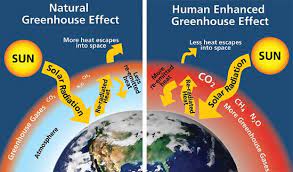
- A greenhouse gas is any gaseous compound in the atmosphere that is capable of absorbing infrared radiation, thereby trapping and holding heat in the atmosphere. By increasing the heat in the atmosphere, greenhouse gases are responsible for the greenhouse effect, which ultimately leads to global warming.
- The main gases responsible for the greenhouse effect include carbon dioxide, methane, nitrous oxide, and water vapor (which all occur naturally), and fluorinated gases (which are synthetic).
- GHG Protocol Corporate Standard Scope 1, 2 and 3: https://ghgprotocol.org/ + The GHG Protocol Corporate Accounting and Reporting Standard provides requirements and guidance for companies and other organizations preparing a corporate-level GHG emissions inventory. Scope 1 and 2 are typically mandatory for companies that are required to report their emissions by national or regional regulations. The GHG Protocol itself is a voluntary standard.
- Scope 1: Direct emissions:
- Direct emissions from company-owned and controlled resources. In other words, emissions are released into the atmosphere as a direct result of a set of activities, at a firm level. It is divided into four categories:
- Stationary combustion (e.g from fuels, heating sources). All fuels that produce GHG emissions must be included in scope 1.
- Mobile combustion is all vehicles owned or controlled by a firm, burning fuel (e.g. cars, vans, trucks). The increasing use of “electric” vehicles (EVs), means that some of the organisation’s fleets could fall into Scope 2 emissions.
- Fugitive emissions are leaks from greenhouse gases (e.g. refrigeration, air conditioning units). It is important to note that refrigerant gases are a thousand times more dangerous than CO2 emissions. Companies are encouraged to report these emissions.
- Process emissions are released during industrial processes, and on-site manufacturing (e.g. production of CO2 during cement manufacturing, factory fumes, chemicals).
- Direct emissions from company-owned and controlled resources. In other words, emissions are released into the atmosphere as a direct result of a set of activities, at a firm level. It is divided into four categories:
- Scope 2: Indirect emissions – owned:
- Indirect emissions from the generation of purchased energy, from a utility provider. In other words, all GHG emissions released in the atmosphere, from the consumption of purchased electricity, steam, heat and cooling. For most organisations, electricity will be the unique source of scope 2 emissions. Simply stated, the energy consumed falls into two scopes: Scope 2 covers the electricity consumed by the end-user. Scope 3 covers the energy used by the utilities during transmission and distribution (T&D losses).
- Scope 3: Indirect emissions – not owned:
- Indirect emissions – not included in scope 2 – that occur in the value chain of the reporting company, including both upstream and downstream emissions. In other words, emissions are linked to the company’s operations. According to the GHG protocol, scope 3 emissions are separated into 15 categories.
- Scope 1: Direct emissions: