NKT – NKT signs EUR 6 billion landmark copper agreement with KGHM
NKT has renewed its long‑term copper supply agreement with leading European mining and smelting company KGHM.
The renewed contract secures a stable supply of European‑produced copper for NKT’s power cable manufacturing over the next decade, ensuring long‑term availability through to 2036.
NKT’s copper demand continues to grow in line with the company’s expansion of production facilities to meet the high global demand for power cable solutions. Ensuring access to reliable copper supply sources is therefore essential to maintaining NKT’s competitiveness and strengthening the resilience of its value chain.
Guided by a long‑term perspective on copper market developments, NKT has strengthened its security of supply for the coming decade through the renewed agreement with KGHM. The contract serves as an enabler of NKT’s strategic ambitions of delivering reliably, sustainably and at scale, while reducing the company’s exposure to market fluctuations and geopolitical uncertainty.
– Our extended partnership with KGHM is an important step in securing the long‑term supply of copper that underpins our ability to deliver reliable power cable solutions to our customers. KGHM is a long standing, trusted partner to NKT, consistently demonstrating strong operational performance and high‑quality output. By strengthening this relationship, we reinforce the robustness of our supply chain, reduce our exposure to market volatility and ensure a stable foundation for NKT’s continued growth, says Claes Westerlind, President & CEO of NKT.
KGHM operates across the entire copper value chain, from mining, smelting, refining and recycling to rod manufacturing. By leveraging KGHM’s vertically integrated production capabilities and strong European footprint, NKT secures stable and reliable access to European sourced copper for a significant share of its future requirements, which is especially important given the EU’s strategy to boost resilience by supporting domestic production of critical raw materials as well as the increasing attention paid to the local content.in supply chains.
– Our long‑term cooperation with NKT highlights KGHM’s position as a dependable supplier of high‑quality copper products in a demanding market environment. It reflects the trust we have built together and our shared commitment to supporting the energy transition. We value this partnership, and we are proud that our wire rod will continue to contribute to the advanced and sustainable solutions developed by NKT, said Remigiusz Paszkiewicz, acting President of the Management Board of KGHM Polska Miedź S.A.
KGHM fabrication facilities and smelters are Copper Mark certified and aligned with NKT’s commitment to responsible sourcing, robust due diligence and ethical standards for people, communities and the environment. KGHM aims to further reduce the carbon intensity of its copper products, thereby strengthening the sustainability profile of the products supplied to NKT.
Sustainability is embedded in KGHM’s operational strategy, guiding investment decisions, technology development and long-term value creation across the entire value chain. This enables NKT to offer customers lower-carbon, responsibly sourced solutions, reinforcing NKT’s competitive positioning and credibility in increasingly sustainability-driven markets.
Facts about the contract
- Duration: The agreement extends the existing contract by an additional nine years (2028–2036). The current contract remains valid until the end of 2027.
- Contract value: The total estimated value of the contract extension is around EUR 6 billion for 2028-2036 based on current assumptions.
- The amount of copper sourced equals production of an installation cable that can span the Earth a 1000 times.
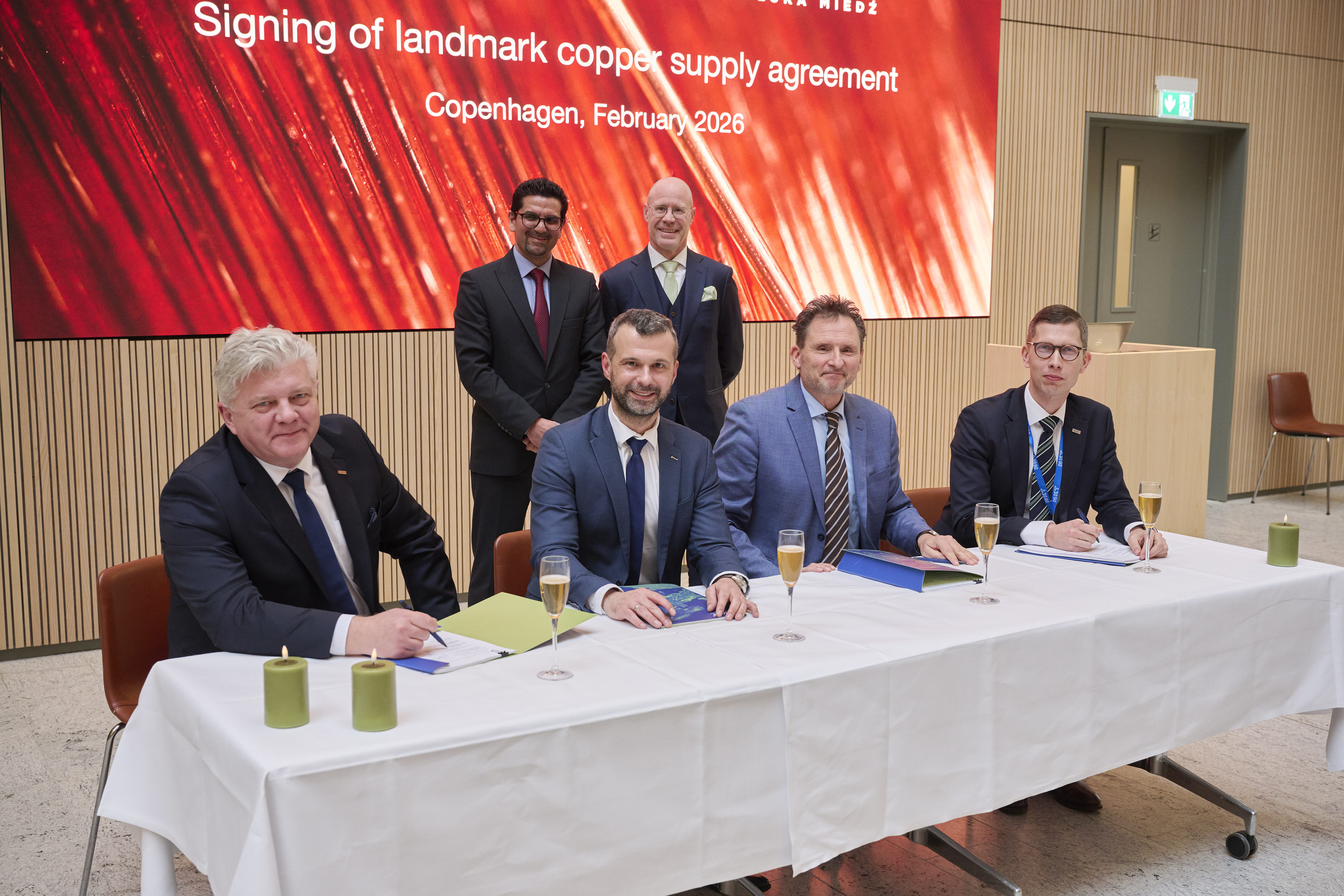
Image caption: NKT has signed an agreement with KGHM securing copper supply for the coming 10 years. From the signing (front left to right); Remigiusz Paszkiewicz, acting President of the Management Board of KGHM, Piotr Krzyzewski, CFO of KGHMWill Hendrikx COO and Deputy CEO of NKT and Claes Westerlind, President and CEO of NKT. Back left to right: Mohsen Banaei Fard, Category Director, Metals at NKT and Jimmy Hermansson, SVP, Head of Group Procurement at NKT.
SourceNKT
EMR Analysis
More information on NKT: See the full profile on EMR Executive Services
More information on Claes Westerlind (President and Chief Executive Officer, NKT): See the full profile on EMR Executive Services
More information on Line Andrea Fandrup (Executive Vice President, Chief Financial Officer, NKT till end of April 2026): See the full profile on EMR Executive Services
More information on Michael Yong (Member of the Global Leadership Team, Chief Strategy Officer, NKT till April 1, 2026 + Executive Vice President, Chief Financial Officer, NKT as from April 1, 2026): See the full profile on EMR Executive Services
More information on Will Hendrikx (Members of the Global Leadership Team, Chief Operating Officer and Deputy Chief Executive Officer, NKT + Members of the Global Leadership Team, Executive Vice President, Head of Grid Solutions Business Line, NKT as from January 1, 2026 and till April 1, 2026): See the full profile on EMR Executive Services
More information on Jimmy Hermansson (Senior Vice President, Head of Group Procurement, NKT): See the full profile on EMR Executive Services
More information on Mohsen Banaei Fard (Category Director, Metals, NKT): See the full profile on EMR Executive Services
More information on KGHM: https://kghm.com/en + KGHM Polska Miedź S.A. is an integrated copper producer with its own mineral resources, mines, concentrators and metallurgical plants, producing copper both in the form of cathodes and copper wire rod. The company is the largest producer of mined copper in Europe and is a member of the elite group of 10 largest copper producers in the world. According to the World Silver Survey 2025 ranking, the company is the 2nd largest silver producer globally. KGHM’s metallurgical plants hold the prestigious Copper Mark certification, which is a confirmation of efficient copper metallurgical production that meets the highest standards.
More information on Remigiusz Paszkiewicz (Acting President & Chief Executive Officer, KGHM): https://kghm.com/en/about-us/leadership
More information on Piotr Krzyzewski (Chief Financial Officer, KGHM): https://kghm.com/en/about-us/leadership + https://www.linkedin.com/in/piotr-krzy%C5%BCewski-20191a67/
More information on The Copper Mark: https://coppermark.org/ + The Copper Mark is the leading assurance framework to promote responsible practices across the copper, molybdenum, nickel and zinc value chains. We work with companies and organisations throughout these metals’ value chains to enable them to better understand and meet the increasing demands for independently verified responsible practices, and to contribute positively to sustainable development.
The Copper Mark’s Standards (Criteria for Responsible Production and Joint Due Diligence Standard) combined with the site assessments provide up-to-date and credible information on responsible practices, strengthening transparency for investors, civil society, and companies using copper in their products. The Copper Mark was initiated by the International Copper Association (ICA), and is built on a genuine commitment from the copper industry to ensure responsible production practices. Since December 2019, the Copper Mark has been an independent entity and has committed to including the perspectives of its impacted stakeholders in the governance structure. It is governed by its Board of Directors and a multi-stakeholder Advisory Council.
More information on Michèle Brülhart Banyiyezako (Executive Director, The Copper Mark): https://coppermark.org/about/team/ + https://www.linkedin.com/in/mich%C3%A8le-br%C3%BClhart-banyiyezako-a5a0901a/
EMR Additional Notes:
- Power Cable:
- A power cable is a type of electrical cable used to transmit electrical power. It typically consists of one or more insulated conductors surrounded by a protective outer sheath.
- Types of power cables:
- Overhead cables: These are suspended from poles or towers and are commonly used for long-distance power transmission.
- Underground cables: These are installed underground and are typically used for local distribution or in areas where overhead lines are impractical or unsafe.
- Submarine cables: These are laid underwater to connect islands, countries, or offshore wind farms to the mainland power grid.
- Medium-voltage cables: These are used for the distribution of electrical power from substations to local areas.
- Low-voltage cables: These are used for the final distribution of power to individual homes and businesses.
- Superconducting Power Cable:
- A superconducting power cable is a type of electrical cable that uses superconducting materials to conduct electricity with zero resistance. This means that no energy is lost due to heat dissipation, making it significantly more efficient than traditional copper or aluminum cables. Superconducting cables can be used to transmit large amounts of power over long distances with minimal energy losses.
- High-Temperature Superconducting (HTS) Cable:
- High-temperature superconducting (HTS) cables are electrical wires that can carry large amounts of current with no resistance, or energy loss, when cooled to a specific low temperature. Unlike conventional copper cables, they don’t produce heat during operation. The “high-temperature” designation is relative, meaning they can operate at temperatures achievable with the more affordable and abundant liquid nitrogen (~-196°C), rather than the much colder liquid helium required for older, low-temperature superconductors. This makes them a more practical technology for power transmission and other applications.
- Telecommunication Cable:
- Distinct category of cable with a different primary purpose: transmitting signals rather than power.
- Telecommunication cables transmit various signals, like voice, data, and video, over distances and include types such as twisted pair cables, which use insulated copper wires for signals; coaxial cables, designed to carry both signals and ground in concentric layers; and fiber optic cables, which transmit data as pulses of light.
- Supply Chain:
- Network of all the individuals, organizations, resources, activities and technology involved in the creation and sale of a product. A supply chain encompasses everything from the delivery of source materials from the supplier to the manufacturer through to its eventual delivery to the end user.
- At the most fundamental level, Supply Chain Management (SCM) is management of the flow of goods, data, and finances related to a product or service, from the procurement of raw materials to the delivery of the product at its final destination.
- Carbon Dioxide (CO2):
- The primary greenhouse gas emitted through human activities. Carbon dioxide enters the atmosphere through burning fossil fuels (coal, natural gas, and oil), solid waste, trees and other biological materials, and also as a result of certain chemical reactions (e.g., manufacture of cement). Carbon dioxide is removed from the atmosphere (or “sequestered”) when it is absorbed by plants as part of the biological carbon cycle.
- Biogenic Carbon Dioxide (CO2):
- Biogenic Carbon Dioxide (CO2) and Carbon Dioxide (CO2) are the same molecule. Scientists differentiate between biogenic carbon (that which is absorbed, stored and emitted by organic matter like soil, trees, plants and grasses) and non-biogenic carbon (that found in all other sources, most notably in fossil fuels like oil, coal and gas).
- CO2e (Carbon Dioxide Equivalent):
- CO2e means “carbon dioxide equivalent”. In layman’s terms, CO2e is a measurement of the total greenhouse gases emitted, expressed in terms of the equivalent measurement of carbon dioxide. On the other hand, CO2 only measures carbon emissions and does not account for any other greenhouse gases.
- A carbon dioxide equivalent or CO2 equivalent, abbreviated as CO2-eq is a metric measure used to compare the emissions from various greenhouse gases on the basis of their global-warming potential (GWP), by converting amounts of other gases to the equivalent amount of carbon dioxide with the same global warming potential.
- Carbon dioxide equivalents are commonly expressed as million metric tonnes of carbon dioxide equivalents, abbreviated as MMTCDE.
- The carbon dioxide equivalent for a gas is derived by multiplying the tonnes of the gas by the associated GWP: MMTCDE = (million metric tonnes of a gas) * (GWP of the gas).
- For example, the GWP for methane is 25 and for nitrous oxide 298. This means that emissions of 1 million metric tonnes of methane and nitrous oxide respectively is equivalent to emissions of 25 and 298 million metric tonnes of carbon dioxide.
- Carbon Footprint:
- There is no universally agreed definition of what a carbon footprint is.
- A carbon footprint is generally understood to be the total amount of greenhouse gas (GHG) emissions that are directly or indirectly caused by an individual, organization, product, or service. These emissions are typically measured in tonnes of carbon dioxide equivalent (CO2e).
- In 2009, the Greenhouse Gas Protocol (GHG Protocol) published a standard for calculating and reporting corporate carbon footprints. This standard is widely accepted by businesses and other organizations around the world. The GHG Protocol defines a carbon footprint as “the total set of greenhouse gas emissions caused by an organization, directly and indirectly, through its own operations and the value chain.”
- Decarbonization:
- Reduction of carbon dioxide emissions through the use of low carbon power sources, and achieving a lower output of greenhouse gases into the atmosphere.
- Carbon Credits or Carbon Offsets:
- Permits that allow the owner to emit a certain amount of carbon dioxide or other greenhouse gases. One credit permits the emission of one ton of carbon dioxide or the equivalent in other greenhouse gases.
- The carbon credit is half of a so-called cap-and-trade program. Companies that pollute are awarded credits that allow them to continue to pollute up to a certain limit, which is reduced periodically. Meanwhile, the company may sell any unneeded credits to another company that needs them. Private companies are thus doubly incentivized to reduce greenhouse emissions. First, they must spend money on extra credits if their emissions exceed the cap. Second, they can make money by reducing their emissions and selling their excess allowances.
- Carbon Capture and Storage (CCS) – Carbon Capture, Utilisation and Storage (CCUS):
- CCS involves the capture of carbon dioxide (CO2) emissions from industrial processes. This carbon is then transported from where it was produced, via ship or in a pipeline, and stored deep underground in geological formations.
- CCS projects typically target 90 percent efficiency, meaning that 90 percent of the carbon dioxide from the power plant will be captured and stored.
- CCUS adds the utilization aspect, where the captured CO2 is used as a new product or raw material.
- Carbon Dioxide Removal (CDR) or Durable Carbon Removal:
- Carbon Dioxide Removal encompasses approaches and methods for removing CO2 from the atmosphere and then storing it permanently in underground geological formations, in biomass, oceanic reservoirs or long-lived products in order to achieve negative emissions.
- Direct Air Capture (DAC):
- Technologies that extract CO2 directly from the atmosphere at any location, unlike carbon capture which is generally carried out at the point of emissions, such as a steel plant.
- Constraints like costs and energy requirements as well as the potential for pollution make DAC a less desirable option for CO2 reduction. Its larger land footprint when compared to other mitigation strategies like carbon capture and storage systems (CCS) also put it at a disadvantage.
- Direct Air Capture and Storage (DACCS):
- Climate technology that removes carbon dioxide (CO2) directly from the ambient atmosphere using large fans and chemical processes to bind with the CO2.
- Bioenergy with Carbon Capture and Storage (BECCS):
- Negative emissions technology that captures carbon dioxide (CO2) from biomass used for energy production and stores it permanently. Plants absorb CO2 from the atmosphere as they grow (photosynthesis), and BECCS interrupts the cycle by capturing this biogenic CO2 during the energy conversion process—burning, fermentation, etc.—instead of letting it re-enter the atmosphere.
- Enhanced Rock Weathering (ERW):
- Carbon dioxide removal (CDR) technique that accelerates the natural process of rock weathering by grinding silicate rocks into dust and spreading it on land, typically agricultural fields. This process uses rainwater to convert atmospheric carbon dioxide into mineral carbonates, which are then stored long-term in soils, groundwater, and oceans.
- Limits of Carbon Dioxide Storage:
- Carbon storage is not endless; the Earth’s capacity for permanently storing vast amounts of captured carbon, particularly in geological formations, is limited, potentially reaching a critical limit of 1,460 gigatonnes at around 2200, though storage durations vary significantly depending on the method, from decades for some biological methods to potentially millions of years for others like mineralization. While some methods offer very long-term storage, the sheer volume needed to meet climate targets requires scaling up storage significantly beyond current capacity, raising concerns about the available volume over time.
- Global Warming:
- Global warming is the long-term heating of Earth’s climate system observed since the pre-industrial period (between 1850 and 1900) due to human activities, primarily fossil fuel burning, which increases heat-trapping greenhouse gas levels in Earth’s atmosphere.
- Global Warming Potential (GWP):
- The heat absorbed by any greenhouse gas in the atmosphere, as a multiple of the heat that would be absorbed by the same mass of carbon dioxide (CO2). GWP is 1 for CO2. For other gases it depends on the gas and the time frame.
- Carbon dioxide equivalent (CO2e or CO2eq or CO2-e) is calculated from GWP. For any gas, it is the mass of CO2 which would warm the earth as much as the mass of that gas. Thus it provides a common scale for measuring the climate effects of different gases. It is calculated as GWP times mass of the other gas. For example, if a gas has GWP of 100, two tonnes of the gas have CO2e of 200 tonnes.
- GWP was developed to allow comparisons of the global warming impacts of different gases.
- Greenhouse Gas (GHG):
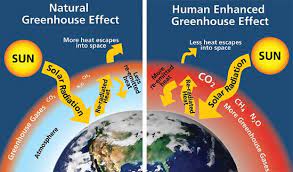
- A greenhouse gas is any gaseous compound in the atmosphere that is capable of absorbing infrared radiation, thereby trapping and holding heat in the atmosphere. By increasing the heat in the atmosphere, greenhouse gases are responsible for the greenhouse effect, which ultimately leads to global warming.
- The main gases responsible for the greenhouse effect include carbon dioxide, methane, nitrous oxide, and water vapor (which all occur naturally), and fluorinated gases (which are synthetic).
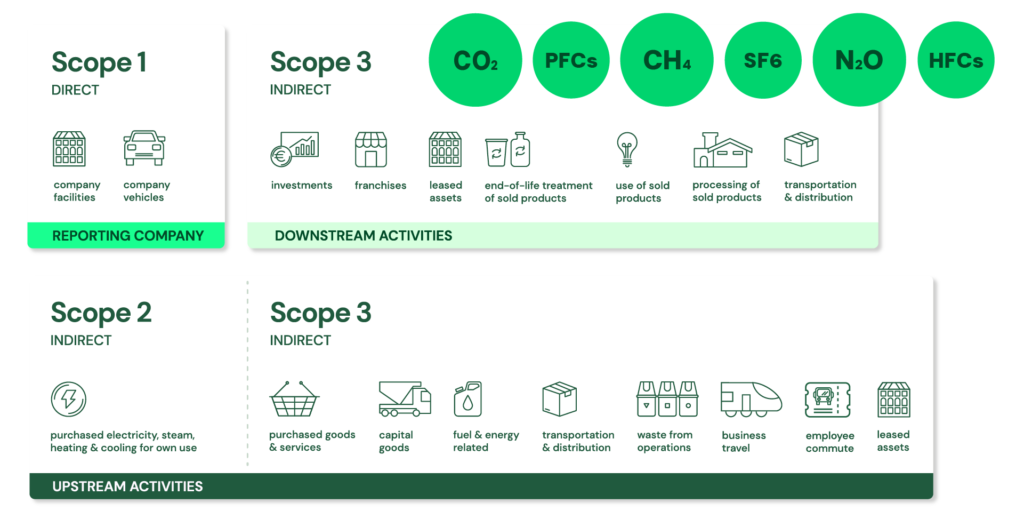
- GHG Protocol Corporate Standard Scope 1, 2 and 3: https://ghgprotocol.org/ + The GHG Protocol Corporate Accounting and Reporting Standard provides requirements and guidance for companies and other organizations preparing a corporate-level GHG emissions inventory. Scope 1 and 2 are typically mandatory for companies that are required to report their emissions by national or regional regulations. The GHG Protocol itself is a voluntary standard.
- Scope 1: Direct emissions:
- Direct emissions from company-owned and controlled resources. In other words, emissions are released into the atmosphere as a direct result of a set of activities, at a firm level. It is divided into four categories:
- Stationary combustion (e.g from fuels, heating sources). All fuels that produce GHG emissions must be included in scope 1.
- Mobile combustion is all vehicles owned or controlled by a firm, burning fuel (e.g. cars, vans, trucks). The increasing use of “electric” vehicles (EVs), means that some of the organisation’s fleets could fall into Scope 2 emissions.
- Fugitive emissions are leaks from greenhouse gases (e.g. refrigeration, air conditioning units). It is important to note that refrigerant gases are a thousand times more dangerous than CO2 emissions. Companies are encouraged to report these emissions.
- Process emissions are released during industrial processes, and on-site manufacturing (e.g. production of CO2 during cement manufacturing, factory fumes, chemicals).
- Direct emissions from company-owned and controlled resources. In other words, emissions are released into the atmosphere as a direct result of a set of activities, at a firm level. It is divided into four categories:
- Scope 2: Indirect emissions – owned:
- Indirect emissions from the generation of purchased energy, from a utility provider. In other words, all GHG emissions released in the atmosphere, from the consumption of purchased electricity, steam, heat and cooling. For most organisations, electricity will be the unique source of scope 2 emissions. Simply stated, the energy consumed falls into two scopes: Scope 2 covers the electricity consumed by the end-user. Scope 3 covers the energy used by the utilities during transmission and distribution (T&D losses).
- Scope 3: Indirect emissions – not owned:
- Indirect emissions – not included in scope 2 – that occur in the value chain of the reporting company, including both upstream and downstream emissions. In other words, emissions are linked to the company’s operations. According to the GHG protocol, scope 3 emissions are separated into 15 categories.
- Scope 1: Direct emissions: