
NKT – NKT secures ten-year solar power agreement to supply German manufacturing sites

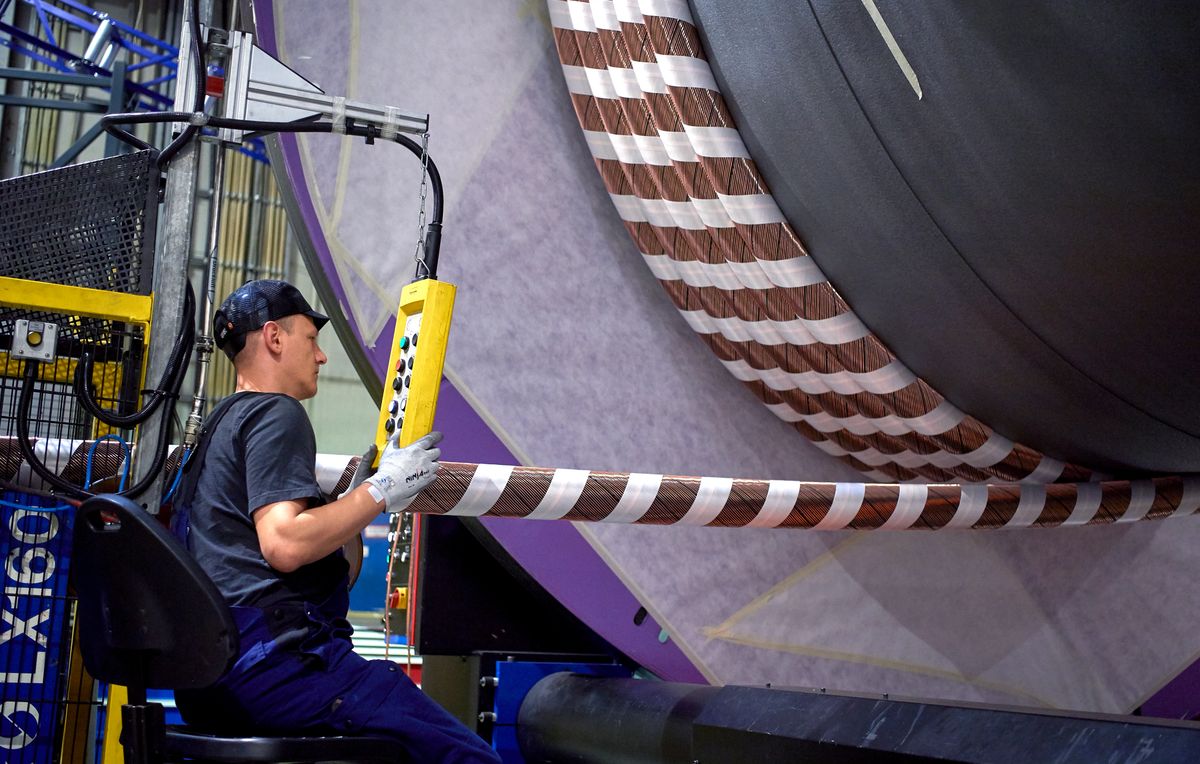
NKT and Uniper have signed a long-term Power Purchase Agreement (PPA) for electricity supplied from Uniper’s newly developed photovoltaic (PV) facility in Wilhelmshaven, Germany.
The renewable energy will support NKT’s production sites in Cologne as well as in Nordenham, which is located close to the PV installation. The agreement forms part of NKT’s continued strategic efforts to advance decarbonisation across its value chain and own operations.
NKT and Uniper have entered into a ten-year Power Purchase Agreement for the supply of renewable electricity from Uniper’s newly developed photovoltaic asset in Wilhelmshaven, Germany.
– This agreement is an important and natural next step in our strategic work to decarbonise our operations. By sourcing renewable electricity directly from a local solar power plant, we are able to reduce our environmental footprint while supporting regional renewable energy development. We see a clear trend where customers and partners increasingly expect credible, long‑term commitments to renewable energy sourcing as part of wider supply chain decarbonisation, and a PPA is recognised as one of the most robust instruments to demonstrate this progress, says Michael C. Hjorth, CCO of NKT.
The renewable electricity will support NKT’s operations at the high-voltage cable factory in Cologne, as well as the cable accessories factory in Nordenham, which is located close to the PV installation.
The agreement marks an important step for both companies as they reinforce their sustainability ambitions and increase the use of regionally sourced renewable energy.
– This project shows how regional renewables can directly support industrial decarbonisation, and we are pleased to supply NKT with clean power from a site that symbolises real transformation. At the same time, Power Purchase Agreements provide our partners with long‑term price stability, creating certainty while accelerating the energy transition, says Andreas Gemballa, CCO at Uniper Energy Sales.
The Voslapper Groden solar park, located on the former ash field of the coal-fired power plant in Wilhelmshaven, has an installed capacity of 17.2 megawatt peak (MWp). It is expected to generate approximately 17,872 MWh of renewable electricity annually. Under the terms of the physical PPA, NKT will purchase 100% of the hourly, as-produced renewable electricity, as well as 100% of all available Guarantees of Origin (GoOs) from the facility.
The agreed target Commercial Operation Date (COD) is 31 January 2027, although commissioning may begin earlier if the site becomes operational ahead of schedule.
SourceNKT
EMR Analysis
More information on NKT: See the full profile on EMR Executive Services
More information on Claes Westerlind (President and Chief Executive Officer, NKT): See the full profile on EMR Executive Services
More information on Line Andrea Fandrup (Executive Vice President, Chief Financial Officer, NKT till end of April 2026): See the full profile on EMR Executive Services
More information on Michael C. Hjorth (Members of the Global Leadership Team, Chief Commercial Officer, NKT): See the full profile on EMR Executive Services
More information on Uniper: https://www.uniper.energy/ + Düsseldorf-based Uniper is a European energy company with global reach and operations in more than 40 countries. It has about 7,500 employees and plays a key role in ensuring a secure energy supply in Europe, particularly in its core markets of Germany, the United Kingdom, Sweden, and the Netherlands. Uniper’s 14 gigawatts of flexible power generating capacity make it a mainstay of reliable power production. Uniper is a leading gas trader and one of Northwestern Europe’s most important LNG importers, and its broad procurement portfolio enhances supply security. Uniper’s investments in renewables, hydrogen, and other low-carbon energy carriers propel the transformation of the energy system.
Uniper provides energy and services to about 1,000 municipalities and industrial companies in its home market, Germany. Uniper is also Germany’s largest operator of gas storage facilities and hydropower plants.
- Active in more than 40 countries, with core markets in Germany, the Netherlands, Sweden and the UK.
- Roughly 19.5 GW of power generation capacity (roughly equal to the total capacity of the Netherlands)
- Entire business to be carbon-neutral by 2040
- Gas portfolio consisting of over 130 TWh of long-term contracts, LNG, and short-term market transactions.
- About 7,500 employees
- €2.6 billion in adjusted EBITDA
More information on Michael D. Lewis (Chief Executive Officer, Uniper): https://www.uniper.energy/investors/corporate-governance/management-board + https://www.linkedin.com/in/michael-lewis-uniper/
More information on Andreas Gemballa (Chief Commercial Officer, Uniper Energy Sales, Uniper): https://www.linkedin.com/in/andreas-gemballa-2880529/
EMR Additional Notes:
- Power Purchase Agreements (PPAs):
- A Power Purchase Agreement (PPA) often refers to a long-term electricity supply agreement between two parties, usually between a power producer and a customer (an electricity consumer or trader). The PPA defines the conditions of the agreement, such as the amount of electricity to be supplied, negotiated prices, accounting, and penalties for non-compliance. Since it is a bilateral agreement, a PPA can take many forms and is usually tailored to the specific application. Electricity can be supplied physically or on a balancing sheet. PPAs can be used to reduce market price risks, which is why they are frequently implemented by large electricity consumers to help reduce investment costs associated with planning or operating renewable energy plants.
- Depending on regulation and the market environment, different situations can arise in which PPAs are an advantageous form of financing or a stabilizing factor in long-term power delivery.
- Carbon Dioxide (CO2):
- The primary greenhouse gas emitted through human activities. Carbon dioxide enters the atmosphere through burning fossil fuels (coal, natural gas, and oil), solid waste, trees and other biological materials, and also as a result of certain chemical reactions (e.g., manufacture of cement). Carbon dioxide is removed from the atmosphere (or “sequestered”) when it is absorbed by plants as part of the biological carbon cycle.
- Biogenic Carbon Dioxide (CO2):
- Biogenic Carbon Dioxide (CO2) and Carbon Dioxide (CO2) are the same molecule. Scientists differentiate between biogenic carbon (that which is absorbed, stored and emitted by organic matter like soil, trees, plants and grasses) and non-biogenic carbon (that found in all other sources, most notably in fossil fuels like oil, coal and gas).
- CO2e (Carbon Dioxide Equivalent):
- CO2e means “carbon dioxide equivalent”. In layman’s terms, CO2e is a measurement of the total greenhouse gases emitted, expressed in terms of the equivalent measurement of carbon dioxide. On the other hand, CO2 only measures carbon emissions and does not account for any other greenhouse gases.
- A carbon dioxide equivalent or CO2 equivalent, abbreviated as CO2-eq is a metric measure used to compare the emissions from various greenhouse gases on the basis of their global-warming potential (GWP), by converting amounts of other gases to the equivalent amount of carbon dioxide with the same global warming potential.
- Carbon dioxide equivalents are commonly expressed as million metric tonnes of carbon dioxide equivalents, abbreviated as MMTCDE.
- The carbon dioxide equivalent for a gas is derived by multiplying the tonnes of the gas by the associated GWP: MMTCDE = (million metric tonnes of a gas) * (GWP of the gas).
- For example, the GWP for methane is 25 and for nitrous oxide 298. This means that emissions of 1 million metric tonnes of methane and nitrous oxide respectively is equivalent to emissions of 25 and 298 million metric tonnes of carbon dioxide.
- Carbon Footprint:
- There is no universally agreed definition of what a carbon footprint is.
- A carbon footprint is generally understood to be the total amount of greenhouse gas (GHG) emissions that are directly or indirectly caused by an individual, organization, product, or service. These emissions are typically measured in tonnes of carbon dioxide equivalent (CO2e).
- In 2009, the Greenhouse Gas Protocol (GHG Protocol) published a standard for calculating and reporting corporate carbon footprints. This standard is widely accepted by businesses and other organizations around the world. The GHG Protocol defines a carbon footprint as “the total set of greenhouse gas emissions caused by an organization, directly and indirectly, through its own operations and the value chain.”
- Decarbonization:
- Reduction of carbon dioxide emissions through the use of low carbon power sources, and achieving a lower output of greenhouse gases into the atmosphere.
- Carbon Credits or Carbon Offsets:
- Permits that allow the owner to emit a certain amount of carbon dioxide or other greenhouse gases. One credit permits the emission of one ton of carbon dioxide or the equivalent in other greenhouse gases.
- The carbon credit is half of a so-called cap-and-trade program. Companies that pollute are awarded credits that allow them to continue to pollute up to a certain limit, which is reduced periodically. Meanwhile, the company may sell any unneeded credits to another company that needs them. Private companies are thus doubly incentivized to reduce greenhouse emissions. First, they must spend money on extra credits if their emissions exceed the cap. Second, they can make money by reducing their emissions and selling their excess allowances.
- Carbon Capture and Storage (CCS) – Carbon Capture, Utilisation and Storage (CCUS):
- CCS involves the capture of carbon dioxide (CO2) emissions from industrial processes. This carbon is then transported from where it was produced, via ship or in a pipeline, and stored deep underground in geological formations.
- CCS projects typically target 90 percent efficiency, meaning that 90 percent of the carbon dioxide from the power plant will be captured and stored.
- CCUS adds the utilization aspect, where the captured CO2 is used as a new product or raw material.
- Carbon Dioxide Removal (CDR) or Durable Carbon Removal:
- Carbon Dioxide Removal encompasses approaches and methods for removing CO2 from the atmosphere and then storing it permanently in underground geological formations, in biomass, oceanic reservoirs or long-lived products in order to achieve negative emissions.
- Direct Air Capture (DAC):
- Technologies that extract CO2 directly from the atmosphere at any location, unlike carbon capture which is generally carried out at the point of emissions, such as a steel plant.
- Constraints like costs and energy requirements as well as the potential for pollution make DAC a less desirable option for CO2 reduction. Its larger land footprint when compared to other mitigation strategies like carbon capture and storage systems (CCS) also put it at a disadvantage.
- Direct Air Capture and Storage (DACCS):
- Climate technology that removes carbon dioxide (CO2) directly from the ambient atmosphere using large fans and chemical processes to bind with the CO2.
- Bioenergy with Carbon Capture and Storage (BECCS):
- Negative emissions technology that captures carbon dioxide (CO2) from biomass used for energy production and stores it permanently. Plants absorb CO2 from the atmosphere as they grow (photosynthesis), and BECCS interrupts the cycle by capturing this biogenic CO2 during the energy conversion process—burning, fermentation, etc.—instead of letting it re-enter the atmosphere.
- Enhanced Rock Weathering (ERW):
- Carbon dioxide removal (CDR) technique that accelerates the natural process of rock weathering by grinding silicate rocks into dust and spreading it on land, typically agricultural fields. This process uses rainwater to convert atmospheric carbon dioxide into mineral carbonates, which are then stored long-term in soils, groundwater, and oceans.
- Limits of Carbon Dioxide Storage:
- Carbon storage is not endless; the Earth’s capacity for permanently storing vast amounts of captured carbon, particularly in geological formations, is limited, potentially reaching a critical limit of 1,460 gigatonnes at around 2200, though storage durations vary significantly depending on the method, from decades for some biological methods to potentially millions of years for others like mineralization. While some methods offer very long-term storage, the sheer volume needed to meet climate targets requires scaling up storage significantly beyond current capacity, raising concerns about the available volume over time.
- Global Warming:
- Global warming is the long-term heating of Earth’s climate system observed since the pre-industrial period (between 1850 and 1900) due to human activities, primarily fossil fuel burning, which increases heat-trapping greenhouse gas levels in Earth’s atmosphere.
- Global Warming Potential (GWP):
- The heat absorbed by any greenhouse gas in the atmosphere, as a multiple of the heat that would be absorbed by the same mass of carbon dioxide (CO2). GWP is 1 for CO2. For other gases it depends on the gas and the time frame.
- Carbon dioxide equivalent (CO2e or CO2eq or CO2-e) is calculated from GWP. For any gas, it is the mass of CO2 which would warm the earth as much as the mass of that gas. Thus it provides a common scale for measuring the climate effects of different gases. It is calculated as GWP times mass of the other gas. For example, if a gas has GWP of 100, two tonnes of the gas have CO2e of 200 tonnes.
- GWP was developed to allow comparisons of the global warming impacts of different gases.
- Greenhouse Gas (GHG):
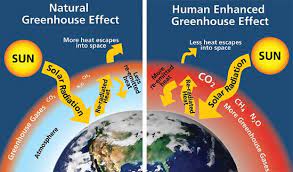
- A greenhouse gas is any gaseous compound in the atmosphere that is capable of absorbing infrared radiation, thereby trapping and holding heat in the atmosphere. By increasing the heat in the atmosphere, greenhouse gases are responsible for the greenhouse effect, which ultimately leads to global warming.
- The main gases responsible for the greenhouse effect include carbon dioxide, methane, nitrous oxide, and water vapor (which all occur naturally), and fluorinated gases (which are synthetic).
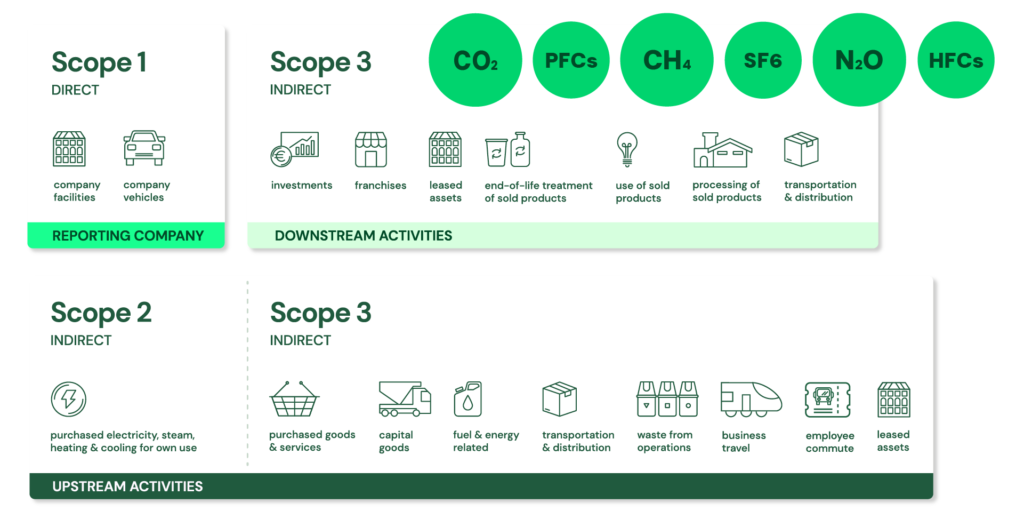
- GHG Protocol Corporate Standard Scope 1, 2 and 3: https://ghgprotocol.org/ + The GHG Protocol Corporate Accounting and Reporting Standard provides requirements and guidance for companies and other organizations preparing a corporate-level GHG emissions inventory. Scope 1 and 2 are typically mandatory for companies that are required to report their emissions by national or regional regulations. The GHG Protocol itself is a voluntary standard.
- Scope 1: Direct emissions:
- Direct emissions from company-owned and controlled resources. In other words, emissions are released into the atmosphere as a direct result of a set of activities, at a firm level. It is divided into four categories:
- Stationary combustion (e.g from fuels, heating sources). All fuels that produce GHG emissions must be included in scope 1.
- Mobile combustion is all vehicles owned or controlled by a firm, burning fuel (e.g. cars, vans, trucks). The increasing use of “electric” vehicles (EVs), means that some of the organisation’s fleets could fall into Scope 2 emissions.
- Fugitive emissions are leaks from greenhouse gases (e.g. refrigeration, air conditioning units). It is important to note that refrigerant gases are a thousand times more dangerous than CO2 emissions. Companies are encouraged to report these emissions.
- Process emissions are released during industrial processes, and on-site manufacturing (e.g. production of CO2 during cement manufacturing, factory fumes, chemicals).
- Direct emissions from company-owned and controlled resources. In other words, emissions are released into the atmosphere as a direct result of a set of activities, at a firm level. It is divided into four categories:
- Scope 2: Indirect emissions – owned:
- Indirect emissions from the generation of purchased energy, from a utility provider. In other words, all GHG emissions released in the atmosphere, from the consumption of purchased electricity, steam, heat and cooling. For most organisations, electricity will be the unique source of scope 2 emissions. Simply stated, the energy consumed falls into two scopes: Scope 2 covers the electricity consumed by the end-user. Scope 3 covers the energy used by the utilities during transmission and distribution (T&D losses).
- Scope 3: Indirect emissions – not owned:
- Indirect emissions – not included in scope 2 – that occur in the value chain of the reporting company, including both upstream and downstream emissions. In other words, emissions are linked to the company’s operations. According to the GHG protocol, scope 3 emissions are separated into 15 categories.
- Scope 1: Direct emissions:
- Extra Low-Voltage (ELV):
- Extra-Low Voltage (ELV) is defined as a voltage of 50V or less (AC RMS), or 120V or less (ripple-free DC).
- Low-Voltage (LV):
- The International Electrotechnical Commission (IEC) defines Low Voltage (LV) for supply systems as voltage in the range 50–1000 V AC or 120–1500 V DC.
- Medium-Voltage (MV):
- Medium Voltage (MV) is a voltage class that typically falls between low voltage and high voltage, with a common range being from 1 kV to 35 kV. In some contexts, this range can extend higher, up to 69 kV.
- High-Voltage (HV):
- The International Electrotechnical Commission define high voltage as above 1000 V for alternating current, and at least 1500 V for direct current.
- Super High-Voltage or Extra High-Voltage (EHV):
- Super High-Voltage or Extra High-Voltage (EHV) is the voltage class used for long-distance bulk power transmission. The range for EHV systems is typically from 230 kV to 800 kV.
- Ultra High-Voltage (UHV):
- Ultra High-Voltage (UHV) is the highest voltage class used in electrical transmission, defined as a voltage of 1000 kV or greater.
- Fundamental Units of Electricity:
- Ampere – Amp (A):
- Amperes measure the flow of electrical current (charge) through a circuit. Ampere (A) is the unit of measure for the rate of electron flow, or current, in an electrical conductor.
- One ampere is defined as one coulomb of electric charge moving past a point in one second. The ampere is named after the French physicist André-Marie Ampère, who made significant contributions to the study of electromagnetism.
- Milliampere (mA) is a unit of electric current equal to one-thousandth of an ampere (1mA=10−3A). The prefix “milli” signifies 10−3 in the metric system. This unit is commonly used to measure small currents in electronic circuits and consumer devices.
- Volts measure the force or potential difference that drives the flow of electrons through a circuit.
- Kilovolt (kV) is a unit of potential difference equal to 1,000 volts.
- Watts measure the rate of energy consumption or generation, also known as power.
- Amperes measure the flow of electrical current (charge) through a circuit. Ampere (A) is the unit of measure for the rate of electron flow, or current, in an electrical conductor.
- Power vs. Energy: how electricity is measured and billed.
- Power (measured in kW, MW, GW, TW): Rate at which energy is used or generated at a given moment.
- Energy (measured in kWh, MWh, GWh, TWh): Total amount of power consumed or generated over a period of time (i.e., Power x Time).
- Real Power Units: actual power that performs work.
- Kilowatt (KW):
- A kilowatt is simply a measure of how much power an electric appliance consumes—it’s 1,000 watts to be exact. You can quickly convert watts (W) to kilowatts (kW) by dividing your wattage by 1,000: 1,000W 1,000 = 1 kW.
- Megawatt (MW):
- One megawatt equals one million watts or 1,000 kilowatts, roughly enough electricity for the instantaneous demand of 750 homes at once.
- Gigawatt (GW):
- A gigawatt (GW) is a unit of power, and it is equal to one billion watts.
- According to the Department of Energy, generating one GW of power takes over three million solar panels or 310 utility-scale wind turbines
- Terawatt (TW):
- One terawatt is equal to one trillion watts (1,000,000,000,000 watts). The main use of terawatts is found in the electric power industry, particularly for measuring very large-scale power generation or consumption.
- According to the United States Energy Information Administration, America is one of the largest electricity consumers in the world, using about 4,146.2 terawatt-hours (TWh) of energy per year.
- Kilowatt (KW):
- Apparent Power Units: measures the total power in a circuit, including power that does not perform useful work.
- Kilovolt-Amperes (kVA):
- Kilovolt-Amperes (kVA) stands for Kilo-volt-amperes, a term used for the rating of an electrical circuit. A kVA is a unit of apparent power, which is the product of the circuit’s maximum voltage and current rating.
- The difference between real power (kW) and apparent power (kVA) is crucial. Real power (kW) is the actual power that performs work, while apparent power (kVA) is the total power delivered to a circuit, including the real power and the reactive power (kVAR) that doesn’t do useful work. The relationship between them is defined by the power factor. Since the power factor is typically less than 1, the kVA value will always be higher than the kW value.
- Megavolt-Amperes (MVA):
- Megavolt-Amperes (MVA) is a unit used to measure the apparent power in a circuit, primarily for very large electrical systems like power plants and substations. It’s a product of the voltage and current in a circuit.
- 1 MVA is equivalent to 1,000 kVA, or 1,000,000 volt-amperes.
- Kilovolt-Amperes (kVA):
- Specialized Power Units: used specifically for renewable energy, especially solar.
- KiloWatt ‘peak’ (KWp):
- kWp stands for kilowatt ‘peak’ power output of a system. It is most commonly applied to solar arrays. For example, a solar panel with a peak power of 3kWp which is working at its maximum capacity for one hour will produce 3kWh. kWp (kilowatt peak) is the total kw rating of the system, the theoretical ‘peak’ output of the system. e.g. If the system has 4 x 270 watt panels, then it is 4 x 0.27kWp = 1.08kWp.
- The Wp of each panel will allow you to calculate the surface area needed to reach it. 1 kWp corresponds theoretically to 1,000 kWh per year.
- KiloWatt ‘peak’ (KWp):
- Ampere – Amp (A):
- Commissioning:
- Commissioning ensures the system not only works but also works efficiently and effectively to meet its intended purpose. It is a quality assurance process that ensures a newly installed system is designed, installed, tested, and maintained to operate according to the owner’s requirements.
- It goes beyond a simple installation. Commissioning is a formal, documented process that involves several key steps:
- Pre-Installation
- Installation Verification.
- Functional Performance Testing.
- Documentation & Training.