NKT – NKT joint venture inaugurates offshore power cable factory in Taiwan
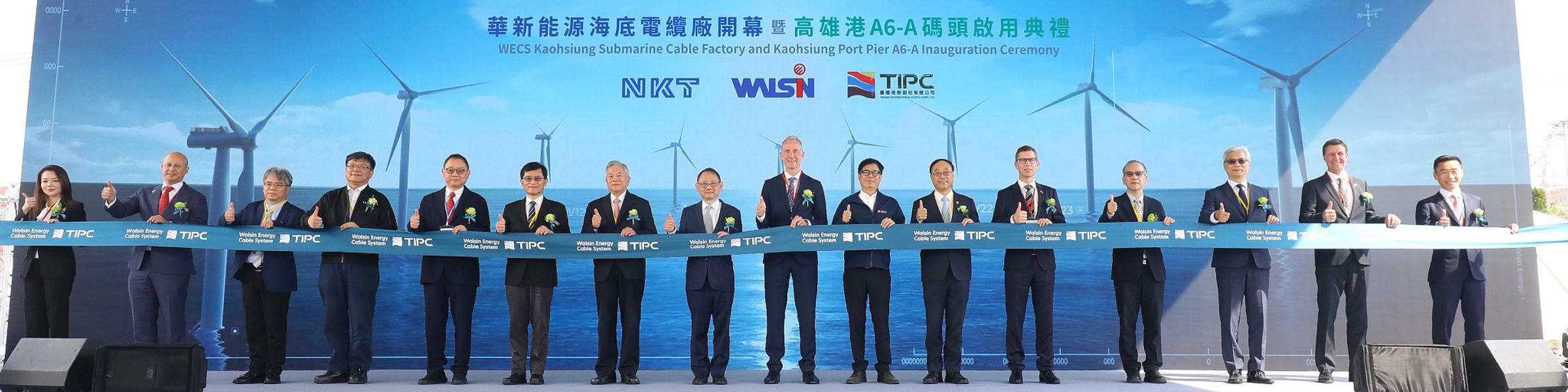
Taiwan has reached a major milestone in its transition towards renewable energy with the unveiling of the country’s first offshore power cable factory.
The inauguration marks a significant achievement in the pioneering joint venture between Taiwanese cable company Walsin Lihwa and NKT. Through this collaboration, NKT is leveraging its technology and factory-building expertise to meet global demand for power cables driven by electrification, digitalisation, the green transition, and energy independence.
A state-of-the-art offshore power cable factory was inaugurated today, Saturday 6 December, in Kaohsiung, Taiwan. Operated by Walsin Energy Cable System (WECS), a joint venture between NKT and Taiwanese Walsin Lihwa, the facility is Taiwan’s first localised submarine cable production site, marking the nation’s entry into offshore cable manufacturing.
Spanning 231,000 square metres and incorporating a 50-metre extrusion tower, the factory will produce high- and medium-voltage AC offshore power cables primarily for Taiwan’s offshore wind market.
– The inauguration of the WECS offshore cable factory is a moment of pride and an important milestone. Since the formation of the partnership in 2023, Walsin Lihwa and NKT have combined expertise, culture, and vision to jointly build this state-of-the-art offshore cable factory. This achievement embodies our shared vision of accelerating the global clean energy transition and strengthening the resilience of critical infrastructure. With its expertise and commitment, NKT is honoured to contribute to Taiwan’s path towards energy autonomy and net-zero emissions, says Claes Westerlind, CEO of NKT.
At the opening ceremony WECS emphasised the strategic importance of the facility in strengthening Taiwan’s energy infrastructure and supporting its long-term renewable energy ambitions.
– We are delighted to collaborate with NKT, whose leading technology and expertise – combined with our shared commitment to environmental, social, and corporate governance principles – have enabled us to successfully complete the construction of our submarine cable factory in record time. This partnership represents a major milestone in Taiwan’s green energy transition and opens new opportunities for both parties across the Asia-Pacific market, says Mr. Yu-Lon Chiao, Chairman of Walsin Energy Cable System.
Commercial production is scheduled to begin in 2027 following type tests and prequalification.
SourceNKT
EMR Analysis
More information on NKT: See the full profile on EMR Executive Services
More information on Claes Westerlind (President and Chief Executive Officer, NKT): See the full profile on EMR Executive Services
More information on Line Andrea Fandrup (Executive Vice President, Chief Financial Officer, NKT till end of April 2026): See the full profile on EMR Executive Services
More information on Walsin Lihwa: https://www.walsin.com/en/ + Established in 1966, Walsin Lihwa dedicates itself to the development of wire and cable, stainless steel, commodity resources, real estate, and renewable energies. As a leader in the wire and cable and the stainless steel industry in the Greater China region, the company has also expanded itself into a multinational conglomerate with hi-tech and energy investments.
Walsin Lihwa Corporation, established in 1966 with a capital of NT$30 million, began by producing aluminum conductor cables. Today, Walsin Lihwa has established itself as a leading manufacturer of wires and cables in Greater China, as well as a global leader in the stainless steel industry. The company has also expanded itself into a multinational conglomerate with high-tech and energy investments.
Listed on the Taiwan Stock Exchange in 1972, Walsin Lihwa achieved a consolidated revenue of approximately NT$179.3 billion in 2024 and employs more than 11,000 people.
Headquartered in Taipei, Walsin Lihwa has been aggressively pursuing global growth with over 40 operational sites located in Hsinchuang, Yangmei, Taichung, Yenshui, Kaohsiung, Shanghai, Hangzhou, Jiangyin, Nanjing, Changshu, Dongguan, Yantai; Japan; Indonesia; Malaysia; the U.S.A.; the UK; Germany; Italy; and Sweden.
More information on Yu-Lon Chiao (Chairman, Walsin Energy Cable System (WECS), Walsin Lihwa & NKT + Chairman, Walsin Lihwa): https://www.walsin.com/en/about-us/who-we-are/#pills-leadership
More information on Walsin Energy Cable System (WECS) by Walsin Lihwa & NKT: https://www.walsinenergy.com/ + Few cable makers specialize exclusively in submarine cables, and Walsin Energy Cable System (WECS) is making a significant leap in such regards. As a joint venture between a leading European enterprise in power transmission, NKT, and Taiwan’s Walsin Lihwa Group, WECS is dedicated to bringing cutting-edge technology to transform the future landscape of energy connectivity.
As the global supply chain works towards providing sufficient quality and reliable power systems, WECS is driven to meet client needs in the Taiwanese market by leveraging the connectivity of Kaohsiung Port, one of the most critical harbors in Asia.
We deeply believe that the energy transition requires the efforts of multinational stakeholders. Both of our parent companies share this belief and have taken action accordingly. We are here as a humble new entrant, committed to rebuilding a greener world.
The company’s mission is to drive Taiwan’s green energy transition by delivering reliable, high-quality, and competitive offshore cable products on time. WECS aims to strengthen Taiwan’s strategic position in the international wind and offshore cable industry, contributing to wind power generation and enhancing energy resilience. The joint venture includes a technology license agreement licensing NKT technology to the joint venture. NKT owns a share of the joint venture and also act as the technical partner for WECS.
More information on Yu-Lon Chiao (Chairman, Walsin Energy Cable System (WECS), Walsin Lihwa & NKT + Chairman, Walsin Lihwa): https://www.walsin.com/en/about-us/who-we-are/#pills-leadership
More information on The Science Based Targets initiative (SBTi): https://sciencebasedtargets.org/ + The Science Based Targets initiative (SBTi) is a global body enabling businesses to set ambitious emissions reductions targets in line with the latest climate science. It is focused on accelerating companies across the world to halve emissions before 2030 and achieve net-zero emissions before 2050.
The initiative is a collaboration between CDP, the United Nations Global Compact, World Resources Institute (WRI) and the World Wide Fund for Nature (WWF) and one of the We Mean Business Coalition commitments. The SBTi defines and promotes best practice in science-based target setting, offers resources and guidance to reduce barriers to adoption, and independently assesses and approves companies’ targets.
- Defines and promotes best practices in emissions reductions and net-zero targets in line with climate science.
- Provides target setting methods and guidance to companies to set science-based targets in line with the latest climate science.
- Includes a team of experts to provide companies with independent assessment and validation of targets.
- Serves as the lead partner of the Business Ambition for 1.5°C campaign, an urgent call to action from a global coalition of UN agencies, business and industry leaders that mobilizes companies to set net-zero science-based targets in line with a 1.5 degrees C future.
More information on Net Zero by 2050 by the United Nations: https://www.un.org/en/climatechange/net-zero-coalition + Put simply, net zero means cutting greenhouse gas emissions to as close to zero as possible, with any remaining emissions re-absorbed from the atmosphere, by oceans and forests for instance.
Currently, the Earth is already about 1.1°C warmer than it was in the late 1800s, and emissions continue to rise. To keep global warming to no more than 1.5°C – as called for in the Paris Agreement – emissions need to be reduced by 45% by 2030 and reach net zero by 2050.
More than 140 countries, including the biggest polluters – China, the United States, India and the European Union – have set a net-zero target, covering about 88% of global emissions. More than 9,000 companies, over 1000 cities, more than 1000 educational institutions, and over 600 financial institutions have joined the Race to Zero, pledging to take rigorous, immediate action to halve global emissions by 2030.
More information on Net Zero by 2050 by the Science Based Targets initiative (SBTi): https://sciencebasedtargets.org/net-zero + The SBTi’s Corporate Net-Zero Standard is the world’s only framework for corporate net-zero target setting in line with climate science. It includes the guidance, criteria, and recommendations companies need to set science-based net-zero targets consistent with limiting global temperature rise to 1.5°C.
UN vs. SBTi:
- UN targets nations, while SBTi focuses on companies. UN sets a broad goal, while SBTI provides a detailed framework for target setting.
- Both aim to achieve net zero emissions and limit warming to 1.5°C. The UN sets the overall direction, and SBTi helps businesses translate that goal into actionable plans.
Key components of the Corporate Net-Zero Standard:
- Near-term targets: Rapid, deep cuts to direct and indirect value-chain emissions must be the overarching priority for companies. Companies must set near-term science-based targets to roughly halve emission before 2030. This is the most effective, scientifically-sound way of limiting global temperature rise to 1.5°C.
- Long-term targets: Companies must set long-term science-based targets. Companies must cut all possible – usually more than 90% – of emissions before 2050.
- Neutralize residual emissions: After a company has achieved its long-term target and cut emissions by more than 90%, it must use permanent carbon removal and storage to counterbalance the final 10% or more of residual emissions that cannot be eliminated. A company is only considered to have reached net-zero when it has achieved its long-term science-based target and neutralized any residual emissions.
- Beyond Value Chain Mitigation (BVCM): Businesses should invest now in actions to reduce and remove emissions outside of their value chains in addition to near- and long-term science-based targets.
EMR Additional Notes:
- Power Cable:
- A power cable is a type of electrical cable used to transmit electrical power. It typically consists of one or more insulated conductors surrounded by a protective outer sheath.
- Types of power cables:
- Overhead cables: These are suspended from poles or towers and are commonly used for long-distance power transmission.
- Underground cables: These are installed underground and are typically used for local distribution or in areas where overhead lines are impractical or unsafe.
- Submarine cables: These are laid underwater to connect islands, countries, or offshore wind farms to the mainland power grid.
- Medium-voltage cables: These are used for the distribution of electrical power from substations to local areas.
- Low-voltage cables: These are used for the final distribution of power to individual homes and businesses.
- Superconducting Power Cable:
- A superconducting power cable is a type of electrical cable that uses superconducting materials to conduct electricity with zero resistance. This means that no energy is lost due to heat dissipation, making it significantly more efficient than traditional copper or aluminum cables. Superconducting cables can be used to transmit large amounts of power over long distances with minimal energy losses.
- Telecommunication Cable:
- Distinct category of cable with a different primary purpose: transmitting signals rather than power.
- Telecommunication cables transmit various signals, like voice, data, and video, over distances and include types such as twisted pair cables, which use insulated copper wires for signals; coaxial cables, designed to carry both signals and ground in concentric layers; and fiber optic cables, which transmit data as pulses of light.
- Extra Low-Voltage (ELV):
- Extra-Low Voltage (ELV) is defined as a voltage of 50V or less (AC RMS), or 120V or less (ripple-free DC).
- Low-Voltage (LV):
- The International Electrotechnical Commission (IEC) defines Low Voltage (LV) for supply systems as voltage in the range 50–1000 V AC or 120–1500 V DC.
- Medium-Voltage (MV):
- Medium Voltage (MV) is a voltage class that typically falls between low voltage and high voltage, with a common range being from 1 kV to 35 kV. In some contexts, this range can extend higher, up to 69 kV.
- High-Voltage (HV):
- The International Electrotechnical Commission define high voltage as above 1000 V for alternating current, and at least 1500 V for direct current.
- Super High-Voltage or Extra High-Voltage (EHV):
- Super High-Voltage or Extra High-Voltage (EHV) is the voltage class used for long-distance bulk power transmission. The range for EHV systems is typically from 230 kV to 800 kV.
- Ultra High-Voltage (UHV):
- Ultra High-Voltage (UHV) is the highest voltage class used in electrical transmission, defined as a voltage of 1000 kV or greater.
- AC (Alternating Current) & DC (Direct Current) & UC (Universal Current):
- Direct current (DC): Electric current that is uni-directional, so the flow of charge is always in the same direction. As opposed to alternating current, the direction of direct currents does not change. It is used in many household electronics and in all devices that use batteries.
- Direct current has many uses, from the charging of batteries to large power supplies for electronic systems, motors, and more. Very large quantities of electrical energy provided via direct-current are used in the smelting of aluminum and other electrochemical processes.
- In contrast to AC power, DC power is more efficient for long-distance transmission, especially at high voltages, because it avoids the reactive power losses and skin effect associated with AC. This makes it more suitable for long-distance power grids.
- Alternating Current (AC): Used in homes because it can be easily stepped up or stepped down with the help of transformers, whereas direct current cannot. This ability to easily convert voltage allows for efficient transmission of electricity over long distances at high voltage before it is stepped down to a low, safe voltage for home use.
- Universal Current (UC): Means it can accept either DC or AC. So a 24 V UC input can accept either 24 V AC or 24 V DC.
- Direct current (DC): Electric current that is uni-directional, so the flow of charge is always in the same direction. As opposed to alternating current, the direction of direct currents does not change. It is used in many household electronics and in all devices that use batteries.
- CSR (Corporate Social Responsibility):
- Framework or business model that helps a company be socially accountable to itself, its stakeholders, and the public.
- The purpose of CSR is to give back to the community, take part in philanthropic causes, and provide positive social value. Businesses are increasingly turning to CSR to make a difference and build a positive brand around their company.
- CSR tends to target opinion formers – politicians, pressure groups, media. Sustainability targets here the whole value chain – from suppliers to operations to partners to end-consumers.
- ESG (Environmental, Social and Governance):
- Refers to the three key factors when measuring the sustainability and ethical impact of an investment in a business or company. Most socially responsible investors check companies out using ESG criteria to screen investments.
- ESG metrics are not commonly part of mandatory financial reporting, though companies are increasingly making disclosures in their annual report or in a standalone sustainability report.
- There is not a standardized approach to the calculation or presentation of different ESG metrics.
- Environmental: Conservation of the natural world
- Climate change and carbon emissions
- Air and water pollution
- Biodiversity
- Deforestation
- Energy efficiency
- Waste management
- Water scarcity
- …
- Social: Consideration of people & relationships
- Customer satisfaction
- Data protection and privacy
- Gender and diversity
- Employee engagement
- Community relations
- Human rights
- Labor standards
- …
- Governance: Standards for running a company
- Board composition
- Audit committee structure
- Bribery and corruption
- Executive compensation
- Lobbying
- Political contributions
- Whistleblower schemes
- …
- Environmental: Conservation of the natural world
- Criteria are of increasing interest to companies, their investors and other stakeholders. With growing concern about he ethical status of quoted companies, these standards are the central factors that measure the ethical impact and sustainability of investment in a company.
- Consequently, ESG analysis considers how companies serve society and how this impacts their current and future performance.
- CSR vs. ESG:
- CSR is a company’s framework of sustainability plans and responsible cultural influence, whereas ESG is the assessable outcome concerning a company’s overall sustainability performance.
- The major difference between them is that CSR is a business model used by individual companies, while ESG is a criteria that investors use to assess a company and determine if they are worth investing in.