Mersen – Mersen: change to its Board of Directors

Mersen has announced a change to its Board of Directors.
Paris, January 27, 2026 – Mersen (Euronext FR0000039620 – MRN), a global expert in electrical power and advanced materials, has announced a change to its Board of Directors.
Mrs Emmanuelle Picard, a board member since 2023, has informed the Board of her decision to resign for personal reasons. The Board of Directors has decided to appoint, as of today, Mrs Florence Lambert to replace Mrs Emmanuelle Picard for the remainder of her’s term, which runs through the end of the General Meeting to be held in 2027. Currently Chief Executive Officer of Genvia, a leader in high‑temperature electrolysis and a key player in the energy transition, Mrs Florence Lambert will bring to the Board her extensive experience in the field of renewable energies, a key market for Mersen, as well as her expertise in innovation and R&D.
The Board of Directors wishes to thank Mrs Emmanuelle Picard sincerely for her contributions, in particular for her work on the Audit and Accounts Committee, as well as for her role as Director in charge of coordination on strategic matters.
In accordance with the criteria set out in the AFEP‑MEDEF Code and reflected in Mersen’s Board of Directors’ Internal Regulations, the Board has deemed Mrs Florence Lambert to be independent. Her appointment will be submitted for ratification at the next General Meeting.
Biography
Florence Lambert (52) began her career in 2000 at the French Atomic Energy and Alternative Energies Commission (CEA) where she held various positions. She participated in the creation of the French National Institute for Solar Energy (INES) of the CEA, before joining it in 2006. In 2009, she became Head of the Electricity and Hydrogen for Transportation Department. From 2012 to 2020, she was head of the CEA-LITEN (Innovation Laboratory for New Energy Technologies and Nanomaterials). Since 2021, she has been Chief Executive Officer of Genvia, a company that aims to develop and deploy industrial technology for the production of decarbonized hydrogen. She is also an independant board member of Arkema.
SourceMersen
EMR Analysis
More information on Mersen: See the full profile on EMR Executive Services
More information on Olivier Legrain (Independent Director, Chairman of the Board of Directors & Member of the Governance, Appointments and Remuneration Committee, Mersen): See the full profile on EMR Executive Services
More information on Florence Lambert-Hognon (Independent Director, Member of the Board of Directors & Member of the Audit and Accounts Committee, Mersen + Chief Executive Officer, Genvia): See the full profile on EMR Executive Services
More information on Luc Themelin (Chief Executive Officer, Mersen until Annual General Meeting in May 2026 + Nominated Non-Executive Chairman of the Board, Mersen at Annual General Meeting in May 2026): See the full profile on EMR Executive Services
More information on Salvador Lamas (Chief Operating Officer, Mersen + Designated Chief Executive Officer, Mersen until Annual General Meeting in May 2026 + Chief Executive Officer, Mersen as from after the Annual General Meeting in May 2026): See the full profile on EMR Executive Services
More information on Thomas Baumgartner (Chief Financial Officer, Mersen): See the full profile on EMR Executive Services
More information on Genvia: https://genvia.com/ + See the full profile on EMR Executive Services + Genvia aims to industrialize the manufacture of high-temperature electrolyzers (EHT) to mass-produce carbon-free hydrogen – a first in France – and thus contribute to achieving carbon neutrality by 2050, particularly for industry. At Genvia, our mission is therefore to support industrial sites that emit CO2, yet are essential to the development of our society, in the energy transition to help achieve decarbonization targets on a global scale.
Founded in 2021, Genvia is a joint venture created by industrialist SLB, CEA, as well as Vicat, Vinci and the Occitanie / Midi-Pyrénées Region via ARIS. This strong alliance between partners with complementary expertise is essential to industrialize this innovative electrolysis technology developed by the CEA.
Currently Genvia employs over 150 people across 3 locations.
More information on Florence Lambert-Hognon (Independent Director, Member of the Board of Directors & Member of the Audit and Accounts Committee, Mersen + Chief Executive Officer, Genvia): See the full profile on EMR Executive Services
More information on the AFEP-MEDEF Corporate Governance Code: https://afep.com/en/publications-en/le-code-afep-medef-revise-de-2018/ + Since 1995, AFEP and MEDEF have developed governance standards, to help listed companies improve their operations and management in full transparency, thus meeting the expectations of investors and the public. Revisions of the Code that have given rise to consultation between the various stakeholders, in particular the public authorities, shareholder associations, investors, proxy advisers, etc., have been published on a dedicated website since 2016. The latest revision of the Code took place in June 2018. This set of recommendations, which constitutes the AFEP-MEDEF Code, may be designated by listed corporations as their reference code pursuant to Articles L.225-37 and L.22568 of the French Commercial Code. The Code, which has been adopted by nearly all the companies listed on the SBF 120, contains a set of demanding and precise recommendations on corporate governance, in particular on the remuneration of executive and non-executive officers.
Set up in 2013, the High Committee on corporate governance diligently monitors application of the Code’s recommendations and assists companies in doing so through its regularly updated application guide.
Concerted professional regulation is a system that is carefully applied in practice and that has shown its value. The Code plays a crucial role in the development of good governance practices, providing a frame of reference to improve the governance of listed companies and disseminate best practices.
These recommendations are intended for companies whose shares are admitted for trading on a regulated market. It is also both desirable and recommended that other companies apply these recommendations either in whole or in part, adapting them to their specific circumstances.
More information on CEA: https://www.cea.fr/english + The CEA – a key player in scientific and technological research.
The French Alternative Energies and Atomic Energy Commission (CEA) is a key player in research, development and innovation in four main areas: defence and security, low carbon energies (nuclear and renewables), technological research for industry, fundamental research in the physical sciences and life sciences.
- 22,000+ Employees
- € 6.4bn Annual Budget
- 9 Research Centers
- 700+ industry Partners
More information on Anne-Isabelle Etienvre (Chairman, CEA): https://www.cea.fr/Pages/le-cea/organigramme.aspx + https://www.linkedin.com/in/anne-isabelle-etienvre-bb6b9233/
More information on French National Institute for Solar Energy (INES) by CEA: https://www.ines-solaire.org/en/ + NES is a world leader in R&D, expertise and training for advanced photovoltaic solar technologies, their integration into electrical systems and intelligent energy management. Our people and partners are redesigning the future for the energy transition.
More information on CEA LITEN by CEA: https://liten.cea.fr/cea-tech/liten/english + Our institute is totally dedicated to the energy transition. Our activities focus on several key areas: solar energy, smart grids, batteries and hydrogen, with a view to energy efficiency and the circular economy.
More information on Arkema: https://www.arkema.com/global/en/ + Arkema, a leader in Specialty Materials
Building on its unique set of expertise in materials science, Arkema designs materials to address the ever-growing demand for innovative and sustainable materials, driven by the challenges of new energies, new technologies, the depletion of resources, mobility, and increasing urbanization.
The Group is structured into three coherent and complementary segments dedicated to Specialty Materials (Adhesive Solutions, Advanced Materials, and Coating Solutions) accounting for 92% of its sales, and an Intermediates segment leveraging competitive and global product lines.
Sustained by the collective energy of its 21,150 employees, Arkema operates in some 55 countries and reports sales of €9.5 billion.
More information on Thierry Le Hénaff (Chairman and Chief Executive Officer, Arkema): https://www.arkema.com/global/en/arkema-group/governance/executive-committee/ + https://www.linkedin.com/in/thierry-le-henaff/?locale=en
EMR Additional Notes:
- Hydrogen:
- The atom of hydrogen is the first element in the periodic table, with chemical symbol H and the first element created after the Big Bang. It is the most common substance in the universe and the richest energy source for stars like the sun. It consists of one proton (a core unit of positive charge) and one electron (negative charge).
- Hydrogen doesn’t exist naturally on Earth. Since it forms covalent compounds with most non-metallic elements, most of the hydrogen on Earth exists in molecular forms such as water or organic compounds. Combined with oxygen, it is water (H2O). Combined with carbon, it forms methane (CH4), coal, and petroleum. It is found in all growing things (biomass).
- Hydrogen (H2) is the most abundant element on earth but it rarely exists alone, therefore it is produced by extracting it from its compound.
- Hydrogen can be produced in numerous ways. Some methods produce CO2 while others are carbon free.
- H2 can be renewable or decarbonized if produced using renewable or carbon free electricity.
- Hydrogen has the highest energy content of any common fuel by weight.
- Hydrogen is a high efficiency, low polluting fuel that can be used for transportation, heating, and power generation in places where it is difficult to use electricity or as a CO2 neutral feedstock for chemical processes (ammonia-fertilizers).
- Grey, Blue or Green Hydrogen:
- There is a growing international consensus that clean hydrogen will play a key role in the world’s transition to a sustainable energy future. It is crucial to help reduce carbon emissions from industry and heavy transport, and also to provide long-term energy storage at scale.
- Researchers have found that clean hydrogen still costs too much to enable it to be widely deployed. Prices may not come down sufficiently until the 2030s, according to some estimates. But despite the uncertainty surrounding the future of clean hydrogen, there are promising signs that it could become more affordable sooner than expected.
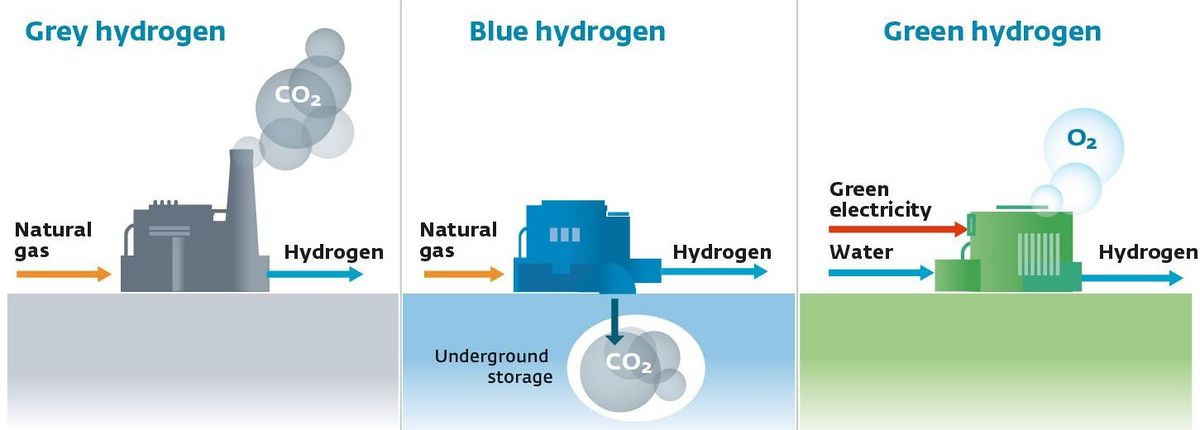
- Where the hydrogen comes from is important. At the moment, it’s mainly produced industrially from natural gas, which generates significant carbon emissions. That type is known as “grey” hydrogen.
- A cleaner version is “blue” hydrogen, for which the carbon emissions are captured and stored, or reused.
- The cleanest one of all is “green” hydrogen, which is generated by renewable energy sources without producing carbon emissions in the first place.
- Electrolysis:
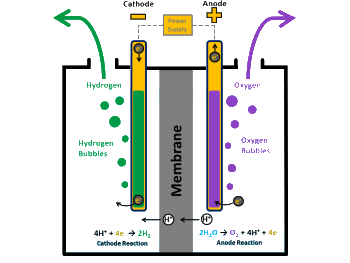
- Electrolysis is the process of using electricity to split water into hydrogen and oxygen. This reaction takes place in a unit called an electrolyzer.
- Hydrogen Electrolyzer:
- An electrolyzer is a system that uses electricity to break water into hydrogen and oxygen in a process called electrolysis. Through electrolysis, the electrolyzer system creates hydrogen gas.
- Steam at the cathode combines with electrons from the external circuit to form hydrogen gas and negatively charged oxygen ions. The oxygen ions pass through the solid ceramic membrane and react at the anode to form oxygen gas and generate electrons for the external circuit.