
Schneider Electric – Conference call presentation : Schneider Electric + PTC – Creating the next level of energy & industrial intelligence


Schneider Electric + PTC
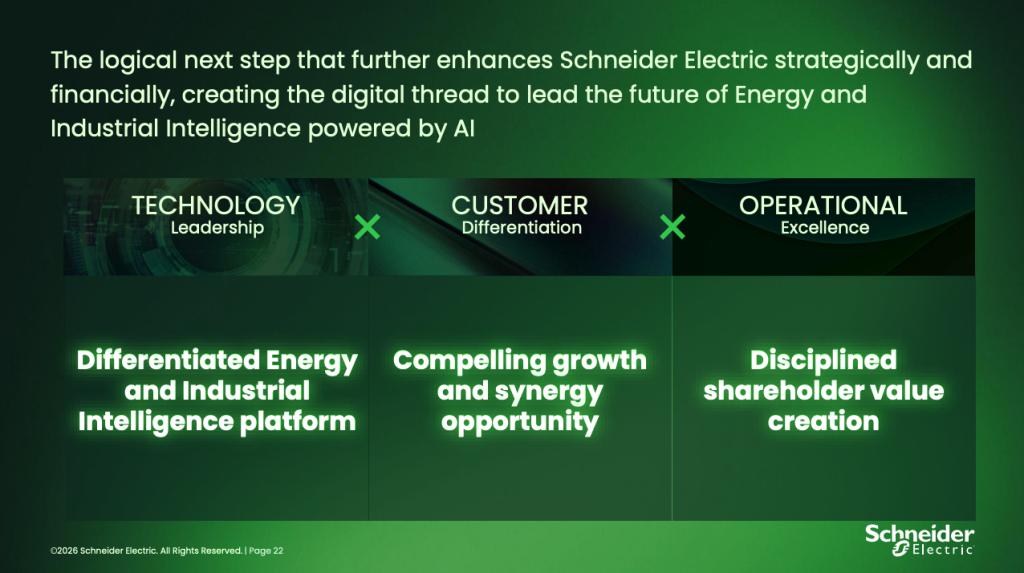
Transaction announcement .
Creating the next level of Energy & Industrial Intelligence.

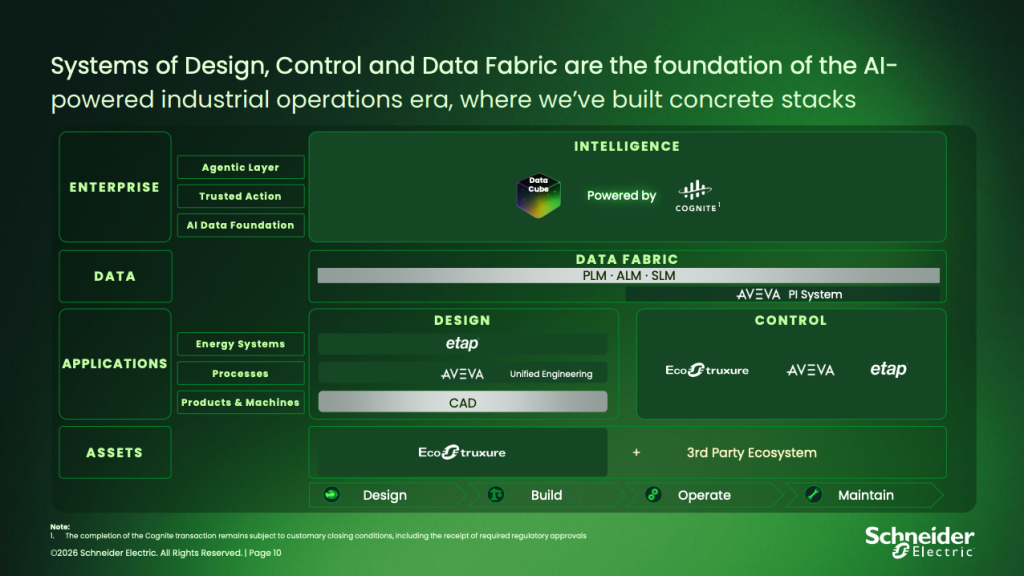
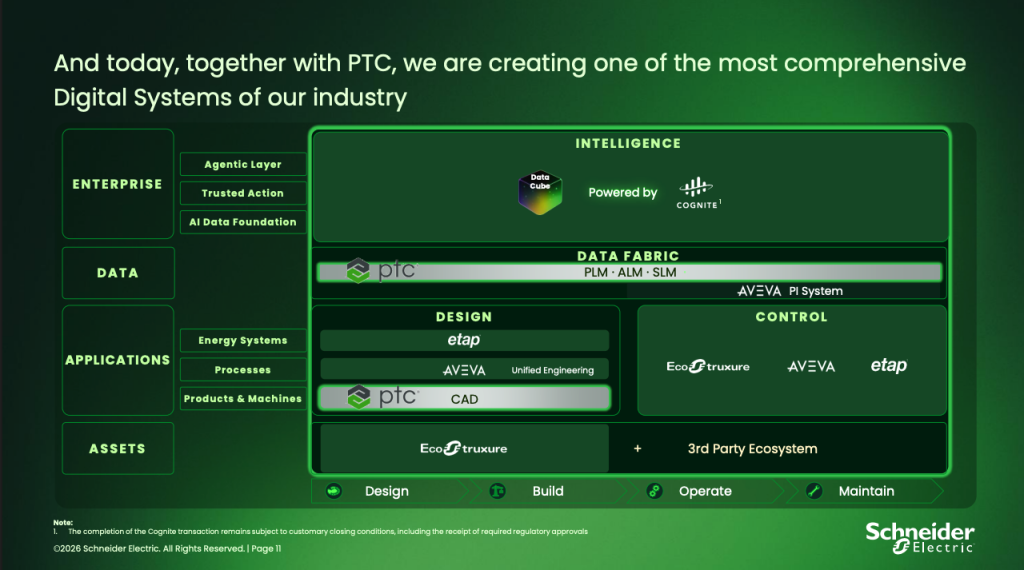
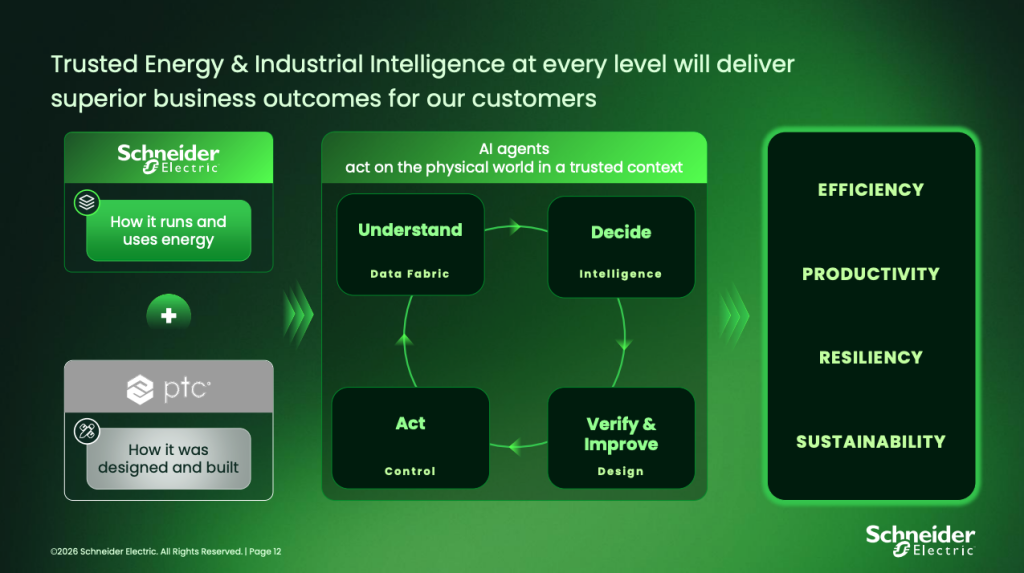
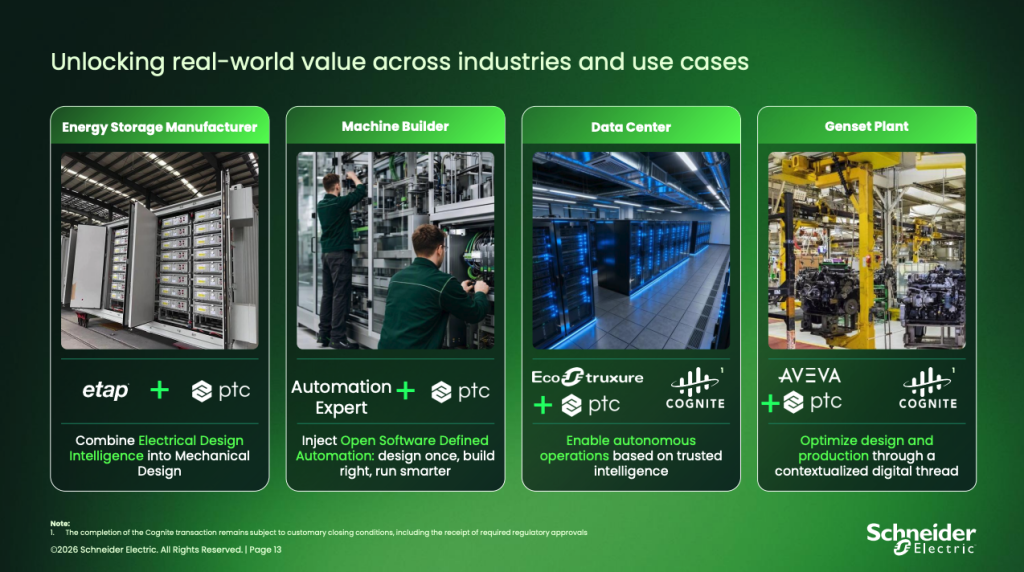
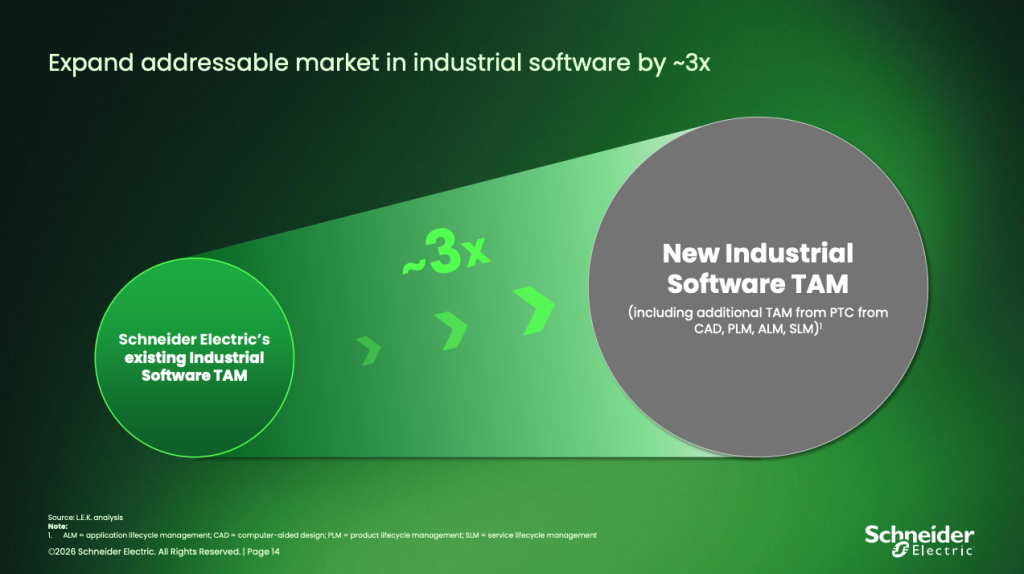
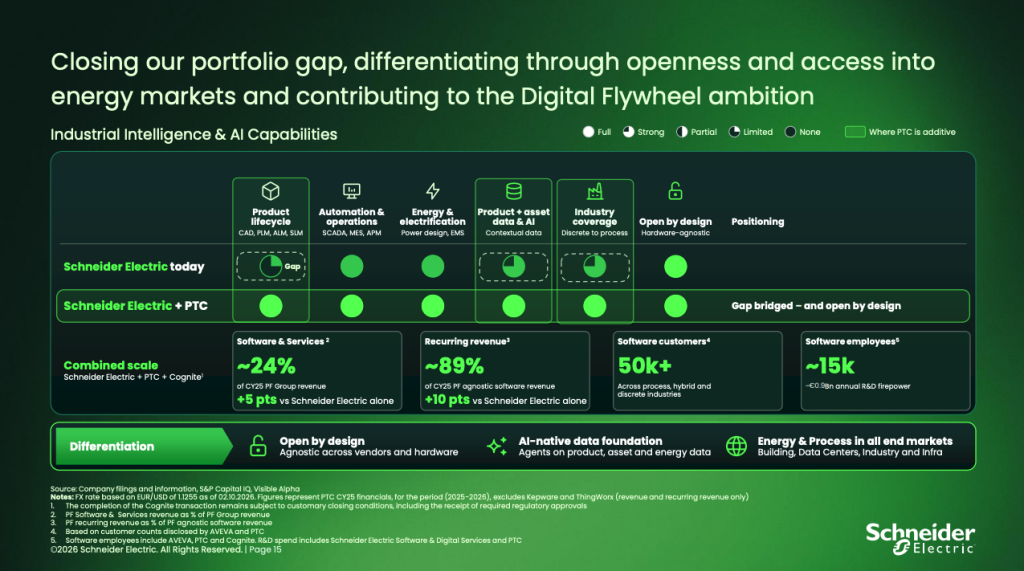
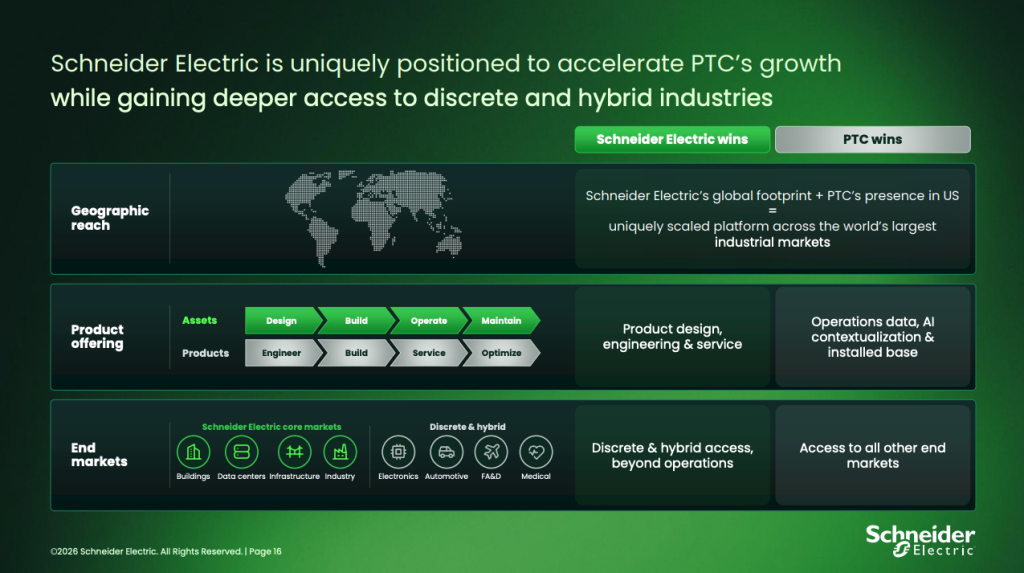
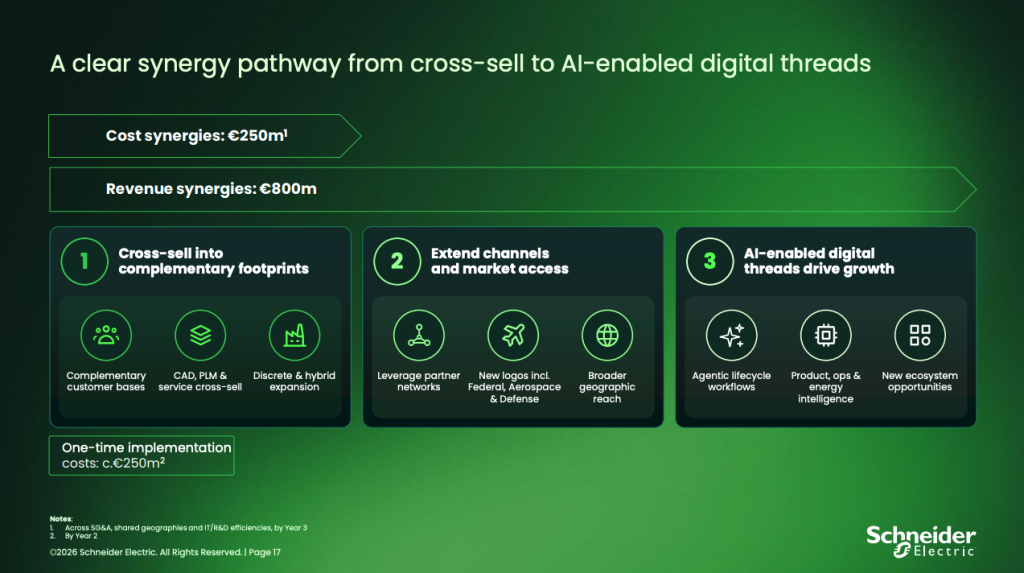
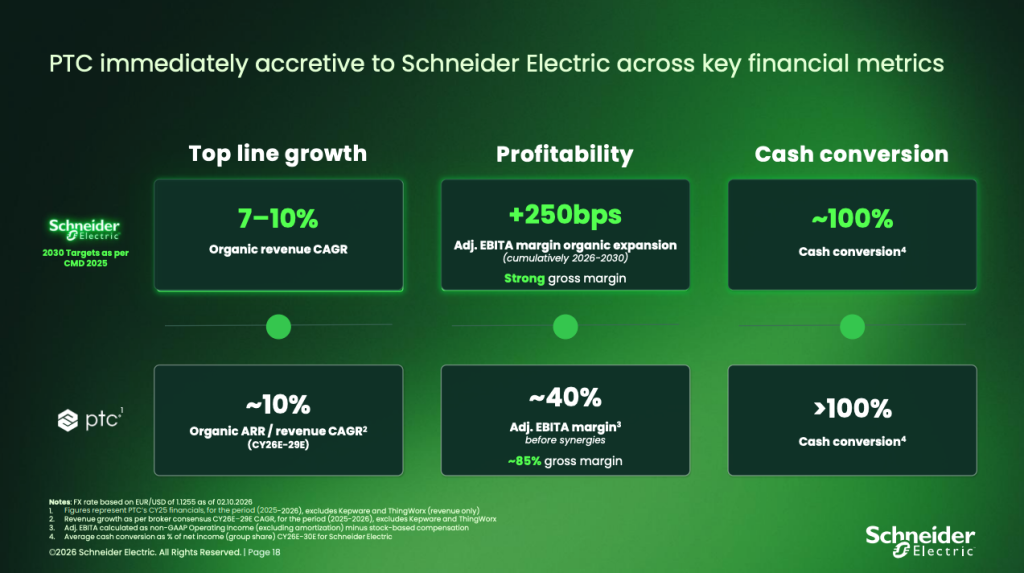
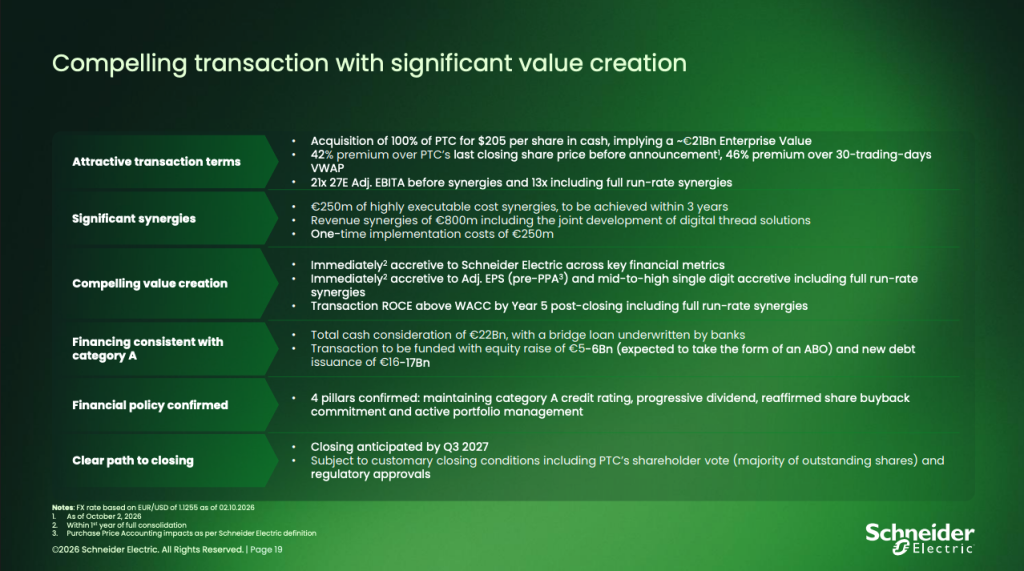
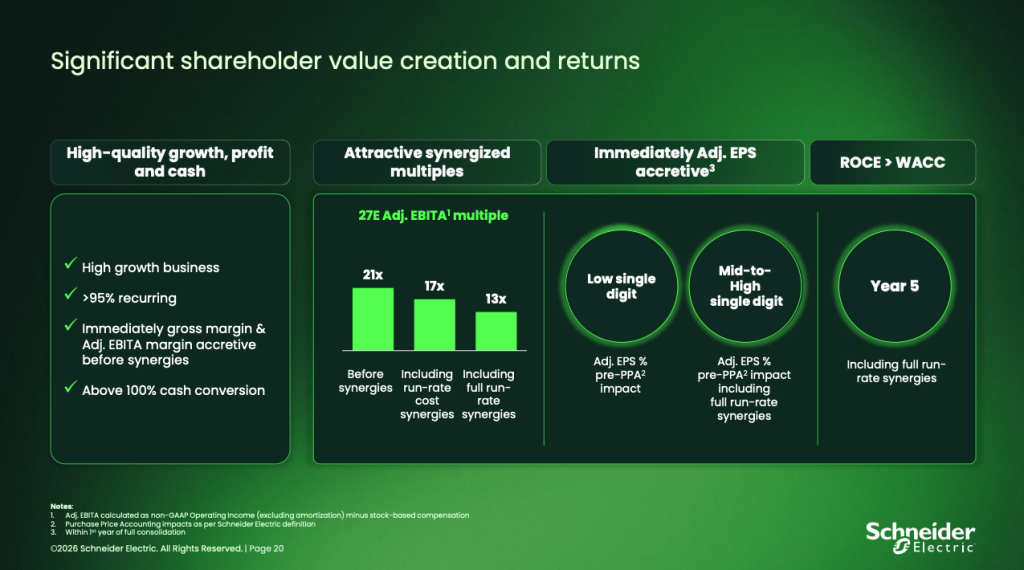
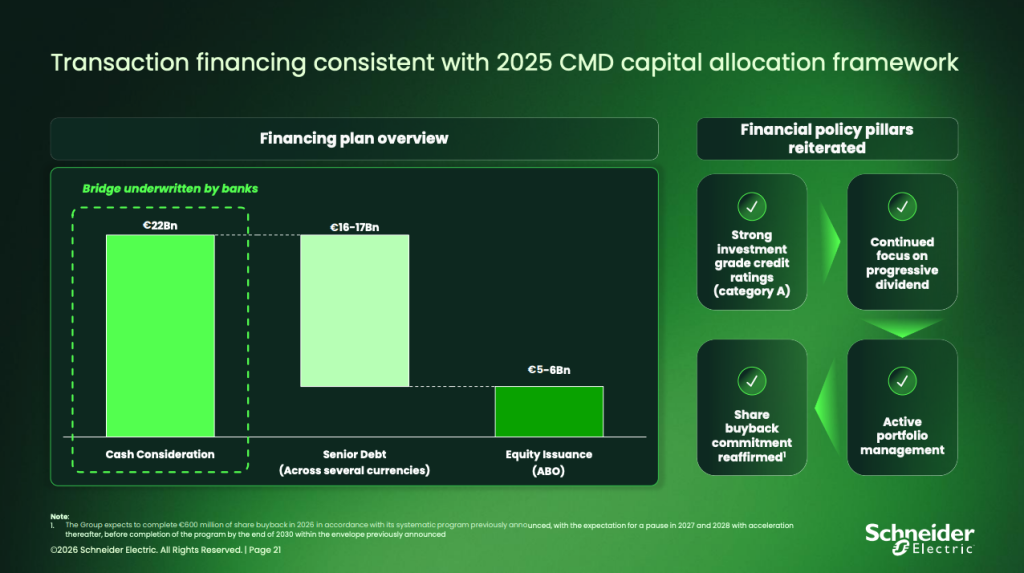
SourceSchneider Electric
EMR Analysis
More information on Schneider Electric: See the full profile on EMR Executive Services
More information on Olivier Blum (Chief Executive Officer, Schneider Electric): See the full profile on EMR Executive Services
More information on Nathan Fast ( Member of the Executive Committee and Executive Vice President, Group Chief Financial Officer, Schneider Electric): See the full profile on EMR Executive Services
More information on Digital Flywheel by Schneider Electric: See the full profile on EMR Executive Services
More information on AVEVA by Schneider Electric: See the full profile on EMR Executive Services
More information on Caspar Herzberg (Member of the Executive Committee, Chief Executive Officer, AVEVA, Schneider Electric): See the full profile on EMR Executive Services
More information on Cognite Holding B.V. by AVEVA by Schneider Electric: See the full profile on EMR Executive Services
More information on Girish Rishi (Chairman of the Board of Directors and Chief Executive Officer, Cognite, AVEVA, Schneider Electric): See the full profile on EMR Executive Services
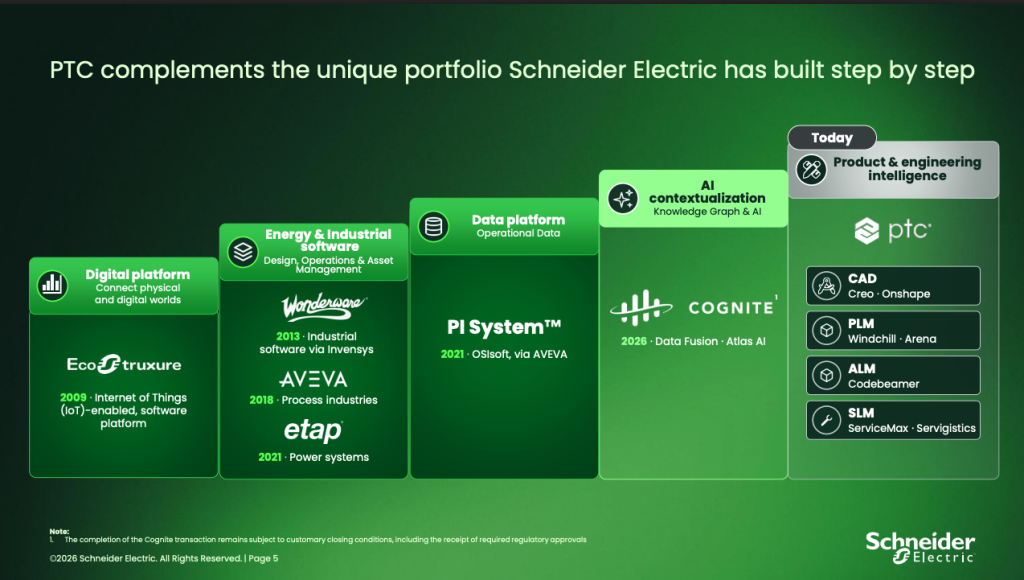
More information on Cognite Data Fusion® by Cognite Holding B.V. by AVEVA by Schneider Electric: https://www.cognite.com/en/product/cognite_data_fusion_industrial_dataops_platform + Get Simple Access to Complex Industrial Data. Take advantage of unmatched data management and comprehensive AI capabilities to improve operational performance, reduce costs, and unlock opportunities in real-time.
An open, secure Industrial Data and AI platform that enables quick deployment of a contextualized data foundation for rapid scaling of AI-powered digital solutions. Take advantage of pre-built industry solutions or build your own to solve 100s of business-critical challenges and redefine operational efficiency.
More information on Cognite Atlas AI™ by Cognite Holding B.V. by AVEVA by Schneider Electric: https://www.cognite.com/en/product/atlas + fully realize the promise of Agentic AI for Industry.
Cognite Atlas AI™ is the only low-code industrial AI agents workbench that powers agents with AI-ready industrial data to automate your industrial workflows and accelerate business impact across the organization at scale like never before.
More information on Energy Management by Schneider Electric: See the full profile on EMR Executive Services
More information on Frédéric Godémél (Member of the Executive Committee and Executive Vice President, Energy Management, Schneider Electric): See the full profile on EMR Executive Services
More information on Industrial Automation by Schneider Electric: See the full profile on EMR Executive Services
More information on Gwenaelle Avice-Huet (Member of the Executive Committee and Executive Vice President, Industrial Automation, Schneider Electric): See the full profile on EMR Executive Services
More information on Operation Technology Inc. (“ETAP”) by Schneider Electric: See the full profile on EMR Executive Services
More information on Tanuj Khandelwal (Chief Executive Officer, ETAP, Schneider Electric): See the full profile on EMR Executive Services
More information on EcoStruxure™ by Schneider Electric: https://www.se.com/ww/en/work/campaign/innovation/overview.jsp + EcoStruxure is Schneider Electric’s IoT-enabled, plug-and-play, open, interoperable architecture and platform, in Homes, Buildings, Data Centers, Infrastructure and Industries. Innovation at Every Level from Connected Products to Edge Control, and Apps, Analytics and Services.
- 45,000 + Developers and system integrators
- 650,000+ Service providers and partners
- 480,000 Sites deployed
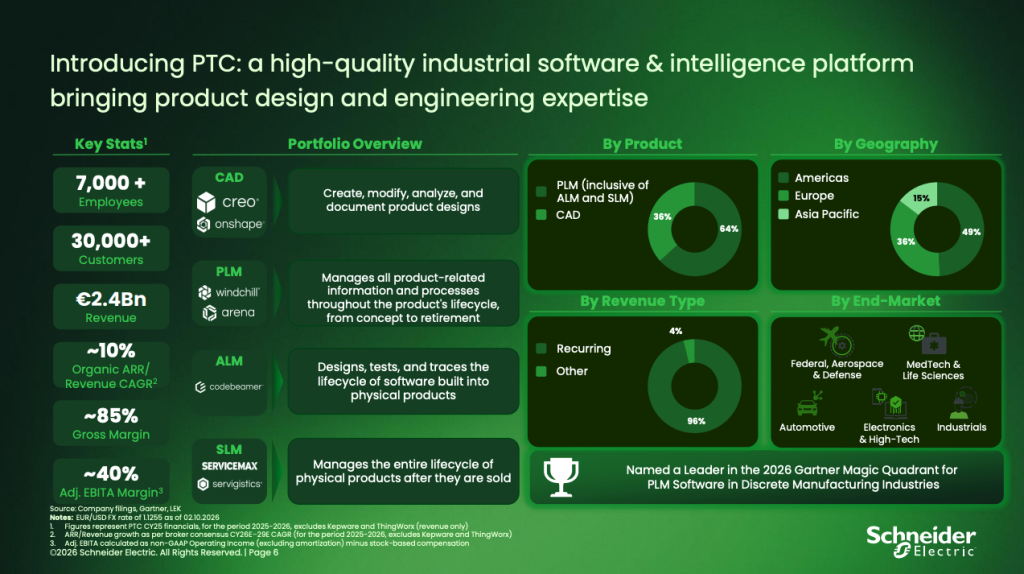
More information on PTC: https://www.ptc.com/en + PTC (NASDAQ: PTC) is a global software company enables manufacturers and product companies to digitally transform how they design, manufacture, and service the physical products that the world relies on. Headquartered in Boston, Massachusetts, PTC employs over 7,000 people and supports more than 30,000 customers globally.
PTC, PTC Next, Creo, Onshape, Windchill, Arena, Codebeamer, ServiceMax, Servigistics, PTC Orbit, PTC Jetstream, Pure Variants, and the PTC logo are trademarks or registered trademarks of PTC Inc. and its subsidiaries in the United States and other countries.
Our purpose statement is the Power To Create.
More information on Neil Barua (President and Chief Executive Officer, PTC): https://www.ptc.com/en/about/executive-team + https://www.linkedin.com/in/neilbarua/
EMR Additional Notes:
- Hardware vs. Software vs. Firmware:
- Hardware is physical: it’s tangible electronic or mechanical components. It can break, wear out, or be damaged by environmental factors (heat, water, shock, etc.).
- Since hardware is part of the “real” world, it all eventually wears out. Being a physical thing, it’s also possible to break it, drown it, overheat it, and otherwise expose it to the elements.
- Here are some examples of hardware:
- Smartphone
- Tablet
- Laptop
- Desktop computer
- Printer
- Flash drive
- Router
- Software is virtual: it consists of programs and data that run on hardware to perform functions. It can be copied, modified, updated, or deleted.
- Software is everything about your computer that isn’t hardware.
- Here are some examples of software:
- Operating systems like Windows 11 or iOS
- Web browsers
- Antivirus tools
- Adobe Photoshop
- Mobile apps
- Firmware is virtual: is embedded software that is tightly coupled to specific hardware and controls its low-level functions.
- While not as common a term as hardware or software, firmware is everywhere—on your smartphone, your PC’s motherboard, your camera, your headphones, and even your TV remote control.
- Firmware is a specialized type of software that serves a specific control and interface role between hardware and higher-level software.
- Hardware is physical: it’s tangible electronic or mechanical components. It can break, wear out, or be damaged by environmental factors (heat, water, shock, etc.).
- AI – Artificial Intelligence:
- Artificial Intelligence (AI) is the broad field of computer science focused on developing systems that can perform tasks that typically require capabilities associated with human or other forms of intelligent behavior, such as learning, reasoning, perception, language understanding, planning, and decision-making.
- AI systems may:
- Process data or information from various sources;
- Identify patterns, relationships, or relevant features;
- Make predictions, classifications, decisions, or recommendations;
- Reason, plan, generate content, or take actions toward defined goals.
- AI is an umbrella term that includes machine learning, deep learning, generative AI, and other approaches such as rule-based systems, search, planning, knowledge representation, probabilistic methods, and optimization. Not all AI systems learn from data.
- A popular but non-standard conceptual taxonomy describes AI as reactive machines, limited-memory systems, theory-of-mind AI, and self-aware AI. This taxonomy is useful for explaining different hypothetical levels of capability, but it is not a formal scientific classification of AI systems.
- Main types of AI:
- Type 1: Reactive machines. These AI systems do not use persistent memory of previous experiences to inform their decisions and generally respond only to the current input or state. An example is Deep Blue, the IBM chess-playing system that defeated Garry Kasparov in the 1990s. Deep Blue used chess-specific search and evaluation techniques to select moves rather than learning from previous games in the manner of modern machine-learning systems.
- Type 2: Limited memory. These AI systems can use information from previous observations, stored data, or recent states when making decisions. Many modern AI systems use forms of memory or contextual information, although the term “limited memory” is a broad conceptual category rather than a precise technical classification.
- Type 3: Theory of mind. A hypothetical form of AI capable of modeling aspects of other people’s beliefs, intentions, knowledge, emotions, or perspectives and using this understanding in interaction. Such capabilities remain an active area of research rather than an established category of deployed AI.
- Type 4: Self-awareness. A hypothetical form of AI possessing a subjective sense of self or consciousness. No generally accepted evidence demonstrates the existence of genuinely self-aware or conscious AI systems.
- AI programming therefore does not have a universally accepted set of “three cognitive skills”; learning, reasoning, perception, planning, language processing, and decision-making are among the capabilities commonly associated with AI.
- Machine Learning (ML):
- Machine Learning (ML) is a subset of AI in which algorithms learn patterns or relationships from data to perform tasks such as prediction, classification, generation, or decision-making, rather than relying solely on manually specified rules for every case.
- ML uses historical or newly collected data to learn statistical patterns and improve performance on a defined task or objective.
- ML is the dominant approach underlying many modern AI systems, but rule-based, optimization-based, search-based, and other non-ML approaches remain important in many applications.
- ML allows software applications to learn from data and improve their performance on a defined task without requiring every decision rule to be explicitly programmed.
- Recommendation engines are a common use case for ML. Other uses include fraud detection, spam filtering, image and speech recognition, forecasting, business process automation (BPA), and predictive maintenance.
- Classical ML is often categorized according to how an algorithm learns from data. Common approaches include:
- Supervised learning,
- Unsupervised learning,
- Semi-supervised learning,
- Self-supervised learning, and
- Reinforcement learning.
- Deep Learning (DL):
- Deep Learning (DL) is a subset of ML that uses neural networks with multiple computational layers to learn complex representations and relationships from data.
- DL can be particularly effective for high-dimensional and unstructured or complex data such as images, audio, video, and natural language, although classical ML methods can outperform deep learning on some structured or tabular datasets.
- DL uses multiple layers of information processing that can learn increasingly complex representations of input data. In some image-recognition systems, for example, earlier layers may learn lower-level visual features while later layers combine these features into more complex representations.
- DL has enabled major advances in computer vision, speech recognition, natural language processing, generative AI, and other fields, but it is not inherently the “most sophisticated” AI architecture; different architectures and approaches are better suited to different tasks.
- Generative AI (GenAI):
- Generative AI (GenAI) refers to AI systems that generate new content or other outputs, such as text, images, code, audio, video, or structured data, based on patterns learned during training and on subsequent inputs or instructions.
- GenAI is typically powered by machine-learning and deep-learning models, including large language models and other foundation models, rather than constituting a completely separate AI paradigm.
- Generative AI can generate outputs based on prompts, structured inputs, multimodal inputs, tool calls, or instructions provided by people or software systems.
- The public release of ChatGPT in November 2022 significantly increased public awareness and adoption of generative AI capable of producing natural-language responses and other forms of content.
- Small Language Models (SLM) and Large Language Models (LLM):
- Small Language Models (SLMs) are relatively compact language models designed to process and generate natural-language content, often with lower computational, memory, or deployment requirements than larger models.
- Large Language Models (LLMs) are machine-learning models trained on large amounts of data to process and generate natural language and perform tasks such as text generation, summarization, translation, classification, question answering, reasoning, and information extraction.
- “Small” and “large” are relative terms rather than universally defined categories based on a fixed number of parameters.
- Modern LLMs are commonly based on transformer or related neural-network architectures.
- Virtual assistants such as Siri, Alexa, and Google Assistant can incorporate language models, speech-recognition systems, search, rules, APIs, and other technologies; whether and to what extent they use LLMs depends on the specific version and implementation.
- Computer Vision (CV) / Vision AI & Machine Vision (MV):
- Computer Vision (CV) is a broad field of AI and computer science concerned with enabling computers to acquire, process, analyze, and interpret visual information from images, video, and other visual sensors.
- CV can use deep learning, classical image-processing techniques, geometric methods, machine learning, and other computational approaches to recognize objects, detect patterns, estimate properties, understand scenes, or extract information from visual data.
- Applications include object detection, image classification, optical character recognition (OCR), facial recognition, medical imaging, autonomous systems, visual search, and image-based measurement and inspection.
- Machine Vision (MV) is an application of computer vision focused particularly on automated visual inspection, measurement, identification, guidance, and control, especially in industrial and manufacturing environments.
- Machine Vision commonly uses cameras, lighting, image-processing software, AI or other vision algorithms, and interfaces to industrial control systems, robots, or other equipment.
- The key difference is that CV is the broader technical field, while MV generally refers to application-oriented vision systems used to perform defined automated tasks.
- Multimodal Intelligence and Agents:
- Multimodal AI refers to AI systems that can process and/or generate information across multiple modalities, such as text, images, audio, video, and other sensor or structured data.
- Multimodal capabilities allow AI systems to combine information from different types of input and output, enabling applications such as visual question answering, speech interaction, document understanding, and systems that can see, hear, speak, and generate visual or textual content.
- An AI agent is a software system that perceives information from an environment, maintains or uses relevant state or context, and selects and takes actions toward a defined goal. An agent may incorporate one or more AI models, tools, memory, planning mechanisms, and orchestration components.
- What distinguishes an AI agent from a conventional AI model is not simply decision-making, but the ability to take actions in an environment toward a goal, often through tools or external systems.
- Agents can be classified or implemented in different ways, including reactive or planning-oriented agents, single-agent or multi-agent systems, and agents operating in static or dynamic environments. Multimodal agents can process multiple forms of information.
- Agentic AI:
- Agentic AI is an emerging term for AI systems designed to pursue defined goals by planning, making decisions, using tools, interacting with their environment, and taking actions with a degree of autonomy and limited human intervention.
- Agentic AI systems may use large language models, other machine-learning models, planning mechanisms, memory or state, tools, external data sources, and orchestration components.
- Unlike conventional AI models that primarily produce an output in response to an input, agentic systems extend model capabilities into action-oriented workflows, potentially executing multiple steps and adapting their actions based on intermediate results or changes in the environment.
- Multi-agent systems are one implementation approach in which multiple specialized agents coordinate their activities to achieve a broader goal.
- Agentic AI can build on generative AI, particularly LLMs, but agentic AI is not synonymous with generative AI or LLMs.
- Agentic Enterprise:
- An agentic enterprise is an emerging business operating model in which people, AI agents, enterprise applications, data, and automation systems work together to execute or coordinate business processes and workflows.
- Compared with conventional automation, agentic systems can interpret information, make decisions within defined boundaries, use enterprise tools, and take actions across multiple workflow steps, while appropriate governance, security, permissions, monitoring, and human oversight can constrain or supervise those actions.
- The term is increasingly used by technology companies and analysts to describe an evolution toward more autonomous AI-enabled enterprise operations, but it is not a standardized technical or organizational category.
- Edge AI Technology:
- Edge AI refers to the deployment and execution of AI models or inference workloads on or close to the devices and systems where data is generated, such as cameras, sensors, industrial controllers, vehicles, smartphones, and other IoT devices, rather than relying entirely on centralized cloud infrastructure.
- Edge AI combines edge computing with AI/ML to process data locally or near its source, potentially reducing latency, bandwidth requirements, cloud dependence, or exposure of sensitive data.
- Edge AI can operate with intermittent or no internet connectivity for some functions, although many systems continue to communicate with cloud or other centralized systems.
- Applications include autonomous vehicles, industrial inspection, wearable devices, security cameras, robotics, and smart-home equipment.
- High-Density AI:
- High-density AI refers to the concentration of AI computing capacity—particularly GPUs or other accelerators, memory, networking, power delivery, and cooling—in a relatively small physical or data-center footprint.
- It is an AI infrastructure and data-center design trend, not a distinct category of AI. High-density infrastructure can provide greater computing capacity per rack, room, or unit of floor space, but also creates significant requirements for power distribution, thermal management, networking, and physical infrastructure.
- Explainable AI (XAI) and Human-Centered Explainable AI (HCXAI):
- Explainable AI (XAI) refers to methods, techniques, and system designs intended to make AI model behavior, predictions, decisions, or outputs understandable to people.
- Human-Centered Explainable AI (HCXAI) goes further by designing explanations around the needs, context, goals, knowledge, and capabilities of the people who use or are affected by the AI system.
- While XAI focuses on understanding and communicating aspects of model behavior, HCXAI emphasizes whether explanations are relevant, comprehensible, useful, and appropriate for their human context. Related considerations can include fairness, accountability, trust, safety, and ethical use, although these are not themselves defining features of explainability.
- Physical AI & Embodied AI:
- Physical AI refers to AI systems designed to perceive, reason about, predict, and/or act in the physical world, often using data from sensors and controlling physical devices or actuators.
- Embodied AI refers to AI systems whose intelligence is situated within or coupled to a physical or simulated body or agent, emphasizing the interaction between perception, decision-making, action, and the environment.
- Physical AI and Embodied AI overlap substantially, and the terms are not universally defined as a strict hierarchy. They are commonly associated with robotics, autonomous vehicles, industrial systems, and other applications in which AI interacts with a physical environment.
- Federated Learning and Reinforcement Learning:
- Federated Learning (FL) is a machine-learning technique in which models are trained across multiple decentralized devices or organizations while the raw training data generally remains at its original location; model parameters, gradients, or other training information are communicated to an aggregation or coordination system. In simple terms: “Train AI without centrally collecting the raw data.”
- Federated learning can improve data governance and reduce the need to centralize sensitive data, but it does not by itself guarantee privacy or security. Additional techniques such as secure aggregation or differential privacy may be used.
- Reinforcement Learning (RL) is a type of machine learning in which an agent learns to select actions by interacting with an environment and receiving rewards or penalties, with the objective of improving its policy or long-term expected reward. In simple terms: “Learning through interaction and feedback.”
- Federated Learning and Reinforcement Learning can be combined as Federated Reinforcement Learning (FRL), in which multiple agents or devices learn policies locally and share selected model information or updates to improve a common or coordinated policy without centrally sharing their raw experience data.
- FRL is an active research area with applications being investigated in areas such as distributed resource management, communications networks, robotics, and autonomous systems.
- AI Factories:
- AI Factories are industrial-scale computing and operational infrastructures designed to transform data and computing resources into AI models, inference services, and other AI outputs at scale.
- AI factories can encompass data preparation, model training, fine-tuning, inference, serving, storage, high-speed networking, accelerated computing, power, cooling, and associated software and operational systems.
- “AI factory” is a conceptual and industry term rather than a standardized technical category. It can refer to a dedicated AI data center or, more broadly, an integrated infrastructure and operating model for producing and deploying AI capabilities at scale.
- Companies and organizations use the term in different ways, including in connection with hyperscale and specialized data-center infrastructure, accelerated computing, and public-sector AI infrastructure initiatives.
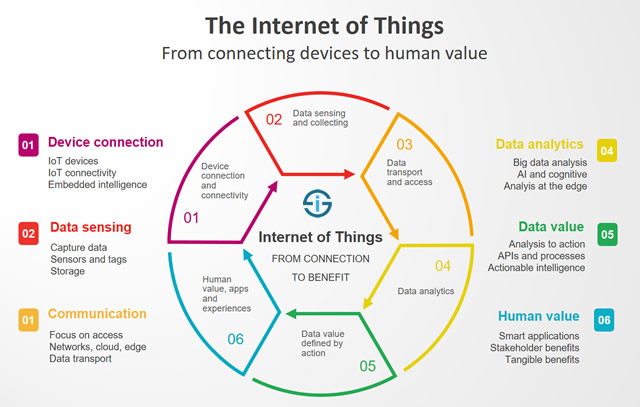
- IoT (Internet of Things):
- The Internet of Things (IoT) refers to a network of identifiable physical objects and, in broader definitions, virtual entities that use sensing, processing, actuation and communication capabilities to exchange data and support digital services. These devices may communicate automatically, with minimal human intervention, or through user-directed interactions. The ITU defines IoT as an infrastructure that interconnects physical and virtual things using interoperable information and communication technologies.
- IoT encompasses physical objects—often called things—equipped with sensors, actuators, embedded software, processing capabilities and network connectivity. Devices may communicate through the internet, private IP networks, cellular networks, local wireless networks or specialized protocols through gateways. Direct connection to the public internet is not required.
- IoT systems typically include:
- Devices and endpoints: sensors, actuators, controllers and connected equipment
- Connectivity: wired or wireless networks and communication protocols
- Edge or cloud computing: data processing, storage, analysis and device coordination
- Applications and interfaces: monitoring, visualization, configuration, automation and user interaction
- Security and device management: authentication, access control, updates, monitoring and lifecycle management
- Examples of consumer IoT devices include:
- Smartwatches and connected fitness trackers
- Smart thermostats and environmental sensors
- Voice-activated smart speakers and assistants
- Smart locks, doorbells and security systems
- Connected health-monitoring devices
- Smart lighting, appliances and home-energy systems
- IIoT (Industrial IoT):
- Industrial IoT (IIoT) is the application of IoT technologies to industrial operations, manufacturing, infrastructure and other operational environments, connecting sensors, instruments, machines, control systems and software to collect, exchange and analyze operational data. It supports equipment monitoring, maintenance, production analytics, process optimization and, where appropriate, automated control.
- IIoT applies connected-device technologies specifically to industrial environments, with particular emphasis on reliability, availability, safety, cybersecurity, deterministic or time-sensitive communication where required, and integration with operational technology (OT). Relevant systems include Programmable Logic Controllers (PLCs), Supervisory Control and Data Acquisition (SCADA) systems, Distributed Control Systems (DCS), industrial robots and Manufacturing Execution Systems (MES).
- Typical use cases include:
- Predictive and condition-based maintenance
- Asset, equipment and infrastructure monitoring
- Industrial energy management
- Production and process optimization
- Quality monitoring and traceability
- Remote diagnostics and operational decision support
- Connected supply chains and industrial automation
- AIoT (Artificial Intelligence of Things):
- AIoT refers to the integration of artificial intelligence (AI) with IoT infrastructure, combining connected devices, operational data and AI-based processing to enable intelligent monitoring, analysis, prediction and decision-making. AIoT can support more efficient IoT operations, improved human–machine interaction and enhanced data management and analytics. The ITU formalized an AIoT reference model in Recommendation ITU-T Y.4618 in 2026.
- AI adds value to IoT through capabilities such as pattern recognition, anomaly detection, forecasting, image and signal analysis, optimization and decision support. IoT, in turn, provides AI systems with connected data sources, contextual information and opportunities to interact with physical environments through actuators and control systems.
- AIoT processing can take place:
- On the device: local inference and immediate responses
- At the edge: processing on gateways, industrial computers or local servers
- In the cloud: large-scale analytics, model training, storage and centralized coordination
- The aim is to improve operational efficiency, responsiveness, reliability and decision-making, potentially enabling semi-autonomous or autonomous operation where appropriate. AIoT does not necessarily require fully autonomous control or continuous learning; the degree of automation depends on the application and its safety requirements.
- xIoT (xTended Internet of Things) – Context Dependent – Cybersecurity Term:
- xIoT, commonly expanded as Extended Internet of Things, is a cybersecurity-oriented umbrella term for a broad range of connected or network-accessible devices extending beyond conventional consumer IoT. Its scope can include enterprise IoT, industrial IoT, operational technology (OT), connected medical devices, physical-security systems and network infrastructure. The exact definition varies across cybersecurity vendors and industry contexts; it is not a universally standardized device classification.
Examples of device categories that may be included are:- Enterprise IoT: cameras, printers, access-control readers and building-management devices
- Operational technology: PLCs, HMIs, industrial controllers, robots and connected machinery
- Network infrastructure: switches, Wi-Fi routers, wireless access points and network-attached storage
- Connected building and security systems: HVAC controllers, surveillance cameras, alarms and door controllers
- Connected medical and specialized equipment: networked monitoring devices and purpose-built embedded systems
- xIoT is used particularly in cybersecurity, asset discovery, network visibility, attack-surface management and risk assessment to account for devices that may not be covered by conventional endpoint-security tools. Its emphasis is on identifying and managing the security exposure of connected assets, including devices with limited patching, monitoring or endpoint-protection capabilities.
- xIoT, commonly expanded as Extended Internet of Things, is a cybersecurity-oriented umbrella term for a broad range of connected or network-accessible devices extending beyond conventional consumer IoT. Its scope can include enterprise IoT, industrial IoT, operational technology (OT), connected medical devices, physical-security systems and network infrastructure. The exact definition varies across cybersecurity vendors and industry contexts; it is not a universally standardized device classification.
- Industrial Automation:
- Industrial Automation (umbrella term) is the use of technologies such as computer software and robotics to control machinery and processes which replace human beings in performing specific functions. The functions are primarily centered on manufacturing, quality control and material handling processes.
- Process Automation / Manufacturing:
- Process automation (based on the nature of the raw materials and final product) is defined as the use of software and technologies to automate business processes and functions in order to accomplish defined organizational goals, such as producing a product, hiring and onboarding an employee, or providing customer service.
- Process manufacturing utilizes chemical, physical and compositional changes to convert raw material or feedstock into a product. Process manufacturing includes industries such as cement and glass, chemicals, electric power generation, food and beverage, life sciences, metals and mining, oil and gas, pulp and paper, refining, and water and wastewater. Process manufacturing includes both continuous and batch processes.
- Discrete Automation / Manufacturing:
- Discrete automation (focusing on individual, quantifiable parts and products) is the production of parts that are of a quantifiable nature. That may include cell phones, soda bottles, automobiles, airplanes, toys, etc. As you know, an automobile contains many, many parts. The parts required for an automobile are also quantifiable in nature.
- Discrete manufacturing processes include the production of individual parts as well as their assembly into a final product. Discrete manufacturing examples include automobiles, appliances, and consumer electronics.
- Process Automation / Manufacturing:
- Types of Automation Systems (by flexibility):
- Fixed Automation:
- Most basic, least flexible type of automation, ideal for high-volume, unchanging production.
- Fixed automation systems are utilized in high volume production settings that have dedicated equipment. The equipment has fixed operation sets and is designed to perform efficiently with the operation sets. This type of automation is mainly used in discrete mass production and continuous flow systems like paint shops, distillation processes, transfer lines and conveyors. All these processes rely on mechanized machinery to perform their fixed and repetitive operations to achieve high production volumes.
- Programmable Automation:
- Next level of flexibility, where the system can be reprogrammed, but with a significant effort.
- Programmable automation systems facilitate changeable operation sequences and machine configuration using electronic controls. With programmable automation, non-trivial programming efforts are required to reprogram sequence and machine operations. Since production processes are not changed often, programmable automation systems tend to be less expensive in the long run. This type of system is mainly used in low job variety and medium-to-high product volume settings. It may also be used in mass production settings like paper mills and steel rolling mills.
- Flexible Automation:
- Most advanced type of automation based on flexibility, allowing for easy, high-level changes without major reprogramming.
- Flexible automation systems are utilized in computer-controlled flexible manufacturing systems. Human operators enter high-level commands in the form of computer codes that identify products and their location in the system’s sequence to trigger automatic lower-level changes. Every production machine receives instructions from a human-operated computer. The instructions trigger the loading and unloading of necessary tools before carrying out their computer-instructed processes. Once processing is completed, the end products are transferred to the next machine automatically. Flexible industrial automation is used in batch processes and job shops with high product varieties and low-to-medium job volumes.
- Fixed Automation:
- Advanced and Integrated Concepts (most complex):
- Integrated Automation:
- Takes flexible automation to the next level by explaining how an entire plant’s processes, from manufacturing to business operations, are linked under a single computer-controlled system.
- Integrated industrial automation involves the total automation of manufacturing plants where all processes function under digital information processing coordination and computer control. It comprises technologies like:
- Computer-aided process planning
- Computer-supported design and manufacturing
- Flexible machine systems
- Computer numerical control machine tools
- Automated material handling systems, like robots
- Automatic storage and retrieval systems
- Computerized production and scheduling control
- Automated conveyors and cranes
- Additionally, an integrated automation system can integrate a business system via a common database. That is, it supports the full integration of management operations and processes using communication and information technologies. Such technologies are utilized in computer integrated manufacturing and advanced process automation systems.
- Smart Manufacturing (SM):
- Modern evolution of automation, driven by data and connectivity.
- Technology-driven approach that utilizes Internet-connected machinery to monitor the production process. The goal of SM is to identify opportunities for automating operations and use data analytics to improve manufacturing performance.
- An example of what the cloud can do for smart manufacturing is the Volkswagen Industrial Cloud, which combines all data from 122 Volkswagen Group facilities and processes it in real time to make improvements.
- Hybrid Automation / Manufacturing:
- Combines different approaches, showing how both additive and subtractive manufacturing can be integrated into one process. It also introduces the “hybrid” method for implementing automation projects.
- The Hybrid Automation Method follows two guiding principles: Implementing robust automation solutions that are easy and affordable for organisations to maintain. Realising process efficiency rapidly by reducing project overheads and time-to-value.
- Hybrid manufacturing is a combination of additive manufacturing (AM) and subtractive manufacturing within the same machine.
- Additive Manufacturing (AM):
- Key technology of one of the core components of the “hybrid” approach.
- Additive manufacturing is the process of creating an object by building it one layer at a time. It is the opposite of subtractive manufacturing, in which an object is created by cutting away at a solid block of material until the final product is complete.
- Operators across a variety of different manufacturing industries utilize additive manufacturing in various ways. For instance: Medical device manufacturers use 3D printing to develop high variance products such as dental implants.
- The term “additive manufacturing” refers to the creation of objects by “adding” material. Therefore, 3D printing is a form of additive manufacturing. When an object is created by adding material — as opposed to removing material — it’s considered additive manufacturing.
- Integrated Automation:
- Industrial Automation (umbrella term) is the use of technologies such as computer software and robotics to control machinery and processes which replace human beings in performing specific functions. The functions are primarily centered on manufacturing, quality control and material handling processes.
- CAGR (Compound Annual Growth Rate):
- The Compound Annual Growth Rate is the rate of return that would be required for an investment to grow from its beginning balance to its ending balance, assuming the profits were reinvested at the end of each period of the investment’s life span.
- To calculate the CAGR of an investment:
- Divide the value of an investment at the end of the period by its value at the beginning of that period.
- Raise the result to an exponent of one divided by the number of years.
- Subtract one from the subsequent result.
- Multiply by 100 to convert the answer into a percentage.
- EBIT:
- Earnings Before Interest and Taxes (EBIT) is a measure of a company’s operating profitability before accounting for interest expenses and income taxes. It is also known as operating profit and shows how effectively a company’s core business is generating profit from its operations.
- EBITA:
- Earnings before interest, taxes, and amortization (EBITA) is a measure of company profitability used by investors. It is helpful for comparing one company to another in the same line of business.
- EBITA = Net income + Interest + Taxes + Amortization
- EBITDA:
- Earnings before interest, taxes, depreciation, and amortization (EBITDA) is an alternate measure of profitability to net income. By including depreciation and amortization as well as taxes and debt payment costs, EBITDA attempts to represent the cash profit generated by the company’s operations.
- EBITDA and EBITA are both measures of profitability. The difference is that EBITDA also excludes depreciation.
- EBITDA is the more commonly used measure because it adds depreciation—the accounting practice of recording the reduced value of a company’s tangible assets over time—to the list of factors.
- EV/EBITDA (Enterprise Multiple):
- Enterprise multiple, also known as the EV-to-EBITDA multiple, is a ratio used to determine the value of a company.
- It is computed by dividing enterprise value by EBITDA.
- The enterprise multiple takes into account a company’s debt and cash levels in addition to its stock price and relates that value to the firm’s cash profitability.
- Enterprise multiples can vary depending on the industry.
- Higher enterprise multiples are expected in high-growth industries and lower multiples in industries with slow growth.
- Earning Per Share (EPS):
- Company’s net income attributable to common shareholders (net income minus preferred dividends) divided by the weighted average number of common shares outstanding.
- The resulting number serves as an indicator of a company’s profitability on a per-share basis. It is common for a company to report adjusted EPS (e.g., excluding extraordinary or non-recurring items) and diluted EPS (including potential shares from options, convertible debt, or warrants).
- The higher a company’s EPS, the more profitable it is considered to be (although EPS should always be analyzed in context—e.g., growth, industry, and capital structure).
- Earnings per share value is calculated as net income divided by available shares. A more refined calculation adjusts the numerator and denominator for potential dilution (stock options, convertible securities, warrants).
- The numerator of the equation is also more relevant if it is adjusted for continuing operations (excluding one-off or discontinued activities).
- Dividend Per Share (DPS):
- DPS is the actual portion of those earnings distributed to shareholders as dividends (cash or sometimes stock dividends).
- The actual cash paid out by the company to an investor for each share owned, calculated as:
Total dividends paid to common shareholders / Number of common shares outstanding (or weighted average shares). - High-growth companies often have a high EPS but a DPS of $0 because they reinvest all profits. Established, mature companies tend to pay out a portion of their earnings (payout ratio) as a DPS.
- A company’s DPS can exceed EPS in a given year (e.g., using retained earnings or debt), but this is generally not sustainable over the long term.
- => EPS vs. DPS:
- EPS measures how much profit a company generates per share, while DPS shows how much of that profit is actually distributed to shareholders. EPS reflects profitability, whereas DPS reflects distribution policy.
- Return on Capital Employed (ROCE):
- Return on Capital Employed (ROCE) is a financial ratio that measures how effectively a company generates operating profit from the capital employed in its business.
- The commonly used formula is:
- ROCE = EBIT / Capital Employed × 100
- EBIT = Earnings Before Interest and Tax
- Capital Employed = Total Assets − Current Liabilities
- ROCE = EBIT / Capital Employed × 100
- ROCE indicates the operating return generated for each unit of capital employed. It is commonly used to assess profitability and capital efficiency and to compare performance across periods or with comparable companies.
- A higher ROCE generally indicates more effective use of capital, but there is no universal threshold for a “good” ROCE. Interpretation depends on the industry, business model, capital intensity, economic conditions and the company’s cost of capital.
- Comparing ROCE with WACC can be particularly useful: a sustained ROCE above WACC generally indicates that the company is generating returns in excess of its cost of capital.
- Weighted Average Cost of Capital (WACC):
- Weighted Average Cost of Capital (WACC) is the weighted average required return associated with a company’s principal sources of long-term capital, primarily equity and debt.
- The commonly used formula is:
- WACC = (E / (D + E) × Cost of Equity) + (D / (D + E) × Cost of Debt × (1 − Tax Rate))
- E = Market value of equity
- D = Market value of interest-bearing debt
- Cost of Equity = Required return expected by equity investors
- Cost of Debt = Required return or borrowing cost associated with the company’s debt
- Tax Rate = Applicable corporate tax rate
- WACC = (E / (D + E) × Cost of Equity) + (D / (D + E) × Cost of Debt × (1 − Tax Rate))
- WACC represents the average return that providers of capital require for financing the company’s activities, weighted according to their relative contribution to the company’s capital structure.
- WACC is widely used as a benchmark or discount rate in corporate finance, company valuation and investment decisions. For a project with similar risk to the company’s existing operations, WACC can also serve as a reference hurdle rate.
- A higher WACC generally reflects a higher overall cost of capital, which may result from greater business or financial risk, higher interest rates or changes in the company’s financing structure.
- A, B and C Shares:
- Companies can issue different classes of shares (e.g., Class A, B, C) that provide different rights in terms of voting, dividends, and control.
- Class A Shares:
- Typically offered to public investors and usually provide standard voting rights (often 1 vote per share), along with rights to dividends and capital in case of liquidation.
- Class B Shares:
- Often held by founders, executives, or early investors and typically provide enhanced voting rights (e.g., multiple votes per share), allowing them to retain control over the company.
- Class C Shares:
- Usually issued with no or very limited voting rights, but still provide economic rights such as dividends.
- Class A Shares:
- Companies can issue different classes of shares (e.g., Class A, B, C) that provide different rights in terms of voting, dividends, and control.
- Treasury Shares:
- Treasury shares (or treasury stock) are a company’s own shares that it has repurchased from the market and held on its balance sheet rather than being canceled.
- These shares:
- are no longer considered outstanding shares
- do not carry voting rights
- do not receive dividends
- are excluded from earnings-per-share (EPS) calculations
- Companies may later:
- reissue them
- use them for employee stock plans
- or cancel them permanently
- Share Buyback:
- A share buyback, also known as a share repurchase, occurs when a company purchases its own outstanding shares from the market, reducing the total number of shares in circulation.
- This can:
- increase earnings per share (EPS) by reducing share count
- return capital to shareholders (alternative to dividends)
- signal management’s confidence in the company’s value
- adjust ownership structure or defend against takeovers