ABB – ABB’s new direct current portfolio aims to rewire AI data center energy infrastructure
- ABB introduces Infinitus, the industry’s first source-to-rack direct current portfolio for AI data centers designed for architecture flexibility
- Breakthrough Infinitus solid-state transformers help maximize energy efficiency and reduce physical footprint, alongside DC power distribution and protection technologies to enhance overall system performance
- Infinitus direct current portfolio expected to drive similar benefits across other industries including industrial buildings, manufacturing, renewables, and marine operations
ABB today announced the launch of Infinitus, a portfolio of direct current (DC) solutions designed to manage the increasing power demands of AI data centers. The portfolio will accelerate the adoption of DC architectures in data centers improving energy efficiency and reducing power infrastructure footprint, while increasing available computing capacity. ABB expects other energy-intensive industries to make the same transition.
The International Energy Agency (IEA) expects global data center electricity demand to more than double by 2030 and ABB estimates that approximately 25-40% of new capacity installed in 2030 could be using DC distribution. Next-generation AI chips are expected to draw 1 MW per rack and beyond, an increase from today’s almost 200 kW, requiring a shift to DC architecture that can support performance while driving energy efficiency. With 800 VDC distribution, the footprint is more compact while eliminating redundant conversion steps and cutting heat losses of conventional alternating current (AC) systems. A recent BCG / ABB report calculated that DC distribution delivers energy efficiency gains of more than 5% and increases available space for compute racks. For a 500MW data center, a 5% efficiency gain can mean 25 MW more power for revenue-generating IT loads and more than US $300 million in potential additional revenue per year. With 5% efficiency gains for a 500 MW data center campus, the energy savings over one year would be equivalent to powering Washington D.C. for almost a full week.
Giampiero Frisio, President of ABB’s Electrification business area, said: “ABB has pioneered DC technology for more than 25 years across several segments. We are working closely with chipmakers, hyperscale customers, supply partners and industry bodies to set the standards and the pace for the roll-out of high-efficiency DC architectures. Infinitus is the first portfolio providing the building blocks for any data center architecture – either DC native or hybrid AC/ DC – to power next-generation AI chips efficiently. This technology will bring similar energy efficiency gains to other energy-intensive industries such as large scale manufacturing, renewables and marine operations.”
Infinitus is the industry’s first integrated source-to-rack DC portfolio. At its core is ABB’s breakthrough Infinitus solid-state transformer technology, enabling sites to operate with a smaller footprint and greater energy efficiency. As the only major electrification supplier with both the world’s first fully IEC-certified solid-state circuit breaker and an industry-first static medium-voltage UPS in production, ABB delivers a breadth of technology unmatched in the market.
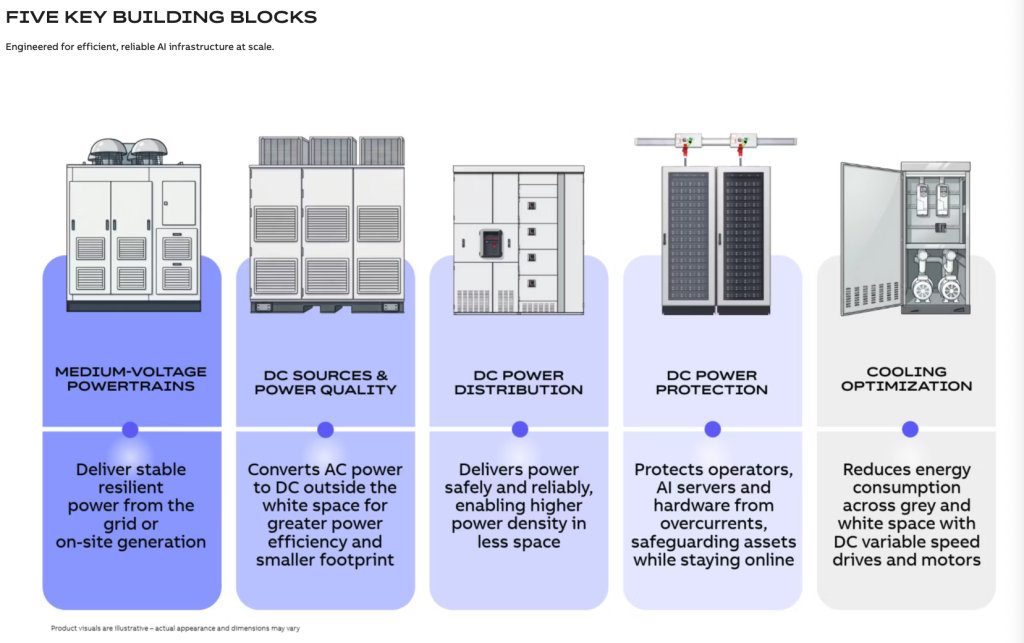
ABB’s Infinitus DC portfolio includes five key building blocks:
- Medium Voltage Powertrains deliver stable resilient power from the grid or on-site generation;
- DC Sources and Power Quality converts AC to DC removing conversion from white space;
- DC Power Distribution delivers power safely and reliably, enabling higher power density in a smaller footprint;
- DC Power Protection provides protection for operators, AI servers and hardware from DC overcurrents;
- Cooling Optimization reduces energy consumption across grey and white space with DC connected variable speed drives and motors.
ABB works with customers to design solutions tailored to their specific power demands, facility layout, and energy mix. This partnership approach ensures each deployment is optimized for maximum efficiency and reliability. The Infinitus portfolio complements traditional AC systems with DC flexibility that supports customers across all power architectures while also enabling unprecedented efficiency, reliability, and scalability for AI-era data centers.
For next-generation data centers, this integrated architecture enables the high-density, high-efficiency power delivery that future AI chips demand. With a number of main components produced in the next twelve months, the first DC-native facilities using the complete Infinitus portfolio are expected to be installed and operational within two to three years.
The portfolio launch extends support for ABB’s continued collaboration with NVIDIA, first announced in October 2025, to develop 800 VDC power architectures for gigawatt-scale AI facilities. ABB brings more than 25 years of DC experience and over 700 patents spanning renewables, power generation, energy storage, motors and drives.
SourceABB
EMR Analysis
More information on ABB: See full profile on EMR Executive Services
More information on Morten Wierod (Chief Executive Officer and Member of the Group Executive Committee, ABB): See full profile on EMR Executive Services
More information on Christian Nilsson (Chief Financial Officer and Member of the Executive Committee, ABB): See full profile on EMR Executive Services
More information on the ABB Way: See full profile on EMR Executive Services
More information on Electrification Business Area by ABB: See the full profile on EMR Executive Services
More information on Giampiero Frisio (President, Electrification Business Area and Member of the Executive Committee, ABB): See full profile on EMR Executive Services
More information on Infinitus by ABB: https://www.abb.com/global/en/areas/electrification/campaigns/infinitus-experience + https://www.abb.com/global/en/areas/electrification/campaigns/infinitus-dc-portfolio + The Infinitus DC portfolio is an integrated source-to-rack direct current power portfolio for AI data centers. It brings together the building blocks needed for DC-native and hybrid AC/DC architectures, including medium-voltage powertrain solutions, 800 VDC power conversion, power quality, distribution and protection solutions, and cooling optimization technologies.
The Infinitus portfolio provides the building blocks for DC-native and hybrid AC/DC data center architectures, helping data center operators improve energy efficiency, reduce power infrastructure footprint, and support greater computing capacity.
At the heart of the portfolio is the ABB Infinitus solid-state transformer (SST), designed to convert medium-voltage AC power to 800 VDC with fewer conversion stages.
Infinitus brings together power conversion, power quality, distribution, protection and cooling optimization in a coordinated architecture designed for efficient, reliable, and scalable AI infrastructure.
More information on the Report “The Strategic Case for Hybrid AC/DC Power: Shaping the Transition to the Next Electrical Architecture” by ABB and BCG: https://www.abb.com/global/en/company/innovation/hybrid-ac-dc-power
More information on IEA (International Energy Agency): https://www.iea.org + The IEA is at the heart of global dialogue on energy, providing authoritative analysis, data, policy recommendations, and real-world solutions to help countries provide secure and sustainable energy for all.
The IEA was created in 1974 to help co-ordinate a collective response to major disruptions in the supply of oil. While oil security this remains a key aspect of our work, the IEA has evolved and expanded significantly since its foundation.
Taking an all-fuels, all-technology approach, the IEA recommends policies that enhance the reliability, affordability and sustainability of energy. It examines the full spectrum issues including renewables, oil, gas and coal supply and demand, energy efficiency, clean energy technologies, electricity systems and markets, access to energy, demand-side management, and much more.
Since 2015, the IEA has opened its doors to major emerging countries to expand its global impact, and deepen cooperation in energy security, data and statistics, energy policy analysis, energy efficiency, and the growing use of clean energy technologies.
More information on Dr. Fatih Birol (Executive Director, International Energy Agency): https://www.iea.org/about + https://www.linkedin.com/in/fatih-birol/
More information on The Boston Consulting Group (BCG): https://www.bcg.com/ + Boston Consulting Group bridges the gap between ambition and outcomes for the world’s leading companies and organizations. We are built for this era of unprecedented change — bringing strategic clarity rooted in over 60 years of deep domain knowledge, combined with applied AI shaped by our practitioners. BCG works shoulder-to-shoulder with CEOs across industries and geographies to deliver transformative impact at scale: stronger returns, transferred capabilities, and change that sticks.
- 33.5K global employees
- $14.4B annual revenue
- 40% of revenue from tech and AI
- 12% higher shareholder returns for BCG’s Top 100 clients compared to the S&P 1200
- 16 industries and 20 capabilities served, supported by 9 specialty businesses
- 100+ cities with BCG offices, in more than 50 countries
More information on Christoph Schweizer (Chief Executive Officer, BCG): https://www.bcg.com/about/people-culture/leadership + https://www.linkedin.com/in/christophschweizer/
More information on International Electrotechnical Commission (IEC): https://www.iec.ch/homepage + The IEC (International Electrotechnical Commission) brings together 170 countries, and more than 20,000 experts cooperate on the global IEC platform to ensure that products work everywhere safely with each other.
The IEC is the world’s leading organization that prepares and publishes globally relevant International Standards for the whole energy chain, including all electrical, electronic and related technologies, devices and systems. The IEC also supports all forms of conformity assessment and administers four Conformity Assessment Systems that certify that components, equipment and systems used in homes, offices, healthcare facilities, public spaces, transportation, manufacturing, explosive environments and energy generation conform to them.
IEC work covers a vast range of technologies: power generation (including all renewable energy sources), transmission, distribution, Smart Grid, batteries, home appliances, office and medical equipment, all public and private transportation, semiconductors, fibre optics, nanotechnology, multimedia, information technology, and more. It also addresses safety, EMC, performance and the environment.
More information on Jim Matthews (President 2026-2028, International Electrotechnical Commission (IEC)): https://www.iec.ch/leadership + https://www.linkedin.com/in/jim-matthews-a08b261b4/
More information on NVIDIA: https://www.nvidia.com/en-us/ + NVIDIA (NASDAQ: NVDA) pioneered accelerated computing. The company’s invention of the GPU in 1999 sparked the growth of the PC gaming market, redefined computer graphics, and ignited the era of modern AI. NVIDIA is now driving the platform shift of accelerated computing and generative AI, transforming the world’s largest industries and profoundly impacting society.
More information on Jensen Huang (Chief Executive Officer, NVIDIA): https://nvidianews.nvidia.com/bios + https://www.linkedin.com/in/jenhsunhuang/
EMR Additional Notes:
- AC (Alternating Current) & DC (Direct Current) & UC (Universal Current):
- Direct Current (DC):
- Electric current that is unidirectional, meaning the flow of charge is always in the same direction. Unlike alternating current, the direction does not change. It is used in many household electronics and in all battery-powered devices.
- Direct current has many uses, from charging batteries to supplying power for electronic systems, motors, and industrial processes. Very large quantities of DC power are used in applications such as aluminum smelting and other electrochemical processes.
- DC is more efficient for long-distance transmission at very high voltages (HVDC) because it avoids reactive power losses and reduces skin effect and capacitive losses, especially over long distances and submarine cables.
- Alternating Current (AC):
- Alternating current is an electric current in which the direction of flow periodically reverses (typically 50 or 60 Hz).
- AC is used in power grids and homes because it can be easily transformed to higher or lower voltages using transformers. This allows efficient transmission at high voltage over long distances and safe distribution at low voltage for end users.
- DC can also be converted to different voltage levels, but it requires power electronics (converters), not simple transformers.
- Universal Current (UC): .
- Universal Current (UC) means a device can operate with either AC or DC input.
- For example, a 24 V UC input can accept either 24 V AC or 24 V DC.
- UC is not a type of current, but a device input specification indicating compatibility with both AC and DC supplies.
- Direct Current (DC):
- Volts of Direct Current (VDC):
- VDC stands for Volts of Direct Current, representing electric potential in a system where current flows consistently in one direction, from positive to negative. Unlike VAC (Alternating Current), VDC is used by batteries, solar panels, and electronics, providing stable, non-reversing power, typically for low-voltage devices, electronics, and industrial sensors.
- VDC Main Distribution Bus:
- A VDC (Volts Direct Current) main distribution bus is a central, heavy-duty electrical conductor—typically a copper or aluminum bar—used to collect and distribute direct current power from sources (like batteries, solar panels, or rectifiers) to various loads in a high-power system. It acts as the central backbone of a DC power architecture, commonly operating at higher voltages (e.g., 380V, 400V, 800V, or 1000V) in modern industrial, data center, and marine applications to increase efficiency and reduce copper losses.
- AI – Artificial Intelligence:
- Artificial Intelligence (AI) is the broad field of computer science focused on developing systems that can perform tasks that typically require capabilities associated with human or other forms of intelligent behavior, such as learning, reasoning, perception, language understanding, planning, and decision-making.
- AI systems may:
- Process data or information from various sources;
- Identify patterns, relationships, or relevant features;
- Make predictions, classifications, decisions, or recommendations;
- Reason, plan, generate content, or take actions toward defined goals.
- AI is an umbrella term that includes machine learning, deep learning, generative AI, and other approaches such as rule-based systems, search, planning, knowledge representation, probabilistic methods, and optimization. Not all AI systems learn from data.
- A popular but non-standard conceptual taxonomy describes AI as reactive machines, limited-memory systems, theory-of-mind AI, and self-aware AI. This taxonomy is useful for explaining different hypothetical levels of capability, but it is not a formal scientific classification of AI systems.
- Main types of AI:
- Type 1: Reactive machines. These AI systems do not use persistent memory of previous experiences to inform their decisions and generally respond only to the current input or state. An example is Deep Blue, the IBM chess-playing system that defeated Garry Kasparov in the 1990s. Deep Blue used chess-specific search and evaluation techniques to select moves rather than learning from previous games in the manner of modern machine-learning systems.
- Type 2: Limited memory. These AI systems can use information from previous observations, stored data, or recent states when making decisions. Many modern AI systems use forms of memory or contextual information, although the term “limited memory” is a broad conceptual category rather than a precise technical classification.
- Type 3: Theory of mind. A hypothetical form of AI capable of modeling aspects of other people’s beliefs, intentions, knowledge, emotions, or perspectives and using this understanding in interaction. Such capabilities remain an active area of research rather than an established category of deployed AI.
- Type 4: Self-awareness. A hypothetical form of AI possessing a subjective sense of self or consciousness. No generally accepted evidence demonstrates the existence of genuinely self-aware or conscious AI systems.
- AI programming therefore does not have a universally accepted set of “three cognitive skills”; learning, reasoning, perception, planning, language processing, and decision-making are among the capabilities commonly associated with AI.
- Machine Learning (ML):
- Machine Learning (ML) is a subset of AI in which algorithms learn patterns or relationships from data to perform tasks such as prediction, classification, generation, or decision-making, rather than relying solely on manually specified rules for every case.
- ML uses historical or newly collected data to learn statistical patterns and improve performance on a defined task or objective.
- ML is the dominant approach underlying many modern AI systems, but rule-based, optimization-based, search-based, and other non-ML approaches remain important in many applications.
- ML allows software applications to learn from data and improve their performance on a defined task without requiring every decision rule to be explicitly programmed.
- Recommendation engines are a common use case for ML. Other uses include fraud detection, spam filtering, image and speech recognition, forecasting, business process automation (BPA), and predictive maintenance.
- Classical ML is often categorized according to how an algorithm learns from data. Common approaches include:
- Supervised learning,
- Unsupervised learning,
- Semi-supervised learning,
- Self-supervised learning, and
- Reinforcement learning.
- Deep Learning (DL):
- Deep Learning (DL) is a subset of ML that uses neural networks with multiple computational layers to learn complex representations and relationships from data.
- DL can be particularly effective for high-dimensional and unstructured or complex data such as images, audio, video, and natural language, although classical ML methods can outperform deep learning on some structured or tabular datasets.
- DL uses multiple layers of information processing that can learn increasingly complex representations of input data. In some image-recognition systems, for example, earlier layers may learn lower-level visual features while later layers combine these features into more complex representations.
- DL has enabled major advances in computer vision, speech recognition, natural language processing, generative AI, and other fields, but it is not inherently the “most sophisticated” AI architecture; different architectures and approaches are better suited to different tasks.
- Generative AI (GenAI):
- Generative AI (GenAI) refers to AI systems that generate new content or other outputs, such as text, images, code, audio, video, or structured data, based on patterns learned during training and on subsequent inputs or instructions.
- GenAI is typically powered by machine-learning and deep-learning models, including large language models and other foundation models, rather than constituting a completely separate AI paradigm.
- Generative AI can generate outputs based on prompts, structured inputs, multimodal inputs, tool calls, or instructions provided by people or software systems.
- The public release of ChatGPT in November 2022 significantly increased public awareness and adoption of generative AI capable of producing natural-language responses and other forms of content.
- Small Language Models (SLM) and Large Language Models (LLM):
- Small Language Models (SLMs) are relatively compact language models designed to process and generate natural-language content, often with lower computational, memory, or deployment requirements than larger models.
- Large Language Models (LLMs) are machine-learning models trained on large amounts of data to process and generate natural language and perform tasks such as text generation, summarization, translation, classification, question answering, reasoning, and information extraction.
- “Small” and “large” are relative terms rather than universally defined categories based on a fixed number of parameters.
- Modern LLMs are commonly based on transformer or related neural-network architectures.
- Virtual assistants such as Siri, Alexa, and Google Assistant can incorporate language models, speech-recognition systems, search, rules, APIs, and other technologies; whether and to what extent they use LLMs depends on the specific version and implementation.
- Computer Vision (CV) / Vision AI & Machine Vision (MV):
- Computer Vision (CV) is a broad field of AI and computer science concerned with enabling computers to acquire, process, analyze, and interpret visual information from images, video, and other visual sensors.
- CV can use deep learning, classical image-processing techniques, geometric methods, machine learning, and other computational approaches to recognize objects, detect patterns, estimate properties, understand scenes, or extract information from visual data.
- Applications include object detection, image classification, optical character recognition (OCR), facial recognition, medical imaging, autonomous systems, visual search, and image-based measurement and inspection.
- Machine Vision (MV) is an application of computer vision focused particularly on automated visual inspection, measurement, identification, guidance, and control, especially in industrial and manufacturing environments.
- Machine Vision commonly uses cameras, lighting, image-processing software, AI or other vision algorithms, and interfaces to industrial control systems, robots, or other equipment.
- The key difference is that CV is the broader technical field, while MV generally refers to application-oriented vision systems used to perform defined automated tasks.
- Multimodal Intelligence and Agents:
- Multimodal AI refers to AI systems that can process and/or generate information across multiple modalities, such as text, images, audio, video, and other sensor or structured data.
- Multimodal capabilities allow AI systems to combine information from different types of input and output, enabling applications such as visual question answering, speech interaction, document understanding, and systems that can see, hear, speak, and generate visual or textual content.
- An AI agent is a software system that perceives information from an environment, maintains or uses relevant state or context, and selects and takes actions toward a defined goal. An agent may incorporate one or more AI models, tools, memory, planning mechanisms, and orchestration components.
- What distinguishes an AI agent from a conventional AI model is not simply decision-making, but the ability to take actions in an environment toward a goal, often through tools or external systems.
- Agents can be classified or implemented in different ways, including reactive or planning-oriented agents, single-agent or multi-agent systems, and agents operating in static or dynamic environments. Multimodal agents can process multiple forms of information.
- Agentic AI:
- Agentic AI is an emerging term for AI systems designed to pursue defined goals by planning, making decisions, using tools, interacting with their environment, and taking actions with a degree of autonomy and limited human intervention.
- Agentic AI systems may use large language models, other machine-learning models, planning mechanisms, memory or state, tools, external data sources, and orchestration components.
- Unlike conventional AI models that primarily produce an output in response to an input, agentic systems extend model capabilities into action-oriented workflows, potentially executing multiple steps and adapting their actions based on intermediate results or changes in the environment.
- Multi-agent systems are one implementation approach in which multiple specialized agents coordinate their activities to achieve a broader goal.
- Agentic AI can build on generative AI, particularly LLMs, but agentic AI is not synonymous with generative AI or LLMs.
- Agentic Enterprise:
- An agentic enterprise is an emerging business operating model in which people, AI agents, enterprise applications, data, and automation systems work together to execute or coordinate business processes and workflows.
- Compared with conventional automation, agentic systems can interpret information, make decisions within defined boundaries, use enterprise tools, and take actions across multiple workflow steps, while appropriate governance, security, permissions, monitoring, and human oversight can constrain or supervise those actions.
- The term is increasingly used by technology companies and analysts to describe an evolution toward more autonomous AI-enabled enterprise operations, but it is not a standardized technical or organizational category.
- Edge AI Technology:
- Edge AI refers to the deployment and execution of AI models or inference workloads on or close to the devices and systems where data is generated, such as cameras, sensors, industrial controllers, vehicles, smartphones, and other IoT devices, rather than relying entirely on centralized cloud infrastructure.
- Edge AI combines edge computing with AI/ML to process data locally or near its source, potentially reducing latency, bandwidth requirements, cloud dependence, or exposure of sensitive data.
- Edge AI can operate with intermittent or no internet connectivity for some functions, although many systems continue to communicate with cloud or other centralized systems.
- Applications include autonomous vehicles, industrial inspection, wearable devices, security cameras, robotics, and smart-home equipment.
- High-Density AI:
- High-density AI refers to the concentration of AI computing capacity—particularly GPUs or other accelerators, memory, networking, power delivery, and cooling—in a relatively small physical or data-center footprint.
- It is an AI infrastructure and data-center design trend, not a distinct category of AI. High-density infrastructure can provide greater computing capacity per rack, room, or unit of floor space, but also creates significant requirements for power distribution, thermal management, networking, and physical infrastructure.
- Explainable AI (XAI) and Human-Centered Explainable AI (HCXAI):
- Explainable AI (XAI) refers to methods, techniques, and system designs intended to make AI model behavior, predictions, decisions, or outputs understandable to people.
- Human-Centered Explainable AI (HCXAI) goes further by designing explanations around the needs, context, goals, knowledge, and capabilities of the people who use or are affected by the AI system.
- While XAI focuses on understanding and communicating aspects of model behavior, HCXAI emphasizes whether explanations are relevant, comprehensible, useful, and appropriate for their human context. Related considerations can include fairness, accountability, trust, safety, and ethical use, although these are not themselves defining features of explainability.
- Physical AI & Embodied AI:
- Physical AI refers to AI systems designed to perceive, reason about, predict, and/or act in the physical world, often using data from sensors and controlling physical devices or actuators.
- Embodied AI refers to AI systems whose intelligence is situated within or coupled to a physical or simulated body or agent, emphasizing the interaction between perception, decision-making, action, and the environment.
- Physical AI and Embodied AI overlap substantially, and the terms are not universally defined as a strict hierarchy. They are commonly associated with robotics, autonomous vehicles, industrial systems, and other applications in which AI interacts with a physical environment.
- Federated Learning and Reinforcement Learning:
- Federated Learning (FL) is a machine-learning technique in which models are trained across multiple decentralized devices or organizations while the raw training data generally remains at its original location; model parameters, gradients, or other training information are communicated to an aggregation or coordination system. In simple terms: “Train AI without centrally collecting the raw data.”
- Federated learning can improve data governance and reduce the need to centralize sensitive data, but it does not by itself guarantee privacy or security. Additional techniques such as secure aggregation or differential privacy may be used.
- Reinforcement Learning (RL) is a type of machine learning in which an agent learns to select actions by interacting with an environment and receiving rewards or penalties, with the objective of improving its policy or long-term expected reward. In simple terms: “Learning through interaction and feedback.”
- Federated Learning and Reinforcement Learning can be combined as Federated Reinforcement Learning (FRL), in which multiple agents or devices learn policies locally and share selected model information or updates to improve a common or coordinated policy without centrally sharing their raw experience data.
- FRL is an active research area with applications being investigated in areas such as distributed resource management, communications networks, robotics, and autonomous systems.
- AI Factories:
- AI Factories are industrial-scale computing and operational infrastructures designed to transform data and computing resources into AI models, inference services, and other AI outputs at scale.
- AI factories can encompass data preparation, model training, fine-tuning, inference, serving, storage, high-speed networking, accelerated computing, power, cooling, and associated software and operational systems.
- “AI factory” is a conceptual and industry term rather than a standardized technical category. It can refer to a dedicated AI data center or, more broadly, an integrated infrastructure and operating model for producing and deploying AI capabilities at scale.
- Companies and organizations use the term in different ways, including in connection with hyperscale and specialized data-center infrastructure, accelerated computing, and public-sector AI infrastructure initiatives.
- Cloud Computing:
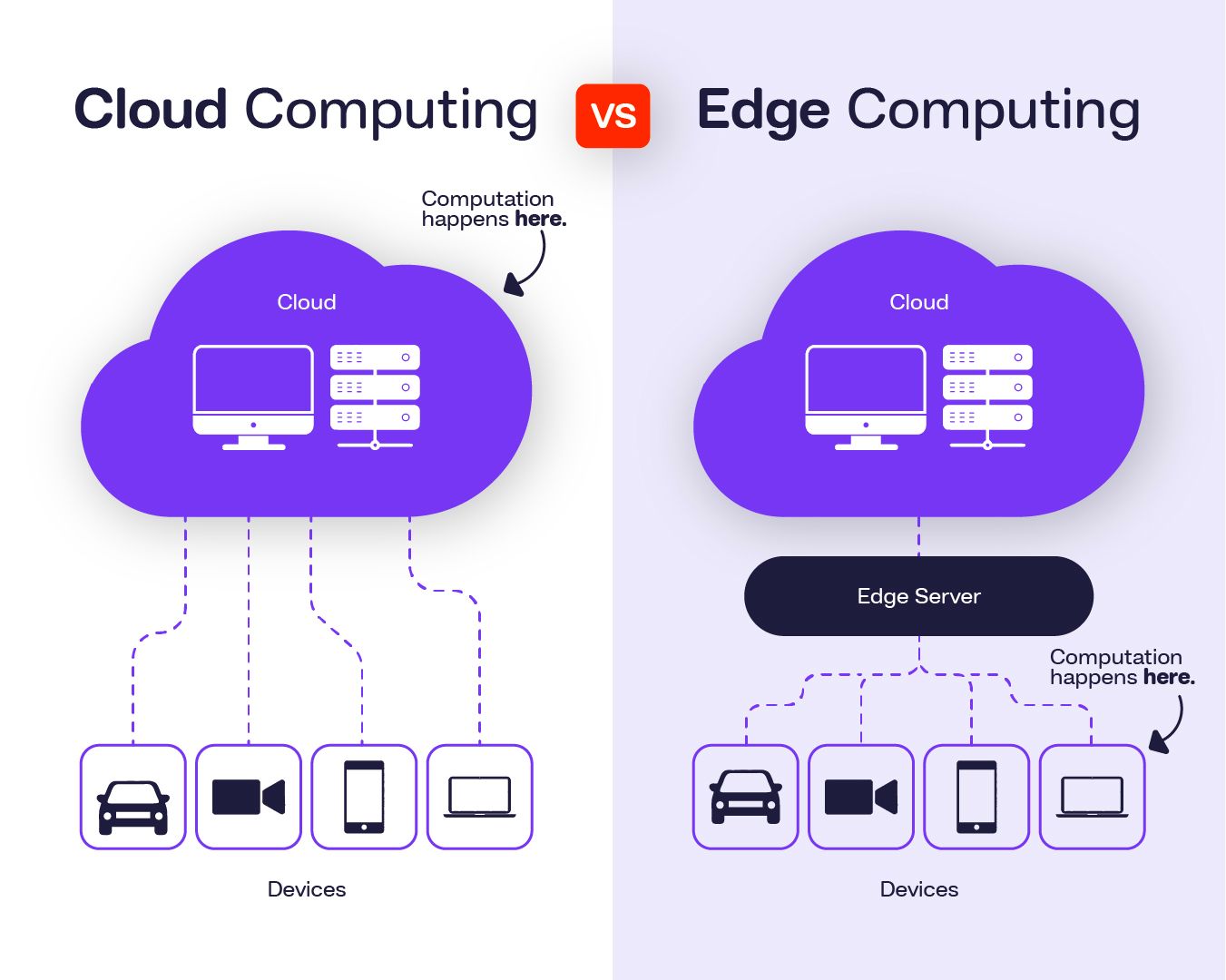
- Cloud computing is a general term for anything that involves delivering hosted services over the internet. It is the on-demand availability of computer system resources, especially data storage and computing power, without direct active management by the user. Large clouds often have functions distributed over multiple locations, each location being a data center. Cloud services typically include IaaS, PaaS, and SaaS service models.
- Edge Computing:
- Edge computing is a form of computing that is done on site or near a particular data source, minimizing the need for data to be processed in a remote data center.
- Edge computing can enable more effective city traffic management. Examples of this include optimising bus frequency given fluctuations in demand, managing the opening and closing of extra lanes, and, in future, managing autonomous car flows.
- An edge device is any piece of hardware that controls data flow at the boundary between two networks. Edge devices fulfill a variety of roles, depending on what type of device they are, but they essentially serve as network entry — or exit — points.
- There are five main types of edge computing devices: IoT sensors, smart cameras, uCPE equipment, servers and processors. IoT sensors, smart cameras and uCPE equipment will reside on the customer premises, whereas servers and processors will reside in an edge computing data centre.
- In service-based industries such as the finance and e-commerce sector, edge computing devices also have roles to play. In this case, a smart phone, laptop, or tablet becomes the edge computing device.
- Edge Devices:
- Edge devices encompass a broad range of device types, including sensors, actuators and other endpoints, as well as IoT gateways. Within a local area network (LAN), switches in the access layer — that is, those connecting end-user devices to the aggregation layer — are sometimes called edge switches.
- Edge devices act as the interface between the physical world (data generation) and digital networks.
- Hybrid Computing:
- A hybrid cloud integrates private, on-premises infrastructure with public cloud services, offering flexibility to distribute workloads between these environments. Hybrid models often incorporate edge computing, allowing organizations to run critical workloads locally at the edge while using the cloud for other tasks, thereby optimizing performance, cost, and data management for various business needs.
- HPC (Hight-Performance Computing):
- Practice of aggregating computing resources to gain performance greater than that of a single workstation, server, or computer. HPC can take the form of custom-built supercomputers or groups of individual computers called clusters.
- HPC is typically used for simulation, scientific computing, AI training, and complex modeling.
- Data Centers – Physical Infrastructure:
- A data center is a facility that centralizes an organization’s shared IT operations and equipment for the purposes of storing, processing, and disseminating data and applications. Because they house an organization’s most critical and proprietary assets, data centers are vital to the continuity of daily operations.
- Hyperscale Data Centers – Physical Infrastructure:
- The clue is in the name: hyperscale data centers are massive facilities built by companies with vast data processing and storage needs. These firms may derive their income directly from the applications or websites the equipment supports, or sell technology management services to third parties.
- Hyperscale Data Centers are typically operated by large cloud providers (e.g., hyperscalers) and designed for horizontal scalability.
- White Space and Grey Space in Data Centers – Physical Infrastructure:
- White space in a data center refers to the area where IT equipment is placed. It typically houses servers, storage, network gear, and racks.
- Gray space, on the other hand, is the area where the back-end infrastructure is located. This space is essential for supporting the IT equipment and includes areas for switchgear, UPS, transformers, chillers, and generators.
- Colocation in Data Centers – Physical Infrastructure:
- A colocation data center is a facility where businesses rent space, power, and cooling to house their own servers and networking hardware, rather than maintaining them in-house. It offers a cost-effective way to access high-level security, internet connectivity, and 24/7 technical support while retaining control of the equipment.
- Edge & Cloud Services – Integrated Architecture (Edge-to-Cloud):
- Edge services perform data processing on local devices and servers near the data source, reducing latency for time-sensitive operations, while cloud services centralize large computations and storage in remote datacenters, offering massive scalability and flexibility for general workloads.
- Most organizations use both, creating an “edge-to-cloud” architecture where edge devices handle immediate tasks, and the cloud manages large-scale data processing and complex applications, providing a seamless and efficient experience.
- Hyperscale, Neocloud and Colocation:
- Hyperscale, neocloud, and colocation represent three important models in modern data-center infrastructure and cloud computing. While all can provide infrastructure used to run software and workloads, they differ primarily in their scale, architecture, service offerings, ownership and business models, and degree of workload specialization. They are not mutually exclusive: cloud providers, including hyperscalers and neoclouds, may use their own facilities, third-party colocation facilities, or a combination of both.
- To look at them side by side, colocation is primarily a data-center service model in which customers place and operate their own IT equipment in a third-party facility; hyperscale refers to operating IT infrastructure and cloud platforms at very large scale, typically with highly automated, distributed infrastructure; and neocloud generally refers to a newer category of cloud provider specializing in GPU-intensive AI, HPC, and other compute-intensive workloads.
- Colocation (The Data-Center Service Model):
- Colocation facilities provide customers with space, power, cooling, connectivity, physical security, and related services for housing their own servers and other IT equipment. Companies such as Equinix and Digital Realty operate large colocation facilities where customers may lease individual cabinets/racks, cages, suites, or larger dedicated areas. The customer generally retains ownership and control of its IT equipment.
- Hyperscale (The Large-Scale Cloud Model):
- Hyperscalers are very large technology and cloud providers that operate highly scalable, distributed computing infrastructure across multiple data centers and regions. Examples include Amazon Web Services (AWS), Microsoft Azure, and Google Cloud. They typically offer broad portfolios of computing, storage, networking, databases, analytics, AI, security, and other cloud services, serving a wide range of workloads rather than focusing on one specific application type.
- Neocloud (The Specialized Cloud Models):
- Neoclouds are an emerging category of cloud providers that specialize primarily in GPU-intensive AI, machine-learning, HPC, and other compute-intensive workloads. They typically emphasize access to large-scale accelerator infrastructure, high-performance networking, storage, orchestration, and relatively focused cloud services, rather than the very broad service portfolios of hyperscalers. Examples commonly associated with the neocloud category include CoreWeave, Lambda, and Nebius. The term “neocloud” is still evolving, and providers differ in their architectures, services, and degree of AI specialization.
- Substation:
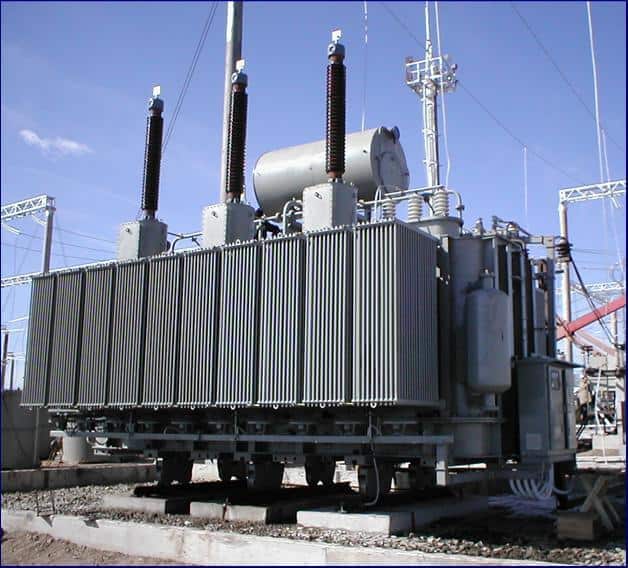
- A power station is where the power is generated. A substation is a critical part of an electrical transmission and distribution system (not generation itself), where power is transformed, switched, controlled, and distributed further into the grid.
- Substations contain specialized equipment that allows the voltage of electricity to be transformed and controlled. The voltage is stepped up or down through transformers located within the substation.
- Substations also perform protection, monitoring, and grid control functions—not just voltage transformation.
- Substations typically include:
- Transformers: The core components for voltage transformation.
- Circuit Breakers: To isolate and protect equipment.
- Switchgear: For controlling and protecting the flow of electricity.
- Shunt Reactors (sometimes): Used to improve system stability.
- Other equipment: Measuring instruments, control panels, etc.
- Transformers (Power Transformers, Distribution Transformers, Traction Transformers, HVDC Converters, Solid State Transformers (SST), Rectifier Transformers):
- A transformer is a passive electrical device that transfers electrical energy from one circuit to another through electromagnetic induction. It can be classified into three types based on voltage change:
- Step-up: Increases voltage and decreases current.
- Step-down: Decreases voltage and increases current.
- Isolation: Provides electrical isolation without changing the voltage.
- Distribution vs. Power Transformers:
- Power Transformers: These are used in high-voltage transmission networks for both stepping up and stepping down applications (e.g., 400 kV, 220 kV). They are generally rated above ~100–200 MVA (not a strict boundary) and are designed for maximum efficiency at or near full load.
- Distribution Transformers: These are used in lower-voltage distribution networks to connect to end-users (e.g., 11 kV → 400/230 V). They are generally rated below ~100 MVA (typically much smaller in practice) and are designed for maximum efficiency at partial load (~50–70%), as they operate continuously with variable demand. They perform the final voltage transformation for household and commercial use.
- Specialized Transformers:
- Traction Transformers: These are special transformers used in railway systems to step down high-voltage AC power from the overhead catenary to the required voltage for the train’s traction system. They are typically standard grid-frequency transformers (50/60 Hz).
- HVDC Converter Transformers: Used in HVDC stations. These transformers adapt AC voltage levels and provide galvanic isolation and phase shifting before conversion to DC (rectification) or after inversion back to AC.
- Solid State Transformers (SSTs): Also known as power electronic transformers (PETs) or intelligent universal transformers (IUTs). These are power-electronic-based conversion systems (not purely AC-AC transformers) that include AC/DC/AC conversion stages with a high-frequency transformer, enabling reduced size, advanced control, and bidirectional power flow.
- Rectifier Transformers: These transformers supply AC power to rectifier systems, which convert it into DC. Their design minimizes harmonics and ensures stable DC output. They are used in industrial processes requiring large DC power (e.g., electrolysis, traction, HVDC).
- A transformer is a passive electrical device that transfers electrical energy from one circuit to another through electromagnetic induction. It can be classified into three types based on voltage change:

- Shunt Reactor:
- Shunt reactors are used in high-voltage transmission systems to control voltage during load variations.
- A shunt reactor is a device that absorbs reactive power (inductive compensation), thereby stabilizing voltage and improving system efficiency, especially in long transmission lines and cable systems.
- A shunt reactor can be directly connected to the power line or to a tertiary winding of a three-winding transformer. It can be permanently connected or switched via a circuit breaker.
- Unlike a power transformer, a shunt reactor typically has a single winding per phase and is designed to consume reactive power rather than transfer active power.
- Chip, Computer Chip and Integrated Circuit (IC):
- An integrated circuit (IC) is an electronic circuit in which electronic components such as transistors, diodes, resistors, capacitors, and their interconnections are fabricated together in or on a semiconductor substrate, typically silicon. ICs can contain from a few components to billions of transistors and are manufactured on semiconductor wafers, which are subsequently separated into individual dies.
- Terms are often used interchangeably but there are subtle differences:
- Chip: Is the most general informal term. It commonly refers to a semiconductor die or an integrated-circuit device, although the exact meaning depends on context. A chip can contain an IC and may subsequently be packaged for use in an electronic system.
- Integrated Circuit (IC): This is the technical term for an electronic circuit whose components and interconnections are fabricated together as an integrated structure, typically on a semiconductor substrate. It describes the electronic functionality implemented in the integrated circuit, rather than simply the physical piece of semiconductor material.
- Die: A die is an individual piece of semiconductor material containing an IC or other semiconductor device, separated from a processed wafer during semiconductor manufacturing. A die is commonly packaged before being used as a finished semiconductor component.
- Computer Chip: This term is an informal, broad term for a semiconductor device or IC used in a computer or computing system, such as a microprocessor/CPU, memory device, graphics processor/GPU, or other processor or accelerator.
- AI Chips:
- Artificial intelligence (AI) chips are semiconductor processors or accelerators optimized for the computational workloads used by AI and machine-learning systems. They are designed to efficiently perform operations such as matrix and vector computations, tensor operations, and other highly parallel workloads used in neural-network training and inference. AI chips can support applications including generative AI, computer vision, speech processing, recommendation systems, and natural-language processing (NLP).
- AI chips can be based on different architectures and technologies, including GPUs, CPUs with AI acceleration, NPUs, TPUs, ASICs, FPGAs, and other specialized accelerators. They are not necessarily a single standardized category of semiconductor device.
- Chips are made primarily from semiconductor materials, with silicon being the dominant substrate material for mainstream integrated circuits. Other semiconductor materials, including compound and wide-bandgap materials, are used for specific applications.
- Taiwan is a major global center for semiconductor manufacturing, including advanced semiconductor fabrication, with Taiwan Semiconductor Manufacturing Company (TSMC) being one of the world’s leading semiconductor foundries. The geographic distribution of semiconductor manufacturing and the relative share of advanced-node production are dynamic market characteristics.
- NVIDIA uses external semiconductor foundries, including TSMC, to manufacture many of its advanced processors and accelerators. The specific manufacturing arrangements and process nodes used for individual NVIDIA products vary by generation and product.
- Grid-to-Chip:
- “Grid-to-chip” is an expression used mainly in data-center, power-delivery, and AI-infrastructure contexts.
- It describes the end-to-end electrical power-delivery chain from the utility/grid connection to the semiconductor device, including the intermediate electrical distribution and power-conversion stages required to deliver usable power to computing equipment and ultimately to the chip. Depending on the architecture, these stages can include transformers, switchgear, generators, UPS systems, power distribution equipment, power supplies, voltage regulators, and point-of-load or on-package power-conversion stages.
- The term emphasizes the complete power path and the increasing importance of power delivery and conversion as computing and AI power densities increase.
- System-On-a-Chip:
- A System-on-a-Chip (SoC) is an integrated circuit that combines multiple major functional blocks of a computer or electronic system onto a single semiconductor chip. Depending on its application, an SoC may integrate components such as one or more CPUs, GPUs or other accelerators, memory controllers, interfaces, security functions, communication/connectivity blocks, and peripheral controllers.
- Rather than implementing the system using separate ICs for each major function, an SoC integrates many of these functions into a single chip, reducing physical size, inter-chip communication, power consumption, and potentially system cost.
- External components may still be required, such as memory, storage, power-management components, sensors, antennas, or other specialized devices, depending on the system.
- Fundamental Units of Electricity:
- Electric Current:
- Ampere – Amp (A):
- Amperes measure the flow of electrical current (electric charge) through a circuit. Ampere (A) is the SI unit of measure for the rate of electron flow, or current, in an electrical conductor.
- One ampere is defined as one coulomb of electric charge moving past a point in one second (1 A = 1 C/s). The ampere is named after the French physicist André-Marie Ampère, who made significant contributions to the study of electromagnetism.
- Milliampere (mA):
- Milliampere (mA) is a unit of electric current equal to one-thousandth of an ampere (1 mA = 0.001 A = 10⁻³ A). The prefix “milli” signifies 10⁻³ in the metric system. This unit is commonly used to measure small currents in electronic circuits and consumer devices.
- Ampere – Amp (A):
- Electrical Potential (Voltage):
- Volt (V):
- Volts measure the electric potential difference that drives the flow of electrons through a circuit. Voltage can be thought of as the “electrical pressure” that pushes current through a conductor.
- Kilovolt (kV):
- Kilovolt (kV) is a unit of potential difference equal to 1,000 volts (1 kV = 1,000 V).
- Volt (V):
- Electrical Power vs. Electrical Energy:
- Watts measure the rate of energy consumption or generation, also known as power.
- A useful analogy is:
- Power = the speed at which electricity is used or generated
- Energy = the total amount of electricity used or generated over time
- Power vs. Energy: how electricity is measured and billed.
- Power (measured in W, kW, MW, GW, TW): Rate at which energy is used or generated at a given moment.
- Energy (measured in Wh, kWh, MWh, GWh, TWh): Total amount of power consumed or generated over a period of time (Energy = Power × Time).
- Real Power Units:
- Real power units measure the actual (active) power that performs useful work.
- Kilowatt (kW):
- A kilowatt is simply a measure of how much power an electric appliance consumes—it’s 1,000 watts to be exact.
- You can quickly convert watts (W) to kilowatts (kW) by dividing your wattage by 1,000:
- 1,000 W = 1 kW
- Megawatt (MW):
- One megawatt equals one million watts or 1,000 kilowatts, roughly enough electricity for the instantaneous demand of approximately 500–1,000 homes (depending on region and consumption patterns).
- Gigawatt (GW):
- A gigawatt (GW) is a unit of power, and it is equal to one billion watts.
- According to the Department of Energy, generating one GW of power takes over three million solar panels or approximately 310 utility-scale wind turbines.
- Terawatt (TW):
- One terawatt is equal to one trillion watts (1,000,000,000,000 watts). The main use of terawatts is found in the electric power industry, particularly for measuring very large-scale power generation or consumption.
- According to the U.S. Energy Information Administration, America is one of the largest electricity consumers in the world, using about 4,146.2 terawatt-hours (TWh) of energy per year.
- Energy consumption should always be expressed in TWh (energy), not TW (power).
- Apparent Power Units:
- Apparent power measures the total electrical power supplied to an AC circuit, including both useful (real) power and non-working (reactive) power.
- Kilovolt-Amperes (kVA):
- Kilovolt-Amperes (kVA) stands for Kilo-volt-amperes, a term used for the rating of an electrical circuit. A kVA is a unit of apparent power, which is the product of the circuit’s voltage and current.
- The difference between real power (kW) and apparent power (kVA) is crucial.
- Real power (kW) is the actual power that performs work, while apparent power (kVA) is the total power delivered to a circuit, including the reactive power (measured in kVAR) that doesn’t perform useful work but is necessary to energize inductive equipment such as motors and transformers.
- The relationship between them is defined by the power factor.
- kW = kVA × Power Factor
- Since the power factor is typically less than 1, the kVA value will always be higher than the kW value.
- Megavolt-Amperes (MVA):
- Megavolt-Amperes (MVA) is a unit used to measure the apparent power in a circuit, primarily for very large electrical systems like power plants, substations, and transmission networks.
- 1 MVA is equivalent to:
- 1,000 kVA
- 1,000,000 VA
- Specialized Renewable Energy Unit:
- Kilowatt-peak (kWp):
- kWp stands for kilowatt-peak power output of a system. It is most commonly applied to solar photovoltaic (PV) systems.
- For example, a solar panel system with a peak power of 3 kWp working at its maximum capacity for one hour will produce up to 3 kWh.
- kWp (kilowatt peak) is the total kW rating of the system under Standard Test Conditions (STC).
- Example: If the system has four 270-watt panels: 4 × 0.27 kW = 1.08 kWp
- kWp does not universally correspond to 1,000 kWh/year; actual production depends strongly on location, irradiation, panel orientation, temperature, shading, and overall system efficiency (typically around 800–1,200 kWh/year per installed kWp in much of Europe).
- Kilowatt-peak (kWp):
- Electric Current:
- Information Technology (IT) & Operational Technology (OT):
- Information Technology (IT):
- Refers to anything related to computer technology, including hardware and software. Your email, for example, falls under the IT umbrella. IT forms the technological backbone of most organizations and companies by managing data, communications, and business processes.
- These devices and programs have high flexibility and are frequently updated, with a strong focus on data processing, storage, cybersecurity, and user interaction.
- Operational Technology (OT):
- Refers to the hardware and software used to change, monitor, or control physical devices, processes, and events within a company or organization. This form of technology is most commonly used in industrial settings, where these systems are engineered for safety, reliability, and precision control. An example of OT includes SCADA (Supervisory Control and Data Acquisition).
- OT systems often include PLCs (Programmable Logic Controllers), DCS (Distributed Control Systems), and industrial sensors/actuators.
- => The main difference between OT and IT devices: OT devices control the physical world, while IT systems manage data.
- Information Technology (IT):
- Extra Low-Voltage (ELV):
- Extra-Low Voltage (ELV) is defined as a voltage of ≤ 50 V AC (RMS) or ≤ 120 V DC (ripple-free).
- ELV systems are typically used where electrical safety is critical (e.g., building automation, control circuits, lighting, telecom).
- Low-Voltage (LV):
- The International Electrotechnical Commission (IEC) defines Low Voltage (LV) for supply systems as voltage in the range > 50–1000 V AC or > 120–1500 V DC.
- Medium-Voltage (MV):
- Medium Voltage (MV) is a voltage class that typically falls between low voltage and high voltage, with a common range being from > 1 kV up to ~30–36 kV (typical IEC practice).
- Some regions (e.g., North America) extend MV up to ~69 kV, depending on utility definitions.
- High-Voltage (HV):
- The International Electrotechnical Commission defines high voltage as above 1000 V AC and above 1500 V DC.
- In practice, HV is often considered from ~36 kV up to ~230 kV in transmission systems.
- Super High-Voltage or Extra High-Voltage (EHV):
- Extra High-Voltage (EHV) is the voltage class used for long-distance bulk power transmission. The range for EHV systems is typically from ~220 kV to ~765–800 kV. “Super High Voltage” is not a standard IEC term.
- Ultra High-Voltage (UHV):
- Ultra High-Voltage (UHV) is the highest voltage class used in electrical transmission, defined as a voltage of ≥ 800 kV (AC) and ≥ 800–1000 kV (DC, depending on classification).
- UPS (Uninterruptible Power Supply):
- An Uninterruptible Power Supply (UPS) is an electrical device that provides immediate, seamless backup power and power conditioning to critical loads when the primary power source fails or becomes unstable.
- A UPS uses an internal energy storage system (typically batteries, but sometimes flywheels or supercapacitors in specialized applications) to supply power without interruption, while also protecting equipment from power disturbances such as:
- Voltage spikes and surges
- Brownouts and sags
- Frequency variations and electrical noise
- Complete power outages
- UPS systems are commonly used to ensure the continuity and reliability of sensitive equipment, such as data centers, telecommunications infrastructure, healthcare equipment, industrial control systems, and critical building services.
- A UPS typically provides power for a limited duration (from a few minutes to several hours depending on its size and configuration), allowing critical equipment to continue operating until normal power is restored or a standby generator starts and assumes the load.
- Powertrain:
- A powertrain is a system inside a vehicle, boat or another type of machinery. The system is designed to propel the vehicle forward. In a car, a powertrain consists of the engine or motor and its internal components, such as the energy storage system, transmission and driveshaft. In a conventional internal combustion engine (ICE), the powertrain converts the stored gasoline or diesel energy to kinetic energy in the engine and transfers it via the transmission, driveshaft and differential as torque to the wheels of the vehicle, propelling it forward.
- The vast majority of powertrain systems in production today are based on ICEs. These can either be spark ignition (SI) in the case of gasoline or compression ignition (CI) for diesel. Electrification of road vehicles has significantly increased the production of both hybrid engines, which use a mix of ICE and electrified powertrains, and fully electrified systems. The energy for electrified systems can come from a range of sources, including onboard generation, plug-in charging or even hydrogen fuel cells.
- Grid, Microgrids, DERs and DERM’s:
- Grid / Power Grid:
- The power grid is a network for delivering electricity to consumers. The power grid includes power generation facilities, substations, transmission lines and towers, distribution networks, protection and control equipment, and associated communication and monitoring infrastructure.
- The grid continuously balances electricity generation and consumption while maintaining system stability and power quality, supplying electricity for applications ranging from industry to household appliances.
- Electric grids perform three major functions or stages of electricity supply: power generation, transmission, and distribution. Grid operation also includes functions such as system balancing, protection, control, monitoring, and, increasingly, energy storage and demand-side management.
- The power grid is a network for delivering electricity to consumers. The power grid includes power generation facilities, substations, transmission lines and towers, distribution networks, protection and control equipment, and associated communication and monitoring infrastructure.
- Microgrid:
- A microgrid is a group of interconnected loads and distributed energy resources (DERs) within clearly defined electrical boundaries that acts as a single controllable entity with respect to the main grid and can operate either connected to the main grid or, when appropriately designed, intentionally and controllably in an islanded mode.
- Microgrids can integrate local generation, energy storage, controllable loads, and other DERs to improve resilience, flexibility, efficiency, or local energy management.
- A microgrid is a group of interconnected loads and distributed energy resources (DERs) within clearly defined electrical boundaries that acts as a single controllable entity with respect to the main grid and can operate either connected to the main grid or, when appropriately designed, intentionally and controllably in an islanded mode.
- Smart Grid:
- A smart grid is an electrical grid enhanced with digital communications, sensing, automation, control, and data/analytics technologies across generation, transmission, distribution, and/or customer-side systems to improve the monitoring, operation, efficiency, reliability, resilience, and flexibility of the power system.
- Distributed Energy Resources (DERs):
- Distributed energy resources (DERs) are relatively small-scale electricity generation, storage, and flexible demand resources, located at or near the distribution system or customer premises, that can supply, store, or modify electricity consumption and are interconnected to the electric grid. They are often located close to load centers and can be used individually or in aggregate to provide value to the grid.
- Common examples of DERs include rooftop solar PV units, small wind turbines, small gas-fired generators or engines/turbines, microturbines, biomass generators, fuel cells, combined heat and power (CHP) or tri-generation systems with electrical generation, battery storage, electric vehicles and controllable EV charging or discharging where they can provide grid flexibility, and demand response applications.
- Distributed energy resources (DERs) are relatively small-scale electricity generation, storage, and flexible demand resources, located at or near the distribution system or customer premises, that can supply, store, or modify electricity consumption and are interconnected to the electric grid. They are often located close to load centers and can be used individually or in aggregate to provide value to the grid.
- Distributed Energy Resources Management Systems (DERMS):
- Distributed Energy Resources Management Systems (DERMS) are software platforms that help utilities, distribution system operators (DSOs), aggregators, and other energy-sector organizations monitor, provide visibility into, forecast, coordinate, optimize, and, where supported, control distributed energy resources (DERs).
- DERMS can be used to aggregate and coordinate large numbers of DERs and flexible loads for grid services, including voltage and power-flow management, congestion and constraint management, balancing, flexibility services, resilience, and participation in demand-response or other electricity markets. DERMS can be defined in many ways, depending on the use case, the types of DERs being managed, the responsibilities of the organization using the system, and the architecture of the power system.
- Distributed Energy Resources Management Systems (DERMS) are software platforms that help utilities, distribution system operators (DSOs), aggregators, and other energy-sector organizations monitor, provide visibility into, forecast, coordinate, optimize, and, where supported, control distributed energy resources (DERs).
- Grid / Power Grid:
- Power Quality:
- The term power quality may be defined as a range of electrical phenomena and characteristics that describe the voltage, current, frequency, and waveform conditions at a given time and location in a power system, including deviations from expected or specified conditions.
- Power quality refers to the characteristics of the electrical supply and electrical quantities that affect the proper operation of electrical equipment and systems. It encompasses factors like voltage magnitude and variation, frequency, waveform distortion (including harmonics), voltage unbalance, transients, flicker, and interruptions or other supply disturbances. Deviations from specified or acceptable conditions can lead to equipment malfunction, reduced performance, nuisance tripping, premature aging, data loss, and, in severe cases, damage.
- Essentially, it describes how closely the actual electrical supply and its characteristics match the ideal or specified conditions required for the proper operation of electrical equipment and systems.
- Hardware vs. Software vs. Firmware:
- Hardware is physical: it’s tangible electronic or mechanical components. It can break, wear out, or be damaged by environmental factors (heat, water, shock, etc.).
- Since hardware is part of the “real” world, it all eventually wears out. Being a physical thing, it’s also possible to break it, drown it, overheat it, and otherwise expose it to the elements.
- Here are some examples of hardware:
- Smartphone
- Tablet
- Laptop
- Desktop computer
- Printer
- Flash drive
- Router
- Software is virtual: it consists of programs and data that run on hardware to perform functions. It can be copied, modified, updated, or deleted.
- Software is everything about your computer that isn’t hardware.
- Here are some examples of software:
- Operating systems like Windows 11 or iOS
- Web browsers
- Antivirus tools
- Adobe Photoshop
- Mobile apps
- Firmware is virtual: is embedded software that is tightly coupled to specific hardware and controls its low-level functions.
- While not as common a term as hardware or software, firmware is everywhere—on your smartphone, your PC’s motherboard, your camera, your headphones, and even your TV remote control.
- Firmware is a specialized type of software that serves a specific control and interface role between hardware and higher-level software.
- Hardware is physical: it’s tangible electronic or mechanical components. It can break, wear out, or be damaged by environmental factors (heat, water, shock, etc.).
- Energy Storage System (ESS):
- An Energy Storage System (ESS) is a system or group of components capable of storing energy in one form and delivering it later in the same or another usable form, including electrical energy.
- An ESS may include three main functional components:
- A Power Conversion System (PCS), which converts electrical power between different electrical forms, such as AC and DC, where required
- A storage unit, which stores the energy
- A control system, which manages energy flow, operating conditions, protection, and system operation
- ESS is a broad concept that includes multiple storage technologies (including electrochemical, mechanical, thermal, chemical, and electrical storage), not only electrical-to-electrical systems. Not every ESS necessarily contains a PCS or all of these components; the architecture depends on the storage technology and application.
- Battery Energy Storage System (BESS):
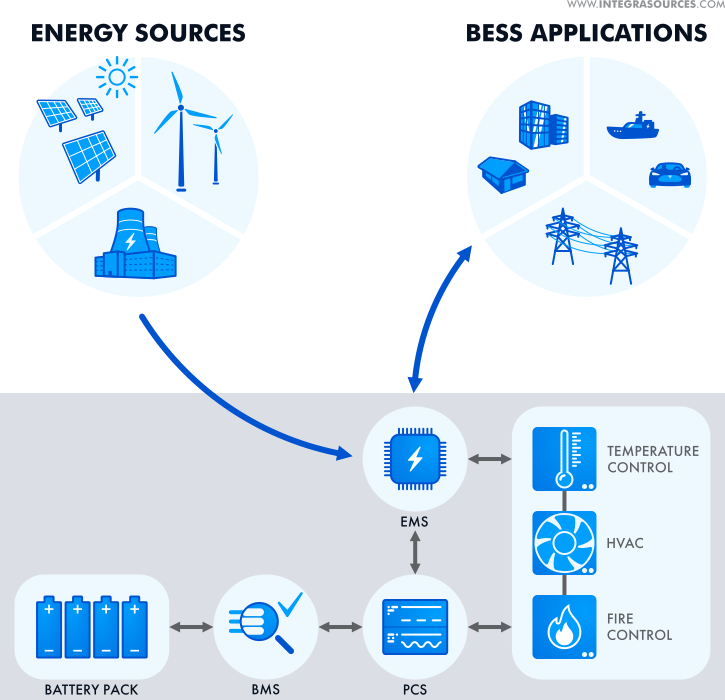
- A BESS is a type of ESS that stores energy specifically in rechargeable electrochemical batteries. It captures energy from sources such as the electrical grid or renewable generation, stores it, and releases it when needed.
- A BESS typically includes:
- battery cells assembled into modules, packs/racks, or other battery assemblies (e.g., lithium-ion)
- a Battery Management System (BMS)
- a bidirectional Power Conversion System (PCS), typically an inverter/rectifier for AC-grid applications
- an Energy Management System (EMS) and/or higher-level control system
- protection and, depending on the design, thermal-management, monitoring, switching, and auxiliary systems
- “Battery energy storage system architecture” refers to the structural and functional integration of these subsystems into a complete, controllable solution, not just the batteries themselves.
- Hybridized Energy Storage System (HESS):
- A Hybrid Energy Storage System (HESS) combines two or more different energy-storage technologies or storage subsystems to leverage their complementary characteristics.
- This can improve overall system performance, power/energy capability, efficiency, operating range, or lifetime when appropriately designed and controlled, compared to a single storage technology.
- High-power components (e.g., supercapacitors) handle rapid, short-duration power demands or peaks
- High-energy components (e.g., batteries) handle longer-duration energy storage and supply
- Distributed Energy Storage Systems (DESS):
- Distributed Energy Storage Systems (DESS) are energy-storage resources deployed across multiple geographically distributed locations rather than in a single centralized facility.
- These systems can range from residential batteries to commercial, industrial, community, and utility-scale installations and are used to:
- store excess energy (e.g., from solar or wind)
- supply energy during peak demand
- provide grid services such as flexibility, voltage support, frequency regulation, or congestion management, where applicable
- improve grid resilience and operational flexibility
- DESS is a deployment/distribution model (where storage is located), not a specific storage technology.
- Motors, Generators and Drives:
- Motor:
- A motor is a machine (electromechanical device) that converts electrical energy into mechanical energy, generating rotational or linear motion used to power a machine.
- Electric motors are among the most widely used industrial devices and power equipment such as pumps, fans, compressors, conveyors, machine tools, and robotics.
- NEMA / IEC Motors:
- NEMA motors are commonly made with rolled steel or cast iron frames while IEC motors are commonly made with cast aluminum or cast iron frames.
- North American National Electrical Manufacturers Association (NEMA) and International Electrotechnical Commission (IEC) standards are crucial because they ensure that motors from different manufacturers are standardized and interchangeable in terms of dimensions, mounting, performance, efficiency, safety, and testing.
- The main differences between NEMA and IEC motors are frame dimensions, shaft sizes, mounting standards, enclosure classifications, and regional electrical standards rather than motor operating principles.
- Servo Motor:
- A servo motor is a self-contained electrical device that rotates parts of a machine with high precision and dynamic control.
- The output shaft of this motor can be moved to a particular position, angle, velocity, and torque, which a regular motor does not inherently control.
- It consists of a suitable motor coupled to a feedback device (e.g., encoder or resolver) for position and speed feedback, and requires a dedicated servo drive/controller to operate in a closed-loop control system.
- Servo motors are widely used in robotics, CNC machines, packaging equipment, semiconductor manufacturing, and other high-precision automation systems.
- Shaft Grounded Motor:
- A shaft-grounded motor is an electric motor equipped with a device to safely redirect shaft-induced electrical currents (e.g., caused by variable frequency drives) away from its internal bearings.
- Without this protection, these currents can cause bearing pitting, electrical erosion, and premature motor failure.
- Shaft grounding rings or brushes provide a low-resistance path to ground, preventing damaging bearing currents.
- Synchronous and Asynchronous Motors:
- An AC motor that runs at exactly synchronous speed (the speed of the rotating magnetic field) is known as a synchronous motor.
- An AC motor that runs at slightly less than synchronous speed is known as an asynchronous (induction) motor.
- The advantages of the synchronous motor are the ease with which the power factor can be controlled and the constant rotational speed of the machine, irrespective of the applied load.
- Synchronous motors, however, are generally more expensive and traditionally require DC excitation or permanent magnets at the rotor.
- Synchronous motors are generally not self-starting. The construction of a synchronous motor is more complicated than that of induction motors.
- Synchronous motors are costlier than induction motors.
- Asynchronous (induction) motors are self-starting, rugged, inexpensive, and by far the most common motors used in industrial applications.
- NEMA / IEC Motors:
- Generator:
- A generator does the opposite of a motor, converting mechanical energy into electrical energy.
- It does not create electricity; rather, it induces the movement of electric charges (electrons) in a conductor through electromagnetic induction, producing an electric current.
- Generators are commonly driven by turbines (steam, gas, hydro, or wind) or internal combustion engines.
- Drive:
- A drive (also called a motor drive or motor controller) is the electronic power conversion and control system that regulates the electrical energy supplied to a motor.
- By positioning a drive between the electrical supply and the motor, power is fed into the drive, and the drive then modulates voltage, current, and frequency before supplying it to the motor.
- This allows precise control of:
- speed
- direction
- acceleration / deceleration
- torque
- and, in advanced systems, position (when combined with feedback devices)
- Drives are essential for energy efficiency, process control, and equipment protection, especially in modern industrial applications.
- Depending on the motor type, drives include Variable Frequency Drives (VFDs) for AC motors, servo drives for servo motors, and DC drives for DC motors.
- Motor: