Sonepar – Sonepar to showcase its data center expertise at Data Centre World Asia

Sonepar will present its “From the Grid to the Chip” approach at Data Centre World Asia (DCWA), taking place September 29-30, 2026 in Singapore.
As demand for reliable and scalable digital infrastructure continues to grow, data center projects require coordinated support across every stage of their lifecycle. Sonepar helps customers address these challenges by connecting them with the solutions, technologies, and partners needed to design, build, and expand their facilities.
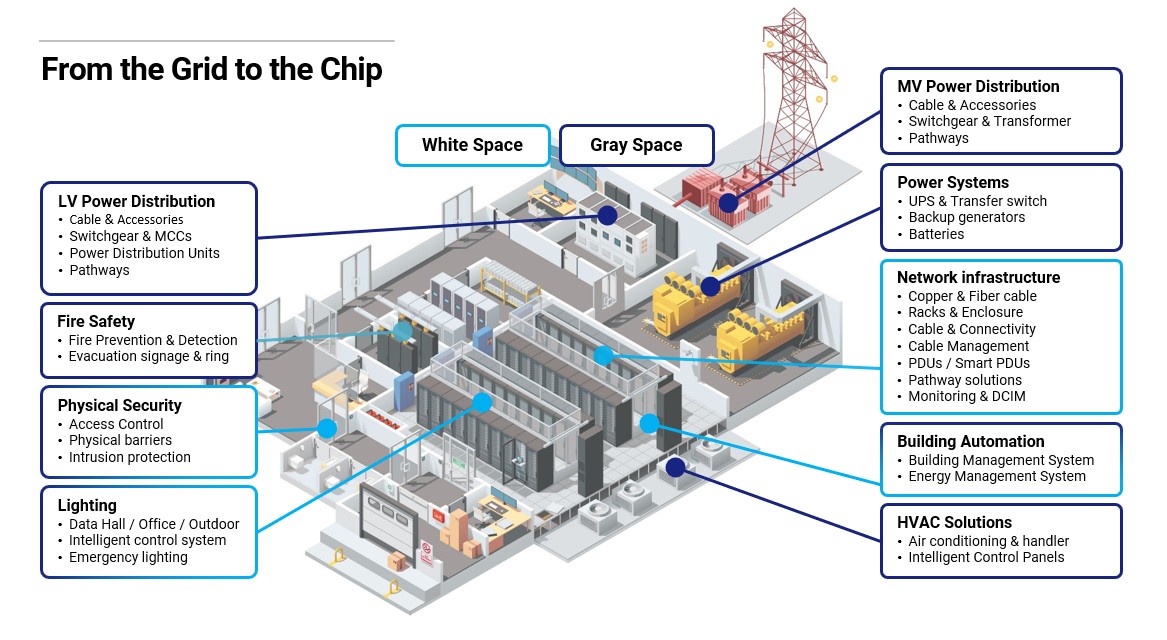
At Data Centre World Asia, Sonepar will highlight its “From the Grid to the Chip” approach, which supports customers in both gray space and white space, with a coordinated portfolio that includes:
- Medium and low voltage power distribution
- Power systems such as UPS, generators, and batteries
- HVAC and thermal management
- Network infrastructure and structured cabling
- Building automation and energy monitoring
- Fire safety, lighting, and physical security
Visitors will have the opportunity to meet Sonepar’s data center specialists and discuss practical project requirements, from electrical infrastructure and connectivity to supply chain support and technical guidance.
The event will be held on September 29-30, 2026 at the Sands Expo & Convention Centre in Singapore. Attendees can meet the Sonepar team at Booth 3-E2 to learn more about the company’s capabilities in supporting data center projects worldwide.
SourceSonepar
EMR Analysis
More information on Sonepar: See the full profile on EMR Executive Services
More information on Philippe Delpech (Permanent Representative of Colam Entreprendre + President, Sonepar SAS): See the full profile on EMR Executive Services
More information on Jérôme Baniol (Chief Financial Officer and M&A, Sonepar + Member of the Sonepar Strategic Committee (SSC) + Member of the Sonepar Executive Committee (SEC), Sonepar): See the full profile on EMR Executive Services
More information on Data Center Solutions by Sonepar: https://www.sonepar.com/en/offer/markets-and-solutions/data-center-solutions + Data centers are critical enablers of the digital world. They support cloud services, artificial intelligence, and core applications that require constant availability and efficiency.
As the digital infrastructure becomes more complex and energy constraints increase, data center projects demand reliable partners who can coordinate products, logistics, and expertise at scale.
Sonepar’s Data Center Solutions support data center projects from design to operation. We work alongside installers, system integrators, general contractors, enterprises, colocation operators, and hyperscalers to help deliver infrastructure that is reliable, scalable, and energy conscious.
More information on Data Centre World Asia (September 29-30, 2026 – Marina Bay Sands, Singapore): https://www.singaporetechnologyweek.com/data-centre-world + As the backbone of the digital economy, data centres are evolving rapidly to meet the demands of a hyper-connected world. From scalable infrastructure to energy-efficient operations, the data centre landscape is defined by innovation and resilience.
The 12th edition of Data Centre World Asia will take place on 29-30 September 2026. Whether you’re modernising critical infrastructure, scaling AI-ready environments, or shaping the future of digital operations, Data Centre World Asia is where we invite you to join us to understand what’s next for your organisation’s infrastructure.
EMR Additional Notes:
- Grid, Microgrids, DERs and DERM’s:
- Grid / Power Grid:
- The power grid is a network for delivering electricity to consumers. The power grid includes power generation facilities, substations, transmission lines and towers, distribution networks, protection and control equipment, and associated communication and monitoring infrastructure.
- The grid continuously balances electricity generation and consumption while maintaining system stability and power quality, supplying electricity for applications ranging from industry to household appliances.
- Electric grids perform three major functions or stages of electricity supply: power generation, transmission, and distribution. Grid operation also includes functions such as system balancing, protection, control, monitoring, and, increasingly, energy storage and demand-side management.
- The power grid is a network for delivering electricity to consumers. The power grid includes power generation facilities, substations, transmission lines and towers, distribution networks, protection and control equipment, and associated communication and monitoring infrastructure.
- Microgrid:
- A microgrid is a group of interconnected loads and distributed energy resources (DERs) within clearly defined electrical boundaries that acts as a single controllable entity with respect to the main grid and can operate either connected to the main grid or, when appropriately designed, intentionally and controllably in an islanded mode.
- Microgrids can integrate local generation, energy storage, controllable loads, and other DERs to improve resilience, flexibility, efficiency, or local energy management.
- A microgrid is a group of interconnected loads and distributed energy resources (DERs) within clearly defined electrical boundaries that acts as a single controllable entity with respect to the main grid and can operate either connected to the main grid or, when appropriately designed, intentionally and controllably in an islanded mode.
- Smart Grid:
- A smart grid is an electrical grid enhanced with digital communications, sensing, automation, control, and data/analytics technologies across generation, transmission, distribution, and/or customer-side systems to improve the monitoring, operation, efficiency, reliability, resilience, and flexibility of the power system.
- Distributed Energy Resources (DERs):
- Distributed energy resources (DERs) are relatively small-scale electricity generation, storage, and flexible demand resources, located at or near the distribution system or customer premises, that can supply, store, or modify electricity consumption and are interconnected to the electric grid. They are often located close to load centers and can be used individually or in aggregate to provide value to the grid.
- Common examples of DERs include rooftop solar PV units, small wind turbines, small gas-fired generators or engines/turbines, microturbines, biomass generators, fuel cells, combined heat and power (CHP) or tri-generation systems with electrical generation, battery storage, electric vehicles and controllable EV charging or discharging where they can provide grid flexibility, and demand response applications.
- Distributed energy resources (DERs) are relatively small-scale electricity generation, storage, and flexible demand resources, located at or near the distribution system or customer premises, that can supply, store, or modify electricity consumption and are interconnected to the electric grid. They are often located close to load centers and can be used individually or in aggregate to provide value to the grid.
- Distributed Energy Resources Management Systems (DERMS):
- Distributed Energy Resources Management Systems (DERMS) are software platforms that help utilities, distribution system operators (DSOs), aggregators, and other energy-sector organizations monitor, provide visibility into, forecast, coordinate, optimize, and, where supported, control distributed energy resources (DERs).
- DERMS can be used to aggregate and coordinate large numbers of DERs and flexible loads for grid services, including voltage and power-flow management, congestion and constraint management, balancing, flexibility services, resilience, and participation in demand-response or other electricity markets. DERMS can be defined in many ways, depending on the use case, the types of DERs being managed, the responsibilities of the organization using the system, and the architecture of the power system.
- Distributed Energy Resources Management Systems (DERMS) are software platforms that help utilities, distribution system operators (DSOs), aggregators, and other energy-sector organizations monitor, provide visibility into, forecast, coordinate, optimize, and, where supported, control distributed energy resources (DERs).
- Grid / Power Grid:
- Chip, Computer Chip and Integrated Circuit (IC):
- An integrated circuit (IC) is an electronic circuit in which electronic components such as transistors, diodes, resistors, capacitors, and their interconnections are fabricated together in or on a semiconductor substrate, typically silicon. ICs can contain from a few components to billions of transistors and are manufactured on semiconductor wafers, which are subsequently separated into individual dies.
- Terms are often used interchangeably but there are subtle differences:
- Chip: Is the most general informal term. It commonly refers to a semiconductor die or an integrated-circuit device, although the exact meaning depends on context. A chip can contain an IC and may subsequently be packaged for use in an electronic system.
- Integrated Circuit (IC): This is the technical term for an electronic circuit whose components and interconnections are fabricated together as an integrated structure, typically on a semiconductor substrate. It describes the electronic functionality implemented in the integrated circuit, rather than simply the physical piece of semiconductor material.
- Die: A die is an individual piece of semiconductor material containing an IC or other semiconductor device, separated from a processed wafer during semiconductor manufacturing. A die is commonly packaged before being used as a finished semiconductor component.
- Computer Chip: This term is an informal, broad term for a semiconductor device or IC used in a computer or computing system, such as a microprocessor/CPU, memory device, graphics processor/GPU, or other processor or accelerator.
- AI Chips:
- Artificial intelligence (AI) chips are semiconductor processors or accelerators optimized for the computational workloads used by AI and machine-learning systems. They are designed to efficiently perform operations such as matrix and vector computations, tensor operations, and other highly parallel workloads used in neural-network training and inference. AI chips can support applications including generative AI, computer vision, speech processing, recommendation systems, and natural-language processing (NLP).
- AI chips can be based on different architectures and technologies, including GPUs, CPUs with AI acceleration, NPUs, TPUs, ASICs, FPGAs, and other specialized accelerators. They are not necessarily a single standardized category of semiconductor device.
- Chips are made primarily from semiconductor materials, with silicon being the dominant substrate material for mainstream integrated circuits. Other semiconductor materials, including compound and wide-bandgap materials, are used for specific applications.
- Taiwan is a major global center for semiconductor manufacturing, including advanced semiconductor fabrication, with Taiwan Semiconductor Manufacturing Company (TSMC) being one of the world’s leading semiconductor foundries. The geographic distribution of semiconductor manufacturing and the relative share of advanced-node production are dynamic market characteristics.
- NVIDIA uses external semiconductor foundries, including TSMC, to manufacture many of its advanced processors and accelerators. The specific manufacturing arrangements and process nodes used for individual NVIDIA products vary by generation and product.
- Grid-to-Chip:
- “Grid-to-chip” is an expression used mainly in data-center, power-delivery, and AI-infrastructure contexts.
- It describes the end-to-end electrical power-delivery chain from the utility/grid connection to the semiconductor device, including the intermediate electrical distribution and power-conversion stages required to deliver usable power to computing equipment and ultimately to the chip. Depending on the architecture, these stages can include transformers, switchgear, generators, UPS systems, power distribution equipment, power supplies, voltage regulators, and point-of-load or on-package power-conversion stages.
- The term emphasizes the complete power path and the increasing importance of power delivery and conversion as computing and AI power densities increase.
- System-On-a-Chip:
- A System-on-a-Chip (SoC) is an integrated circuit that combines multiple major functional blocks of a computer or electronic system onto a single semiconductor chip. Depending on its application, an SoC may integrate components such as one or more CPUs, GPUs or other accelerators, memory controllers, interfaces, security functions, communication/connectivity blocks, and peripheral controllers.
- Rather than implementing the system using separate ICs for each major function, an SoC integrates many of these functions into a single chip, reducing physical size, inter-chip communication, power consumption, and potentially system cost.
- External components may still be required, such as memory, storage, power-management components, sensors, antennas, or other specialized devices, depending on the system.
- Cloud Computing:
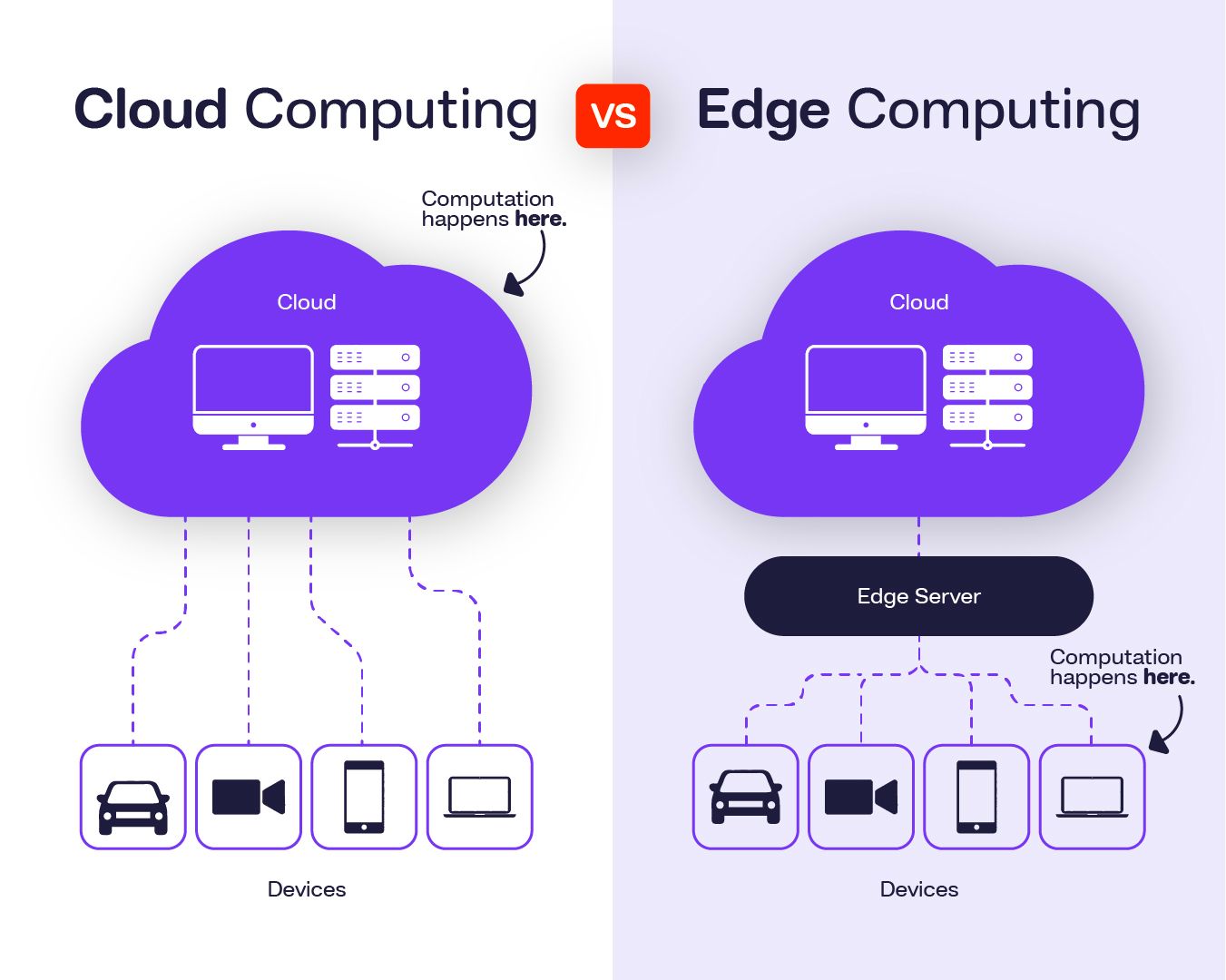
- Cloud computing is a general term for anything that involves delivering hosted services over the internet. It is the on-demand availability of computer system resources, especially data storage and computing power, without direct active management by the user. Large clouds often have functions distributed over multiple locations, each location being a data center. Cloud services typically include IaaS, PaaS, and SaaS service models.
- Edge Computing:
- Edge computing is a form of computing that is done on site or near a particular data source, minimizing the need for data to be processed in a remote data center.
- Edge computing can enable more effective city traffic management. Examples of this include optimising bus frequency given fluctuations in demand, managing the opening and closing of extra lanes, and, in future, managing autonomous car flows.
- An edge device is any piece of hardware that controls data flow at the boundary between two networks. Edge devices fulfill a variety of roles, depending on what type of device they are, but they essentially serve as network entry — or exit — points.
- There are five main types of edge computing devices: IoT sensors, smart cameras, uCPE equipment, servers and processors. IoT sensors, smart cameras and uCPE equipment will reside on the customer premises, whereas servers and processors will reside in an edge computing data centre.
- In service-based industries such as the finance and e-commerce sector, edge computing devices also have roles to play. In this case, a smart phone, laptop, or tablet becomes the edge computing device.
- Edge Devices:
- Edge devices encompass a broad range of device types, including sensors, actuators and other endpoints, as well as IoT gateways. Within a local area network (LAN), switches in the access layer — that is, those connecting end-user devices to the aggregation layer — are sometimes called edge switches.
- Edge devices act as the interface between the physical world (data generation) and digital networks.
- Hybrid Computing:
- A hybrid cloud integrates private, on-premises infrastructure with public cloud services, offering flexibility to distribute workloads between these environments. Hybrid models often incorporate edge computing, allowing organizations to run critical workloads locally at the edge while using the cloud for other tasks, thereby optimizing performance, cost, and data management for various business needs.
- HPC (Hight-Performance Computing):
- Practice of aggregating computing resources to gain performance greater than that of a single workstation, server, or computer. HPC can take the form of custom-built supercomputers or groups of individual computers called clusters.
- HPC is typically used for simulation, scientific computing, AI training, and complex modeling.
- Data Centers – Physical Infrastructure:
- A data center is a facility that centralizes an organization’s shared IT operations and equipment for the purposes of storing, processing, and disseminating data and applications. Because they house an organization’s most critical and proprietary assets, data centers are vital to the continuity of daily operations.
- Hyperscale Data Centers – Physical Infrastructure:
- The clue is in the name: hyperscale data centers are massive facilities built by companies with vast data processing and storage needs. These firms may derive their income directly from the applications or websites the equipment supports, or sell technology management services to third parties.
- Hyperscale Data Centers are typically operated by large cloud providers (e.g., hyperscalers) and designed for horizontal scalability.
- White Space and Grey Space in Data Centers – Physical Infrastructure:
- White space in a data center refers to the area where IT equipment is placed. It typically houses servers, storage, network gear, and racks.
- Gray space, on the other hand, is the area where the back-end infrastructure is located. This space is essential for supporting the IT equipment and includes areas for switchgear, UPS, transformers, chillers, and generators.
- Colocation in Data Centers – Physical Infrastructure:
- A colocation data center is a facility where businesses rent space, power, and cooling to house their own servers and networking hardware, rather than maintaining them in-house. It offers a cost-effective way to access high-level security, internet connectivity, and 24/7 technical support while retaining control of the equipment.
- Edge & Cloud Services – Integrated Architecture (Edge-to-Cloud):
- Edge services perform data processing on local devices and servers near the data source, reducing latency for time-sensitive operations, while cloud services centralize large computations and storage in remote datacenters, offering massive scalability and flexibility for general workloads.
- Most organizations use both, creating an “edge-to-cloud” architecture where edge devices handle immediate tasks, and the cloud manages large-scale data processing and complex applications, providing a seamless and efficient experience.
- Extra Low-Voltage (ELV):
- Extra-Low Voltage (ELV) is defined as a voltage of ≤ 50 V AC (RMS) or ≤ 120 V DC (ripple-free).
- ELV systems are typically used where electrical safety is critical (e.g., building automation, control circuits, lighting, telecom).
- Low-Voltage (LV):
- The International Electrotechnical Commission (IEC) defines Low Voltage (LV) for supply systems as voltage in the range > 50–1000 V AC or > 120–1500 V DC.
- Medium-Voltage (MV):
- Medium Voltage (MV) is a voltage class that typically falls between low voltage and high voltage, with a common range being from > 1 kV up to ~30–36 kV (typical IEC practice).
- Some regions (e.g., North America) extend MV up to ~69 kV, depending on utility definitions.
- High-Voltage (HV):
- The International Electrotechnical Commission defines high voltage as above 1000 V AC and above 1500 V DC.
- In practice, HV is often considered from ~36 kV up to ~230 kV in transmission systems.
- Super High-Voltage or Extra High-Voltage (EHV):
- Extra High-Voltage (EHV) is the voltage class used for long-distance bulk power transmission. The range for EHV systems is typically from ~220 kV to ~765–800 kV. “Super High Voltage” is not a standard IEC term.
- Ultra High-Voltage (UHV):
- Ultra High-Voltage (UHV) is the highest voltage class used in electrical transmission, defined as a voltage of ≥ 800 kV (AC) and ≥ 800–1000 kV (DC, depending on classification).
- UPS (Uninterruptible Power Supply):
- An Uninterruptible Power Supply (UPS) is an electrical device that provides immediate, seamless backup power and power conditioning to critical loads when the primary power source fails or becomes unstable.
- A UPS uses an internal energy storage system (typically batteries, but sometimes flywheels or supercapacitors in specialized applications) to supply power without interruption, while also protecting equipment from power disturbances such as:
- Voltage spikes and surges
- Brownouts and sags
- Frequency variations and electrical noise
- Complete power outages
- UPS systems are commonly used to ensure the continuity and reliability of sensitive equipment, such as data centers, telecommunications infrastructure, healthcare equipment, industrial control systems, and critical building services.
- A UPS typically provides power for a limited duration (from a few minutes to several hours depending on its size and configuration), allowing critical equipment to continue operating until normal power is restored or a standby generator starts and assumes the load.
- Motors, Generators and Drives:
- Motor:
- A motor is a machine (electromechanical device) that converts electrical energy into mechanical energy, generating rotational or linear motion used to power a machine.
- Electric motors are among the most widely used industrial devices and power equipment such as pumps, fans, compressors, conveyors, machine tools, and robotics.
- NEMA / IEC Motors:
- NEMA motors are commonly made with rolled steel or cast iron frames while IEC motors are commonly made with cast aluminum or cast iron frames.
- North American National Electrical Manufacturers Association (NEMA) and International Electrotechnical Commission (IEC) standards are crucial because they ensure that motors from different manufacturers are standardized and interchangeable in terms of dimensions, mounting, performance, efficiency, safety, and testing.
- The main differences between NEMA and IEC motors are frame dimensions, shaft sizes, mounting standards, enclosure classifications, and regional electrical standards rather than motor operating principles.
- Servo Motor:
- A servo motor is a self-contained electrical device that rotates parts of a machine with high precision and dynamic control.
- The output shaft of this motor can be moved to a particular position, angle, velocity, and torque, which a regular motor does not inherently control.
- It consists of a suitable motor coupled to a feedback device (e.g., encoder or resolver) for position and speed feedback, and requires a dedicated servo drive/controller to operate in a closed-loop control system.
- Servo motors are widely used in robotics, CNC machines, packaging equipment, semiconductor manufacturing, and other high-precision automation systems.
- Shaft Grounded Motor:
- A shaft-grounded motor is an electric motor equipped with a device to safely redirect shaft-induced electrical currents (e.g., caused by variable frequency drives) away from its internal bearings.
- Without this protection, these currents can cause bearing pitting, electrical erosion, and premature motor failure.
- Shaft grounding rings or brushes provide a low-resistance path to ground, preventing damaging bearing currents.
- Synchronous and Asynchronous Motors:
- An AC motor that runs at exactly synchronous speed (the speed of the rotating magnetic field) is known as a synchronous motor.
- An AC motor that runs at slightly less than synchronous speed is known as an asynchronous (induction) motor.
- The advantages of the synchronous motor are the ease with which the power factor can be controlled and the constant rotational speed of the machine, irrespective of the applied load.
- Synchronous motors, however, are generally more expensive and traditionally require DC excitation or permanent magnets at the rotor.
- Synchronous motors are generally not self-starting. The construction of a synchronous motor is more complicated than that of induction motors.
- Synchronous motors are costlier than induction motors.
- Asynchronous (induction) motors are self-starting, rugged, inexpensive, and by far the most common motors used in industrial applications.
- NEMA / IEC Motors:
- Generator:
- A generator does the opposite of a motor, converting mechanical energy into electrical energy.
- It does not create electricity; rather, it induces the movement of electric charges (electrons) in a conductor through electromagnetic induction, producing an electric current.
- Generators are commonly driven by turbines (steam, gas, hydro, or wind) or internal combustion engines.
- Drive:
- A drive (also called a motor drive or motor controller) is the electronic power conversion and control system that regulates the electrical energy supplied to a motor.
- By positioning a drive between the electrical supply and the motor, power is fed into the drive, and the drive then modulates voltage, current, and frequency before supplying it to the motor.
- This allows precise control of:
- speed
- direction
- acceleration / deceleration
- torque
- and, in advanced systems, position (when combined with feedback devices)
- Drives are essential for energy efficiency, process control, and equipment protection, especially in modern industrial applications.
- Depending on the motor type, drives include Variable Frequency Drives (VFDs) for AC motors, servo drives for servo motors, and DC drives for DC motors.
- Motor:
- Battery Technology:
- Lead-Acid Batteries:
- Lead-acid is the oldest commercially established rechargeable battery technology still in widespread use, with relatively low energy density and generally shorter cycle life than modern lithium-ion batteries. Typical cycle life can range from a few hundred to more than 1,000 cycles depending strongly on battery type, depth of discharge, temperature, charging regime, and operating conditions.
- Primarily used in automotive starter batteries, backup power systems (UPS), telecommunications, material-handling equipment, and low-speed electric vehicles such as golf carts, due to their low cost, established manufacturing base, high surge-current capability, and reliability.
- Nickel-Metal Hydride (NiMH):
- Nickel-metal hydride (NiMH) is a mature rechargeable battery technology with lower energy density than most modern lithium-ion batteries, but with good durability and established performance.
- Primarily found in hybrid electric vehicles (HEVs), including Toyota Prius models, as well as some consumer and industrial applications, due to good cycle durability, safety characteristics, and tolerance of frequent charge/discharge operation.
- Lithium-ion Technology (Li-ion):
- Lithium-ion technology is an umbrella family of rechargeable battery technologies in which lithium ions act as the primary charge carriers.
- During a discharge cycle, lithium ions generally move from the negative electrode to the positive electrode through the electrolyte, while electrons flow through the external circuit in the same overall direction from the negative to the positive electrode, providing usable electrical energy. During charging, the ion and electron flows are reversed.
- Lithium-ion is one of the dominant rechargeable battery technologies, widely used in mobile devices, electric vehicles, power tools, and stationary energy-storage systems.
- Lithium-ion batteries consist of one or more electrochemical cells, together with components such as a battery management system (BMS), thermal-management systems, protection circuitry, and mechanical/electrical interconnections depending on the application, to manage safety, performance, and service life.
- Lithium Iron Phosphate (LFP):
- LFP batteries belong to the lithium-ion family and use lithium iron phosphate (LiFePO₄) as the cathode active material.
- LFP offers good thermal stability, safety characteristics, long cycle life, and relatively low material cost, although its energy density is generally lower than that of many nickel-rich lithium-ion chemistries. Cycle life can reach several thousand cycles in suitable applications and operating conditions.
- Often used in electric vehicles, stationary energy storage, buses, commercial vehicles, and industrial applications.
- LFP is one of the more thermally stable lithium-ion cathode chemistries and generally has a lower tendency toward thermal runaway than some nickel-rich chemistries, although all lithium-ion batteries require appropriate safety and thermal management.
- Nickel Manganese Cobalt (NMC):
- NMC batteries belong to the lithium-ion family and use a layered metal-oxide cathode containing nickel, manganese, and cobalt, commonly represented as LiNiₓMnᵧCo_zO₂.
- They are known for high energy density and a favorable balance of energy density, power capability, and cycle life, making them suitable for electric vehicles, power tools, and other applications where compact energy storage is important.
- Cycle life varies substantially with cell chemistry, design, charging regime, depth of discharge, temperature, and application; therefore, a fixed value such as 1,000–2,000 cycles should be regarded only as an indicative range rather than a general specification.
- Trade-off: nickel-rich NMC chemistries can provide high energy density but may have greater thermal-management and material-cost considerations than LFP. The use of cobalt can also increase material cost and supply-chain considerations.
- Nickel Cobalt Manganese Aluminum (NCMA):
- NCMA batteries are a nickel-rich layered-oxide lithium-ion chemistry related to NMC, with aluminum incorporated into the cathode composition. Aluminum can contribute to structural and thermal stability while allowing reduced cobalt content compared with some conventional NMC formulations.
- They offer a balance of high energy density, power capability, cycle performance, and improved material utilization, with the exact characteristics depending on the specific cathode composition and cell design.
- Sodium-ion Technology (Na-ion / SIB):
- Sodium-ion batteries are rechargeable batteries that use sodium ions (Na⁺) as charge carriers, with a working principle broadly similar to that of lithium-ion batteries.
- Sodium is abundant and widely distributed, and sodium-ion batteries can reduce reliance on lithium and other critical materials in some designs. Their potential cost advantages depend on cell chemistry, manufacturing scale, raw-material costs, and supply-chain development.
- Advantages:
- Potentially good safety characteristics, depending on chemistry and cell design
- Good low-temperature performance in some commercial chemistries
- Potential for lower material costs and reduced dependence on lithium
- Limitation:
- Generally lower gravimetric and volumetric energy density than many lithium-ion chemistries, which can result in larger or heavier battery packs for the same stored energy.
- Zinc-ion Technology (ZIB):
- Zinc-ion batteries use zinc ions as charge carriers and commonly use zinc metal as the negative electrode, with a variety of electrolyte and cathode chemistries. Many emerging zinc-ion designs use aqueous electrolytes.
- They offer potential advantages such as:
- Good safety characteristics in many aqueous designs
- Potentially low material cost and abundant zinc resources
- Reduced dependence on some critical battery materials
- Challenges include dendrite formation, side reactions, limited cycle life in some chemistries, and lower energy density compared with established lithium-ion technologies.
- Solid-State Batteries:
- Solid-state batteries replace the conventional liquid or gel electrolyte used in many lithium-ion cells with a solid electrolyte. They can use different electrode chemistries and are therefore a battery architecture/technology rather than a single battery chemistry.
- They operate on similar electrochemical principles but offer potential advantages:
- Potentially higher energy density, depending on the cell design and materials
- Potentially improved safety and thermal stability when a non-flammable solid electrolyte is used
- Potential compatibility with lithium-metal anodes in some designs, potentially enabling higher energy density
- However, they remain under development and scale-up due to challenges including:
- Manufacturing complexity and yield
- Cost
- Interface stability and resistance between solid materials
- Mechanical degradation and maintaining reliable solid-solid contact
- Scaling production while maintaining consistent performance
- Current reality: Solid-state batteries are progressing toward commercial deployment, but large-scale production and widespread adoption remain more limited than for conventional liquid-electrolyte lithium-ion batteries.
- Lead-Acid Batteries:
- HVAC-R (Heating, Ventilation, and Air Conditioning – Refrigeration):
- Heating, Ventilation, Air Conditioning, and Refrigeration (HVAC-R) refers to the technologies, systems, and engineering disciplines used to control temperature, humidity, air quality, air movement, and refrigeration processes within residential, commercial, industrial, and institutional environments.
- Heating, ventilation, and air conditioning is the use of various technologies to control the temperature, humidity, and indoor air quality (IAQ) of an enclosed space. Its goal is to provide thermal comfort, occupant health and safety, and acceptable indoor air quality.
- HVAC-R involves the design, installation, operation, maintenance, repair, and optimization of heating, ventilation, air conditioning, and refrigeration systems.
- The HVAC portion focuses on:
- Heating (boilers, furnaces, heat pumps, electric heaters)
- Ventilation (fresh air supply, exhaust air, filtration, air distribution)
- Air Conditioning (cooling, dehumidification, temperature control)
- The refrigeration portion focuses on:
- Cooling and preserving products, materials, or processes at temperatures below ambient conditions
- Applications such as cold storage, food processing, supermarkets, pharmaceutical facilities, industrial processes, and data center cooling systems
- HVAC-R systems typically include equipment such as:
- Chillers
- Cooling towers
- Air Handling Units (AHUs)
- Rooftop Units (RTUs)
- CRAC/CRAH units
- Heat pumps
- Compressors
- Refrigeration plants
- Ductwork and piping systems
- Building Management Systems (BMS)
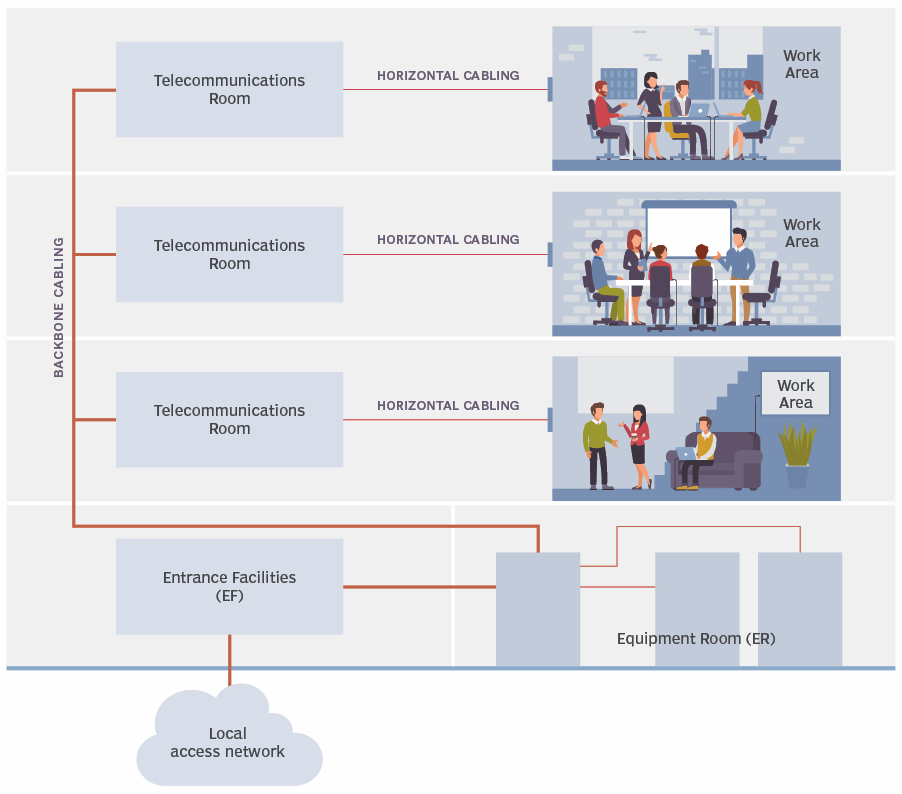
- Structured Cabling:
- In telecommunications, structured cabling is a standardized cabling infrastructure for buildings or campuses that consists of a number of defined subsystems as defined by standards such as TIA-568 / ISO/IEC 11801.
- Structured cabling components include copper (twisted pair) and fiber optic cabling, patch panels, and patch cables as well as racks, connectors, outlets, and cross-connect hardware.
- Structured cabling is based on six components that, together, provide a standardized, scalable, and modular framework for installing telecommunications cabling. The six components are:
- Entrance Facilities
- Equipment Room
- Backbone Cabling
- Telecommunications Room
- Horizontal Cabling
- Work Area
- It is designed to be application-agnostic (data, voice, video) and to support future upgrades without replacing the entire infrastructure.
- Supply Chain:
- A supply chain is the end-to-end network of individuals, organizations, resources, activities, data, and technologies involved in the creation and delivery of a product or service—from raw materials to the final customer.
- A supply chain includes not only physical flows (goods), but also information flows and financial flows across all participants.
- At the most fundamental level, Supply Chain Management (SCM) is the integrated planning, coordination, and optimization of the flow of:
- goods
- information
- and finances
- from raw material sourcing to final delivery.
- At its core, SCM is not just “management of flows” but the optimization of those flows across cost, service level, speed, and risk.
- Supply Chain vs Logistics:
- Supply Chain: entire ecosystem (end-to-end)
- Logistics: subset focused on movement and storage of goods