Siemens Energy – Siemens Energy delivers turbines, advanced power plant technology, to 2.6 GW Taweelah C power project in Abu Dhabi

Siemens Energy will supply advanced gas and steam turbine technology for the Taweelah C IPP (Independent Power Producer) project in Abu Dhabi, UAE.
It is the third power plant on the site to be equipped by Siemens Energy. The scope of supply includes three gas turbines, two steam turbines, five generators, and auxiliary systems for the combined cycle power plant with a total planned capacity of 2.6 gigawatts.
The new power plant will deliver critical flexibility, strengthen grid stability, and enable large-scale renewable energy integration in the Emirate of Abu Dhabi. The plant is designed to enable the possible utilization of carbon capture and storage units in the future, in alignment with the UAE’s goal to become climate-neutral by 2050.
The project is being developed by the Abu Dhabi National Energy Company (TAQA), and an international consortium comprising Saudi Arabia’s Al Jomaih Energy and Water Company, and Sembcorp Industries from Singapore. China Energy Engineering Group Corporation serves as the contractor responsible for the plant’s engineering, procurement, and construction. The Emirates Water and Electricity Company (EWEC) will act as the sole procurer of the electricity generated.
Karim Amin, Member of the Executive Board of Siemens Energy, said: “As energy systems around the world face growing demand and pressure to deliver both reliability and flexibility, the role of dispatchable gas-fired power generation is more crucial than ever. We are proud to contribute our technologies and expertise to the Taweelah C project, including the first HL-class gas turbine in the UAE, with industry-leading performance. This milestone builds on a long-standing legacy of supporting the UAE’s energy security and economic development, and reinforces our commitment to strategic partnerships that serve the country’s ambitions.”
The components for the new power plant will be produced within Siemens Energy’s global manufacturing network: The
and SST5-5000 steam turbines are manufactured in Berlin and Muelheim, Germany. The SGen5-3000W and SGen5-2000P generators are manufactured at the plant in Charlotte, USA.

Siemens Energy SGT5-9000HL Gas Turbine
SourceSiemens Energy
EMR Analysis
More information on Siemens Energy AG: See the full profile on EMR Executive Services
More information on Dr. -Ing. Christian Bruch (President and Chief Executive Officer, Siemens Energy AG + President and Chief Executive Officer, Siemens Energy Management GmbH + Chief Sustainability Officer, Siemens Energy AG + Export Control, Siemens Energy AG): See the full profile on EMR Executive Services
More information on Maria Ferraro (Chief Financial Officer, Siemens Energy AG): See the full profile on EMR Executive Services
More information on ELEVATE (Our way to drive performance – Three priorities) by Siemens Energy AG: See the full profile on EMR Executive Services
More information on Gas Services by Siemens Energy AG: See the full profile on EMR Executive Services
More information on Karim Amin (Member of the Executive Board – Business Area: Gas Services, Siemens Energy AG + Member of the Executive Board, Siemens Energy Management GmbH): See the full profile on EMR Executive Services
More information on Grid Technologies by Siemens Energy AG: See the full profile on EMR Executive Services
More information on Transformation of Industry by Siemens Energy AG: See the full profile on EMR Executive Services
More information on Siemens Gamesa by Siemens Energy AG: See the full profile on EMR Executive Services
More information on TAQA (The Abu Dhabi National Energy Company): https://www.taqa.com/ + Our roots are in Abu Dhabi with operations in the UAE and beyond. We’re a top 10 integrated utilities champion in the EMEA region with power and water and oil and gas operations in 25 countries around the world.
TAQA was established in 2005; however, our story begins in 1998 with the privatization of Abu Dhabi’s power and water sector, underscoring the importance of water security and provision of power to communities across the UAE. This move paved the way for TAQA’s establishment as a publicly listed company on the Abu Dhabi Securities Exchange (ADX) in 2005. Since then, we’ve grown into a diversified company with operations in the UAE as well as Canada, Ghana, Morocco, Netherlands, Oman, Saudi Arabia, United Kingdom and United States.
We are proud to be a company that provides energy and water to communities around the world.
More information on H.E. Jassem Mohammed Bu Ataba Al Zaabi (Chairman, Abu Dhabi National Energy Company (TAQA) + Non-Executive, Independent Board Member, TAQA): https://www.taqa.com/who-we-are/?csrt=15260903674505371977
More information on Jasim Husain Thabet (Group Chief Executive Officer and Managing Director, Abu Dhabi National Energy Company (TAQA)): https://www.taqa.com/who-we-are/?csrt=15260903674505371977 + https://www.linkedin.com/in/jasimthabet/
More information on Al Jomaih Energy and Water Company (AEW): https://www.aljomaih.com/en/aljomaih-energy-and-water-company + Established in 2007, Al Jomaih Energy and Water Company (AEW) is a fully owned portfolio company of Al Jomaih Holding and functions as its energy and water investments arm.
We have been part of the pulse fueling the country’s prosperity. We aim to further advance our country’s interests towards sustaining economic growth.
Built upon our commitment to Islamic principles, Al Jomaih Holding’s activities strive to ethically achieve its goals while keeping all stakeholders’ best interests in mind. It is due to these values that we continue our history of growth and progress.
Al Jomaih Holding owns direct and indirect investments in ventures, allowing us to grow over the years, along with our partners.
More information on Ibrahim Aljomaih (Chairman, Al Jomaih Energy and Water Company (AEW)): https://www.jenwa.com/en/chairman-message.html
More information on Eng. Adnan Buhuligah (Chief Executive Officer, Al Jomaih Energy and Water Company (AEW)): https://www.linkedin.com/posts/jenwa_we-are-pleased-to-announce-the-appointment-activity-7447296265744326660-pXe9/
More information on Sembcorp Industries: https://www.sembcorp.com/en/ + Sembcorp Industries (Sembcorp) is a leading energy and urban solutions provider, led by its purpose to drive energy transition.
Headquartered in Singapore, Sembcorp delivers sustainable solutions to support energy transition and urban development by leveraging its sector expertise and global track record.
Sembcorp has a balanced energy portfolio of 35.2GW, including 21.9GW of gross renewable energy capacity, across 12 countries.
Its urban development projects span over 17,600 hectares across Asia and have generated over 466,000 employment opportunities and attracted US$64 billion of investment capital.
Sembcorp is listed on the main board of the Singapore Exchange. It is a constituent stock of FTSE Russell Index, MSCI Singapore Index, Straits Times Index as well as sustainability indices including FTSE4Good Index and several MSCI ESG indices.
More information on Wong Kim Yin (Group President & Chief Executive Officer, Sembcorp Industries): https://www.sembcorp.com/en/about-sembcorp/leadership/board-of-directors/
More information on China Energy Engineering Group Corporation: https://en.ceec.net.cn/ + China Energy Engineering Group Co., Ltd (Energy China) is a comprehensive, super-large conglomerate providing systematic, integrated, full-cycle, and comprehensive development plans and services for the energy, power, and infrastructure industries in China and globally. Consistently listed among the Fortune Global 500 for eleven consecutive years, the company has made remarkable contributions to century-spanning engineering projects such as the Three Gorges Project, South-to-North Water Diversion Project, West-East Power Transmission Project, West-East Gas Pipeline Project, as well as significant achievements in three generations of nuclear power, among others, establishing multiple world records.
We possess cutting-edge technology in various fields including new energy storage, high-altitude wind energy, solar-thermal power generation, thermal power generation, conventional islands for nuclear power, water conservancy, hydropower, and ultra-high voltage design and construction, having won six National Science and Technology Progress Special Award. As a leading company deeply involved in international production capacity cooperation and high-quality construction of the Belt and Road Initiative, our operations span across more than 140 countries and regions worldwide, where we have constructed a series of projects.
Upholding the core development concept of “Innovation, Green, Digital Intelligence and Integration”, we foster strategic emerging industries and future-oriented industries, accelerate the development of new quality productive forces, and contribute Chinese wisdom, Chinese solutions and Chinese strength to world energy transition and sustainable development.
More information on Ni Zhen (Chairman, China Energy Engineering Group Corporation): https://en.ceec.net.cn/col/col58596/index.html
More information on the Emirates Water and Electricity Company (EWEC): https://www.ewec.ae/ + EWEC (Emirates Water and Electricity Company) is the sole procurer and supplier of water and electricity in the emirate of Abu Dhabi. EWEC drives the planning, forecasting, purchasing, and system despatch services of water and electricity. EWEC fulfils these vital responsibilities through the short-term and long-term balancing of bulk supply and demand for distribution companies and authorities in Abu Dhabi and other Emirates. EWEC is supporting the government of Abu Dhabi and the government of the UAE by enabling the reduction of cost whilst also providing the increased security of supply that comes from a cleaner, larger, and more integrated system.
EWEC is mandated to implement strategic initiatives that will achieve the 60 per cent clean energy target outlined in the Abu Dhabi Department of Energy’s (DoE) Clean Energy Strategic Target 2035 for Electricity Production in Abu Dhabi, in addition to enabling the achievement of UAE Water Security Strategy 2036, UAE Energy Strategy by 2050, and the UAE Net Zero by 2050 strategic initiative. EWEC is accelerating Abu Dhabi and the UAE’s energy transition by diversifying the country’s energy mix through developing and deploying renewable and clean energy as well as low-carbon intensive water desalination capacities. EWEC is part of ADQ, an active sovereign investor focusing on critical infrastructure and global supply chains.
More information on Hamad Al Hammadi (Chairman, Emirates Water and Electricity Company (EWEC)): https://ewec.ae/leadership-team
More information on Ahmed Ali Alshamsi (Chief Executive Officer, Emirates Water and Electricity Company (EWEC)): https://ewec.ae/leadership-team
EMR Additional Notes:
- Turbines (Gas and Steam):
- Gas turbines and steam turbines are rotary engines that convert thermal energy into mechanical power, but they differ fundamentally in their working fluids, thermodynamic cycles, and operational dynamics. Gas turbines use a continuous flow of hot compressed gas, while steam turbines use high-pressure, high-temperature steam.
- The primary difference is that gas turbines utilize the direct combustion of air and fuel to produce hot, high-velocity gases that spin the turbine blades, whereas steam turbines rely on an external heat source to boil water into high-pressure steam, which expands to drive the rotor.
- A gas turbine is a rotary internal combustion engine that uses pressurized gas, typically air, to spin a turbine and generate power. It’s a type of continuous flow combustion engine, meaning it uses a steady stream of gases to produce mechanical energy. This mechanical energy can then be converted into electricity using a generator, or used for other purposes like powering aircraft or industrial machinery.
- A steam turbine is a rotary external combustion engine that converts the energy of high-pressure steam into mechanical power. It operates on the Rankine cycle, where water is heated (often in a boiler) to produce steam, which expands through turbine blades to drive a rotor. The steam is then condensed and recycled in a closed loop.
- Power Plants:
- Power plants, or power stations, are industrial facilities that generate electricity by converting primary energy sources into electrical energy. They use various technologies, such as turbine-driven generators, to transform mechanical energy into electricity, which is then supplied to the power grid for societal use. Power plants utilize diverse energy sources, including fossil fuels (like coal, oil, and natural gas), nuclear energy, and renewable sources (such as wind, solar, hydro, and wave power).
- Peaker Plants:
- A peaker plant is a power plant that operates only during periods of high electricity demand to balance the grid. These plants are designed to start up quickly to meet surges in energy consumption and are typically simple-cycle gas turbines, although some may use liquid fuels like diesel. While crucial for grid stability, they are often more expensive and contribute more to greenhouse gas emissions than base load plants, leading to their gradual replacement by technologies like battery storage.
- Gas-fired Power Plant:
- A gas-fired power plant is a thermal power station that burns natural gas to generate electricity. Generating roughly 23% of the world’s electricity, these facilities serve as a critical bridge in the global energy transition. They offer grid stability and a highly flexible, weather-independent backup to renewable energy sources like wind and solar power.
- Open-Cycle / Simple-Cycle Gas Turbine (OCGT / SCGT): The exhaust gas is vented directly into the atmosphere after spinning the primary turbine. While less efficient (typically 35%–45%), they can ramp up to maximum capacity in under 10 minutes, making them ideal “peaker plants” during sudden spikes in demand.
- Combined-Cycle Gas Turbine (CCGT): Captures the hot exhaust from the first turbine and routes it to a Heat Recovery Steam Generator (HRSG). The HRSG uses that waste heat to boil water into steam, driving a secondary steam turbine. This dual setup elevates thermodynamic efficiency up to 60% or higher.
- A gas-fired power plant is a thermal power station that burns natural gas to generate electricity. Generating roughly 23% of the world’s electricity, these facilities serve as a critical bridge in the global energy transition. They offer grid stability and a highly flexible, weather-independent backup to renewable energy sources like wind and solar power.
- Nuclear Power Plant (NPP):
- A Nuclear Power Plant (NPP) is a thermal power station that generates electricity using heat from nuclear reactions. While a standard power plant burns fossil fuels like coal or gas to make heat, an NPP relies on a nuclear reactor to split atoms and harvest the energy.
- Fundamental Units of Electricity:
- Ampere – Amp (A):
- Amperes measure the flow of electrical current (charge) through a circuit. Ampere (A) is the unit of measure for the rate of electron flow, or current, in an electrical conductor.
- One ampere is defined as one coulomb of electric charge moving past a point in one second. The ampere is named after the French physicist André-Marie Ampère, who made significant contributions to the study of electromagnetism.
- Milliampere (mA) is a unit of electric current equal to one-thousandth of an ampere (1mA=10−3A). The prefix “milli” signifies 10−3 in the metric system. This unit is commonly used to measure small currents in electronic circuits and consumer devices.
- Volts measure the electric potential difference that drives the flow of electrons through a circuit.
- Kilovolt (kV) is a unit of potential difference equal to 1,000 volts.
- Watts measure the rate of energy consumption or generation, also known as power.
- Amperes measure the flow of electrical current (charge) through a circuit. Ampere (A) is the unit of measure for the rate of electron flow, or current, in an electrical conductor.
- Power vs. Energy: how electricity is measured and billed.
- Power (measured in kW, MW, GW, TW): Rate at which energy is used or generated at a given moment.
- Energy (measured in kWh, MWh, GWh, TWh): Total amount of power consumed or generated over a period of time (i.e., Power x Time).
- Real Power Units: actual power that performs work.
- Kilowatt (KW):
- A kilowatt is simply a measure of how much power an electric appliance consumes—it’s 1,000 watts to be exact. You can quickly convert watts (W) to kilowatts (kW) by dividing your wattage by 1,000: 1,000W 1,000 = 1 kW.
- Megawatt (MW):
- One megawatt equals one million watts or 1,000 kilowatts, roughly enough electricity for the instantaneous demand of ~500–1,000 homes (depending on region and consumption patterns).
- Gigawatt (GW):
- A gigawatt (GW) is a unit of power, and it is equal to one billion watts.
- According to the Department of Energy, generating one GW of power takes over three million solar panels or 310 utility-scale wind turbines
- Terawatt (TW):
- One terawatt is equal to one trillion watts (1,000,000,000,000 watts). The main use of terawatts is found in the electric power industry, particularly for measuring very large-scale power generation or consumption.
- According to the U.S. Energy Information Administration, America is one of the largest electricity consumers in the world, using about 4,146.2 terawatt-hours (TWh) of energy per year.
- Energy consumption should be expressed in TWh (energy), not TW (power).
- Kilowatt (KW):
- Apparent Power Units: measures the total power in a circuit, including power that does not perform useful work.
- Kilovolt-Amperes (kVA):
- Kilovolt-Amperes (kVA) stands for Kilo-volt-amperes, a term used for the rating of an electrical circuit. A kVA is a unit of apparent power, which is the product of the circuit’s maximum voltage and current rating.
- The difference between real power (kW) and apparent power (kVA) is crucial. Real power (kW) is the actual power that performs work, while apparent power (kVA) is the total power delivered to a circuit, including the real power and the reactive power (kVAR) that doesn’t do useful work. The relationship between them is defined by the power factor. Since the power factor is typically less than 1, the kVA value will always be higher than the kW value.
- Megavolt-Amperes (MVA):
- Megavolt-Amperes (MVA) is a unit used to measure the apparent power in a circuit, primarily for very large electrical systems like power plants and substations. It’s a product of the voltage and current in a circuit.
- 1 MVA is equivalent to 1,000 kVA, or 1,000,000 volt-amperes.
- Kilovolt-Amperes (kVA):
- Specialized Power Units: used specifically for renewable energy, especially solar.
- KiloWatt ‘peak’ (KWp):
- kWp stands for kilowatt ‘peak’ power output of a system. It is most commonly applied to solar arrays. For example, a solar panel system with a peak power of 3 kWp working at its maximum capacity for one hour will produce 3 kWh.
- kWp (kilowatt peak) is the total kW rating of the system, the theoretical ‘peak’ output under standard test conditions (STC). e.g. If the system has 4 × 270 watt panels, then it is 4 × 0.27 kWp = 1.08 kWp.
- kWp does not universally correspond to 1,000 kWh/year; actual production depends strongly on location, irradiation, and system efficiency (typically ~800–1,200 kWh/year in Europe).
- KiloWatt ‘peak’ (KWp):
- Ampere – Amp (A):
- Independent Power Producer (IPP):
- An Independent Power Producer (IPP), also known as a non-utility generator (NUG), is a private entity that owns and operates facilities to generate electricity for sale to public utilities, central governments, or end-users. Unlike traditional, vertically integrated utility monopolies, IPPs focus strictly on the generation aspect of energy and do not own the transmission or distribution networks (the electrical grid).
- Motors, Generators and Drives:
- Motor:
- Mechanical or electrical device that converts electrical energy into mechanical energy, generating rotational or linear motion used to power a machine.
- NEMA / IEC Motors:
- NEMA motors are commonly made with rolled steel or cast iron frames while IEC motors are commonly made with cast aluminum or cast iron frames.
- North American National Electrical Manufacturers Association (NEMA) and International Electrotechnical Commission (IEC) standards are crucial because they ensure that motors from different manufacturers are standardized and interchangeable in terms of dimensions, mounting, and performance, while also meeting specific criteria for efficiency, safety, and testing.
- NEMA motors are commonly made with rolled steel or cast iron frames while IEC motors are commonly made with cast aluminum or cast iron frames.
- Servo Motor:
- Self-contained electrical device that rotates parts of a machine with high precision and dynamic control.
- The output shaft of this motor can be moved to a particular position, angle, velocity, and torque, which a regular motor does not inherently control.
- It consists of a suitable motor coupled to a feedback device (e.g., encoder or resolver) for position and speed feedback, and requires a dedicated servo drive/controller to operate in a closed-loop control system.
- Shaft Grounded Motor:
- Electric motor that is equipped with a device to safely redirect shaft-induced electrical currents (e.g., caused by variable frequency drives) away from its internal bearings.
- Without this protection, these currents can cause bearing pitting, electrical erosion, and premature motor failure.
- NEMA / IEC Motors:
- Mechanical or electrical device that converts electrical energy into mechanical energy, generating rotational or linear motion used to power a machine.
- Generator:
- Does the opposite of a motor, converting mechanical energy into electrical energy.
- It does not create electricity; rather, it induces the movement of electric charges (electrons) in a conductor through electromagnetic induction, producing an electric current.
- Drive:
- (also often referred to as an electric controller) is the electronic power conversion and control system that regulates the electrical energy supplied to a motor.
- By positioning a drive between the electrical supply and the motor, power is fed into the drive, and the drive then modulates voltage, current, and frequency before supplying it to the motor.
- This allows precise control of:
- speed
- direction
- acceleration / deceleration
- torque
- and, in advanced systems, position (when combined with feedback devices)
- Drives are essential for energy efficiency, process control, and equipment protection, especially in modern industrial applications.
- Motor:
- Auxiliary System:
- An auxiliary system is a secondary or supporting framework designed to assist, operate alongside, or back up a primary system. These systems provide essential functions like cooling, lubrication, backup power, or structural support, ensuring the main system runs safely and efficiently.
- Auxiliary systems are tailored to the specific industry and context they support. Key examples include:
- Industrial & Power Plants: Includes backup generators, cooling water circuits, lubrication systems, and steam distribution networks that support main turbines or engines.
- Aviation & Automotive: Secondary vehicle systems such as power steering, air conditioning, and electrical alternators.
- Information Technology: Redundant server cooling arrays, uninterruptible power supplies (UPS), and secondary backup networks designed to support primary hardware.
- Building Infrastructure: Support elements including fire alarms, CCTV networks, heating and ventilation (HVAC) control panels, and structured cabling.
- Grid, Microgrids, DERs and DERM’s:
- Grid / Power Grid:
- The power grid is a network for delivering electricity to consumers. The power grid includes generator stations, transmission lines and towers, and distribution networks.
- The grid constantly balances the supply and demand for the energy that powers everything from industry to household appliances.
- Electric grids perform three major functions: generation, transmission, and distribution
- Microgrid:
- Small-scale power grid that can operate independently or collaboratively with other grids. The practice of using microgrids is known as distributed, dispersed, decentralized, district or embedded energy production.
- Group of interconnected loads and DERs (Distributed Energy Resources) within clearly defined electrical and geographical boundaries which acts as a single controllable entity with respect to the main grid.
- A microgrid can operate in both grid-connected mode and islanded (off-grid) mode.
- Smart Grid:
- An electrical grid enhanced with digital communication, automation, and IT systems across generation, transmission, distribution, and consumption levels.
- Enables real-time monitoring, control, demand response, and integration of DERs.
- Distributed Energy Resources (DERs):
- Small-scale electricity supply and demand-side resources (typically in the range of a few kW up to tens of MW, depending on definition) that are interconnected to the electric grid. They are power generation resources and are usually located close to load centers, and can be used individually or in aggregate to provide value to the grid.
- Common examples of DERs include rooftop solar PV units, natural gas turbines, microturbines, wind turbines, biomass generators, fuel cells, tri-generation units, battery storage, electric vehicles (EV) and EV chargers, and demand response resources (load flexibility).
- Distributed Energy Resources Management Systems (DERMS):
- Platforms which help mostly distribution system operators (DSO) manage their grids that are mainly based on distributed energy resources (DER).
- DERMS are used by utilities and other energy companies to aggregate and orchestrate distributed energy resources for participation in the demand response market and grid services (e.g., flexibility, voltage control, congestion management).
- Grid / Power Grid:
- Carbon Dioxide (CO2):
- The primary greenhouse gas emitted through human activities. Carbon dioxide enters the atmosphere through the burning of fossil fuels (coal, natural gas, and oil), solid waste, biomass (e.g. wood), and also as a result of certain industrial chemical reactions (e.g. cement production).
- Carbon dioxide is removed from the atmosphere (or “sequestered”) when it is absorbed by plants as part of the biological carbon cycle and through ocean absorption and geological processes.
- CO₂ is naturally part of the carbon cycle, but human activities have significantly increased its concentration in the atmosphere.
- Biogenic Carbon Dioxide (CO2):
- Biogenic CO₂ and fossil-derived CO₂ are chemically identical molecules.
- The distinction is not chemical, but source-based:
- Biogenic carbon: CO₂ released from organic materials such as plants, wood, soil, and biomass that were recently part of the natural carbon cycle.
- Fossil carbon: CO₂ released from fossil fuels (coal, oil, gas), which were stored underground for millions of years.
- CO2e (Carbon Dioxide Equivalent):
- CO₂e means “carbon dioxide equivalent”.
- It is a standardized climate metric used to express the total climate impact of multiple greenhouse gases in a single standardized unit.
- CO₂e converts all greenhouse gases (such as methane and nitrous oxide) into the amount of CO₂ that would have the same global warming effect over a defined time period.
- Formula: CO₂e = mass of gas × Global Warming Potential (GWP)
- Carbon dioxide equivalents are commonly expressed as million metric tonnes of carbon dioxide equivalents, abbreviated as MMTCDE.
- The carbon dioxide equivalent for a gas is derived by multiplying the tonnes of the gas by the associated GWP: MMTCDE = (million metric tonnes of a gas) * (GWP of the gas).
- For example, the GWP for methane is 25 and for nitrous oxide 298. This means that emissions of 1 million metric tonnes of methane and nitrous oxide respectively is equivalent to emissions of 25 and 298 million metric tonnes of carbon dioxide.
- Carbon Footprint:
- There is no universally agreed definition of what a carbon footprint is.
- The most widely used definition (GHG Protocol) describes it as: “The total set of greenhouse gas (GHG) emissions caused directly and indirectly through an organization’s operations and value chain.”
- A carbon footprint is the total amount of greenhouse gas (GHG) emissions caused directly and indirectly by an individual, organization, product, or activity.
- It is typically measured in CO₂e.
- Decarbonization:
- Reduction of carbon dioxide emissions through the use of low-carbon energy sources and improved efficiency, with the goal of reducing overall greenhouse gas emissions.
- Decarbonization typically refers to system-wide transition, not only emission reduction at a single source.
- Carbon Credits or Carbon Offsets:
- Carbon credits are tradable certificates representing the right to emit one metric ton of CO₂e.
- They are part of cap-and-trade systems, where:
- A cap limits total emissions
- Companies receive or buy allowances
- Excess credits can be traded
- Offsets are often linked to external projects that reduce or remove emissions (e.g. reforestation, renewable energy).
- Carbon Capture and Storage (CCS) – Carbon Capture, Utilisation and Storage (CCUS):
- CCS involves capturing CO₂ emissions from industrial processes and storing them permanently in geological formations (e.g. underground reservoirs).
- CCUS adds a utilization step, where captured CO₂ is reused as a feedstock (e.g. fuels, chemicals, building materials).
- CCS = storage only, CCUS = storage + reuse.
- Carbon Dioxide Removal (CDR) or Durable Carbon Removal:
- CDR refers to methods that actively remove CO₂ from the atmosphere and store it for long periods in geological, biological, or mineral form.
- Examples include:
- Direct Air Capture (DAC)
- Bioenergy with Carbon Capture (BECCS)
- Enhanced Rock Weathering (ERW)
- CDR creates net negative emissions when removal exceeds emissions.
- Direct Air Capture (DAC):
- Technologies that extract CO2 directly from the atmosphere at any location, unlike carbon capture which is generally carried out at the point of emissions, such as a steel plant.
- Constraints like costs and energy requirements as well as the potential for pollution make DAC a less desirable option for CO2 reduction. Its larger land footprint when compared to other mitigation strategies like carbon capture and storage systems (CCS) also put it at a disadvantage.
- Direct Air Capture and Storage (DACCS):
- Climate technology that removes carbon dioxide (CO2) directly from the ambient atmosphere using large fans and chemical processes to bind with the CO2.
- Bioenergy with Carbon Capture and Storage (BECCS):
- Technology that generates energy from biomass while capturing and storing the resulting CO₂.
- Because biomass absorbs CO₂ while growing, BECCS can result in net negative emissions.
- Enhanced Rock Weathering (ERW):
- Carbon dioxide removal (CDR) technique that accelerates the natural process of rock weathering by grinding silicate rocks into dust and spreading it on land, typically agricultural fields. This process uses rainwater to convert atmospheric carbon dioxide into mineral carbonates, which are then stored long-term in soils, groundwater, and oceans.
- Limits of Carbon Dioxide Storage:
- Carbon storage is not endless; the Earth’s capacity for permanently storing vast amounts of captured carbon, particularly in geological formations, is limited, potentially reaching a critical limit of 1,460 gigatonnes at around 2200, though storage durations vary significantly depending on the method, from decades for some biological methods to potentially millions of years for others like mineralization. While some methods offer very long-term storage, the sheer volume needed to meet climate targets requires scaling up storage significantly beyond current capacity, raising concerns about the available volume over time.
- Carbon Impregnation:
- Carbon impregnation is the process of treating activated carbon with chemical agents (such as metals, acids, or bases) to enhance its ability to adsorb specific, hard-to-remove pollutants. By loading substances like silver, sulfur, or potassium hydroxide into its pores, this material combines physical adsorption with chemical reaction for improved, targeted filtration in water and air. This is a materials engineering process, not a climate accounting concept.
- Global Warming:
- Global warming is the long-term heating of Earth’s climate system observed since the pre-industrial period (between 1850 and 1900) due to human activities, primarily fossil fuel burning, which increases heat-trapping greenhouse gas levels in Earth’s atmosphere.
- Global Warming Potential (GWP):
- A measure of how much heat a greenhouse gas traps in the atmosphere compared to CO₂ over a specific time period (commonly 100 years).
- CO₂ has a GWP of 1.
- GWP is the scientific basis for converting gases into CO₂e.
- GWP was developed to allow comparisons of the global warming impacts of different gases.
- Greenhouse Gas (GHG):
- Any gas that absorbs and traps infrared radiation in the atmosphere, contributing to the greenhouse effect.
- Main GHGs include:
- CO₂
- Methane (CH₄)
- Nitrous oxide (N₂O)
- Fluorinated gases
- Water vapor is a GHG but is not directly controlled by human emissions at scale.
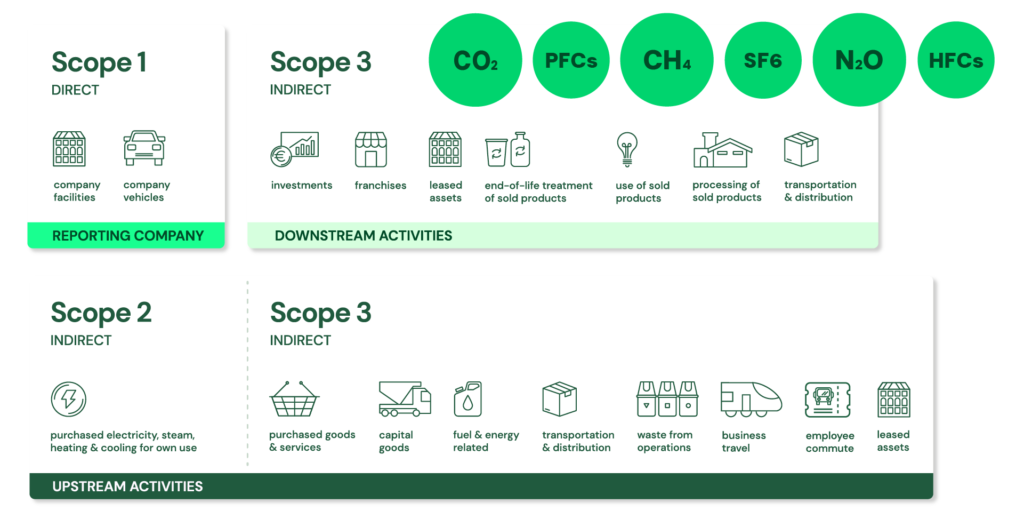
- GHG Protocol Corporate Standard Scope 1, 2 and 3: https://ghgprotocol.org/ + The GHG Protocol Corporate Accounting and Reporting Standard provides requirements and guidance for companies and other organizations preparing a corporate-level GHG emissions inventory. Scope 1 and 2 are typically mandatory for companies that are required to report their emissions by national or regional regulations. The GHG Protocol itself is a voluntary standard.
- Scope 1: Direct emissions:
- Direct emissions from company-owned and controlled resources. In other words, emissions are released into the atmosphere as a direct result of a set of activities, at a firm level. It is divided into four categories:
- Stationary combustion (e.g from fuels, heating sources). All fuels that produce GHG emissions must be included in scope 1.
- Mobile combustion is all vehicles owned or controlled by a firm, burning fuel (e.g. cars, vans, trucks). The increasing use of “electric” vehicles (EVs), means that some of the organisation’s fleets could fall into Scope 2 emissions.
- Fugitive emissions are leaks from greenhouse gases (e.g. refrigeration, air conditioning units). It is important to note that refrigerant gases are a thousand times more dangerous than CO2 emissions. Companies are encouraged to report these emissions.
- Process emissions are released during industrial processes, and on-site manufacturing (e.g. production of CO2 during cement manufacturing, factory fumes, chemicals).
- Direct emissions from company-owned and controlled resources. In other words, emissions are released into the atmosphere as a direct result of a set of activities, at a firm level. It is divided into four categories:
- Scope 2: Indirect emissions – owned:
- Indirect emissions from the generation of purchased energy, from a utility provider. In other words, all GHG emissions released in the atmosphere, from the consumption of purchased electricity, steam, heat and cooling. For most organisations, electricity will be the unique source of scope 2 emissions. Simply stated, the energy consumed falls into two scopes: Scope 2 covers the electricity consumed by the end-user. Scope 3 covers the energy used by the utilities during transmission and distribution (T&D losses).
- Scope 3: Indirect emissions – not owned:
- Indirect emissions – not included in scope 2 – that occur in the value chain of the reporting company, including both upstream and downstream emissions. In other words, emissions are linked to the company’s operations. According to the GHG protocol, scope 3 emissions are separated into 15 categories.
- Scope 1: Direct emissions: