WEG – WEG releases its 2025 Integrated Annual Report and highlights progress in sustainability
Results reflect investments in innovation, people development, and consistent progress in ESG initiatives
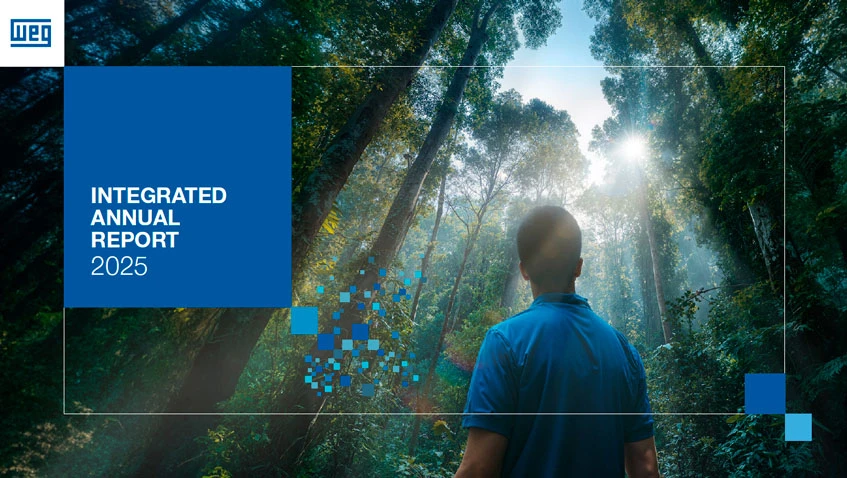
WEG presents its 2025 Integrated Annual Report, bringing together the main financial, operational, and sustainability results achieved throughout the year. The document highlights the company’s continuous progress in value creation, combining growth, innovation, and socio-environmental responsibility.
From a financial perspective, the company maintained solid indicators, reaching net operating revenue of BRL 40.8 billion and a return on invested capital (ROIC) of 32.5%, reflecting disciplined resource allocation and the competitiveness of its solutions portfolio. In addition, WEG was recognized as a global leader in low-voltage industrial electric motors, strengthening its position in the global market.
Throughout the year, innovation remained a strategic driver for the company, with BRL 1.4 billion invested in research, development, and innovation (R&D). This effort contributed to 71% of the company’s revenue coming from sustainable products, reinforcing its role in delivering technologies that support the energy transition.
Additionally, through 335 social projects, more than 778,000 people were positively impacted worldwide.
WEG also made consistent progress toward its greenhouse gas (GHG) reduction targets, achieving a 31.9% absolute reduction compared to the 2021 baseline year. The company also expanded its responsibility across the value chain by defining targets for Scope 3 emissions and obtaining approval from the Science Based Targets Initiative (SBTi). These results reinforce WEG’s role in the energy transition and its commitment to increasingly efficient and sustainable operations.
Prepared based on internationally recognized methodologies, the Integrated Annual Report follows the guidelines of the Global Reporting Initiative (GRI) and the International Integrated Reporting Council (IIRC), and incorporates indicators aligned with the recommendations of the TCFD and SASB.
The full report is available here.
See also the video on YouTube
SourceWEG
EMR Analysis
More information on WEG: See the full profile on EMR Executive Services
More information on Alberto Yoshikazu Kuba (Executive President, WEG Group): See the full profile on EMR Executive Services
More information on André Luís Rodrigues (Vice President, Administrative and Financial, WEG Group): See the full profile on EMR Executive Services
More information on Sustainability and the 2025 Integrated Report by WEG: See the full profile on EMR Executive Services
More information on Daniel Marteleto Godinho (Vice President, Sustainability and Institutional Relations, WEG Group): See the full profile on EMR Executive Services
More information on Gabriela Vieira da Silva (Head of Sustainability, WEG): See the full profile on EMR Executive Services
More information on The Science Based Targets initiative (SBTi): https://sciencebasedtargets.org/ + The Science Based Targets initiative (SBTi) is a global body enabling businesses to set ambitious emissions reductions targets in line with the latest climate science. It is focused on accelerating companies across the world to halve emissions before 2030 and achieve net-zero emissions before 2050.
There are two main types of science-based targets: near-term and net-zero. Near-term targets aim to address emissions reductions over the next 5-10 years, whereas net-zero targets include reductions of 90% or more no later than 2050.
The initiative is a collaboration between CDP, the United Nations Global Compact, World Resources Institute (WRI) and the World Wide Fund for Nature (WWF) and one of the We Mean Business Coalition commitments. The SBTi defines and promotes best practice in science-based target setting, offers resources and guidance to reduce barriers to adoption, and independently assesses and approves companies’ targets.
- Defines and promotes best practices in emissions reductions and net-zero targets in line with climate science.
- Provides target setting methods and guidance to companies to set science-based targets in line with the latest climate science.
- Includes a team of experts to provide companies with independent assessment and validation of targets.
- Serves as the lead partner of the Business Ambition for 1.5°C campaign, an urgent call to action from a global coalition of UN agencies, business and industry leaders that mobilizes companies to set net-zero science-based targets in line with a 1.5 degrees C future.
More information on David Kennedy (Chief Executive Officer, SBTi): https://sciencebasedtargets.org/about-us/the-team + https://www.linkedin.com/in/david-kennedy-1000a3262/
More information on Global Reporting Initiative (GRI): http://www.globalreporting.org/ + For nearly 30 years, Global Reporting Initiative (GRI) has engaged in a multi-stakeholder approach to define and refine the global best practice for sustainability reporting.
An independent and nonprofit international organization, GRI is headquartered in the Netherlands and supported by four Regional Networks, while we have staff in more than 20 countries.
We work with businesses, investors, policymakers, civil society, labor organizations and other experts to develop the GRI Standards and promote their use by organizations around the world.
Used by over 14,000 organizations in over 100 countries, our Standards are advancing the practice of sustainability reporting, and enabling companies and other stakeholders to build sustainable, long-term value – benefiting people and planet.
As confirmed by 2024 research from KPMG, the GRI Standards remain the most widely used sustainability reporting standards globally.
More information on Robin Hodess (Chief Executive Officer, GRI): https://www.globalreporting.org/about-gri/governance/gri-management-board/ + https://www.linkedin.com/in/robin-hodess-85b0a76/
More information on International Integrated Reporting Council (IIRC): https://www.ifrs.org/issued-standards/integrated-reporting/international-integrated-reporting-council/ + The International Integrated Reporting Council (IIRC)—a global coalition of regulators, investors, companies, standard-setters, the accounting profession, academia and non-governmental organisations—has transitioned into the IFRS Foundation’s Integrated Reporting and Connectivity Council, an advisory body to the IFRS Foundation Trustees, the International Accounting Standards Board (IASB) and the International Sustainability Standards Board (ISSB). The Integrated Reporting and Connectivity Council provides guidance on how reporting required by IFRS Accounting and Sustainability Disclosure Standards could be integrated and how the IASB and the ISSB could consider applying principles and concepts from the Integrated Reporting Framework to their projects.
Under the Value Reporting Foundation (VRF), the IIRC was the primary institutional forum for expression of a broad market view on matters relating to integrated reporting and integrating thinking. The IIRC was also a medium for the VRF’s interaction and provision of advice, guidance and input on issues of relevance for the organisation, including its nature, objectives, purpose, vision, mission and strategy and the means by which to deliver that strategy.
The IIRC was dissolved upon the consolidation of the VRF into the IFRS Foundation in June 2022. IIRC members were invited to join the Integrated Reporting and Connectivity Council.
More information on International Financial Reporting Standards (IFRS): https://www.ifrs.org/ + The IFRS Foundation is a not-for-profit, public interest organisation established to develop high-quality, understandable, enforceable and globally accepted accounting and sustainability disclosure standards.
Our Standards are developed by our two standard-setting boards, the International Accounting Standards Board (IASB) and International Sustainability Standards Board (ISSB).
The IFRS Foundation sets standards used globally for financial reporting that improve the communication between companies and investors. We are an independent, not-for-profit organisation founded on the belief that better information from companies leads to better investment decisions. Our standards—called IFRS Standards—boost transparency, comparability and trust in financial reporting.
Since its creation in 2001, the IFRS Foundation has transformed the global landscape of financial information by introducing IFRS Accounting Standards developed by the International Accounting Standards Board (IASB). The Standards have in effect become the global language of financial statements—trusted by investors worldwide and required for use by more than 140 jurisdictions. We are continually developing and improving the Standards.
More information on Michel Madelain (Managing Director, IFRS till autumn 2026): https://www.ifrs.org/about-us/our-structure/
More information on Task Force on Climate Related Financial Disclosures (TCFD) by IFRS: https://www.fsb-tcfd.org/ + Concurrent with the release of its 2023 status report on October 12, 2023, the TCFD has fulfilled its remit and disbanded. The FSB has asked the IFRS Foundation to take over the monitoring of the progress of companies’ climate-related disclosures.
As of November 2023, this website will no longer be updated or monitored but will remain available to serve as a resource for materials developed by the Task Force. The Task Force is deeply grateful to all parties involved for their input, support, and adoption of the TCFD recommendations.
The Financial Stability Board (FSB) created the Task Force on Climate-related Financial Disclosures (TCFD) in 2015 to improve and increase reporting of climate-related financial information. Following the release of the Task Force’s 2023 Status Report, upon request of the FSB, the TCFD has been disbanded.
More information on Sustainability Methodologies Accounting Standards Board (SASB) by IFRS: https://www.ifrs.org/issued-standards/sasb-standards/ + SASB Standards guide the disclosure of financially material sustainability information by companies to their investors. Available for 77 industries, the Standards identify the subset of environmental, social, and governance issues most relevant to financial performance in each industry.
Effective August 1, 2022, the Value Reporting Foundation–home to the SASB Standards–consolidated into the IFRS Foundation, which established the first International Sustainability Standards Board (ISSB). SASB Standards are now under the oversight of the ISSB. The ISSB will build upon the SASB Standards and embed SASB’s industry-based standards development approach into the ISSB’s standards development process. The ISSB actively encourages preparers and investors to continue to provide full support for and to use the SASB Standards until the SASB Standards become the IFRS Sustainability Disclosure Standards.
EMR Additional Financial Notes:
- Major financial KPI’s since 2017 are available on EMR Executive Services under “Financial Results” and comparison with peers under “Market Positioning”
- Companies’ full profile on EMR Executive Services are based on their official press releases, quarterly financial reports, annual reports and other official documents like the Universal Registration Document.
- All members of the Executive Committee and of the Board have their full profile on EMR Executive Services
- The WEG Integrated Annual Report 2025 can be found here: https://api.mziq.com/mzfilemanager/v2/d/50c1bd3e-8ac6-42d9-884f-b9d69f690602/9f3d5eb3-6642-3023-2b15-a97f91879b09?origin=2
- The WEG 4Q 2025 Financial Statements can be found here: https://api.mziq.com/mzfilemanager/v2/d/50c1bd3e-8ac6-42d9-884f-b9d69f690602/f320c89e-7e87-ecf9-7335-207fd50bd06a?origin=2
- The WEG 4Q 2025 Financial Presentation can be found here: https://api.mziq.com/mzfilemanager/v2/d/50c1bd3e-8ac6-42d9-884f-b9d69f690602/5c7dd384-4e66-005b-1937-dbefc4b83258?origin=2
- The WEG 3Q 2025 Financial Statements can be found here: https://api.mziq.com/mzfilemanager/v2/d/50c1bd3e-8ac6-42d9-884f-b9d69f690602/eb39d337-ee77-2e79-1c49-065726e196e6?origin=1
- The WEG 3Q 2025 Financial Presentation can be found here: https://api.mziq.com/mzfilemanager/v2/d/50c1bd3e-8ac6-42d9-884f-b9d69f690602/a9aadf80-2023-4095-688a-ad8bcb0a85ae?origin=2
- The WEG Day 2025 Investor Presentation (03.10.2025) can be found here: https://api.mziq.com/mzfilemanager/v2/d/50c1bd3e-8ac6-42d9-884f-b9d69f690602/fe942f97-e8ff-a4fc-e2de-c171f799aeac?origin=1
- The WEG 2Q 2025 Financial Statements can be found here: https://api.mziq.com/mzfilemanager/v2/d/50c1bd3e-8ac6-42d9-884f-b9d69f690602/53207874-a96b-06c3-48ed-7e89cea775bf?origin=1
- The WEG 2Q 2025 Financial Presentation can be found here: https://api.mziq.com/mzfilemanager/v2/d/50c1bd3e-8ac6-42d9-884f-b9d69f690602/d508a777-b485-535a-afe9-b96d87710eff?origin=1
- The WEG Integrated Annual Report 2024 can be found here: https://ri.weg.net/en/financial-information/annual-reports/
- The WEG Financial Statements 2024 can be found here: https://api.mziq.com/mzfilemanager/v2/d/50c1bd3e-8ac6-42d9-884f-b9d69f690602/d55c3099-ff87-5e41-ed29-96cc4f5bf627?origin=1
- The WEG Integrated Annual Report 2023 can be found here: https://api.mziq.com/mzfilemanager/v2/d/50c1bd3e-8ac6-42d9-884f-b9d69f690602/b96ceffc-95bf-5115-8eec-72fbc563ea72?origin=1
- The WEG Investor Presentation 2024 (29.05.2024) can be found here: https://ri.weg.net/en/publications-and-documents/presentations-and-documents/
- The WEG 2022 Integrated Annual Report can be found here: https://api.mziq.com/mzfilemanager/v2/d/50c1bd3e-8ac6-42d9-884f-b9d69f690602/8c163d4c-541a-75bd-eb61-f7f0694d8003?origin=1