Nestor Cables – Nestor Cables secures €13 million to expand as global fibre demand outpaces supply
Finnish infrastructure provider accelerates international growth and investments as data center expansion and digitalization drive unprecedented demand for fibre networks.
Finnish network infrastructure specialist Nestor Cables Oy has secured €13 million in Term loans and receivable financing from Norion Bank. The funding supports the company’s growth, international expansion and new investments, strengthening its position as a provider of critical network infrastructure in Finland and internationally.
The financing provides Nestor Cables with increased flexibility to fund growth investments, strengthen working capital and enhance delivery capabilities at a time when global demand for fibre infrastructure is at an exceptionally high level. Rapid expansion of data centers, accelerating digitalization and the continuous need for faster and more reliable connectivity have created a market where high-quality fibre solutions are, in some areas, in short supply.
“Fibre is the most critical infrastructure of this decade. Demand is currently growing faster than supply, and we intend to be among the companies that can respond to this globally. This financing gives us the ability to move fast, invest in the right areas and take a significantly stronger role in the market. Our ambition is to be one of the leading players in this transformation,” says CEO Aleksanteri Pyrrö.
With the financing, Nestor Cables will further develop its production, delivery reliability and ability to serve demanding infrastructure projects where reliability and scalability are essential. The company is targeting growth particularly in international markets.
An important element of this growth journey is the support of a financing partner that understands the needs of fast growing, internationally oriented companies. Norion Bank brings a strong track record in supporting international growth, and the financing was led by Karl Mikael (Miku) Holmbäck at Norion Bank.
GOS Group acted as financial advisor to Nestor Cables in the financing arrangement and assisted in the preparation and execution of the transaction
SourceNestor Cables
EMR Analysis
More information on Nestor Cables: https://www.nestorcables.com + Nestor Cables was founded in 2007 by cable technology professionals to preserve the Finnish tradition of producing high-quality cable. Currently we are one of the leading developers and manufacturers of fibre optic cable solutions in the Northern Europe.
Our product portfolio helps you to build fibre optic networks that fulfill the demands of future smart cities. Our products are developed and tested to meet the highest quality standards.
In July 2022, our long-term customer Clearfield Inc. acquired the entire share capital of Nestor Cables Oy and we officially became an independent subsidiary of Clearfield Inc.
In November 2025, Nestor Cables, moved back to Finnish entrepreneurial ownership as Aleksanteri Pyrrö and Aki Eklund acquired the entire shareholding of Nestor Cables Ltd from U.S.-based Clearfield Inc.
More information on Aleksanteri Pyrrö (Co-owner, President & Chief Executive Officer, Nestor Cables): See the full profile on EMR Executive Services
More information on Aki Eklund (Co-owner and Technical Director, Nestor Cables): See the full profile on EMR Executive Services
More information on Anssi Sepponen (Chief Financial and Administrative Officer, Nestor Cables): See the full profile on EMR Executive Services
More information on Norion Bank: https://www.norionbank.se/ + As specialists in financing solutions for medium-sized companies and real estate companies, we know what it takes when companies want to grow and develop. We offer transparent processes and efficient decision-making paths, so that our clients can make the right decisions at the right time. Close to when it matters most.
Norion Bank Group is a business-oriented Nordic finance bank. Through the group’s brands Norion Bank, Walley and Collector, the group offers customized financing services that meet distinct customer needs within three customer segments: medium-sized companies and real estate companies, traders and private individuals. As a specialist in financing solutions, Norion Bank Group is a leading complement to traditional large banks, with the vision of being the leading Nordic finance bank within the selected segments.
Norion Bank’s offering includes corporate and real estate loans as well as factoring for medium-sized companies. Through the Walley brand, flexible payment and checkout solutions are offered to traders and private individuals. The Collector brand provides personal loans and credit cards to private individuals as well as savings accounts for private individuals and companies. Norion Bank Group was founded in 1999 and has offices in Gothenburg, Stockholm, Helsingborg, Oslo and Helsinki. The operations are conducted through Norion Bank AB (publ), which is listed on Nasdaq Stockholm.
More information on Martin Nossman (Chief Executive Officer, Norion Bank): https://www.norionbank.se/investor-relations/bolagsstyrning/ledning + https://www.linkedin.com/in/martin-nossman-378995104/
More information on Karl-Mikael Holmbäck (Client Executive Corporate Credits, Norion Bank): https://www.norionbank.fi/yritys/ota-meihin-yhteytta + https://www.linkedin.com/in/mikaelholmback/
More information on GOS Group Oyj: https://www.gos.fi/en/ + GOS Group Plc is a fast-growing finance, business research and financial management expert organization founded in 2015. We support the management, owners and stakeholders of our client companies by producing information and services that are critical for decision-making. We use the most advanced systems and experienced professionals. Our services scale as needed, from simple accounting to financial management and financing.
More information on Matias Kaila (President & Chief Executive Officer, GOS Group Oyj): https://www.gos.fi/team-gos-group/ + https://www.linkedin.com/in/matias-kaila-093a671/
EMR Additional Notes:
- Structured Cabling:
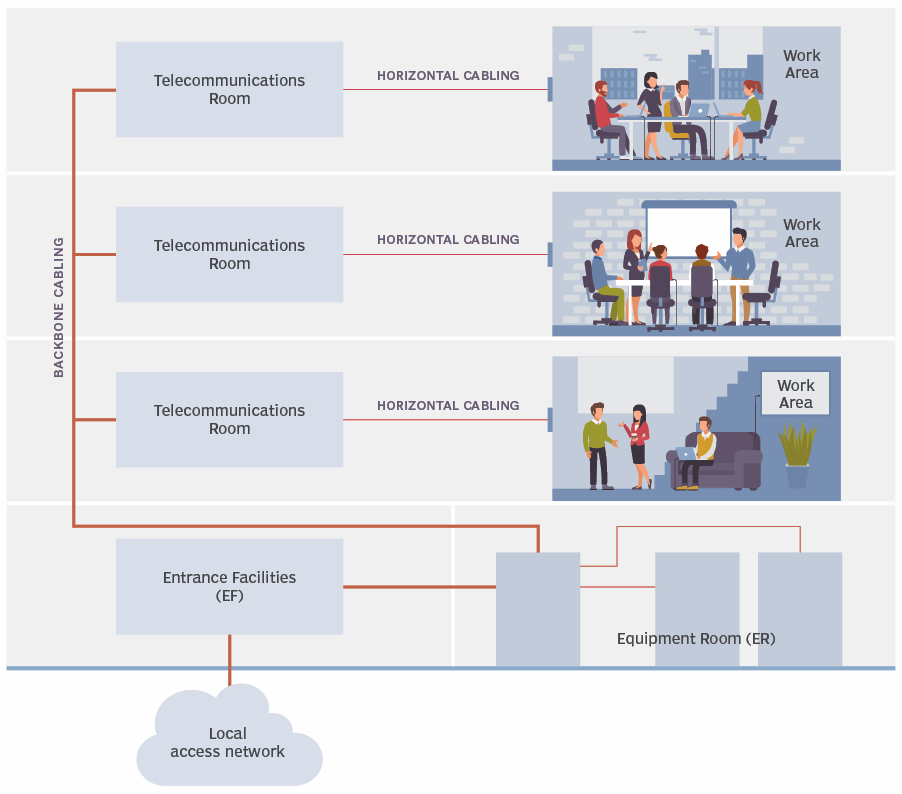
- In telecommunications, structured cabling is building or campus cabling infrastructure that consists of a number of standardized smaller elements (hence structured) called subsystems. Structured cabling components include twisted pair and optical cabling, patch panels and patch cables.
- Structured cabling is based on six components that, together, provide a convenient, repeatable and easily implemented framework for installing telecommunications cabling. The six components of structured cabling are the following:
- Entrance Facilities
- Equipment Room
- Backbone Cabling
- Telecommunications Room
- Horizontal Cabling
- Work Area
- Network Cabling:
- Coaxial Cable:
- Coaxial cables or coax, have a single copper conductor at the center, while a plastic layer provides insulation between the center conductor and braided metal shield. The metal shield blocks outside interference from fluorescent lights, motors, and other computers.
- Twisted Pair (Copper):
- Twisted pair uses copper wires that are, as the name suggests, twisted together in pairs. The twist effect of each pair in the cables ensures any interference presented or picked up on one cable is canceled by the cable’s partner that twists around the initial cable. Twisting the two wires also reduces the electromagnetic radiation emitted by the circuit.
- Unshielded Twisted Pair (UTP) Cable:
- UTP cables typically contain four pairs of copper wires, with each pair containing two wires twisted together. These pairs are covered by plastic insulation. They do not have any shielding and just have an outer jacket.
- Most categories of twisted-pair cables are available as UTP. But some newer categories are also available in combinations of shielded, foil shielded and unshielded.
- Shielded Twisted Pair (STP) Cable:
- In STP, copper wires are first covered by plastic insulation. A metal shield, which consists of metal foil or braid, surrounds the bundle of insulated pairs. Where electromagnetic radiation is a serious issue, each pair of wires may be individually shielded in addition to the outer shield. This is known as foil twisted pair (FTP).
- Foil Twisted Pair (FTP) Cable:
- A variation where individual pairs may be shielded in addition to an outer shield, used where EMI is a serious issue.
- Unshielded Twisted Pair (UTP) Cable:
- Twisted pair uses copper wires that are, as the name suggests, twisted together in pairs. The twist effect of each pair in the cables ensures any interference presented or picked up on one cable is canceled by the cable’s partner that twists around the initial cable. Twisting the two wires also reduces the electromagnetic radiation emitted by the circuit.
- Fiber Optic Cable:
- Fiber optic cables consist of a thin optical fiber surrounded by cladding. Cladding is made from glass that is less pure than the core and has a lower refractive index than the core. The difference in refractive indices causes light to be reflected at the boundary. Additional layers, such as the buffer layer and jacket layer, surround the cladding to add strength and protect the cable against damage.
- Data rates have increased throughout the network, and in some cases, fiber optics is the only option. While high-end copper Cat8 twisted-pair cables can carry up to 40 Gbps of data, fiber supports data rates up to 400 Gbps and beyond (up to 60 Tbps).
- In home audio (Toslink), optical cables transmit digital audio but are limited compared to HDMI. HDMI can carry high-resolution formats (Dolby TrueHD, DTS HD) and video, which optical cannot.
- Fiber has a low error rate. Network data is encoded in a light beam. Unlike with twisted-pair cables, the light beam neither generates nor is affected by electronic interference. Additionally, multiple frequency data streams can be multiplexed over a single fiber to increase the total data rate.
- Coaxial Cable:

- Fiber to the “X” (FTTX):
- Fiber to the Home (FTTH), Fiber to the Building (FTTB), Fiber to the Premises (FTTP) and Fiber to the Curb (FTTC), termed as FTTx are various technology and deployment options developed to enable reach of fiber as close to the user location as possible to provide high speed data and voice services.
- Fiber to the home (FTTH) is the delivery of a communications signal over optical fiber from the operator’s switching equipment all the way to a home or business, thereby replacing existing copper infrastructure such as telephone wires and coaxial cable.
- FTTP and FTTH are two different abbreviations for the same thing. FTTP stands for ‘fibre to the premises’ and FTTH stands for ‘fibre to the home’. … Unlike FTTC, FTTP broadband is delivered via fibre-optic cables not only as far as the cabinet, but across the entire span to your home or business.
- Fiber-optic cables are less susceptible to glitches than traditional copper wires and can withstand the shock and vibration from inclement weather. FTTH is considered “future proof” and offers the flexibility to deliver additional services in the years to come.

- Key Differences Between Copper Cable and Fiber Optics:
- Data transmission speed of a fiber cable is comparatively more than that of copper cable. Copper cables are nearly 31% slower in data transmission than fiber cable.
- A copper cable transmits the data through it in the form of electrical pulse i.e., due to the movement of electrons. As against in a fiber optics, the data transmission is the result of movement of photons thus it transmits in the form of light pulses.
- The bandwidth provided by a copper cable is less than that of the fiber optics. Thus, a copper cabling meets the industry standards and provides a performance of up to 10 Gbps. However, a fiber optics due to its large bandwidth possess better performance of up to 60 Tbps and above.
- The energy consumed by a copper cable during its operation is somewhat greater than 10W but on the other side, fiber optics consumes less energy i.e., around 2W per user.
- The lifespan of a copper wire is approximately 5 years as it gets easily affected by temperature variations and other environmental factors. However, fiber optics possess a lifespan of 30 to 50 years.
- As fiber optics are difficult to be tapped as compared to copper cables thus proves advantageous from the security point of view. Due to this reason fiber optics are widely used for data transmission at present time.
- A fiber optics allows transmission of data at a much faster rate as compared to copper cable.
- The installation and maintenance cost of a fiber cable is more than copper cable.
- Broadband Connectivity:
- Broadband refers to various high-capacity transmission technologies that transmit data, voice, and video across long distances and at high speeds.
- Broadband refers to telecommunications in which a wide band of frequencies is available to transmit information. Because a wide band of frequencies is available, information can be multiplexed and sent on many different frequencies or channels within the band concurrently. Multiplexing enables more information to be transmitted in a given time, much as more lanes on a highway support more cars.
- Optical Cabling:
- An optical cable transfers audio digitally, but instead of copper wire, light is used. This is a variation of fiber optics, which is used in a variety of applications.
- The biggest difference between Optical Cables and HDMI is that HDMI can pass higher-resolution audio, including the formats found on Blu-ray: Dolby TrueHD and DTS HD Master Audio. These formats can’t get transmitted across optical. In terms of simplicity, HDMI also passes video signals.