
Phoenix Contact – Phoenix Contact sells Perle Systems Ltd. to Hitron Technologies Inc.

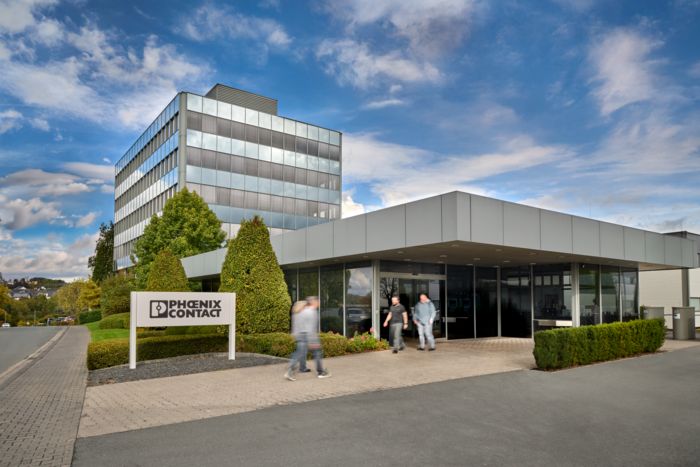
Phoenix Contact has reached an agreement to sell Perle Systems Ltd. and its subsidiaries to Hitron Technologies Inc.
The transaction represents an important step in Phoenix Contact’s strategic focus on its core businesses.
Perle Systems, headquartered in Ontario, Canada, is a globally recognized provider of high-availability industrial networking solutions that has developed well in its business areas over its time within the Phoenix Contact Group. Its products include serial-to-Ethernet devices, industrial Ethernet switches and advanced networking hardware for the industry automation, telecommunications, energy and transportation sectors. The company has almost 50 years of industry experience and serves customers in several countries around the world, primarily its sales network and distribution partners. In 2016 Phoenix Contact acquired Perle Systems and has since supported the company in strengthening its technology offering, expanding its international presence and positioning itself in key industrial and networking segments.
“Perle Systems has been a valued part of the Phoenix Contact family for a decade, delivering high-quality services, building strong capabilities and driving innovation in industrial networking,” emphasizes Dirk Görlitzer, CEO of Phoenix Contact. “The company’s development during the last ten years has been extraordinary, and we are confident that Hitron is the right strategic partner to support the next phase of Perle’s growth.”
Hitron Technologies is a global leader in broadband, Wi-Fi and enterprise networking technologies. The acquisition is Hitron’s first overseas acquisition and represents an important step in its global footprint, strengthening its enterprise and industrial networking capabilities. Phoenix Contact is focused on its long-term strategic priorities and will continue to expand its core portfolio to drive industrial digitalization, electrification and automation worldwide.
The closing of the transaction is subject to foreign direct investment (FDI) approvals in various countries. Phoenix Contact and Hitron will work closely together to ensure a smooth transition for employees, partners and customers.
SourcePhoenix Contact
EMR Analysis
More information on Phoenix Contact: See the full profile on EMR Executive Services
More information on Dirk Görlitzer (Chief Executive Officer and Chairman of the Executive Board, Phoenix Contact): See the full profile on EMR Executive Services
More information on Axel Wachholz (Chief Financial Officer, Phoenix Contact): See the full profile on EMR Executive Services
More information on Perle Systems Ltd. by Phoenix Contact: https://www.perle.com/ + Founded in 1976, Perle Systems designs and manufactures highly reliable device networking, media conversion, and Internet of Things (IoT) connectivity hardware sold through a globally established distributor, systems integrator, and reseller channel. With an extensive range of solutions, Perle products are ideal for organizations that need to establish network connectivity across multiple locations, securely transmit critical and sensitive information, or remotely monitor and control networked devices and appliances.
On August 31, 2016, Phoenix Contact GmbH & Co. KG closed on its acquisition of Perle Systems Limited, its first Canadian acquisition.
At Perle, our commitment goes beyond providing top-tier technology. Our dedicated team of technical engineers is here to guide you every step of the way, offering personalized consultations to help you identify the best solutions for your specific needs. We don’t just provide products; we offer peace of mind — ensuring that your network operates seamlessly, efficiently, and securely, so you can focus on what matters most: growing your business.
More information on Hitron Technologies Inc.: https://www.hitrontech.com/ + Established in 1986, Hitron is changing the way the world works, plays and connects. With a growing count of eleven first-to-market DOCSIS launches and powering DOCSIS 3.0 24×8, 32×8, and DOCSIS 3.1 deployments, Hitron has shipped over 40 million DOCSIS units to customers worldwide. Our leadership in broadband and Wi-Fi technology, combined with our vertically integrated manufacturing services, enable us to continually push the envelope of what’s possible and deliver custom, cost-effective and scalable solutions.
Headquartered in Hsinchu Science Park, Taiwan’s “Silicon Valley,” Hitron Technologies delivers over 3 million DOCSIS products annually to MSOs worldwide which support both residential and business class applications. With a world class manufacturing campus in Suzhou, China and subsidiary in Denver (USA) and regional offices in Shenzhen (China), Amsterdam (Netherlands), our global operation spans more than 15 countries with more than 1,000 employees.
More information on David Chou (President, Hitron Technologies Inc.): https://www.hitrontech.com/investors/board-of-directors/
EMR Additional Notes:
- Serial-to-Ethernet Devices:
- Serial-to-Ethernet devices (or device servers) are networking hardware that translate data between serial protocols (RS-232, RS-422, or RS-485) and Ethernet networks. They enable legacy industrial, medical, or security equipment to connect to modern LANs, allowing for remote monitoring, management, and control via an IP address.
- Ethernet:
- Ethernet is the fundamental wired networking standard (IEEE 802.3), commercially introduced in 1980. While traditional Ethernet uses 2 or 4 pairs of wires, the technology has evolved into specialized forms for industrial use.
- Single Pair Ethernet (SPE):
- SPE represents a major shift in cabling architecture, designed to bring Ethernet to the “edge” of industrial networks (sensors, actuators).
- SPE describes the transmission of Ethernet over only one twisted pair of copper wires. This is in contrast to the two or four pairs traditionally used. In addition to data transmission, SPE also enables a simultaneous power supply to terminal devices via PoDL (Power over Data Line).
- Advanced Physical Layer (APL):
- Ethernet-APL is essentially the “ruggedized” version of SPE designed specifically for the process industry (chemical plants, refineries). It is essentially a 2-wire, loop-powered layer safe for hazardous areas (Intrinsically Safe).
- It bridges the gap between OT (Operations Technology) and IT, allowing field devices to connect directly to Ethernet systems without complex gateways.
- PoE (Power over Ethernet):
- Power over Ethernet (PoE) is the process of sending both electrical power and data over a standard copper Ethernet cable. This combination of power and data onto the same RJ45 Ethernet connector allows for power to be supplied to devices without needing a separate electrical outlet.
- As PoE technology has developed, the amount of power that can be sent over Ethernet cable has increased. IEEE-compliant PoE standards can now provide a wide range of power, from around 12 watts to over 90 watts per port, depending on the standard.
- EtherCAT (Ethernet for Control Automation Technology):
- Developed by Beckhoff, this is a high-performance, real-time Ethernet network.
- The Ethernet Fieldbus: https://www.ethercat.org/default.htm
- EtherCAT is the open, real-time Ethernet network originally developed by Beckhoff. It sets new standards for real-time performance and topology flexibility. It achieves this by processing messages on the fly and reading data as the frame passes through, without requiring the frame to be fully received and then sent on. This makes it exceptionally fast.
- EtherCAT Technology Group (ETG):
- The worlds largest Industrial Ethernet organization with 6900+ member companies: https://www.ethercat.org/en/tech_group.html
- The ETG is a global organization in which OEM, End Users and Technology Providers join forces to support and promote the further technology development. The EtherCAT Technology Group keeps EtherCAT technology open for all potential users.
- Single Pair Ethernet System Alliance:
- https://singlepairethernet.com/en/
- The Single Pair Ethernet System Alliance is a worldwide association of leading technology companies. We want to implement and further develop the pioneering Single Pair Ethernet technology. Together and holistically.
- The Single Pair Ethernet System Alliance is an ever-growing, collaborative community. Technology companies from all over the world jointly drive the further development of SPE technology and its implementation in various applications.
- Founding Members are: Weidmüller, Phoenix contact, Rosenberger, Datwyler, Draka and R&M.
- Hardware vs. Software vs. Firmware:
- Hardware is physical: It’s “real,” sometimes breaks, and eventually wears out.
- Since hardware is part of the “real” world, it all eventually wears out. Being a physical thing, it’s also possible to break it, drown it, overheat it, and otherwise expose it to the elements.
- Here are some examples of hardware:
- Smartphone
- Tablet
- Laptop
- Desktop computer
- Printer
- Flash drive
- Router
- Software is virtual: It can be copied, changed, and destroyed.
- Software is everything about your computer that isn’t hardware.
- Here are some examples of software:
- Operating systems like Windows 11 or iOS
- Web browsers
- Antivirus tools
- Adobe Photoshop
- Mobile apps
- Firmware is virtual: It’s software specifically designed for a piece of hardware
- While not as common a term as hardware or software, firmware is everywhere—on your smartphone, your PC’s motherboard, your camera, your headphones, and even your TV remote control.
- Firmware is just a special kind of software that serves a very narrow purpose for a piece of hardware. While you might install and uninstall software on your computer or smartphone on a regular basis, you might only rarely, if ever, update the firmware on a device, and you’d probably only do so if asked by the manufacturer, probably to fix a problem.
- Hardware is physical: It’s “real,” sometimes breaks, and eventually wears out.
- Broadband Connectivity:
- Broadband refers to various high-capacity transmission technologies that transmit data, voice, and video across long distances and at high speeds.
- Broadband refers to telecommunications in which a wide band of frequencies is available to transmit information. Because a wide band of frequencies is available, information can be multiplexed and sent on many different frequencies or channels within the band concurrently. Multiplexing enables more information to be transmitted in a given time, much as more lanes on a highway support more cars.
- Wi-Fi and Z-Wave:
- A Wi-Fi network is simply an internet connection that’s shared with multiple devices in a home or business via a wireless router. The router is connected directly to your internet modem and acts as a hub to broadcast the internet signal to all your Wi-Fi enabled devices.
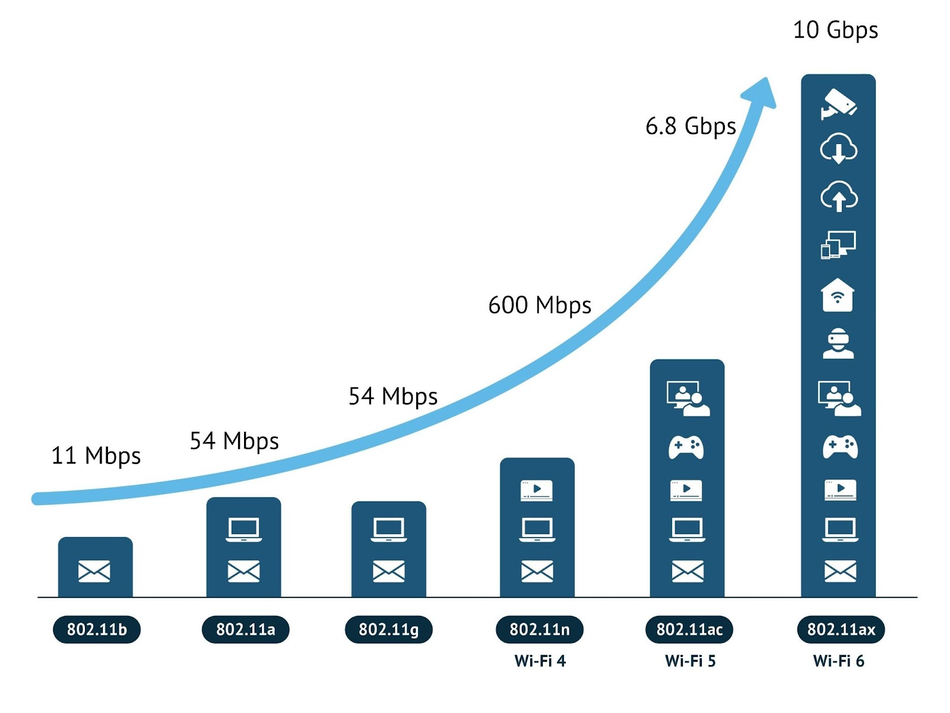
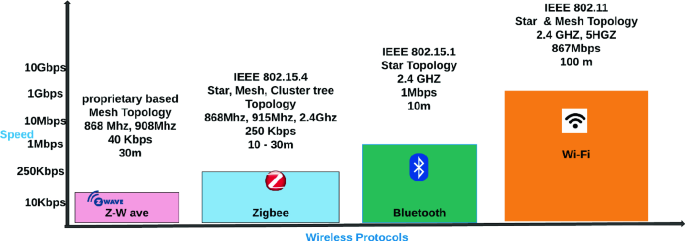
- Wi-Fi, which most of us are familiar with, operates on either 2.4 GHz or 5 GHz frequencies, providing wireless internet to any connected devices. Z-Wave operates on a much lower frequency — between 800 and 900 MHz — and is primarily for home automation.
- On 8 January 2024, the Wi-Fi Alliance introduced its Wi-Fi Certified 7 (IEEE 802.11be) program to certify Wi-Fi 7 devices. While final ratification is not expected until the end of 2024, the technical requirements are essentially complete, and as of February 2024 there are already products labeled as Wi‑Fi 7. WiFi 7 will be much faster than WiFi 6. For the same WiFi radio configuration, the speeds will be 2.4x faster. So, maximum speeds with a typical mobile phone with WiFi 7 can reach up to 5Gbps.
- If you want better range, use 2.4 GHz. If you need higher performance or speed, use the 5GHz band.
- Z-Wave operates on a completely different wireless frequency that will not conflict with your Wi-Fi network signal. Z-Wave is a mesh technology that strengthens the network with several connected devices. Z-wave is popular as smart-property technology, powering locks, lights, sensors, thermostats, etc.
- Z-wave uses much less power than WiFi. That means that it’s possible to use battery-powered Z-wave devices without worrying about having to change the batteries frequently. Z-wave is also more secure since it’s more of a closed system and can offer some additional layers of protection.
- Foreign Direct Investment (FDI):
- Foreign direct investment (FDI) refers to an ownership stake in a foreign company or project made by an investor, company, or government from another country. FDI is generally used to describe a business decision to acquire a substantial stake in a foreign business or to buy it outright to expand operations to a new region.