ABB – ABB and Syre to explore technologies for industrial-scale textile recycling

- ABB and Syre sign MoU to explore automation, electrification and digitalization for textile-to-textile polyester recycling in Vietnam
- Collaboration to assess quality control, process automation, electrification infrastructure and digital applications and solutions
- Partnership supports the industrialization of circular polyester production at scale as solution to global textile waste problem
ABB has signed a Memorandum of Understanding (MoU) with Swedish textile impact company Syre to jointly explore technologies to support the development of Syre’s first textile-to-textile recycling plant in Vietnam.
The agreement establishes a framework for collaboration to investigate how ABB’s automation, electrification and digital technologies could contribute to safe, efficient and scalable operations. It will also explore how these capabilities could further optimize process and quality control performance as Syre advances its ambition to produce circular polyester at industrial scale.
The proposed plant in Gia Lai province, Vietnam, is intended to recycle polyester from used textiles and industrial waste into new recycled polyester material. Polyester is one of the world’s most widely used fibers and is traditionally produced from fossil-based sources. Recycling polyester helps reduce reliance on virgin fossil inputs, lowers climate impact and keeps valuable materials in circulation, supporting the transition toward a more circular textile industry.
Under the MoU, ABB and Syre will assess how ABB’s technologies – including its distributed control systems, digital industrial software and electrification portfolio – could be adapted to meet the specific requirements of polyester textile-to-textile recycling. Activities are expected to run in parallel with the detailed engineering phase of Syre’s first plant.
“This agreement reflects ABB’s role in supporting emerging industrial applications where automation and electrification can enable greater resource efficiency,” said Wilson Monteiro, Global Business Line Manager for Pulp, Paper and Fiber, in ABB’s Process Industries division. “Together with Syre, we will explore how our experience in fiber processing, chemicals and advanced process industries can be applied to polyester recycling. We’re excited to discover what’s possible as we embark on this new technological collaboration.”
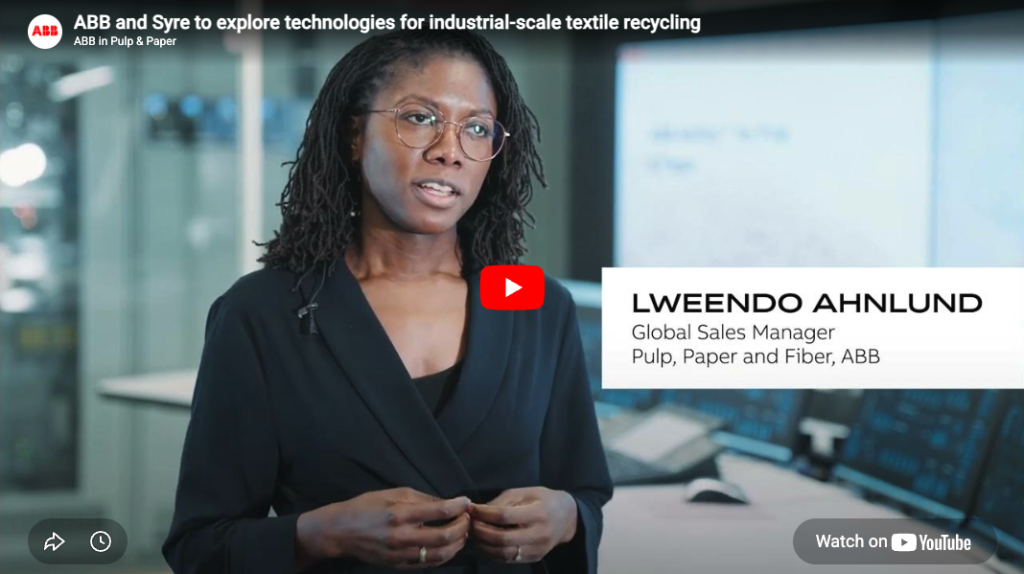
See the video on YouTube
ABB and Syre to explore technologies for industrial-scale textile recycling
“As we now move into full industrial deployment, partnerships like this become critical,” said Dennis Nobelius, CEO of Syre. “Industrializing textile-to-textile recycling is a complex undertaking, and while strong customer demand is essential, it must be matched with best-in-class industrial partners. ABB brings exactly the depth of expertise and execution capability needed, they are a cornerstone of the industrial ecosystem we are building.”
Since its public launch two years ago, Syre has rapidly built its technological foundation, establishing an R&D facility and pilot production line in Mebane, North Carolina. In 2025, the company accelerated to multi-ton production of circular PET chips, demonstrating the viability of its textile-to-textile recycling process. Syre is now focused on advancing plans for its first large-scale production facility in Vietnam, with construction targeted to commence in 2027.
While exploratory in nature, the partnership signals ABB’s dedication to advancing the next generation of fiber-based industries. As circular materials move from ambition to industrial reality, ABB continues to apply its automation, electrification and digital expertise to enable efficient, scalable production.
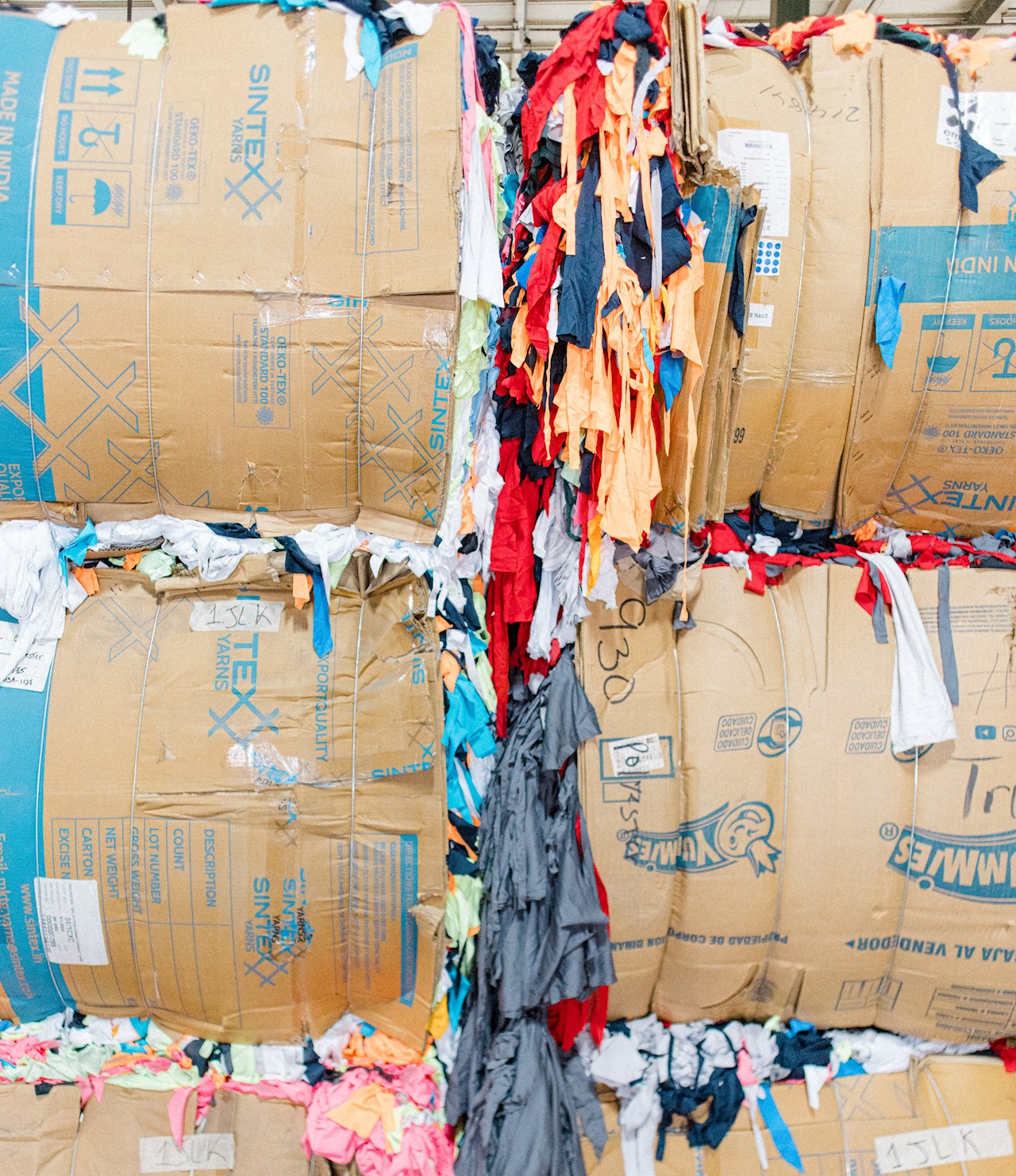
Syre’s plant in Vietnam will be strategically placed to benefit from a supply of textile scrap. Image Syre

Recycling of polyester materials. Image Syre.

Recycling of polyester materials. Image Syre.

Image Syre
SourceABB
EMR Analysis
More information on ABB: See full profile on EMR Executive Services
More information on Morten Wierod (Chief Executive Officer and Member of the Group Executive Committee, ABB): See full profile on EMR Executive Services
More information on Christian Nilsson (Chief Financial Officer and Member of the Executive Committee, ABB): See full profile on EMR Executive Services
More information on the ABB Way: See full profile on EMR Executive Services
More information on Automation Business Area by ABB: See the full profile on EMR Executive Services
More information on Peter Terwiesch (President, Automation Business Area and Member of the Executive Committee, ABB): See full profile on EMR Executive Services
More information on Wilson Monteiro Jr. (Global Business Line Manager, Pulp, Paper and Fiber, ABB Process Industries, Automation Business Area, ABB): See full profile on EMR Executive Services
More information on Electrification Business Area by ABB: See the full profile on EMR Executive Services
More information on Giampiero Frisio (President, Electrification Business Area and Member of the Executive Committee, ABB): See full profile on EMR Executive Services
More information on Syre: https://voltagrid.com/ + Action speakslouder than words. We are a textile impact company decarbonizing and dewasting the industry through textile-to-textile recycling. At hyperscale.
Polyester is the biggest and fastest growing textile fiber – 71 million tons produced annually and widely used across apparel, automotive, and home interior. It is the biggest CO2e emitter, accounting for up to 40% of the textile industry’s total CO2e emissions. Virgin polyester is produced by crude oil and bottle-to-fiber recycled polyester is, unlike textile-to-textile, not a circular solution.
Syre is on a mission to transition polyester waste into new, circular, polyester. Over and over again
More information on Dennis Nobelius (Chief Executive Officer, Syre): https://www.syre.com/our-team + https://www.linkedin.com/in/dennisnobelius/
EMR Additional Notes:
- MoU (Memorandum of Understanding):
- A memorandum of understanding is a type of agreement between two or more parties. It expresses a convergence of will between the parties, indicating an intended common line of action.
- Starting point of negotiations between multiple parties to signal the intent of doing business or coming to an agreement. It simplifies a legal contract by establishing the key objectives and goals.
- A MOU is not a legally binding document. It is a statement of serious intent – agreed voluntarily by equal partners – of the commitment, resources, and other considerations that each of the parties will bring. It has moral force, but does not create legal obligations.
- Olefin (Alkene) & Polyolefin (PE):
- Olefins are a class of chemicals made up of hydrogen and carbon with one or more pairs of carbon atoms linked by a double bond. Ethylene, propylene and 1,3-butadiene are examples of olefins.
- Also called an alkene, a compound made up of hydrogen and carbon that contains one or more pairs of carbon atoms linked by a double bond. Olefins are examples of unsaturated hydrocarbons (compounds that contain only hydrogen and carbon and at least one double or triple bond).
- Polyolefins are a family of thermoplastics that include polyethylene and polypropylene. They are produced by polymerizing, respectively, ethylene and propylene, which are mainly obtained from oil and natural gas but can also be derived from renewable resources (e.g., sugar cane).
- Polyethylene (PE) & High-Density Polyethylene (HDPE):
- Polyethylene (PE) is a thermoplastic polymer considered one of the most versatile plastic materials available today. It is used to manufacture numerous items, including food and beverage containers, cleaning product bottles, pipes, cutting boards, and some shoe parts.
- HDPE (High-Density Polyethylene) is a specific type of PE. It is hard-wearing and does not break down under exposure to sunlight. It can withstand more extreme temperatures than PET, both hot and cold. HDPE can be reused and recycled.
- Polypropylene (PP):
- Polypropylene (PP) is a thermoplastic “addition polymer” made from the combination of propylene monomers. It is a low-density, stress-resistant thermoplastic. It is a rigid, semi-crystalline thermoplastic that was first polymerized in 1951 and is used widely today in a range of domestic and industrial applications.
- Polypropylene is a plastic. Of the commercial plastics on the market today, polypropylene is considered one of the safest.
- Polypropylene uses range from plastic packaging, plastic parts for machinery and equipment and even fibres and textiles.
- Polyamide (PA):
- A polyamide is a polymer with repeating units linked by amide bonds. Polyamides occur both naturally and artificially. Examples of naturally occurring polyamides are proteins, such as wool and silk.
- Synthetic polymer of a type made by the linkage of an amino group of one molecule and a carboxylic acid group of another, including many synthetic fibres such as nylon.
- Nylon is low-friction, more malleable, and can withstand higher temperatures, making it ideal for prototyping and manufacturing components that will be subject to resistance. Polypropylene is generally stronger than many nylons and more resistant to physical stress, making it ideal for high-resistance equipment.
- Polyester (PET):
- Synthetic resin in which the polymer units are linked by ester groups, used chiefly to make synthetic textile fibres.
- Synthetic fabric that’s usually derived from petroleum. This fabric is one of the world’s most popular textiles, and it is used in thousands of different consumer and industrial applications. Chemically, polyester is a polymer primarily composed of compounds within the ester functional group.
- Polyvinyl Chloride (PVC or Vinyl):
- High strength thermoplastic material widely used in applications, such as pipes, medical devices, wire and cable insulation…the list is endless. It is the world’s third-most widely produced synthetic polymer of plastic. About 40 million tons of PVC are produced each year. PVC comes in two basic forms: rigid and flexible. The rigid form of PVC is used in construction for pipe and in profile applications such as doors and windows.
- Vinyl is commonly used as a shorthand name for Polyvinyl Chloride (PVC) plastic.
- Polyester GRP:
- Glass Reinforced Polyester (GRP) is a polyester material reinforced with the addition of glass fibre.
- GRP is made up of a combination of glass fibre and polymer or plastic. It has many desirable properties which include: High strength to weight ratio and excellent durability.
- GRP stands for Glass Reinforced Plastic (or Polymer). You may also know it as FRP (Fibre Reinforced Plastic) or even as Fiberglass. It is a blend of a thermosetting plastic resin (such as polyester) and recycled glass with a tough waterproof resin to bond it all together.
- Polyvinylidene Fluoride (PVDF):
- PVDF is a high-performance, semi-crystalline thermoplastic fluoropolymer known for its extreme chemical resistance, high purity, and stability at high temperatures (up to 150°C). Commonly used in chemical processing, semiconductor, and battery manufacturing, it is durable, non-toxic, and UV-resistant, often appearing as pipes, films, or coatings.
- Industrial Automation:
- Industrial Automation (umbrella term) is the use of technologies such as computer software and robotics to control machinery and processes which replace human beings in performing specific functions. The functions are primarily centered on manufacturing, quality control and material handling processes.
- Process Automation / Manufacturing:
- Process automation (based on the nature of the raw materials and final product) is defined as the use of software and technologies to automate business processes and functions in order to accomplish defined organizational goals, such as producing a product, hiring and onboarding an employee, or providing customer service.
- Process manufacturing utilizes chemical, physical and compositional changes to convert raw material or feedstock into a product. Process manufacturing includes industries such as cement and glass, chemicals, electric power generation, food and beverage, life sciences, metals and mining, oil and gas, pulp and paper, refining, and water and wastewater. Process manufacturing includes both continuous and batch processes.
- Discrete Automation / Manufacturing:
- Discrete automation (focusing on individual, quantifiable parts and products) is the production of parts that are of a quantifiable nature. That may include cell phones, soda bottles, automobiles, airplanes, toys, etc. As you know, an automobile contains many, many parts. The parts required for an automobile are also quantifiable in nature.
- Discrete manufacturing processes include the production of individual parts as well as their assembly into a final product. Discrete manufacturing examples include automobiles, appliances, and consumer electronics.
- Process Automation / Manufacturing:
- Types of Automation Systems (by flexibility):
- Fixed Automation:
- Most basic, least flexible type of automation, ideal for high-volume, unchanging production.
- Fixed automation systems are utilized in high volume production settings that have dedicated equipment. The equipment has fixed operation sets and is designed to perform efficiently with the operation sets. This type of automation is mainly used in discrete mass production and continuous flow systems like paint shops, distillation processes, transfer lines and conveyors. All these processes rely on mechanized machinery to perform their fixed and repetitive operations to achieve high production volumes.
- Programmable Automation:
- Next level of flexibility, where the system can be reprogrammed, but with a significant effort.
- Programmable automation systems facilitate changeable operation sequences and machine configuration using electronic controls. With programmable automation, non-trivial programming efforts are required to reprogram sequence and machine operations. Since production processes are not changed often, programmable automation systems tend to be less expensive in the long run. This type of system is mainly used in low job variety and medium-to-high product volume settings. It may also be used in mass production settings like paper mills and steel rolling mills.
- Flexible Automation:
- Most advanced type of automation based on flexibility, allowing for easy, high-level changes without major reprogramming.
- Flexible automation systems are utilized in computer-controlled flexible manufacturing systems. Human operators enter high-level commands in the form of computer codes that identify products and their location in the system’s sequence to trigger automatic lower-level changes. Every production machine receives instructions from a human-operated computer. The instructions trigger the loading and unloading of necessary tools before carrying out their computer-instructed processes. Once processing is completed, the end products are transferred to the next machine automatically. Flexible industrial automation is used in batch processes and job shops with high product varieties and low-to-medium job volumes.
- Fixed Automation:
- Advanced and Integrated Concepts (most complex):
- Integrated Automation:
- Takes flexible automation to the next level by explaining how an entire plant’s processes, from manufacturing to business operations, are linked under a single computer-controlled system.
- Integrated industrial automation involves the total automation of manufacturing plants where all processes function under digital information processing coordination and computer control. It comprises technologies like:
- Computer-aided process planning
- Computer-supported design and manufacturing
- Flexible machine systems
- Computer numerical control machine tools
- Automated material handling systems, like robots
- Automatic storage and retrieval systems
- Computerized production and scheduling control
- Automated conveyors and cranes
- Additionally, an integrated automation system can integrate a business system via a common database. That is, it supports the full integration of management operations and processes using communication and information technologies. Such technologies are utilized in computer integrated manufacturing and advanced process automation systems.
- Smart Manufacturing (SM):
- Modern evolution of automation, driven by data and connectivity.
- Technology-driven approach that utilizes Internet-connected machinery to monitor the production process. The goal of SM is to identify opportunities for automating operations and use data analytics to improve manufacturing performance.
- An example of what the cloud can do for smart manufacturing is the Volkswagen Industrial Cloud, which combines all data from 122 Volkswagen Group facilities and processes it in real time to make improvements.
- Hybrid Automation / Manufacturing:
- Combines different approaches, showing how both additive and subtractive manufacturing can be integrated into one process. It also introduces the “hybrid” method for implementing automation projects.
- The Hybrid Automation Method follows two guiding principles: Implementing robust automation solutions that are easy and affordable for organisations to maintain. Realising process efficiency rapidly by reducing project overheads and time-to-value.
- Hybrid manufacturing is a combination of additive manufacturing (AM) and subtractive manufacturing within the same machine.
- Additive Manufacturing (AM):
- Key technology of one of the core components of the “hybrid” approach.
- Additive manufacturing is the process of creating an object by building it one layer at a time. It is the opposite of subtractive manufacturing, in which an object is created by cutting away at a solid block of material until the final product is complete.
- Operators across a variety of different manufacturing industries utilize additive manufacturing in various ways. For instance: Medical device manufacturers use 3D printing to develop high variance products such as dental implants.
- The term “additive manufacturing” refers to the creation of objects by “adding” material. Therefore, 3D printing is a form of additive manufacturing. When an object is created by adding material — as opposed to removing material — it’s considered additive manufacturing.
- Integrated Automation:
- Industrial Automation (umbrella term) is the use of technologies such as computer software and robotics to control machinery and processes which replace human beings in performing specific functions. The functions are primarily centered on manufacturing, quality control and material handling processes.
- Circular Economy:
- A circular economy is a systemic approach to economic development designed to benefit businesses, society, and the environment. In contrast to the ‘take-make-waste’ linear model, a circular economy is regenerative by design and aims to gradually decouple growth from the consumption of finite resources.
- In such an economy, all forms of waste, such as clothes, scrap metal and obsolete electronics, are returned to the economy or used more efficiently.
- The aim of a circular economy is hence to create a closed-loop system where waste and pollution are minimized and resources are conserved, reducing the environmental impact of production and consumption.
- Sustainability Vs. Circular Economy:
- Circularity focuses on resource cycles, while sustainability is more broadly related to people, the planet and the economy. Circularity and sustainability stand in a long tradition of related visions, models and theories.
- A sustainable circular economy involves designing and promoting products that last and that can be reused, repaired and remanufactured. This retains the functional value of products, rather than just recovering the energy or materials they contain and continuously making products anew.
- Distributed Control System (DCS):
- The distributed control system is designed to perform more complex and geographically larger industrial processes. The whole industrial process is divided into various control zones and is controlled by dedicated autonomous controllers. Field devices communicate with the controllers at the particular zone of control. These controllers are interconnected through a high-speed communication network and are connected to an engineering PC where overall control, monitoring, data logging, and alarming functions occur.
- In a distributed control system, automated control decisions are primarily made by the controllers themselves, with the plant operator providing oversight and intervening when necessary.
- DCS is a pre-engineered solution that requires configuration and logic development, rather than just programming like a PLC.