
Schneider Electric – Global study shows energy industry ramping up investment in autonomous operations by 2030 as AI reshapes performance


- Study of 400 senior energy and chemicals leaders across 12 countries signals a tipping point: the sector is racing towards almost 50% full automation by 2030 with close to a third of operations already fully autonomous.
- 59% warn that delaying adoption will drive up operating costs, as the sector races to manage inflation and a retiring workforce
- Gulf Cooperation Council (GCC) and Asia lead on current adoptions levels with North America planning the most aggressive acceleration, fueled by AI-driven energy demand and expanding data center footprint
Schneider Electric, a global energy technology leader, today unveils new research highlighting a powerful combination of pressures pushing autonomous operations to the top of the agenda for the energies and chemicals sector.
The study of 400 senior energy and chemicals executives across 12 countries shows a sharp rise in urgency around autonomy. A third of executives (31.5%) say advancing autonomy is a ‘critical’ priority in the next five years, rising to 44% over a ten-year horizon. Fewer than 5% globally view it as a low priority.
Leaders cite strong commercial pressures. They warn that delaying adoption risks higher operating costs (59%), worsening talent shortages (52%), and declining competitiveness (48%). Yet adoption is not without obstacles. Key barriers include high upfront costs (34%), legacy systems (30%), organizational resistance (27%), cybersecurity concerns (26%), and regulatory uncertainty (25%).
Schneider Electric’s Global Autonomous Maturity Report shows the sector at a critical point of transformation as electrification, automation, and digitalization converge. Surging AI demand, driven predominantly by hyperscale cloud and data ‑center growth, is placing unprecedented pressure on global energy systems. Electricity demand is projected to nearly double to 1,000 TWh by 2030, intensifying the need for flexible, efficient, and resilient operations.
Within this emerging AI energy nexus, 49% of executives identify AI as the single biggest enabler of autonomous acceleration, followed by cybersecurity advancements, cloud and edge computing, digital twins, advanced process control, and open, software-defined automation.
“Globally, organizations already report operating at 70% autonomy, with plans to hit 80% by 2030,” said Gwenaelle Avice Huet, Executive Vice President, Schneider Electric. “Autonomy is rapidly becoming the new operating model of industry. As AI advances and energy systems come under growing pressure, autonomous operations are proving essential for resilience and competitiveness. And this shift isn’t about replacing people, it’s about empowering them to focus on higher value work, strengthening safety, and elevating skills. Those who scale now will shape the next era of industrial performance.”
Industry analysts agree the shift is further along than expected. “The report finds the adoption of autonomy in the sector to be more advanced than expected, with open, software-defined automation essentially leading the next phase of energy innovation”, added Gaurav Sharma, Independent Energy Market Analyst and contributor to the research. “In a sector where reliability, safety, and carbon reduction are now non‑negotiable, these technologies are emerging as the most effective way for operators to deliver ‘more with less’ and run more resilient and competitive operations.”
The momentum is clear, but progress uneven, with the data highlighting regional differences in readiness levels. While GCC countries and Asia currently lead in maturity, North America is set for the fastest acceleration in adoption over the next five years, powered by its scale in energy production and consumption, and its rapidly expanding data‑center footprint. Europe maintains steady progress but faces the slowest adoption trajectory.
“Autonomous operations are redefining how energy and chemicals companies run their entire facilities, and Schneider Electric and AVEVA are at the forefront of that shift, supporting customers such as Shell, European Energy, ADNOC and Baosteel on real‑world deployments,” said Devan Pillay, President of Schneider’s Heavy Industries Segment. “By integrating Schneider Electric’s process control and power management with AVEVA’s digital technologies and industrial intelligence, we deliver integrated software-defined architectures that provide real-time visibility and enable AI driven digital twins that can predict, adapt and self-optimize with minimal intervention.”
Recent deployments showcase this shift. At Shell’s Scotford Refinery in Canada, Schneider Electric is helping modernize operations through open, software‑defined automation, supporting more flexible, autonomous operations. At European Energy’s Kassø Power‑to‑X facility, the world’s first commercially viable e‑methanol plant, Schneider Electric and AVEVA are together enabling AI‑supported, self‑optimizing clean‑fuel operations with resilient remote monitoring.
The research was commissioned in partnership with Censuswide and Development Economics, supported by insights from Independent Energy Market Analyst, Gaurav Sharma. It captures insights from 400 senior energy executives across 12 countries in four key regions — North America, Europe, Asia, and the GCC — supported by desk research and conversations with industry stakeholders and commentators across the global energy and chemicals sector.
SourceSchneider Electric
EMR Analysis
More information on Schneider Electric: See the full profile on EMR Executive Services
More information on Olivier Blum (Chief Executive Officer, Schneider Electric): See the full profile on EMR Executive Services
More information on Hilary Maxson (Member of the Executive Committee and Executive Vice President, Group Chief Financial Officer, Schneider Electric till April 5, 2026): See the full profile on EMR Executive Services
More information on Nathan Fast (Senior Vice President, Head of Investor Relations, Schneider Electric till April 5, 2026 + Member of the Executive Committee and Executive Vice President, Group Chief Financial Officer, Schneider Electric as from April 6, 2026): See the full profile on EMR Executive Services
More information on Industrial Automation by Schneider Electric: See the full profile on EMR Executive Services
More information on Gwenaelle Avice-Huet (Member of the Executive Committee and Executive Vice President, Industrial Automation, Schneider Electric): See the full profile on EMR Executive Services
More information on Devan Pillay (President, Heavy Industries Segment, Industrial Automation, Schneider Electric): See the full profile on EMR Executive Services
More information on AVEVA by Schneider Electric: See the full profile on EMR Executive Services
More information on Caspar Herzberg (Member of the Executive Committee, Chief Executive Officer, AVEVA, Schneider Electric): See the full profile on EMR Executive Services
More information on the Global Autonomous Maturity Report by Schneider Electric: https://www.se.com/ww/en/work/solutions/global-autonomous-operations-maturity/ + Autonomous operations in the energies and chemicals sector are advancing faster than expected, driven by rapid gains from automation, digitalization, and electrification.
This report draws on insights from 400 senior decision makers from the energy and chemicals sector across twelve countries. It is built around the ARC Advisory Group Autonomous Operations Maturity Model Index*, a five‑level framework that tracks progress toward full autonomy, with level 5 representing complete autonomous operation.
Ambition for autonomous operations is accelerating across the global energies and chemicals sector. Leaders see autonomy as a way to boost performance, cut costs, and hit sustainability targets.
Top 5 autonomous technologies:
- AI and machine learning
- Cybersecurity and safety
- Cloud and edge computing
- Advanced process control
- Robotics and field automation
More information on the Gulf Cooperation Council (GCC): https://www.gcc-sg.org/en/Pages/default.aspx + The United Arab Emirates, The State of Bahrain, The Kingdom of Saudi Arabia, The Sultanate of Oman, The State of Qatar and The State of Kuwait.
The GCC Charter states that the basic objectives are : 1. To effect co-ordination, integration and inter-connection between member states in all fields in order to achieve unity between them. 2. To deepen and strengthen relations, links and areas of cooperation now prevailing between their peoples in various fields. 3. To formulate similar regulations in various fields including the following: A. Economic and financial affairs. B. Commerce, customs and communications. C. Education and culture. D. Social and health affairs. E. Information and tourism. F. Legislative and administrative affairs. 4.To stimulate scientific and technological progress in the fields of industry , mining, agriculture , water and animal resources: to establish scientific research : to establish joint ventures and encourage cooperation by the private sector for the good of their peoples.
More information on H.E. Jasem Mohamed AlBudaiwi (Secretary General, ETAP, Gulf Cooperation Council (GCC)): https://www.gcc-sg.org/en/GeneralSecretariat/SecretaryGeneral/Pages/default.aspx
More information on Gaurav Sharma (Independent Energy Market Analyst): https://www.linkedin.com/in/gauravsharmajournalist/
More information on Shell: https://www.shell.com/ + Shell is a global group of energy and petrochemical companies, employing around 85,000 people across more than 70 countries. Our activities include oil and gas exploration and production, and the marketing of fuels, lubricants and chemical products. We also offer low-carbon energy products and solutions.
For more than a century, Shell has been at the heart of the global energy system, fuelling people’s homes, industries and transport from cars to planes and ships. Shell provides energy, directly or indirectly, to around a billion people every year.
More information on Wael Sawan (Chief Executive Officer, Shell): https://www.shell.com/who-we-are/leadership/executive-committee.html + https://www.linkedin.com/in/wael-sawan/
More information on European Energy A/S: https://europeanenergy.com/ + Based in Copenhagen, Denmark, European Energy is a leading developer, financier, constructor, and operator of onshore/offshore wind, solar, and Power-to-X (PtX) facilities, with a strong presence across 18 countries including Europe, Brazil, Australia, and the USA. As of early 2026, the company has a development pipeline of approximately 65 GW, with a strong focus on increasing Battery Energy Storage Systems (BESS) alongside its renewable projects.
European Energy was founded by Knud Erik Andersen and Mikael D. Pedersen in 2004. European Energy is a Danish company that started with the first onshore wind projects in Germany. In 2024, we were screening for projects in more than 25 countries and we have actual development activities in 23 countries.
More information on Knud Erik Andersen (Co-founder and Chief Executive Officer, European Energy A/S): https://europeanenergy.com/our-company/ + https://www.linkedin.com/in/knud-erik-andersen-5a2b3b29/
More information on ADNOC (Abu Dhabi National Oil Company): https://www.adnoc.ae + FFounded in 1971, ADNOC is a leading diversified energy group, wholly owned by the Abu Dhabi Government. Our network of fully integrated businesses operates across the energy value chain, helping us to responsibly meet the demands of an ever-changing energy market.
Already in the top tier of the lowest carbon intensity oil and gas producers in the world, we are taking significant steps to make today’s energy cleaner while investing in the clean energies of tomorrow, strengthening our position as a reliable and responsible global energy provider.
We are allocating an initial $23 billion to advance and accelerate lower-carbon solutions, investing in new energies and decarbonization technologies to enable our net zero by 2045 ambition and our commitment to zero methane emissions by 2030.
More information on H.E. Dr. Sultan Ahmed Al Jaber (Minister, Industry and Advanced Technology & UAE Special Envoy for Climate Group, UAE + Managing Director & Chief Executive Officer, ADNOC + Chairman, Masdar): https://www.adnoc.ae/en/our-story/our-leadership + https://www.linkedin.com/in/dr-sultan-al-jaber/
More information on Baosteel: https://www.baosteel.com/ + Baosteel Group Corporation is a legally incorporated state-owned sole corporation and is the most competitive steel complex in China, ranked No. 212th in 2011 Fortune Global 500. In February 2000, Baoshan Iron & Steel Co., Ltd, the subsidiary of Baosteel Group, was set up officially and listed in Shanghai Stock Exchange in December of the same year. By the end of 2010, Baosteel owned a total assets of RMB 432.1 billion, owner’s equity of RMB 260.2 billion. In 2010, Baosteel registered a total operating revenue of RMB 273 billion, and a pre-tax profit of 24.2 billion. By the end of 2010, the total staff is 118500 people. Baosteel produced 44.50 million tons of steel in 2010, ranking No.3 among the global steelmakers. Baosteel entered Fortune Global 500 for 8 years in a row, and ranked No. 212th in 2011.
More information on Zou Jixin (Chairman, China Baowu Steel Group Corporation Limited (formerly Baosteel Group)): https://www.baosteel.com/about/manager + https://www.linkedin.com/in/jixin-zou-393979a7/
More information on Censuswide: https://censuswide.com/ + Censuswide delivers high-quality market research that drives dynamic PR and marketing campaigns, empowers brand decisions, and shapes impactful business decisions.
Our research provides primary data that allows you to identify, engage with, and measure the behaviours of your target audience.
More information on Nicky Marks (Chief Executive Officer, Censuswide): https://censuswide.com/insight/a-new-chapter-nicky-marks-steps-up-as-ceo-of-censuswide/ + https://www.linkedin.com/in/nicky-marks-75841a4/
More information on Development Economics: https://developmenteconomics.co.uk/ + We provide highly robust research, market analysis and advice for private and public sector clients operating across the following fields:
- industry and sectors of the economy
- labour markets, skills and education
- housing
- retail development
- sport, leisure, tourism and cultural industries
- energy and transport infrastructure
- minerals and natural resources
- sustainability and quality of life issues.
More information on Steve Lucas (Managing Director, Development Economics): https://developmenteconomics.co.uk/ + https://www.linkedin.com/in/steve-lucas-046a325b/
EMR Additional Notes:
- AI – Artificial Intelligence:
- Artificial intelligence is the simulation of human intelligence processes by machines, especially computer systems.
- As the hype around AI has accelerated, vendors have been scrambling to promote how their products and services use AI. Often what they refer to as AI is simply one component of AI, such as machine learning. AI requires a foundation of specialized hardware and software for writing and training machine learning algorithms. No one programming language is synonymous with AI, but several, including Python, R and Java, are popular.
- In general, AI systems work by ingesting large amounts of labeled training data, analyzing the data for correlations and patterns, and using these patterns to make predictions about future states. In this way, a chatbot that is fed examples of text chats can learn to produce lifelike exchanges with people, or an image recognition tool can learn to identify and describe objects in images by reviewing millions of examples.
- AI programming focuses on three cognitive skills: learning, reasoning and self-correction.
- The 4 types of artificial intelligence?
- Type 1: Reactive machines. These AI systems have no memory and are task specific. An example is Deep Blue, the IBM chess program that beat Garry Kasparov in the 1990s. Deep Blue can identify pieces on the chessboard and make predictions, but because it has no memory, it cannot use past experiences to inform future ones.
- Type 2: Limited memory. These AI systems have memory, so they can use past experiences to inform future decisions. Some of the decision-making functions in self-driving cars are designed this way.
- Type 3: Theory of mind. Theory of mind is a psychology term. When applied to AI, it means that the system would have the social intelligence to understand emotions. This type of AI will be able to infer human intentions and predict behavior, a necessary skill for AI systems to become integral members of human teams.
- Type 4: Self-awareness. In this category, AI systems have a sense of self, which gives them consciousness. Machines with self-awareness understand their own current state. This type of AI does not yet exist.
- Machine Learning (ML):
- Developed to mimic human intelligence, it lets the machines learn independently by ingesting vast amounts of data, statistics formulas and detecting patterns.
- ML allows software applications to become more accurate at predicting outcomes without being explicitly programmed to do so.
- ML algorithms use historical data as input to predict new output values.
- Recommendation engines are a common use case for ML. Other uses include fraud detection, spam filtering, business process automation (BPA) and predictive maintenance.
- Classical ML is often categorized by how an algorithm learns to become more accurate in its predictions. There are four basic approaches: supervised learning, unsupervised learning, semi-supervised learning and reinforcement learning.
- Deep Learning (DL):
- Subset of machine learning, Deep Learning enabled much smarter results than were originally possible with ML. Face recognition is a good example.
- DL makes use of layers of information processing, each gradually learning more and more complex representations of data. The early layers may learn about colors, the next ones about shapes, the following about combinations of those shapes, and finally actual objects. DL demonstrated a breakthrough in object recognition.
- DL is currently the most sophisticated AI architecture we have developed.
- Generative AI (GenAI):
- Generative AI technology generates outputs based on some kind of input – often a prompt supplied by a person. Some GenAI tools work in one medium, such as turning text inputs into text outputs, for example. With the public release of ChatGPT in late November 2022, the world at large was introduced to an AI app capable of creating text that sounded more authentic and less artificial than any previous generation of computer-crafted text.
- Small Language Models (SLM) and Large Language Models (LLM):
- Small Language Models (SLMs) are artificial intelligence (AI) models capable of processing, understanding and generating natural language content. As their name implies, SLMs are smaller in scale and scope than large language models (LLMs).
- LLM means Large Language Models — a type of machine learning/deep learning model that can perform a variety of natural language processing (NLP) and analysis tasks, including translating, classifying, and generating text; answering questions in a conversational manner; and identifying data patterns.
- For example, virtual assistants like Siri, Alexa, or Google Assistant use LLMs to process natural language queries and provide useful information or execute tasks such as setting reminders or controlling smart home devices.
- Computer Vision (CV) / Vision AI & Machine Vision (MV):
- Field of AI that enables computers to interpret and act on visual data (images, videos). It works by using deep learning models trained on large datasets to recognize patterns, objects, and context.
- The most well-known case of this today is Google’s Translate, which can take an image of anything — from menus to signboards — and convert it into text that the program then translates into the user’s native language.
- Machine Vision (MV) :
- Specific application for industrial settings, relying on cameras to analyze tasks in manufacturing, quality control, and worker safety. The key difference is that CV is a broader field for extracting information from various visual inputs, while MV is more focused on specific industrial tasks.
- Machine Vision is the ability of a computer to see; it employs one or more video cameras, analog-to-digital conversion and digital signal processing. The resulting data goes to a computer or robot controller. Machine Vision is similar in complexity to Voice Recognition.
- MV uses the latest AI technologies to give industrial equipment the ability to see and analyze tasks in smart manufacturing, quality control, and worker safety.
- Multimodal Intelligence and Agents:
- Subset of artificial intelligence that integrates information from various modalities, such as text, images, audio, and video, to build more accurate and comprehensive AI models.
- Multimodal capabilities allows AI to interact with users in a more natural and intuitive way. It can see, hear and speak, which means that users can provide input and receive responses in a variety of ways.
- An AI agent is a computational entity designed to act independently. It performs specific tasks autonomously by making decisions based on its environment, inputs, and a predefined goal. What separates an AI agent from an AI model is the ability to act. There are many different kinds of agents such as reactive agents and proactive agents. Agents can also act in fixed and dynamic environments. Additionally, more sophisticated applications of agents involve utilizing agents to handle data in various formats, known as multimodal agents and deploying multiple agents to tackle complex problems.
- Agentic AI:
- Agentic AI is an artificial intelligence system that can accomplish a specific goal with limited supervision. It consists of AI agents—machine learning models that mimic human decision-making to solve problems in real time. In a multiagent system, each agent performs a specific subtask required to reach the goal and their efforts are coordinated through AI orchestration.
- Unlike traditional AI models, which operate within predefined constraints and require human intervention, agentic AI exhibits autonomy, goal-driven behavior and adaptability. The term “agentic” refers to these models’ agency, or, their capacity to act independently and purposefully.
- Agentic AI builds on generative AI (gen AI) techniques by using large language models (LLMs) to function in dynamic environments. While generative models focus on creating content based on learned patterns, agentic AI extends this capability by applying generative outputs toward specific goals.
- Edge AI Technology:
- Edge artificial intelligence refers to the deployment of AI algorithms and AI models directly on local edge devices such as sensors or Internet of Things (IoT) devices, which enables real-time data processing and analysis without constant reliance on cloud infrastructure.
- Simply stated, edge AI, or “AI on the edge“, refers to the combination of edge computing and artificial intelligence to execute machine learning tasks directly on interconnected edge devices. Edge computing allows for data to be stored close to the device location, and AI algorithms enable the data to be processed right on the network edge, with or without an internet connection. This facilitates the processing of data within milliseconds, providing real-time feedback.
- Self-driving cars, wearable devices, security cameras, and smart home appliances are among the technologies that leverage edge AI capabilities to promptly deliver users with real-time information when it is most essential.
- High-Density AI:
- High-density AI refers to the concentration of AI computing power and storage within a compact physical space, often found in specialized data centers. This approach allows for increased computational capacity, faster training times, and the ability to handle complex simulations that would be impossible with traditional infrastructure.
- Explainable AI (XAI) and Human-Centered Explainable AI (HCXAI):
- Explainable AI (XAI) refers to methods for making AI model decisions understandable to humans, focusing on how the AI works, whereas Human-Centered Explainable AI (HCXAI) goes further by contextualizing those explanations to a user’s specific task and understanding needs. While XAI aims for technical transparency of the model, HCXAI emphasizes the human context, emphasizing user relevance, and the broader implications of explanations, including fairness, trust, and ethical considerations.
- Physical AI & Embodied AI:
- Physical AI refers to a branch of artificial intelligence that enables machines to perceive, understand, and interact with the physical world by directly processing data from a variety of sensors and actuators.
- Physical AI provides the overarching framework for creating autonomous systems that act intelligently in real-world settings. Embodied AI, as a subset, focuses on the sensory, decision-making, and interaction capabilities that enable these systems to function effectively in dynamic and unpredictable environments.
- Federated Learning and Reinforcement Learning:
- Federated Learning is a machine-learning technique where data stays where it is, and only the learned model updates are shared. “Training AI without sharing your data”.
- Reinforcement Learning is a type of AI where an agent learns by interacting with an environment and receiving rewards or penalties. “Learning by trial and error”
- Federated Learning (FL) and Reinforcement Learning (RL) can be combined into a field called Federated Reinforcement Learning (FRL), where multiple agents learn collaboratively without sharing their raw data. In this approach, each agent trains its own RL policy locally and shares model updates, like parameters or gradients, with a central server. The server aggregates these updates to create a more robust, global model. FRL is used in applications like optimizing resource management in communication networks and enhancing the performance of autonomous systems by learning from diverse, distributed experiences while protecting privacy.
- AI Factories:
- AI Factories are specialized, high-performance computing centers designed to train, tune, and deploy artificial intelligence models at scale.
- Companies and organizations involved in AI factory infrastructure and development include Nvidia, AWS, Microsoft, OpenAI, CoreWeave, Lambda, Nebius, Supermicro, and HPE. The European Union is also establishing AI Factories through its EuroHPC Joint Undertaking to foster regional innovation.
- Cybersecurity:
- Computer security, cybersecurity, or information technology security is the protection of computer systems and networks from information disclosure, theft of or damage to their hardware, software, or electronic data, as well as from the disruption or misdirection of the services they provide.
- Cloud Computing:
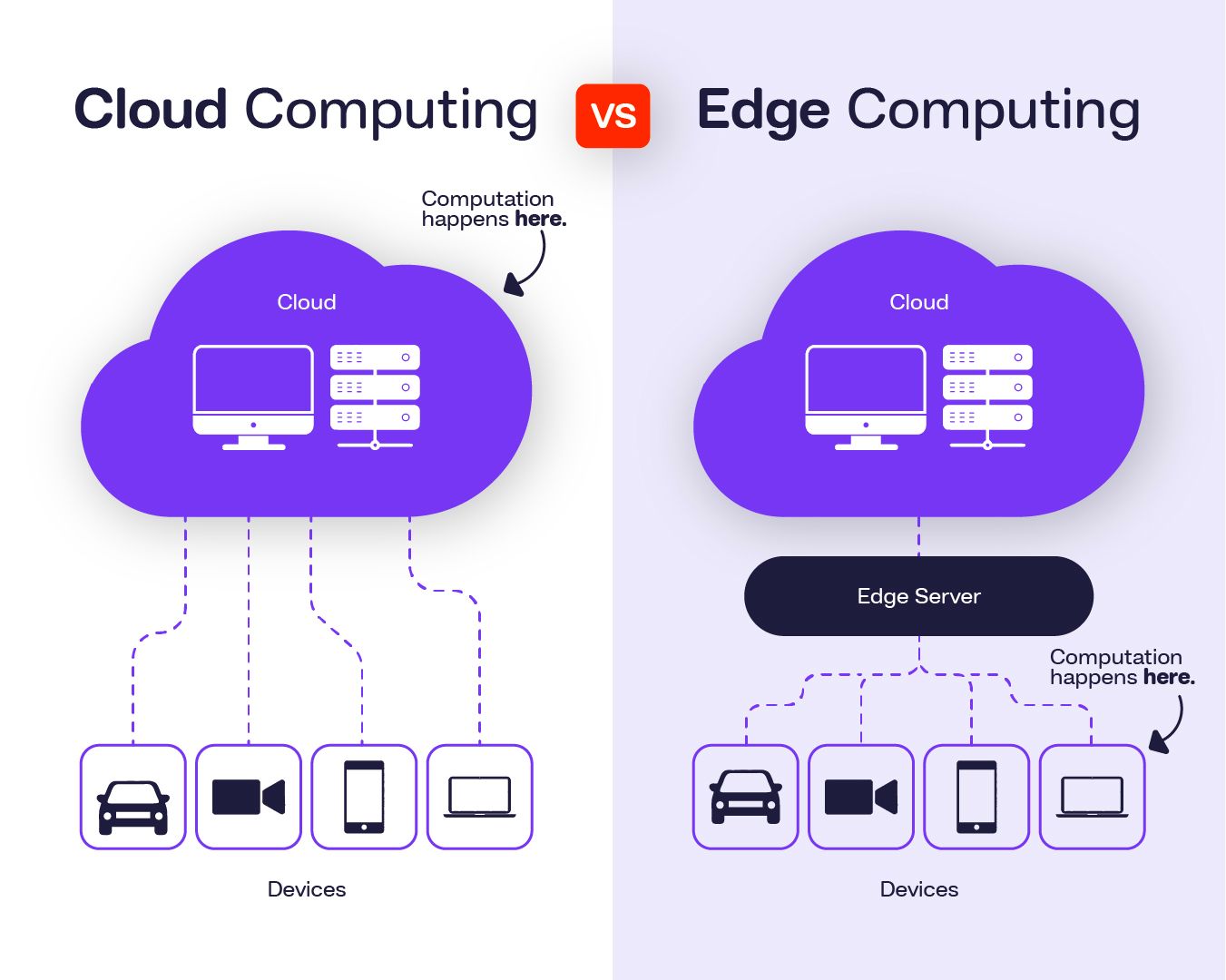
- Cloud computing is a general term for anything that involves delivering hosted services over the internet. It is the on-demand availability of computer system resources, especially data storage and computing power, without direct active management by the user. Large clouds often have functions distributed over multiple locations, each location being a data center.
- Edge Computing:
- Edge computing is a form of computing that is done on site or near a particular data source, minimizing the need for data to be processed in a remote data center.
- Edge computing can enable more effective city traffic management. Examples of this include optimising bus frequency given fluctuations in demand, managing the opening and closing of extra lanes, and, in future, managing autonomous car flows.
- An edge device is any piece of hardware that controls data flow at the boundary between two networks. Edge devices fulfill a variety of roles, depending on what type of device they are, but they essentially serve as network entry — or exit — points.
- There are five main types of edge computing devices: IoT sensors, smart cameras, uCPE equipment, servers and processors. IoT sensors, smart cameras and uCPE equipment will reside on the customer premises, whereas servers and processors will reside in an edge computing data centre.
- In service-based industries such as the finance and e-commerce sector, edge computing devices also have roles to play. In this case, a smart phone, laptop, or tablet becomes the edge computing device.
- Edge Devices:
- Edge devices encompass a broad range of device types, including sensors, actuators and other endpoints, as well as IoT gateways. Within a local area network (LAN), switches in the access layer — that is, those connecting end-user devices to the aggregation layer — are sometimes called edge switches.
- Hybrid Computing:
- A hybrid cloud integrates private, on-premises infrastructure with public cloud services, offering flexibility to distribute workloads between these environments. Hybrid models often incorporate edge computing, allowing organizations to run critical workloads locally at the edge while using the cloud for other tasks, thereby optimizing performance, cost, and data management for various business needs.
- HPC (Hight-Performance Computing):
- Practice of aggregating computing resources to gain performance greater than that of a single workstation, server, or computer. HPC can take the form of custom-built supercomputers or groups of individual computers called clusters.
- Data Centers:
- A data center is a facility that centralizes an organization’s shared IT operations and equipment for the purposes of storing, processing, and disseminating data and applications. Because they house an organization’s most critical and proprietary assets, data centers are vital to the continuity of daily operations.
- Hyperscale Data Centers:
- The clue is in the name: hyperscale data centers are massive facilities built by companies with vast data processing and storage needs. These firms may derive their income directly from the applications or websites the equipment supports, or sell technology management services to third parties.
- White Space and Grey Space in Data Centers:
- White space in a data center refers to the area where IT equipment is placed. It typically houses servers, storage, network gear, and racks.
- Gray space, on the other hand, is the area where the back-end infrastructure is located. This space is essential for supporting the IT equipment and includes areas for switchgear, UPS, transformers, chillers, and generators.
- Edge & Cloud Services:
- Edge services perform data processing on local devices and servers near the data source, reducing latency for time-sensitive operations, while cloud services centralize large computations and storage in remote datacenters, offering massive scalability and flexibility for general workloads.
- Most organizations use both, creating an “edge-to-cloud” architecture where edge devices handle immediate tasks, and the cloud manages large-scale data processing and complex applications, providing a seamless and efficient experience.
- Fundamental Units of Electricity:
- Ampere – Amp (A):
- Amperes measure the flow of electrical current (charge) through a circuit. Ampere (A) is the unit of measure for the rate of electron flow, or current, in an electrical conductor.
- One ampere is defined as one coulomb of electric charge moving past a point in one second. The ampere is named after the French physicist André-Marie Ampère, who made significant contributions to the study of electromagnetism.
- Milliampere (mA) is a unit of electric current equal to one-thousandth of an ampere (1mA=10−3A). The prefix “milli” signifies 10−3 in the metric system. This unit is commonly used to measure small currents in electronic circuits and consumer devices.
- Volts measure the force or potential difference that drives the flow of electrons through a circuit.
- Kilovolt (kV) is a unit of potential difference equal to 1,000 volts.
- Watts measure the rate of energy consumption or generation, also known as power.
- Amperes measure the flow of electrical current (charge) through a circuit. Ampere (A) is the unit of measure for the rate of electron flow, or current, in an electrical conductor.
- Power vs. Energy: how electricity is measured and billed.
- Power (measured in kW, MW, GW, TW): Rate at which energy is used or generated at a given moment.
- Energy (measured in kWh, MWh, GWh, TWh): Total amount of power consumed or generated over a period of time (i.e., Power x Time).
- Real Power Units: actual power that performs work.
- Kilowatt (KW):
- A kilowatt is simply a measure of how much power an electric appliance consumes—it’s 1,000 watts to be exact. You can quickly convert watts (W) to kilowatts (kW) by dividing your wattage by 1,000: 1,000W 1,000 = 1 kW.
- Megawatt (MW):
- One megawatt equals one million watts or 1,000 kilowatts, roughly enough electricity for the instantaneous demand of 750 homes at once.
- Gigawatt (GW):
- A gigawatt (GW) is a unit of power, and it is equal to one billion watts.
- According to the Department of Energy, generating one GW of power takes over three million solar panels or 310 utility-scale wind turbines
- Terawatt (TW):
- One terawatt is equal to one trillion watts (1,000,000,000,000 watts). The main use of terawatts is found in the electric power industry, particularly for measuring very large-scale power generation or consumption.
- According to the United States Energy Information Administration, America is one of the largest electricity consumers in the world, using about 4,146.2 terawatt-hours (TWh) of energy per year.
- Kilowatt (KW):
- Apparent Power Units: measures the total power in a circuit, including power that does not perform useful work.
- Kilovolt-Amperes (kVA):
- Kilovolt-Amperes (kVA) stands for Kilo-volt-amperes, a term used for the rating of an electrical circuit. A kVA is a unit of apparent power, which is the product of the circuit’s maximum voltage and current rating.
- The difference between real power (kW) and apparent power (kVA) is crucial. Real power (kW) is the actual power that performs work, while apparent power (kVA) is the total power delivered to a circuit, including the real power and the reactive power (kVAR) that doesn’t do useful work. The relationship between them is defined by the power factor. Since the power factor is typically less than 1, the kVA value will always be higher than the kW value.
- Megavolt-Amperes (MVA):
- Megavolt-Amperes (MVA) is a unit used to measure the apparent power in a circuit, primarily for very large electrical systems like power plants and substations. It’s a product of the voltage and current in a circuit.
- 1 MVA is equivalent to 1,000 kVA, or 1,000,000 volt-amperes.
- Kilovolt-Amperes (kVA):
- Specialized Power Units: used specifically for renewable energy, especially solar.
- KiloWatt ‘peak’ (KWp):
- kWp stands for kilowatt ‘peak’ power output of a system. It is most commonly applied to solar arrays. For example, a solar panel with a peak power of 3kWp which is working at its maximum capacity for one hour will produce 3kWh. kWp (kilowatt peak) is the total kw rating of the system, the theoretical ‘peak’ output of the system. e.g. If the system has 4 x 270 watt panels, then it is 4 x 0.27kWp = 1.08kWp.
- The Wp of each panel will allow you to calculate the surface area needed to reach it. 1 kWp corresponds theoretically to 1,000 kWh per year.
- KiloWatt ‘peak’ (KWp):
- Ampere – Amp (A):
- Digital Twin:
- Digital Twin is most commonly defined as a software representation of a physical asset, system or process designed to detect, prevent, predict, and optimize through real time analytics to deliver business value.
- A digital twin is a virtual representation of an object or system that spans its lifecycle, is updated from real-time data, and uses simulation, machine learning and reasoning to help decision-making.
- Power-to-X (or P2X or PtX):
- Power-to-X is an energy transformation technology that converts electricity into carbon-neutral synthetic fuels (gas or liquid) which can be stored and later used by the mobility, heating and electricity sectors.
- Power-to-X is essential in achieving a carbon neutral society that meets an increasing demand for energy. Through electrolysis and CO2 reutilisation, Power-to-X can unlock carbon neutral solutions that mitigate unavoidable emissions from industry, for instance by capturing concentrated CO2 streams from biomass-fired power plants or anaerobic digestion. It also offers a competitive option for energy storage.
- The term Power-to-X covers processes for converting renewably sourced electricity (power) to a substance or energy carrier (“X”). This can be in gaseous form such as hydrogen or methane (synthetic natural gas, Power-to-Gas), or it can be liquid synthetic fuels such as methanol, ammonia, synthetic diesel, or kerosene (Power-to-Liquid). Liquid fuels from Power-to-X are also often referred to as electrofuels or merely e-fuels.
- Biomass:
- Biomass is renewable organic material that comes from plants and animals. Biomass contains stored chemical energy from the sun that is produced by plants through photosynthesis.
- Biomass is a clean, renewable energy source. Its initial energy comes from the sun, and plants or algae biomass can regrow in a relatively short amount of time. Trees, crops, and municipal solid waste are consistently available and can be managed sustainably.
- Bioenergy:
- It is a form of renewable energy that is derived from recently living organic materials known as biomass, which can be used to produce transportation fuels, heat, electricity, and products.
- Bioenergy is renewable energy produced from organic matter (called “biomass”) such as plants, which contain energy from sunlight stored as chemical energy. Bioenergy producers can convert this energy into liquid transportation fuel—called “biofuel”—through a chemical conversion process at a biorefinery.
- Types of bioenergy include biogas, bioethanol, and biodiesel which may be sourced from plants (corn, sugarcane), wood, agricultural wastes, and bagasse. Bioenergy is considered renewable because its source is inexhaustible, as plants obtain their energy from the sun through photosynthesis which can be replenished.
- Biofuel:
- Any fuel that is derived from biomass—that is, plant or algae material or animal waste. Since such feedstock material can be replenished readily, biofuel is considered to be a source of renewable energy, unlike fossil fuels such as petroleum, coal, and natural gas.
- The two most common types of biofuels in use today are ethanol and biodiesel, both of which represent the first generation of biofuel technology.
- e-Fuels – Electrofuels:
- eFuels are produced with electricity from renewable sources, water and CO2 and are a sustainable alternative to fossil fuels.
- Electrofuels, also known as e-fuels or synthetic fuels, are a type of drop-in replacement fuel. They are manufactured using captured carbon dioxide or carbon monoxide, together with hydrogen obtained from sustainable electricity sources such as wind, solar and nuclear power.
- e-Methanol:
- eMethanol is also referred to as ‘green’ methanol because of the way in which it is produced: combining biogenic CO2 (put simply, CO2 created by burning biologically based materials, such as biomass) with hydrogen, created by water electrolysis.
- E-methanol is produced by combining green hydrogen and captured carbon dioxide from industrial sources. It still releases some greenhouse gases as it burns, but it emits less carbon dioxide, nitrogen oxides, sulfur oxide and particulate matter than conventional marine fuel.
- Methanol – CH3OH – is four parts hydrogen, one part oxygen and one part carbon. On an industrial scale, methanol is predominantly produced from natural gas by reforming the gas with steam and then converting and distilling the resulting synthesized gas mixture to create pure methanol.
- SAF (Sustainable Aviation Fuel):
- SAF stands for sustainable aviation fuel. It’s produced from sustainable feedstocks and is very similar in its chemistry to traditional fossil jet fuel. Using SAF results in a reduction in carbon emissions compared to the traditional jet fuel it replaces over the lifecycle of the fuel.
- SAF is made by blending conventional kerosene (fossil-based) with renewable hydrocarbon. They are certified as “Jet-A1” fuel and can be used without any technical modifications to aircraft.
- SAF prices are currently about five times higher than prices for conventional jet fuel, data on European spot market prices collected by OPIS show. OPIS is an IHS Markit unit. The disruption to the aviation industry as a result of the COVID-19 pandemic makes cost issues even more prominent today.
- Biocrude:
- Biocrude is a synthetic liquid fuel produced from biomass like wood, agricultural waste, or sewage sludge, using processes such as hydrothermal liquefaction (HTL) or pyrolysis. It is a viscous, dark brown liquid that can be upgraded and refined into fuels such as gasoline, diesel, and jet fuel, serving as a renewable alternative to petroleum.