Danfoss – Financial performance strengthening with record-high cash flow
Key highlights:
- Disciplined execution and implementation of new LEAP 2030 strategy delivering impact across all segments.
- Sales grew organically 3% to EUR 9.4 billion with -3% in H1 and 9% in the second half.
- Operational EBITA margin increased 0.4% points to 12.9%, with investments in innovation (R&D) increasing to 5.3% of sales.
- Cash flow reached a record-high level of EUR 734 million, up 57%.
- Scope 1 and 2 carbon emissions reduced by 33%.
- The 2026 sales outlook is in the range of EUR 9.1–10.6 billion, and operational EBITA margin is expected to be in the range of 12.8–14.3%.
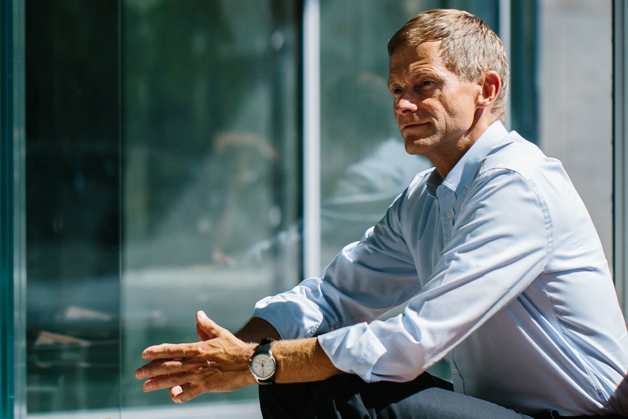
In 2025, we improved our financial performance quarter-by-quarter, delivering record-high cash flow. I’m proud of the disciplined execution demonstrated by our global teams in this volatile environment. I’m also pleased with how our new LEAP 2030 strategy and our decentralized operating model are already showing impact. Our achievements and our resilience in 2025 are the result of the continued dedication of our highly engaged global teams.
Kim Fausing
President and CEO, Danfoss
Throughout 2025, our growth momentum improved significantly and we delivered growth in the second half of 9%. Total sales reached EUR 9.4 billion and grew 3% organically. Our total sales were negatively impacted by a weakening US dollar rate, with an impact of -3%, while our regionalized manufacturing footprint ensured a limited impact on our EBITA margin. Operational EBITA margin also continued to improve throughout the year, increasing 0.4% points to 12.9%. Operational EBITA amounted to EUR 1,213 million. Cash flow amounted to a record-high EUR 734 million and together with a strong balance sheet, we are well positioned to continue investing in our business, supporting growth both organically and inorganically.
Our performance in Asia improved throughout the year, driven by China which saw 13% sales growth. The signs of recovery in Europe remained less pronounced, ending the year with -2% growth. In North America, Danfoss Climate Solutions delivered 26% organic growth, driven by strong data center demand. Danfoss Power Solutions also experienced strong demand from data centers in North America, but this was offset by the negative impact from the downturn in the agricultural market, resulting in a negative sales growth of 2% in Danfoss Power Solutions.
Across our segments, Danfoss Climate Solutions delivered a strong and resilient performance, supported by the demand for energy efficiency, electrification, and data center solutions. In our Danfoss Power Electronics and Drives segment, we delivered a robust performance, driven particularly by our Drives business. Danfoss Power Solutions returned to growth in the second half also driven by data centers, yet was negatively impacted by low demand in agriculture.
In 2025, we continued to scale our data center business, growing and partnering with hyperscalers, co-locaters, and chip suppliers across our regions. Global data center sales reached approximately 7% of our total sales, almost doubling year-on-year. Our innovative and sustainable technologies for both air and liquid-cooled data centers remain one of our high-growth opportunities across our three business segments.
“With a strong balance sheet and record-high cash flow, we are well positioned to continue investing in our business, driving organic growth and M&A. Global megatrends continue to create significant opportunities for Danfoss, and we have never been more relevant with our broad product offering and global presence. We continue to strengthen our customer partnerships and are well positioned for the future. As we have entered 2026, I feel both confident and energized by the engagement I have seen across Danfoss,” says Kim Fausing.
Leading with the broadest portfolio
We invest to deliver the broadest portfolio of innovative, sustainable, and competitive technologies and solutions in the industries we serve and focus on strengthening our leading positions in our three business segments. In line with our LEAP 2030 strategy, our R&D investments increased to 5.3% of sales.
In 2025, our Danfoss Power Solutions segment acquired hose fittings manufacturer Hydro Holding, strengthening our leading position in fluid conveyance for mobile and industrial hydraulics as well as data centers. In Danfoss Power Electronics and Drives and as part of our active portfolio management, we have taken steps to find the best future owner of the Automotive Electrification business. As a consequence, this business is reclassified as discontinued operations in our financial statements.
Strengthening our regional footprint
With a CapEx of EUR 342 million, we further expanded our global factory footprint across the Americas, Europe, and Asia to better serve customers locally, increase competitiveness, and strengthen resilience. We also continued to expand capacity in our Application Development Centers (ADCs) and laboratories. This is where customers experience our technologies within their own applications.
Strong digital backbone in place
We continued to realize the benefits of our significant investment in our digital infrastructure, clean data, and automated processes. We can now apply AI seamlessly where it creates real value – enhancing speed and accuracy to improve the customer experience and productivity. Today, 75% of all customer orders are received and handled digitally with significant additional potential by deploying AI.
Sustainability as a driver of competitiveness
Sustainability is embedded in our LEAP 2030 strategy as this is an integrated part of our value proposition. In 2025, five years ahead of plan, we achieved our former SBTi-validated target to reduce our own emissions (scope 1 and 2) by 46.2% by 2030, demonstrating the effectiveness of our decarbonization initiatives. In 2025 alone, we reduced our own emissions by 33%. We reaffirmed our commitment to decarbonization with an updated near-term SBTi-validated target and a new long-term SBTi-validated target, to achieve net-zero across the value chain by 2050. We also improved our ratings scores with EcoVadis and CDP.
Outlook 2026
Danfoss has a continued ambition to expand or maintain our market share. Sales are expected to be in the range of EUR 9.1-10.6b for the full year. The operational EBITA margin is expected to be in the range of 12.8-14.3%, following our continued investments in new products and solutions. We remain committed to our ambitious target to competitively decarbonize our global operations by 2030.
Key figures from 2025:
- Sales reached EUR 9,430m (2024: 9,496m) with an organic growth of 3%.
- Investments in innovation (R&D) increased to EUR 503m (2024: 476m), corresponding to 5.3% of sales (2024: 5.0%).
- Operational EBITA reached EUR 1,213m (2024: 1,185m), leading to an operational EBITA margin of 12.9% (2024: 12.5%), an increase of 0.4% points.
- Net profit reached EUR 446m (2024: 370m), an increase of 21%.
- Investments (CapEx) excluding M&A were EUR 342m (2024: 362m), amounting to 3.6% of sales.
- Free operating cash flow after financial items and tax (before M&A) amounted to EUR 734m (2024: 467m), an increase of 57%.
Annual Report 2025
Explore our integrated annual report for a holistic view of our financial and sustainability performance and progress, strategy, and governance.
Download the Annual Report 2025
SourceDanfoss
EMR Analysis
More information on Danfoss: See the full profile on EMR Executive Services
More information on Kim Fausing (President and Chief Executive Officer, Danfoss): See the full profile on EMR Executive Services
More information on Jesper V. Christensen (Executive Vice President & Chief Financial Officer, Danfoss): See the full profile on EMR Executive Services
More information on LEAP 2030 by Danfoss: See the full profile on EMR Executive Services
More information on Danfoss Power Solutions: See the full profile on EMR Executive Services
More information on Daniel Winter (Member of the Group Executive Team (GET), President, Danfoss Power Solutions, Danfoss): See the full profile on EMR Executive Services
More information on Danfoss Fluid Conveyance Division by Danfoss Power Solutions by Danfoss: See the full profile on EMR Executive Services + Danfoss Power Solutions’ Fluid Conveyance division manufactures hoses and fittings for mobile and industrial equipment, vehicles, aircraft, mining, food and beverage, and other applications. Product ranges include hydraulic, industrial, thermoplastic, engine, and air conditioning hoses and fittings; connectors and quick-disconnect couplings; and hose machines, tools, and accessories. The division’s annual sales reached EUR 1.2 billion in 2024. With the addition of Hydro Holding’s 350 employees, Fluid Conveyance will have approximately 6,500 employees.
More information on Domenico Traverso (President Incubation Division, Danfoss Power Solutions, Danfoss + President, Fluid Conveyance Division, Danfoss Power Solutions, Danfoss): See the full profile on EMR Executive Services
More information on Hydro Holding Spa by Hydro Business Unit by Fluid Conveyance Division by Danfoss Power Solutions: https://www.hydro-holding.com/ + Born in 2015, Hydro Holding boasts a group of extremely experienced Italian companies, all specializing in the manufacturing of high-quality hydraulic fittings and cold-formed ferrules.
In 2021, Hydro Holding proudly expanded its family by acquiring TIEFFE, MC.S. Hydraulics, and F.B. Hydraulic, further strengthening its position as the largest independent manufacturer of hose fittings in Europe.
Hydro Holding offers a unique selling proposition:
- Co-Engineering: HH enjoys a comprehensive product offering (>16,000 SKUs) mainly for agriculture, construction, mining, and industrial equipment. Holding the technical know-how to design and manufacture bespoke products allows HH to meet all of its customers’ needs and requests.
- Reliability: The capability to supply products that fully respect technical specifications with close-to-zero defects; a trustful and fair commercial approach; and a longstanding presence in the market.
Hydro Holding continues to set the standard in innovation, quality, and customer service across the hydraulic fittings industry.
More information on Stefano Bordegnoni (Vice President, Hydro Business Unit, Fluid Conveyance Division, Danfoss Power Solutions, Danfoss): See the full profile on EMR Executive Services
More information on Danfoss Climate Solutions by Danfoss: See the full profile on EMR Executive Services
More information on Kristian Strand (Member of the Group Executive Team (GET), President, Danfoss Climate Solutions, Danfoss): See the full profile on EMR Executive Services
More information on Danfoss Power Electronics and Drives by Danfoss: See the full profile on EMR Executive Services
More information on Mika Kulju (Member of the Group Executive Team, President Danfoss Power Electronics and Drives, Danfoss + Chairman of the Board, Semikron Danfoss, Danfoss): See the full profile on EMR Executive Services
More information on the Sustainable Strategy, Goals, ESG Reporting 2024 and Climate Transition Plan 2025 by Danfoss: See the full profile on EMR Executive Services
More information on Thomas M. Auerbach (Chief Sustainability Officer & Head of Danfoss Finance Functions, Danfoss): See the full profile on EMR Executive Services
More information on Kitti Tumbász (Senior Director, Head of Group Sustainability, Danfoss): See the full profile on EMR Executive Services
More information on The Science Based Targets initiative (SBTi): https://sciencebasedtargets.org/ + The Science Based Targets initiative (SBTi) is a global body enabling businesses to set ambitious emissions reductions targets in line with the latest climate science. It is focused on accelerating companies across the world to halve emissions before 2030 and achieve net-zero emissions before 2050.
There are two main types of science-based targets: near-term and net-zero. Near-term targets aim to address emissions reductions over the next 5-10 years, whereas net-zero targets include reductions of 90% or more no later than 2050.
The initiative is a collaboration between CDP, the United Nations Global Compact, World Resources Institute (WRI) and the World Wide Fund for Nature (WWF) and one of the We Mean Business Coalition commitments. The SBTi defines and promotes best practice in science-based target setting, offers resources and guidance to reduce barriers to adoption, and independently assesses and approves companies’ targets.
- Defines and promotes best practices in emissions reductions and net-zero targets in line with climate science.
- Provides target setting methods and guidance to companies to set science-based targets in line with the latest climate science.
- Includes a team of experts to provide companies with independent assessment and validation of targets.
- Serves as the lead partner of the Business Ambition for 1.5°C campaign, an urgent call to action from a global coalition of UN agencies, business and industry leaders that mobilizes companies to set net-zero science-based targets in line with a 1.5 degrees C future.
More information on David Kennedy (Chief Executive Officer, SBTi): https://sciencebasedtargets.org/about-us/the-team + https://www.linkedin.com/in/david-kennedy-1000a3262/
More information on Net Zero by 2050 by the United Nations: https://www.un.org/en/climatechange/net-zero-coalition + Put simply, net zero means cutting greenhouse gas emissions to as close to zero as possible, with any remaining emissions re-absorbed from the atmosphere, by oceans and forests for instance.
Currently, the Earth is already about 1.1°C warmer than it was in the late 1800s, and emissions continue to rise. To keep global warming to no more than 1.5°C – as called for in the Paris Agreement – emissions need to be reduced by 45% by 2030 and reach net zero by 2050.
More than 140 countries, including the biggest polluters – China, the United States, India and the European Union – have set a net-zero target, covering about 88% of global emissions. More than 9,000 companies, over 1000 cities, more than 1000 educational institutions, and over 600 financial institutions have joined the Race to Zero, pledging to take rigorous, immediate action to halve global emissions by 2030.
More information on Net Zero by 2050 by the Science Based Targets initiative (SBTi): https://sciencebasedtargets.org/net-zero + The SBTi’s Corporate Net-Zero Standard is the world’s only framework for corporate net-zero target setting in line with climate science. It includes the guidance, criteria, and recommendations companies need to set science-based net-zero targets consistent with limiting global temperature rise to 1.5°C.
UN vs. SBTi:
- UN targets nations, while SBTi focuses on companies. UN sets a broad goal, while SBTI provides a detailed framework for target setting.
- Both aim to achieve net zero emissions and limit warming to 1.5°C. The UN sets the overall direction, and SBTi helps businesses translate that goal into actionable plans.
Key components of the Corporate Net-Zero Standard:
- Near-term targets: Rapid, deep cuts to direct and indirect value-chain emissions must be the overarching priority for companies. Companies must set near-term science-based targets to roughly halve emission before 2030. This is the most effective, scientifically-sound way of limiting global temperature rise to 1.5°C.
- Long-term targets: Companies must set long-term science-based targets. Companies must cut all possible – usually more than 90% – of emissions before 2050.
- Neutralize residual emissions: After a company has achieved its long-term target and cut emissions by more than 90%, it must use permanent carbon removal and storage to counterbalance the final 10% or more of residual emissions that cannot be eliminated. A company is only considered to have reached net-zero when it has achieved its long-term science-based target and neutralized any residual emissions.
- Beyond Value Chain Mitigation (BVCM): Businesses should invest now in actions to reduce and remove emissions outside of their value chains in addition to near- and long-term science-based targets.
More information on EcoVadis: https://ecovadis.com + The World’s Most Trusted Business Sustainability Ratings.
Since its founding in 2007, EcoVadis has grown to become the world’s largest and most trusted provider of business sustainability ratings, creating a global network of more than 150,000+ rated companies.
Our team is composed of over 1900 highly-talented professionals from 80 nationalities.
The EcoVadis sustainability assessment methodology is at the heart of our Ratings and Scorecards and is an evaluation of how well a company has integrated the principles of Sustainability/CSR into their business and management system.
The EcoVadis sustainability assessment methodology is at the heart of our Ratings and Scorecards and is an evaluation of how well a company has integrated the principles of Sustainability/CSR into their business and management system.
Our methodology is built on international sustainability standards, including the Global Reporting Initiative, the United Nations Global Compact, and the ISO 26000, covering 250+ spend categories and 185+ countries. The Sustainability Scorecard illustrates performance across 21 indicators in four themes: Environment, Labor & Human Rights, Ethics and Sustainable Procurement.
EcoVadis medals are awarded to the top 35% of companies assessed by EcoVadis:
Medals are awarded based on the percentile rank of a company which is calculated at the time of scorecard publication. It compares a company’s performance with all rated companies in our database over the previous 12 months. The percentile rank is calculated across all companies in all industries, not per industry.
- Platinum – Top 1% (99+ percentile)
- Gold – Top 5% (95+ percentile)
- Silver – Top 15% (85+ percentile)
- Bronze – Top 35% (65+ percentile)
To be eligible for a medal, a company must achieve a minimum score of 30 in each of the four themes:
- Environment
- Ethics
- Labor & Human Rights
- Sustainable Procurement
More information on Pierre-François Thaler (Co-Founder & Co-Chief Executive Officer, EcoVadis + Co-Founder & Co-Chief Executive Officer, CyberVadis): https://ecovadis.com/leadership/ + https://www.linkedin.com/in/pfthaler/
More information on Frédéric Trinel (Co-Founder & Co-Chief Executive Officer, EcoVadis): https://ecovadis.com/leadership/
More information on the Carbon Disclosure Project (CDP): https://www.cdp.net/en + CDP is a global non-profit that runs the world’s only independent environmental disclosure system for companies, capital markets, cities, states and regions to manage their environmental impacts.
Founded in 2000, CDP was the first organization to leverage investor pressure to influence corporate disclosure on environmental impact. Now with the world’s largest, most comprehensive dataset on environmental action, the insights that CDP holds empower investors, companies, cities, and national and regional governments to make Earth-positive decisions.
As the founder of environmental reporting, we believe in transparency and the power of data to drive change. Partnering with leaders in enterprise, capital, policy and science, we surface the information needed to enable Earth-positive decisions.
We helped more than 22,100 companies and almost 1,000 cities, states and regions disclose their environmental impacts in 2024. Financial institutions with more than a quarter of the world’s institutional assets use CDP data to help inform investment and lending decisions. Aligned with the ISSB’s climate standard, IFRS S2, as its foundational baseline, CDP integrates best-practice reporting standards and frameworks in one place. Our team is truly global, united by our shared desire to build a world where people, planet and profit are truly balanced
Disclosers are evaluated across four scoring levels, representing stages of environmental maturity:
- Disclosure (D/D–): Measures the completeness of a company’s reporting. The number of points allocated to each question depends on both the amount of data requested and their relative importance to data users.
- Awareness (C/C–): Reflects the understanding of how environmental issues relate to the company’s activities and impacts. This level indicates awareness but not yet action.
- Management (B/B–): Recognizes evidence of action and processes to manage environmental issues, showing that the company is moving from understanding to implementation.
- Leadership (A/A–): Represents best practice performance, where the Discloser demonstrates environmental leadership through ambitious strategies, verified progress, and sector-leading action.
More information on Paul Dickinson (Founder Chair, Carbon Disclosure Project (CDP) + Co-Founder, Transition Value Partners (TVP)): https://www.transition-value.com/about + https://www.linkedin.com/in/paul-dickinson-0093a8/
More information on Sherry Madera (Chief Executive Officer, Carbon Disclosure Project (CDP)): https://www.cdp.net/en/about/team + https://www.linkedin.com/in/sherrymadera/
EMR Additional Financial Notes:
- Major financial KPI’s since 2017 are available on EMR Executive Services under “Financial Results” and comparison with peers under “Market Positioning”
- Companies’ full profile on EMR Executive Services are based on their official press releases, quarterly financial reports, annual reports and other official documents.
- All members of the Executive Committee and of the Board have their full profile on EMR Executive Services
- The Danfoss Annual Report 2025 can be found here: https://assets.danfoss.com/documents/latest/579092/AH553954278717en-000101.pdf
- The Danfoss Annual Report 2024 can be found here: https://assets.danfoss.com/documents/latest/467423/AH516931434208en-000201.pdf
- The Danfoss Annual Report 2023 can be found here: https://files.danfoss.com/download/CorporateCommunication/Financial/Annual-Report-2023.pdf
- The Danfoss Annual Report 2022 can be found here: https://www.danfoss.com/annual-report-2022/
- The Danfoss 2022 year in Review can be found here: https://www.danfoss.com/en/about-danfoss/company/financial-information/