
Siemens – Siemens unveils technologies to accelerate the industrial AI revolution at CES 2026
- Siemens and NVIDIA expand their partnership to build the Industrial AI Operating System, reinventing the entire end-to-end industrial value chain through AI – from design and engineering to manufacturing, production, operations, and into supply chains.
- Siemens launches Digital Twin Composer software, available on Siemens Xcelerator Marketplace mid-2026, to power the industrial metaverse at scale
- PepsiCo using Siemens Digital Twin Composer to simulate upgrades to its facilities in the U.S. with plans to scale globally
- Siemens unveils nine industrial copilots to bring intelligence across the industrial value chain
- Siemens highlights new technologies for accelerating drug discovery, autonomous driving and shop floor efficiency
- Siemens brings industrial AI to Meta Ray-Ban AI Glasses
At CES 2026, Siemens’ keynote marked a new era of technology for industry and infrastructure, showcasing how customers and partners are harnessing artificial intelligence to transform their businesses. With AI-enabled technologies, deep domain expertise, and trusted partnerships, Siemens is converting this technological leap into measurable benefits for customers, partners, and society.

CES 2026: “Industrial AI is no longer a feature; it’s a force that will reshape the next century. Siemens is delivering AI-native capabilities, intelligence embedded end-to-end across design, engineering and operations, to help our customers anticipate issues, accelerate innovation and reduce cost,” said Roland Busch, President and CEO of Siemens AG.
“Just as electricity once revolutionized the world, industry is shifting toward elements where AI powers products, factories, buildings, grids and transportation. Industrial AI is no longer a feature; it’s a force that will reshape the next century. Siemens is delivering AI-native capabilities, intelligence embedded end-to-end across design, engineering and operations, to help our customers anticipate issues, accelerate innovation and reduce cost,” said Roland Busch, President and CEO of Siemens AG. “From the most comprehensive digital twin and AI-powered hardware to copilots on the shop floor, we’re scaling intelligence across the physical world, so businesses realize speed, quality and efficiency all at once. This is how we scale a once-in-a-generation technology shift into measurable outcomes.”
Siemens highlighted its long-standing partnership with NVIDIA at CES 2026: The companies are expanding their partnership to build the Industrial AI Operating System – helping customers revolutionize how they design, engineer, and operate physical systems. Siemens and NVIDIA will work together to build AI-accelerated industrial solutions across the full lifecycle of products and production, enabling faster innovation, continuous optimization, and more resilient, sustainable manufacturing. The companies also aim to build the world’s first fully AI-driven, adaptive manufacturing sites globally, starting in 2026 with the Siemens Electronics Factory in Erlangen, Germany, as the first blueprint.
To support development, NVIDIA will provide AI infrastructure, simulation libraries, models, frameworks and blueprints, while Siemens will commit hundreds of industrial AI experts and leading hardware and software. The companies have identified impact areas to make this vision a reality: AI-native EDA, AI-native Simulation, AI-driven adaptive manufacturing and supply chain, and AI-factories.
Siemens also announced that it will be integrating NVIDIA NIM and NVIDIA Nemotron open AI models into its electronic design automation (EDA) software offerings to advance generative and agentic workflows for semiconductor and PCB design. This will both maximize accuracy through domain specialization and significantly lower operational costs by enabling the most efficient model to handle and adapt to every specific need.
“Generative AI and accelerated computing have ignited a new industrial revolution, transforming digital twins from passive simulations into the active intelligence of the physical world,” said Jensen Huang, founder and CEO of NVIDIA. “Our partnership with Siemens fuses the world’s leading industrial software with NVIDIA’s full-stack AI platform to close the gap between ideas and reality — empowering industries to simulate complex systems in software, then seamlessly automate and operate them in the physical world.”
New Technology Connects Digital Twin with Real-Time, Real-World Data
Siemens’ primary product launch at CES 2026 is the Digital Twin Composer, available on the Siemens Xcelerator Marketplace mid-2026. This new technology brings together Siemens’ comprehensive digital twin, simulations built using NVIDIA Omniverse libraries, and real-time, real-world engineering data.
With the Digital Twin Composer, companies can create a virtual 3D model of any product, process, or plant; put it in a 3D scene of their choosing; then move back and forth through time, precisely visualizing the effects of everything from weather changes to engineering changes. With Siemens’ software as the data backbone, the Digital Twin Composer builds Industrial Metaverse environments at scale, empowering organizations to apply industrial AI, simulation and real-time physical data to make decisions virtually, at speed and scale. Digital Twin Composer is part of Siemens Xcelerator, an industry proven portfolio of software used by companies worldwide to develop digital twins.
PepsiCo and Siemens are digitally transforming select U.S. manufacturing and warehouse facilities by converting them into high-fidelity 3D digital twins that simulate plant operations and the end-to-end supply chain to establish a performance baseline. Within weeks, teams optimized and validated new configurations to boost capacity and throughput, giving PepsiCo a unified, real-time view of operations with flexibility to integrate AI-driven capabilities over time.
Leveraging Siemens’ Digital Twin Composer, NVIDIA Omniverse libraries and computer vision, PepsiCo can now recreate every machine, conveyor, pallet route and operator path with physics-level accuracy, enabling AI agents to simulate, test, and refine system changes – identifying up to 90 percent of potential issues before any physical modifications occur. This approach has already delivered a 20 percent increase in throughput on initial deployment and is driving faster design cycles, nearly 100 percent design validation and 10 to 15 percent reductions in capital expenditure (Capex) by uncovering hidden capacity and validating investments in a virtual environment.
New Industrial Copilots Streamline Manufacturing Operations
Siemens also spotlighted its partnership with Microsoft, in a conversation with Jay Parikh, executive vice president for CoreAI at Microsoft. Together, Siemens and Microsoft are bridging the worlds of IT and operations, with a collaboration centered on using AI to help organizations across industries improve productivity, resilience, and innovation. Among the highlights: co-building the award-winning industrial copilot.
Siemens also announced that it is expanding its set of AI-powered copilots across the industrial value chain. This will embed intelligence that extends from design and simulation to product lifecycle management, manufacturing, and operations.
Siemens will deploy nine new AI-powered copilots for its software offerings, this will include Teamcenter, Polarion, and Opcenter. These copilots, respectively, streamline product data navigation, reducing errors and accelerating time to market; automate compliance, helping to ensure faster regulatory approvals and lower risk; and transform manufacturing processes, driving cost savings and operational efficiency.
These copilots, along with the rest of Siemens’ expanding portfolio of industrial AI solutions, are available to companies of every size on the Siemens Xcelerator Marketplace.
AI-Driven Innovations in Life Sciences, Energy and Manufacturing
In life sciences, the acquisition of Dotmatics has enabled the integration of vast research data in AI solutions of Siemens, fueling drug discovery and development. With Dotmatics’ Luma platform, scientists can unify billions of data points generated across instruments and labs, creating a coherent foundation for AI-driven exploration. Combined with Siemens Simcenter simulation and digital twins, teams can rapidly test molecules, identify promising candidates, and virtually scale production to help life-changing therapies reach patients up to 50% faster and at a lower cost.
In energy, Bob Mumgaard, CEO and co-founder of Commonwealth Fusion Systems, described how the company uses Siemens’ technologies as it leads the path to commercial fusion. Commonwealth Fusion Systems uses design software and a strong data backbone to help it accelerate the development of fusion machines that promise clean, limitless energy for generations to come.
n manufacturing, Siemens announced a collaboration to bring Industrial AI to Meta Ray-Ban AI Glasses. With hands-free, real-time audio guidance, safety insights, and feedback, shop floor workers will feel empowered to solve problems efficiently and confidently.
Technology to Transform the Everyday for Everyone
At the Siemens booth in the North Hall of the Las Vegas Convention Center, Siemens is showcasing how its technology transforms the everyday, for everyone. Featured solutions from Siemens and its customers that bring together design, simulation, automation, AI, and digital twin technology:
- PepsiCo is modernizing its global operations to meet evolving customer demands with greater speed and flexibility. With Siemens, the company is digitalizing manufacturing and warehousing processes, enabling faster innovation, more agile production, and smarter decision-making across its supply chain.
- Commonwealth Fusion Systems is pioneering the future of clean energy with commercial fusion. Faced with the challenges of building an entirely new industry, CFS partnered with Siemens to build a comprehensive data backbone and to accelerate the design and manufacturing of this clean, safe, and nearly limitless energy source.
- Haddy is reshaping manufacturing through AI-powered 3D printing and localized micro factories that deliver sustainable, high-quality products faster and closer to customers. Facing challenges around supply chain disruption, sustainability, and production agility, Haddy partnered with Siemens to streamline design, optimize operations, and scale efficiently.
Siemens is also revolutionizing how industrial automation is experienced with the launch of its eXplore tour mobile experience in North Hall. Housed in an 18-wheel vehicle, the eXplore tour delivers an interactive experience that highlights how Siemens technologies converge to drive continuous operational optimization and unlock new levels of efficiency. After CES, the eXplore tour will continue across the U.S. with stops including Realize LIVE in Detroit and Automate in Chicago.
Siemens is also livestreaming from a broadcast studio in North Hall, presented in collaboration with AWS. The broadcast studio will feature conversations with the industry leaders who are shaping the future of industrial AI – including Peter Koerte, Member of the Managing Board, Chief Technology Officer and Chief Strategy Officer at Siemens. The livestream will be broadcast on Siemens’ LinkedIn and YouTube channels.
For the first time, Siemens is hosting its autonomous vehicle experience located at West Hall 4352. The experience will feature Siemens’ new PAVE360 Automotive technology, a system-level digital twin, to accelerate the development of software-defined vehicles. It will demonstrate how this new technology works, with a real vehicle on site, operating autonomously in a completely virtual environment.
Livestream and afterwards a recording of Siemens’ 2026 keynote is available at https://sie.ag/qhKPT
For more information about Siemens’ presence at CES 2026, please visit: https://sie.ag/3r269N; press images will also be available here after the keynote.
SourceSiemens
EMR Analysis
More information on Siemens AG: See full profile on EMR Executive Services
More information on Dr. Roland Busch (President and Chief Executive Officer, Siemens AG): See full profile on EMR Executive Services
More information on Dr. Peter Körte (Member of the Managing Board and Chief Technology and Chief Strategy Officer with responsibility for Siemens Xcelerator and Siemens Advanta, Siemens AG): See the full profile on EMR Executive Services
More information on Digital Twin Composer by Siemens AG: https://news.siemens.com/en-us/digital-twin-composer-ces-2026/ + Digital Twin Composer, a new software solution that builds Industrial Metaverse environments at scale, empowering organizations to apply industrial AI, simulation and real-time physical data to make decisions virtually, at speed and at scale.
Digital Twin Composer enables industrial companies to combine 2D and 3D digital twin data from Siemens’ comprehensive digital twin with physical real-time information in a managed, secure real-time photorealistic visual scene, built using NVIDIA Omniverse libraries. With Digital Twin Composer, companies can rapidly build and maintain this global environment, containing all aspects of their product or production data (both virtual and physical) in a secure, managed high-fidelity 3D experience, throughout the lifecycle of the product, process or facility.
Digital Twin Composer provides contextualized, real-time insights and intelligence enabling companies to visualize, interact with and iterate on any product, process or factory in its real-world context before physical design or construction – whether it’s a new smartphone, a tanker in a shipyard, an autonomous electric vehicle, or a new AI factory on a greenfield or brownfield site.
More information on Xcelerator by Siemens: https://www.sw.siemens.com/en-US/digital-transformation/ + Xcelerator provides the engineering and manufacturing software, services and application development platform to blur the boundaries between industry domains. Companies can use this technology today to build the products of tomorrow. Turn complexity into your competitive advantage with Xcelerator.
Siemens Xcelerator consists of three pillars:
- Portfolio: A curated, modular portfolio of IOT-enabled hardware and software based on standard application programming interfaces, facilitating the integration of information technology (IT) and operational technology (OT).
- Ecosystem: A growing ecosystem of partners.
- Marketplace: Interactions and transactions among customers, partners and developers.
More information on Xcelerator Marketplace by Siemens: https://marketplace.siemens.com/global/en.html + Siemens Xcelerator is an open digital business platform that enables customers to accelerate their digital transformation easier, faster and at scale. Access a curated portfolio of connected hardware and software, a powerful ecosystem of partners, and an extensive marketplace.
More information on Industrial Copilot by Siemens: https://www.siemens.com/global/en/products/automation/topic-areas/industrial-ai/industrial-copilot.html + Generative AI is gaining momentum across industries. With our vision of Industrial Copilots along the entire value chain, we want to unlock this potential to improve human-machine collaboration and accelerate development and innovation cycles. Together with our partners, we make generative AI a reality for our customers on a broad scale. For more sustainable operations and a better tomorrow!
We integrate generative AI into Siemens Industrial Copilots to optimize workflows and enhance human-AI collaboration, driving innovation and productivity across industries. With a comprehensive suite of Industrial Copilots, we offer not just a single solution but cover the entire industrial value chain – from design and planning to engineering, operations, and service. User-friendly and easy to implement, our solutions make generative AI accessible and streamline every phase efficiently.
More information on Teamcenter by Siemens: https://plm.sw.siemens.com/en-US/teamcenter/ + Plan, develop and deliver innovative products with Teamcenter software. Discover why Teamcenter is a leading choice in product lifecycle management (PLM).
- Plan: Set the strategic direction and product definition to guide downstream decisions.
- Develop: Design and document the multi-discipline product to leverage the digital twin.
- Deliver: Weave the digital thread to connect product development with manufacturing, service and suppliers.
More information on Polarion™ by Siemens: https://polarion.plm.automation.siemens.com/ + Everything you need to achieve agility and have full control over your cyber-physical systems application lifecycle.
Since Polarion’s inception in 2004, our mission has been to help companies advance the development, governance and maintenance of software via a unified solution for Requirements, Quality, and Application Lifecycle Management.
More information on Opcenter™ by Siemens: https://plm.sw.siemens.com/en-US/opcenter/ + Manufacturing operations management.
Opcenter is a unified manufacturing operations management (MOM) solutions portfolio, enabling digital software operations management.
More information on Dotmatics by Siemens AG: https://www.dotmatics.com/ + Harmonizing Science & Data to Create a Better Future, Together.
From developing new personalized and preventive patient treatment solutions to revising climate change – Dotmatics solutions are at the core of scientific innovation.
Dotmatics is a leader in R&D scientific software connecting science, data, and decision-making. Its enterprise R&D platform and applications, including GraphPad Prism, SnapGene and Geneious, drive efficiency and accelerate innovation. More than 2 million scientists and 14,000 customers trust Dotmatics to help them create a healthier, cleaner, safer world. Dotmatics is a global team of more than 800 people dedicated to supporting its customers in over 180 countries. The company is headquartered in Boston, with 14 offices and R&D teams located around the world.
More information on Thomas Swalla (Chief Executive Officer, Dotmatics, Siemens AG): See full profile on EMR Executive Services
More information on Simcenter™ by Siemens: https://plm.sw.siemens.com/en-US/simcenter/ + Simcenter simulation and test solutions. Create a more sustainable future. Join the engineers developing the best possible products using the powerful predictive simulation and test applications of Simcenter. By combining advanced engineering tools with industry expertise and dedicated support, we empower innovators.
More information on PAVE360 by Siemens: https://eda.sw.siemens.com/en-US/pave360/ + PAVE360 puts a virtual car on every engineer’s desk. Start earlier and develop faster with hardware and software co-design. Use the PAVE360 digital twin solution to truly realize the software-defined vehicle (SDV) and enhance every stage of the development cycle.
PAVE360 Automotive is a pre-integrated, system-level digital twin for ADAS/AD and IVI. This “SDV Blueprint” provides the reference virtual hardware and software that you need to deploy your digital twin on day one.
More information on Consumer Technology Association (CTA): https://www.cta.tech/ + As North America’s largest technology trade association, the Consumer Technology Association (CTA)® is the tech sector. Our members are the world’s leading innovators – from startups to global brands – helping support more than 18 million American jobs. CTA owns and produces CES® – the most powerful tech event in the world.
More information on Gary Shapiro (Chief Executive Officer and Vice Chair, Consumer Technology Association (CTA)): https://www.cta.tech/about/thought-leaders/ + https://www.linkedin.com/in/gary-shapiro/
More information on Kinsey Fabrizio (President, Consumer Technology Association (CTA)): https://www.cta.tech/about/thought-leaders/ + https://www.linkedin.com/in/kinsey-fabrizio/
More information on CES 2026 (January 6-9, 2026 – Las Vegas, NV, United States) by CTA: https://www.ces.tech/ + CES is owned and produced by the Consumer Technology Association (CTA)®, which provides the ultimate platform for technology leaders to connect, collaborate, and propel consumer technology forward.
This is where brands get business done, meet new partners and where the industry’s sharpest minds take the stage to unveil their latest releases and boldest breakthroughs.
CES unites the brightest tech luminaries to pioneer the future and solve the world’s biggest challenges.
CES connects innovators, decision makers, media, influencers, visionaries, and potential customers across the entire tech ecosystem.
More information on NVIDIA: https://www.nvidia.com/en-us/ + NVIDIA pioneered accelerated computing to tackle challenges no one else can solve. Our work in AI and digital twins is transforming the world’s largest industries and profoundly impacting society.
Founded in 1993, NVIDIA is the world leader in accelerated computing. Our invention of the GPU in 1999 sparked the growth of the PC gaming market, redefined computer graphics, revolutionized accelerated computing, ignited the era of modern AI, and is fueling industrial digitalization across markets. NVIDIA is now a full-stack computing infrastructure company with data-center-scale offerings that are reshaping industry.
More information on Jensen Huang (Chief Executive Officer, NVIDIA): https://nvidianews.nvidia.com/bios + https://www.linkedin.com/in/jenhsunhuang/
More information on Omniverse™ by NVIDIA: https://www.nvidia.com/en-us/omniverse/ + NVIDIA Omniverse™ is a platform of APIs, SDKs, and services that enable developers to easily integrate Universal Scene Description (OpenUSD) and RTX rendering technologies into existing software tools and simulation workflows for building AI systems.
More information on Rev Lebaredian (Vice President, Omniverse and Simulation Technology, NVIDIA): https://blogs.nvidia.com/blog/author/revlebaredian/ + https://www.linkedin.com/in/revlebaredian/
More information on PepsiCo: https://www.pepsico.com/ + PepsiCo products are enjoyed by consumers more than one billion times a day in more than 200 countries and territories around the world. PepsiCo generated nearly $92 billion in net revenue in 2024, driven by a complementary beverage and convenient foods portfolio that includes Lay’s, Doritos, Cheetos, Gatorade, Pepsi-Cola, Mountain Dew, Quaker, and SodaStream. PepsiCo’s product portfolio includes a wide range of enjoyable foods and beverages, including many iconic brands that generate more than $1 billion each in estimated annual retail sales.
Guiding PepsiCo is our vision to Be the Global Leader in Beverages and Convenient Foods by Winning with pep+ (PepsiCo Positive). pep+ is our strategic end-to-end transformation that puts sustainability and human capital at the center of how we will create value and growth by operating within planetary boundaries and inspiring positive change for planet and people.
More information on Ramon L. Laguarta (Chief Executive Officer, PepsiCo): https://www.pepsico.com/who-we-are/leadership + https://www.linkedin.com/in/ramonlaguarta/
More information on Dr. Athina Kanioura (Chief Executive Officer Latin America and Global Chief Strategy and Transformation Officer, PepsiCo): https://www.pepsico.com/leadership/athina-kanioura + https://www.linkedin.com/in/dr-athina-kanioura/
More information on Microsoft: https://www.microsoft.com + Microsoft (Nasdaq “MSFT” @microsoft) enables digital transformation for the era of an intelligent cloud and an intelligent edge. Its mission is to empower every person and every organization on the planet to achieve more. Microsoft refers to Microsoft Corp. and its affiliates, including Microsoft Mobile Oy, a subsidiary of Microsoft. Microsoft Mobile Oy develops, manufactures and distributes Nokia X mobile phones and other devices.
More information on Satya Nadella (Chairman & Chief Executive Officer, Microsoft): https://news.microsoft.com/exec/satya-nadella/ + https://www.linkedin.com/in/satyanadella/
More information on Jay Parikh (Executive Vice President, CoreAI , Microsoft): https://build.microsoft.com/en-US/speakers/504f6bd4-b6af-4820-98a2-b59a72cc2015 + https://www.linkedin.com/in/jayparikh/
More information on Commonwealth Fusion Systems: https://cfs.energy/ + Commonwealth Fusion Systems is the world’s largest and leading private fusion company. The company’s marquee fusion project, SPARC, will generate net energy, paving the way for limitless carbon-free energy. The company has raised almost $3 billion in capital since it was founded in 2018.
More information on Bob Mumgaard (Co-founder and Chief Executive Officer, Commonwealth Fusion Systems): https://cfs.energy/news-and-media/commonwealth-fusion-systems-coming-to-ces-signaling-fusion-is-the-next-big-thing-in-tech + https://www.linkedin.com/in/mumgaard/
More information on Ray-Ban by EssilorLuxottica: https://www.essilorluxottica.com/en/ + EssilorLuxottica is a global leader in the design, manufacturing and distribution of advanced vision care products, eyewear and med-tech solutions.
With about 18,000 stores worldwide, EssilorLuxottica is a leader in the optical retail business.
Our portfolio of proprietary and licensed brands covers a wide range of market segments and is home to pioneering vision care technologies that push the boundaries of optical science and redefine the way people see the world.
More information on Francesco Milleri (Chairman and Chief Executive Officer, EssilorLuxottica): https://www.essilorluxottica.com/en/governance/ + https://www.linkedin.com/in/francesco-milleri/
More information on Meta Ray-Ban AI Glasses by Ray-Ban by EssilorLuxottica: https://www.ray-ban.com/switzerland/en/ray-ban-meta-aiglasses + Ready for the next generation of AI glasses? The Ray-Ban Meta Gen 2 collection combines the latest in wearable tech with authentic Ray-Ban design, to keep you connected wherever you go. The second generation of Ray-Ban Meta glasses take all the features of Ray-Ban Meta and elevate them to meet what users really want.THE NEXT STEP IN SMART EYEWEAR.Ray-Ban AI glasses just got a whole lot smarter. With LLAMA 4 AI model integration, the enhanced generation of Ray-Ban Meta glasses have been optimized to offer a seamless discussion experience with Meta AI, the conversational assistant that you can prompt by simply saying “Hey Meta.” No need to unlock your phone or “press and hold” for assistance. With a few words, the new AI glasses can make calls, send texts, control features, and find answers for those random questions that pop into your head throughout the day.
More information on Haddy: https://www.haddy.life/ + Environmentally Conscious Furniture.
Haddy is a 3D digital manufacturer serving retailers and commercial developers with all furniture needs. Our products are sustainable, designed, beautiful, and on time. We operate the world’s first regional, commercial-level microfactories, enabling local, on-demand production.
Haddy was founded on the principle that technology has the capacity to improve the longevity and quality of life on the planet. We consider this to be the intersection where design and nature both flourish and evolve, in balance with one another. Dedicated to achieving full circularity through its lineage model for additive manufacturing and using renewable and recycleable materials for all of our products, Haddy has built circularity into its foundation by upcycling products at end of use for the next generation of goods.
Our goal is to center people and the planet in all that we do. We envision a future for the furniture manufacturing industry that is kind to the planet, respectful to design, and honors the people who work to bring objects to life as well as those who live their lives upon them.
More information on John B. Rogers (Co-founder and Chief Executive Officer, Haddy): https://www.haddy.life/about-us + https://www.linkedin.com/in/johnbrogersjr/
More information on Amazon: https://www.amazon.com + Amazon is guided by four principles: customer obsession rather than competitor focus, passion for invention, commitment to operational excellence, and long-term thinking. Amazon strives to be Earth’s Most Customer-Centric Company, Earth’s Best Employer, and Earth’s Safest Place to Work. Customer reviews, 1-Click shopping, personalized recommendations, Prime, Fulfillment by Amazon, AWS, Kindle Direct Publishing, Kindle, Career Choice, Fire tablets, Fire TV, Amazon Echo, Alexa, Just Walk Out technology, Amazon Studios, and The Climate Pledge are some of the things pioneered by Amazon.
More information on Jeffrey P. Bezos (Executive Chair, Amazon): See the full profile on EMR Executive Services
More information on Andy Jassy (President and Chief Executive Officer, Amazon): See the full profile on EMR Executive Services
More information on Amazon Web Services, Inc. (AWS) by Amazon: https://aws.amazon.com + Amazon Web Services (AWS) is the world’s most comprehensive and broadly adopted cloud platform, offering over 200 fully featured services from data centers globally. Millions of customers—including the fastest-growing startups, largest enterprises, and leading government agencies—are using AWS to lower costs, become more agile, and innovate faster.
More information on Matt Garman (Chief Executive Officer, Amazon Web Services (AWS), Amazon): https://ir.aboutamazon.com/officers-and-directors/default.aspx + https://www.linkedin.com/in/mattgarman/
EMR Additional Notes:
- AI – Artificial Intelligence:
- Artificial intelligence is the simulation of human intelligence processes by machines, especially computer systems.
- As the hype around AI has accelerated, vendors have been scrambling to promote how their products and services use AI. Often what they refer to as AI is simply one component of AI, such as machine learning. AI requires a foundation of specialized hardware and software for writing and training machine learning algorithms. No one programming language is synonymous with AI, but several, including Python, R and Java, are popular.
- In general, AI systems work by ingesting large amounts of labeled training data, analyzing the data for correlations and patterns, and using these patterns to make predictions about future states. In this way, a chatbot that is fed examples of text chats can learn to produce lifelike exchanges with people, or an image recognition tool can learn to identify and describe objects in images by reviewing millions of examples.
- AI programming focuses on three cognitive skills: learning, reasoning and self-correction.
- The 4 types of artificial intelligence?
- Type 1: Reactive machines. These AI systems have no memory and are task specific. An example is Deep Blue, the IBM chess program that beat Garry Kasparov in the 1990s. Deep Blue can identify pieces on the chessboard and make predictions, but because it has no memory, it cannot use past experiences to inform future ones.
- Type 2: Limited memory. These AI systems have memory, so they can use past experiences to inform future decisions. Some of the decision-making functions in self-driving cars are designed this way.
- Type 3: Theory of mind. Theory of mind is a psychology term. When applied to AI, it means that the system would have the social intelligence to understand emotions. This type of AI will be able to infer human intentions and predict behavior, a necessary skill for AI systems to become integral members of human teams.
- Type 4: Self-awareness. In this category, AI systems have a sense of self, which gives them consciousness. Machines with self-awareness understand their own current state. This type of AI does not yet exist.
- Machine Learning (ML):
- Developed to mimic human intelligence, it lets the machines learn independently by ingesting vast amounts of data, statistics formulas and detecting patterns.
- ML allows software applications to become more accurate at predicting outcomes without being explicitly programmed to do so.
- ML algorithms use historical data as input to predict new output values.
- Recommendation engines are a common use case for ML. Other uses include fraud detection, spam filtering, business process automation (BPA) and predictive maintenance.
- Classical ML is often categorized by how an algorithm learns to become more accurate in its predictions. There are four basic approaches: supervised learning, unsupervised learning, semi-supervised learning and reinforcement learning.
- Deep Learning (DL):
- Subset of machine learning, Deep Learning enabled much smarter results than were originally possible with ML. Face recognition is a good example.
- DL makes use of layers of information processing, each gradually learning more and more complex representations of data. The early layers may learn about colors, the next ones about shapes, the following about combinations of those shapes, and finally actual objects. DL demonstrated a breakthrough in object recognition.
- DL is currently the most sophisticated AI architecture we have developed.
- Generative AI (GenAI):
- Generative AI technology generates outputs based on some kind of input – often a prompt supplied by a person. Some GenAI tools work in one medium, such as turning text inputs into text outputs, for example. With the public release of ChatGPT in late November 2022, the world at large was introduced to an AI app capable of creating text that sounded more authentic and less artificial than any previous generation of computer-crafted text.
- Small Language Models (SLM) and Large Language Models (LLM):
- Small Language Models (SLMs) are artificial intelligence (AI) models capable of processing, understanding and generating natural language content. As their name implies, SLMs are smaller in scale and scope than large language models (LLMs).
- LLM means Large Language Models — a type of machine learning/deep learning model that can perform a variety of natural language processing (NLP) and analysis tasks, including translating, classifying, and generating text; answering questions in a conversational manner; and identifying data patterns.
- For example, virtual assistants like Siri, Alexa, or Google Assistant use LLMs to process natural language queries and provide useful information or execute tasks such as setting reminders or controlling smart home devices.
- Computer Vision (CV) / Vision AI & Machine Vision (MV):
- Field of AI that enables computers to interpret and act on visual data (images, videos). It works by using deep learning models trained on large datasets to recognize patterns, objects, and context.
- The most well-known case of this today is Google’s Translate, which can take an image of anything — from menus to signboards — and convert it into text that the program then translates into the user’s native language.
- Machine Vision (MV) :
- Specific application for industrial settings, relying on cameras to analyze tasks in manufacturing, quality control, and worker safety. The key difference is that CV is a broader field for extracting information from various visual inputs, while MV is more focused on specific industrial tasks.
- Machine Vision is the ability of a computer to see; it employs one or more video cameras, analog-to-digital conversion and digital signal processing. The resulting data goes to a computer or robot controller. Machine Vision is similar in complexity to Voice Recognition.
- MV uses the latest AI technologies to give industrial equipment the ability to see and analyze tasks in smart manufacturing, quality control, and worker safety.
- Multimodal Intelligence and Agents:
- Subset of artificial intelligence that integrates information from various modalities, such as text, images, audio, and video, to build more accurate and comprehensive AI models.
- Multimodal capabilities allows AI to interact with users in a more natural and intuitive way. It can see, hear and speak, which means that users can provide input and receive responses in a variety of ways.
- An AI agent is a computational entity designed to act independently. It performs specific tasks autonomously by making decisions based on its environment, inputs, and a predefined goal. What separates an AI agent from an AI model is the ability to act. There are many different kinds of agents such as reactive agents and proactive agents. Agents can also act in fixed and dynamic environments. Additionally, more sophisticated applications of agents involve utilizing agents to handle data in various formats, known as multimodal agents and deploying multiple agents to tackle complex problems.
- Agentic AI:
- Agentic AI is an artificial intelligence system that can accomplish a specific goal with limited supervision. It consists of AI agents—machine learning models that mimic human decision-making to solve problems in real time. In a multiagent system, each agent performs a specific subtask required to reach the goal and their efforts are coordinated through AI orchestration.
- Unlike traditional AI models, which operate within predefined constraints and require human intervention, agentic AI exhibits autonomy, goal-driven behavior and adaptability. The term “agentic” refers to these models’ agency, or, their capacity to act independently and purposefully.
- Agentic AI builds on generative AI (gen AI) techniques by using large language models (LLMs) to function in dynamic environments. While generative models focus on creating content based on learned patterns, agentic AI extends this capability by applying generative outputs toward specific goals.
- Edge AI Technology:
- Edge artificial intelligence refers to the deployment of AI algorithms and AI models directly on local edge devices such as sensors or Internet of Things (IoT) devices, which enables real-time data processing and analysis without constant reliance on cloud infrastructure.
- Simply stated, edge AI, or “AI on the edge“, refers to the combination of edge computing and artificial intelligence to execute machine learning tasks directly on interconnected edge devices. Edge computing allows for data to be stored close to the device location, and AI algorithms enable the data to be processed right on the network edge, with or without an internet connection. This facilitates the processing of data within milliseconds, providing real-time feedback.
- Self-driving cars, wearable devices, security cameras, and smart home appliances are among the technologies that leverage edge AI capabilities to promptly deliver users with real-time information when it is most essential.
- High-Density AI:
- High-density AI refers to the concentration of AI computing power and storage within a compact physical space, often found in specialized data centers. This approach allows for increased computational capacity, faster training times, and the ability to handle complex simulations that would be impossible with traditional infrastructure.
- Explainable AI (XAI) and Human-Centered Explainable AI (HCXAI):
- Explainable AI (XAI) refers to methods for making AI model decisions understandable to humans, focusing on how the AI works, whereas Human-Centered Explainable AI (HCXAI) goes further by contextualizing those explanations to a user’s specific task and understanding needs. While XAI aims for technical transparency of the model, HCXAI emphasizes the human context, emphasizing user relevance, and the broader implications of explanations, including fairness, trust, and ethical considerations.
- Physical AI & Embodied AI:
- Physical AI refers to a branch of artificial intelligence that enables machines to perceive, understand, and interact with the physical world by directly processing data from a variety of sensors and actuators.
- Physical AI provides the overarching framework for creating autonomous systems that act intelligently in real-world settings. Embodied AI, as a subset, focuses on the sensory, decision-making, and interaction capabilities that enable these systems to function effectively in dynamic and unpredictable environments.
- Federated Learning and Reinforcement Learning:
- Federated Learning is a machine-learning technique where data stays where it is, and only the learned model updates are shared. “Training AI without sharing your data”.
- Reinforcement Learning is a type of AI where an agent learns by interacting with an environment and receiving rewards or penalties. “Learning by trial and error”
- Federated Learning (FL) and Reinforcement Learning (RL) can be combined into a field called Federated Reinforcement Learning (FRL), where multiple agents learn collaboratively without sharing their raw data. In this approach, each agent trains its own RL policy locally and shares model updates, like parameters or gradients, with a central server. The server aggregates these updates to create a more robust, global model. FRL is used in applications like optimizing resource management in communication networks and enhancing the performance of autonomous systems by learning from diverse, distributed experiences while protecting privacy.
- Supply Chain:
- Network of all the individuals, organizations, resources, activities and technology involved in the creation and sale of a product. A supply chain encompasses everything from the delivery of source materials from the supplier to the manufacturer through to its eventual delivery to the end user.
- At the most fundamental level, Supply Chain Management (SCM) is management of the flow of goods, data, and finances related to a product or service, from the procurement of raw materials to the delivery of the product at its final destination.
- Digital Twin:
- Digital Twin is most commonly defined as a software representation of a physical asset, system or process designed to detect, prevent, predict, and optimize through real time analytics to deliver business value.
- A digital twin is a virtual representation of an object or system that spans its lifecycle, is updated from real-time data, and uses simulation, machine learning and reasoning to help decision-making.
- Metaverse:
- The first use of the term ‘metaverse’ was in the 1992 science fiction novel “Snow Crash”, by Neal Stephenson, which described a single virtual world separate from the physical world.
- In the broadest terms, the metaverse is understood as a graphically rich virtual space, with some degree of verisimilitude, where people can work, play, shop, socialize — in short, do the things humans like to do together in real life (or, perhaps more to the point, on the internet).
- The technologies companies refer to when they talk about “the metaverse” can include virtual reality—characterized by persistent virtual worlds that continue to exist even when you’re not playing—as well as augmented reality that combines aspects of the digital and physical worlds.
- Basically, a place parallel to the physical world, where you spend your digital life. A place where you and other people have an avatar, and you interact with them through their avatars.
- The Metaverse represents a highly interactive three-dimensional virtual world. Like the real world, users can trade land, buildings, and other digital assets in the Metaverse and explore the space using their personalized avatars.
- Examples: Hyundai Motor Company debuted Hyundai Mobility Adventure, a metaverse experience on gaming platform Roblox. Gamers’ avatars can experience Hyundai future mobility projects and current products. And last year, Warner Bros. Pictures hosted a virtual party on Roblox to market its movie In the Heights.
- Bloomberg Intelligence tells us that the value of the metaverse is expected to reach $800 billion by the middle 2020s with that figure climbing to $2.5 trillion by 2030.
- Following Meta, the metaverse is the next evolution in social connection and the successor to the mobile Internet.
- Industrial Metaverse:
- The industrial metaverse is a network of digital twins that links physical assets and the digital world. It enables manufacturers to connect their digital twins with their customers and suppliers so they can work together and get insights based on real time data.
- On one side, we have Industry 4.0 (Industrial IoT or IIoT) which has been gathering data from equipment and environments for many years. This data is increasingly stored in the cloud and accessed through an off-the-shelf IoT provider, such as Amazon’s AWS or Microsoft’s Azure. On the other side, we have the 3D world of gaming technology, augmented/virtual/mixed realities, and CAD. Combining the two leads to an immersive environment where IoT data can be accessed in new and innovative ways.
- Digital worlds based on real-time data will allow corporations to have multiple iterations and simulations of themselves. Lessons learned and breakthroughs discovered in the Industrial Metaverse will provide feedback into reality, enabling companies to change real-world parameters to optimise everything!
- The Industrial Metaverse is “basically” a Digital Twin
- Simulations in a metaverse environment could allow manufacturers to test thousands of potential scenarios for their ecosystems to explore different strategies.
- Grid, Microgrids, DERs and DERM’s:
- Grid / Power Grid:
- The power grid is a network for delivering electricity to consumers. The power grid includes generator stations, transmission lines and towers, and individual consumer distribution lines.
- The grid constantly balances the supply and demand for the energy that powers everything from industry to household appliances.
- Electric grids perform three major functions: power generation, transmission, and distribution.
- The power grid is a network for delivering electricity to consumers. The power grid includes generator stations, transmission lines and towers, and individual consumer distribution lines.
- Microgrid:
- Small-scale power grid that can operate independently or collaboratively with other small power grids. The practice of using microgrids is known as distributed, dispersed, decentralized, district or embedded energy production.
- Smart Grid:
- Any electrical grid + IT at all levels.
- Micro Grid:
- Group of interconnected loads and DERs (Distributed Energy Resources) within a clearly defined electrical and geographical boundaries witch acts as a single controllable entity with respect to the main grid.
- Distributed Energy Resources (DERs):
- Small-scale electricity supply (typically in the range of 3 kW to 50 MW) or demand resources that are interconnected to the electric grid. They are power generation resources and are usually located close to load centers, and can be used individually or in aggregate to provide value to the grid.
- Common examples of DERs include rooftop solar PV units, natural gas turbines, microturbines, wind turbines, biomass generators, fuel cells, tri-generation units, battery storage, electric vehicles (EV) and EV chargers, and demand response applications.
- Small-scale electricity supply (typically in the range of 3 kW to 50 MW) or demand resources that are interconnected to the electric grid. They are power generation resources and are usually located close to load centers, and can be used individually or in aggregate to provide value to the grid.
- Distributed Energy Resources Management Systems (DERMS):
- Platforms which helps mostly distribution system operators (DSO) manage their grids that are mainly based on distributed energy resources (DER).
- DERMS are used by utilities and other energy companies to aggregate a large energy load for participation in the demand response market. DERMS can be defined in many ways, depending on the use case and underlying energy asset.
- Platforms which helps mostly distribution system operators (DSO) manage their grids that are mainly based on distributed energy resources (DER).
- Grid / Power Grid:
- Hardware vs. Software vs. Firmware:
- Hardware is physical: It’s “real,” sometimes breaks, and eventually wears out.
- Since hardware is part of the “real” world, it all eventually wears out. Being a physical thing, it’s also possible to break it, drown it, overheat it, and otherwise expose it to the elements.
- Here are some examples of hardware:
- Smartphone
- Tablet
- Laptop
- Desktop computer
- Printer
- Flash drive
- Router
- Software is virtual: It can be copied, changed, and destroyed.
- Software is everything about your computer that isn’t hardware.
- Here are some examples of software:
- Operating systems like Windows 11 or iOS
- Web browsers
- Antivirus tools
- Adobe Photoshop
- Mobile apps
- Firmware is virtual: It’s software specifically designed for a piece of hardware
- While not as common a term as hardware or software, firmware is everywhere—on your smartphone, your PC’s motherboard, your camera, your headphones, and even your TV remote control.
- Firmware is just a special kind of software that serves a very narrow purpose for a piece of hardware. While you might install and uninstall software on your computer or smartphone on a regular basis, you might only rarely, if ever, update the firmware on a device, and you’d probably only do so if asked by the manufacturer, probably to fix a problem.
- Hardware is physical: It’s “real,” sometimes breaks, and eventually wears out.
- Blueprint:
- A blueprint is a guide for making something — it’s a design or pattern that can be followed. Want to build the best tree house ever? Draw up a blueprint and follow the design carefully. The literal meaning of a blueprint is a paper — which is blue — with plans for a building printed on it.
- After the paper was washed and dried to keep those lines from exposing, the result was a negative image of white (or whatever color the blueprint paper originally was) against a dark blue background. The resulting image was therefore appropriately named “blueprint.”.
- By definition, a blueprint is a drawing up of a plan or model. The blueprint perspective allows you to see all the pieces needed to assemble your business before you begin.
- EDA (Electronic Design Automation):
- Electronic Design Automation (EDA) is a specific category of hardware, software, services and processes that use computer-aided design to develop complex electronic systems like printed circuit boards, integrated circuits and microprocessors.
- Electronic Design Automation, or EDA, is a market segment consisting of software, hardware, and services with the collective goal of assisting in the definition, planning, design, implementation, verification, and subsequent manufacturing of semiconductor devices, or chips. Regarding the manufacturing of these devices, the primary providers of this service are semiconductor foundries, or fabs. These highly complex and costly facilities are either owned and operated by large, vertically integrated semiconductor companies or operated as independent, “pure-play” manufacturing service providers. This latter category has become the dominate business model.
- EDA tools play a critical role in semiconductor chip manufacturing for the following reasons: They’re used to vet semiconductor manufacturing processes to ensure they deliver the required performance and density. This part of EDA is called technology computer-aided design (TCAD).
- Semiconductor:
- Solid substance that has a conductivity between that of an insulator and that of most metals, either due to the addition of an impurity or because of temperature effects. Devices made of semiconductors, notably silicon, are essential components of most electronic circuits. Some examples of semiconductors are silicon, germanium, gallium arsenide, and elements near the so-called “metalloid staircase” on the periodic table. … Silicon is a critical element for fabricating most electronic circuits.
- Semiconductor Wafer:
- A semiconductor wafer is a thin, circular slice of a semiconductor material, most commonly silicon, that serves as the foundation for creating integrated circuits and other microelectronic devices. These wafers are made from highly pure, single-crystal material and undergo numerous processing steps to build the complex circuitry of chips.
- SiC Semi-Conductor Technology:
- Silicon carbide (SiC), a semiconductor compound consisting of silicon (Si) and carbon (C), belongs to the wide bandgap (WBG) family of materials. Its physical bond is very strong, giving the semiconductor a high mechanical, chemical and thermal stability.
- Silicon carbide, exceedingly hard, synthetically produced crystalline compound of silicon and carbon. Its chemical formula is SiC. Since the late 19th century silicon carbide has been an important material for sandpapers, grinding wheels, and cutting tools.
- Since there is less energy to dissipate, an SiC device can switch at higher frequencies and improve efficiency. The higher efficiency, smaller size and lower weight of SiC can create a higher-rated solution or a smaller design with reduced cooling requirements.
- Printed Circuit Board (PCB) & PCB Terminal Block Relay:
- A printed circuit board (PCB) is an electronic assembly that uses copper conductors to create electrical connections between components. PCBs also provide mechanical support for electronic components so that a device can be mounted in an enclosure.
- The Printed Circuit Board (PCB) is very important in all electronic gadgets, which are used either for domestic use or for industrial purposes. PCB design services are used to design the electronic circuits. Apart from electrically connecting, it also gives mechanical support to the electrical components.
- Relays are electric switches that use electromagnetism to convert small electrical stimuli into larger currents. These conversions occur when electrical inputs activate electromagnets to either form or break existing circuits.
- A simple electromagnetic relay is made up of a solenoid, which is wire coiled around a soft iron core, an iron yoke that provides a low reluctance path for magnetic flux, a movable iron frame, and one or more sets of contacts. The three main types of relays are electromechanical, solid-state, and reed.
- The electromagnetic PCB relay works by applying an electromagnetic field when power gets applied to the coil, subsequently causing the movement of the armature and making the contacts either close or open. PCB relays get classified by construction, mounting type, or function.
- PCB terminal block connectors are designed using one-piece board mount terminal blocks and two-piece plug connectors with mating right angle and straight shrouded headers. Assembly is made simpler due to our built-in interlocks on the modular housing types.
- PCB terminal blocks enable the easy and safe transmission of signals, data, and power to the PCB. They are suitable for a variety of applications in numerous industries, markets, and for Industry 4.0 applications.
- CapEx vs. OpEx:
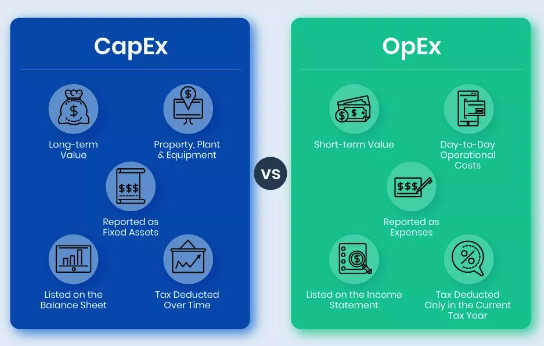
- Capital expenditures (CapEx) are a company’s major, long-term expenses while operating expenses (OpEx) are a company’s day-to-day expenses.
- Examples of CapEx include physical assets, such as buildings, equipment, machinery, and vehicles. Examples of OpEx include employee salaries, rent, utilities, and property taxes.
- Information Technology (IT) & Operational Technology (OT):
- Information Technology (IT):
- Refers to anything related to computer technology, including hardware and software. Your email, for example, falls under the IT umbrella. IT forms the technological backbone of most organizations and companies by managing data, communications, and business processes. These devices and programs have little autonomy and are updated frequently.
- Operational Technology (OT):
- Refers to the hardware and software used to change, monitor, or control physical devices, processes, and events within a company or organization. This form of technology is most commonly used in industrial settings, where these systems are engineered for safety, reliability, and precision control. An example of OT includes SCADA (Supervisory Control and Data Acquisition).
- => The main difference between OT and IT devices: OT devices control the physical world, while IT systems manage data.
- Information Technology (IT):
- Product Lifecycle Management (PLM):
- At the most fundamental level, product lifecycle management (PLM) is the strategic process of managing the complete journey of a product from initial ideation, development, service, and disposal. Put another way, PLM means managing everything involved with a product from cradle to grave.
- Commercial Fusion:
- Commercial fusion refers to the development of privately or publicly funded, utility-scale power plants designed to sell electricity generated by nuclear fusion. Unlike experimental reactors, these aim for economic viability and grid-scale, clean energy production by the 2030s, using methods like high-temperature superconducting (HTS) magnets (tokamaks) to achieve net energy gain.