ABB – ABB strengthens grid automation offerings with Netcontrol acquisition

- Acquisition enhances ABB’s grid automation offerings for utilities facing rising need to digitalize the electrical power grid
- Portfolio includes advanced grid automation solutions to manage power grids
- Netcontrol’s strong grid automation offerings, combined with ABB’s portfolio and global reach create growth opportunities in Europe, Asia and Middle East
ABB today announced that it has signed an agreement to acquire Netcontrol, a provider of electrical grid automation solutions for power utilities and critical infrastructure operators. The transaction is expected to close in Q1 2026, subject to regulatory approvals and customary closing conditions. Financial terms were not disclosed.
As electrification accelerates and the energy transition progresses, grids are under pressure from rising demand, more renewables, and extreme weather. With electricity expected to reach 50 percent of global energy use by 2050 (IEA*), grids must become smarter and digitalized. ABB’s electrification portfolio combined with Netcontrol’s advanced grid automation solutions will help customers on their journey to digitalize the power grid. Headquartered in Helsinki, the company has around 100 employees. Netcontrol was founded in 1991 and is currently owned by Procuritas Partners, a Swedish Private Equity fund.
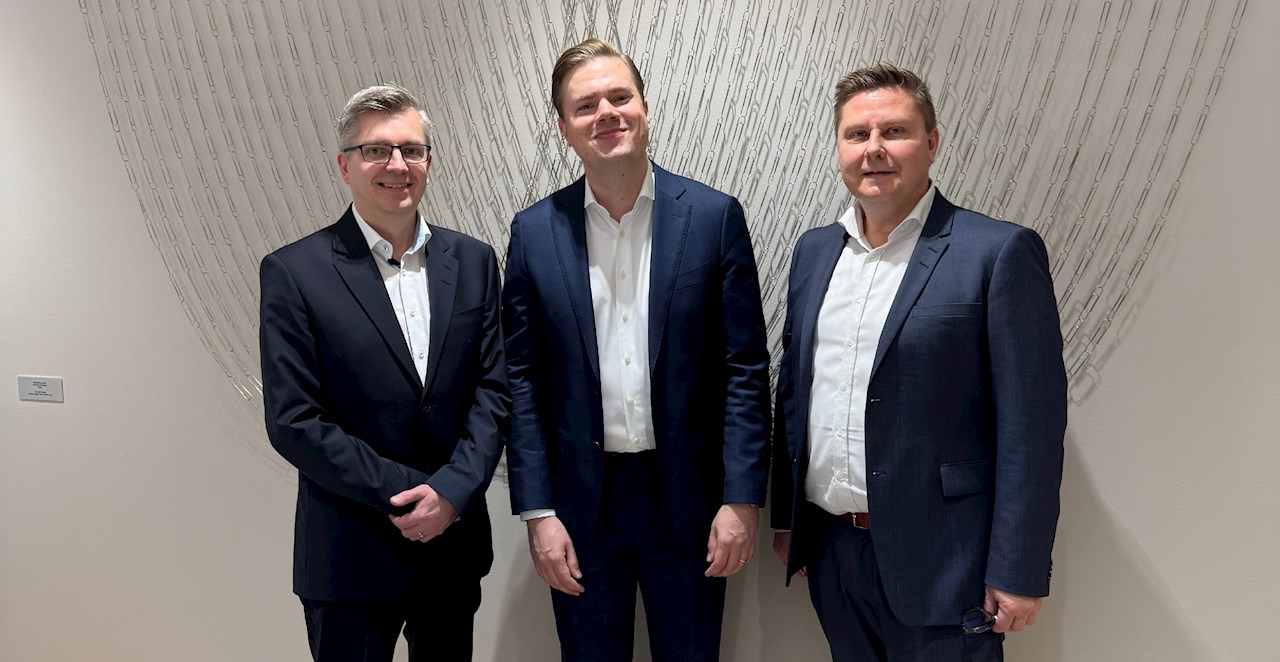
From left: Sami Kurunsaari (CEO, Netcontrol), Jussi Holopainen (Procuritas), Sami Raitakoski (ABB)
“The electrical grid is becoming the bottleneck of the energy transition. The expansion of electricity and grid upgrades are key to energy resilience and ensure that the world has enough power available for growing populations and industries. As we add renewable sources and new consumers, like electric vehicles and heat pumps, connecting everything reliably becomes more and more challenging. Utilities need digitalization and automation to keep the grid stable, resilient, and flexible,” said Adrian Guggisberg, Division President, ABB Distribution Solutions. “Acquiring Netcontrol is a strong fit supporting our grid automation portfolio expansion and a useful step forward to help our customers outrun.”
Once the deal closes, Netcontrol’s products and services are expected to be integrated into ABB’s Distribution Solutions portfolio and offered through its global sales channels.
Sami Kurunsaari, CEO of Netcontrol, said, “Joining ABB marks an exciting next stage in our company’s journey. Our customers rely on us for secure, reliable electrical grid automation solutions and close technical collaboration. Becoming part of ABB will give us the global scale, portfolio, and reach to bring our technology and expertise to many more utilities and industrial customers, while continuing to invest in the products and services our existing customers know and trust.”
*IEA – The International Energy Agency
Important notice about forward-looking information
This press release includes forward-looking information and statements that are based on current expectations, estimates and projections These expectations, estimates and projections are generally identifiable by statements containing words such as “expects,” “believes,” “estimates,” “projects,” or similar expressions. However, there are many risks and uncertainties, many of which are beyond our control, that could affect our ability to achieve any particular goal or objective, including whether this transaction will be consummated. Although ABB Ltd believes that its expectations reflected in any such forward-looking statement are based upon reasonable assumptions, it can give no assurance that those expectations or any particular goal, objective or result will be achieved.
SourceABB
EMR Analysis
More information on ABB: See full profile on EMR Executive Services
More information on Morten Wierod (Chief Executive Officer and Member of the Group Executive Committee, ABB Ltd): See full profile on EMR Executive Services
More information on Timo Ihamuotila (Chief Financial Officer, ABB till end of 2026 + Member of the Executive Committee, ABB till February 1, 2026): See full profile on EMR Executive Services
More information on Christian Nilsson (Chief Financial Officer, Electrification Business Area, ABB till February 1, 2026 + Chief Financial Officer and Member of the Executive Committee, ABB as from February 1, 2026): See full profile on EMR Executive Services
More information on Electrification Business Area by ABB: See the full profile on EMR Executive Services
More information on Giampiero Frisio (President, Electrification Business Area and Member of the Executive Committee, ABB): See full profile on EMR Executive Services
More information on Adrian Guggisberg (Division President, Distribution Solutions, Electrification Business Area, ABB): See full profile on EMR Executive Services
More information on Sami Raitakoski (Global Business Line Manager, Grid Components, Electrification Business Area, ABB): See full profile on EMR Executive Services
More information on Netcontrol by ABB Distribution Solutions by Electrification Business Area byABB: https://www.netcontrol.com/ + Founded in 1991 and headquartered in Helsinki, Finland, Netcontrol, with around 100 employees, provides secure and intelligent automation solutions for modern energy networks. With offices in Sweden, Norway, Latvia, the United Kingdom and South Africa, the company focuses on improving the efficiency, reliability, and sustainability of electricity, district heating, and traction power systems.
Our product and service portfolio includes substation automation, VALVOT – fully managed SCADA service, grid communication, cybersecurity solutions, and smart energy monitoring. These solutions are designed to integrate seamlessly with both existing and future infrastructure, supporting the development of intelligent and flexible energy networks.
In 2024, Netcontrol enhanced its engineering and project management capabilities by acquiring Swedish electrical engineering company Voltyx AB, further strengthening its full-service offering within the industry.
Netcontrol is a leading provider of advanced grid automation solutions, specializing in the control and monitoring of energy distribution systems. With a reputation for delivering reliable, high-quality products, Netcontrol aims to enhance the performance and reliability of energy networks. The company’s innovative approach and commitment to customer satisfaction have made it a trusted name in the industry. The company is headquartered in Helsinki, Finland.
More information on Sami Kurunsaari (Chief Executive Officer, Netcontrol, Distribution Solutions, Electrification Business Area, ABB): See full profile on EMR Executive Services
More information on IEA (International Energy Agency): https://www.iea.org + The IEA is at the heart of global dialogue on energy, providing authoritative analysis, data, policy recommendations, and real-world solutions to help countries provide secure and sustainable energy for all.
The IEA was created in 1974 to help co-ordinate a collective response to major disruptions in the supply of oil. While oil security this remains a key aspect of our work, the IEA has evolved and expanded significantly since its foundation.
Taking an all-fuels, all-technology approach, the IEA recommends policies that enhance the reliability, affordability and sustainability of energy. It examines the full spectrum issues including renewables, oil, gas and coal supply and demand, energy efficiency, clean energy technologies, electricity systems and markets, access to energy, demand-side management, and much more.
Since 2015, the IEA has opened its doors to major emerging countries to expand its global impact, and deepen cooperation in energy security, data and statistics, energy policy analysis, energy efficiency, and the growing use of clean energy technologies.
More information on Dr. Fatih Birol (Executive Director, International Energy Agency): https://www.iea.org/contributors/dr-fatih-birol + https://www.linkedin.com/in/fatih-birol/
More information on Procuritas Partners: https://www.procuritas.com/ + Procuritas was founded in 1986 and has a market leading track record of growing successful companies in the Nordic region. Since its founding, Procuritas-advised funds have completed more than 50 platform investments and hundreds of add-on acquisitions, resulting in attractive returns for its investors. The firm’s deep experience and operational expertise make it an ideal partner for businesses looking to take a transformational step in their growth journey.
More information on Johan Conradsson (Co-Managing Partner, Procuritas Partners): https://www.procuritas.com/people + https://www.linkedin.com/in/johan-conradsson-323278/
More information on Mattias Feiff (Co-Managing Partner, Procuritas Partners): https://www.procuritas.com/people + https://www.linkedin.com/in/mattias-feiff-4837b/
More information on Jussi Holopainen (Partner, Procuritas Partners): https://www.procuritas.com/people + https://www.linkedin.com/in/jussiholopainen/
EMR Additional Notes:
- Grid, Microgrids, DERs and DERM’s:
- Grid / Power Grid:
- The power grid is a network for delivering electricity to consumers. The power grid includes generator stations, transmission lines and towers, and individual consumer distribution lines.
- The grid constantly balances the supply and demand for the energy that powers everything from industry to household appliances.
- Electric grids perform three major functions: power generation, transmission, and distribution.
- The power grid is a network for delivering electricity to consumers. The power grid includes generator stations, transmission lines and towers, and individual consumer distribution lines.
- Microgrid:
- Small-scale power grid that can operate independently or collaboratively with other small power grids. The practice of using microgrids is known as distributed, dispersed, decentralized, district or embedded energy production.
- Smart Grid:
- Any electrical grid + IT at all levels.
- Micro Grid:
- Group of interconnected loads and DERs (Distributed Energy Resources) within a clearly defined electrical and geographical boundaries witch acts as a single controllable entity with respect to the main grid.
- Distributed Energy Resources (DERs):
- Small-scale electricity supply (typically in the range of 3 kW to 50 MW) or demand resources that are interconnected to the electric grid. They are power generation resources and are usually located close to load centers, and can be used individually or in aggregate to provide value to the grid.
- Common examples of DERs include rooftop solar PV units, natural gas turbines, microturbines, wind turbines, biomass generators, fuel cells, tri-generation units, battery storage, electric vehicles (EV) and EV chargers, and demand response applications.
- Small-scale electricity supply (typically in the range of 3 kW to 50 MW) or demand resources that are interconnected to the electric grid. They are power generation resources and are usually located close to load centers, and can be used individually or in aggregate to provide value to the grid.
- Distributed Energy Resources Management Systems (DERMS):
- Platforms which helps mostly distribution system operators (DSO) manage their grids that are mainly based on distributed energy resources (DER).
- DERMS are used by utilities and other energy companies to aggregate a large energy load for participation in the demand response market. DERMS can be defined in many ways, depending on the use case and underlying energy asset.
- Platforms which helps mostly distribution system operators (DSO) manage their grids that are mainly based on distributed energy resources (DER).
- Grid / Power Grid:
- Power Utility – Utilities:
- Also known as an electric utility or power company, is a company or entity responsible for generating, transmitting, and distributing electricity to consumers. They often operate in regulated markets and are major providers of energy in most countries.
- Private Equity and Venture Capital:
- Private Equity (PE):
- Private Equity (PE) is stock in a private company that does not offer stock to the general public. Instead, it is offered to specialized investment funds and limited partnerships that take an active role in managing and structuring the companies.
- Private equity operates with investors and uses funds to invest in private companies or buy out public companies. By doing so, general partners can obtain control over management and other operational changes to increase profitability in hopes to later sell at a successful rate.
- A PE firm typically holds a company for 3 to 7 years before “exiting”.
- Venture Capital (VC):
- Venture Capital (VC) is a form of private equity financing provided by investors to startups and early-stage companies with high growth potential, often in technology or innovative sectors. VCs provide capital in exchange for minority equity stakes, typically offering strategic, managerial, and technical support to help businesses scale. These investments are high-risk, aimed at generating significant returns through exits like IPOs or acquisitions.
- Private Equity (PE):
- Geothermal Heating, Heat Pumps, Chillers, Hydronics & Heat Exchangers:
- Geothermal heating and cooling systems take advantage of the stable temperature underground using a piping system, commonly referred to as a “loop.” Water circulates in the loop to exchange heat between your home, the ground source heat pump, and the earth, providing geothermal heating, cooling, and hot water at remarkably high efficiencies.
- Heat pumps use electricity to transfer heat from a cool space to a warm space, making the cool space cooler and the warm space warmer. During the heating season, heat pumps move heat from the cool outdoors into your warm house. During the cooling season, heat pumps move heat from your house into the outdoors. Because they transfer heat rather than generate heat, heat pumps can efficiently provide comfortable temperatures for your home.
- The only difference between a heat pump and a chiller is that one is designed to remove heat from a space or process stream, making it cooler and rejecting heat to the environment, while the other is designed to extract heat from the environment and use it to provide useful heat.
- Hydronics are systems of heating or cooling that involves transfer of heat by a circulating fluid (such as water or vapor) in a closed system of pipes.
- Heat exchangers are used to transfer heat from one medium to another. These media may be a gas, liquid, or a combination of both. The media may be separated by a solid wall to prevent mixing or may be in direct contact. Heat exchangers are required to provide heating and/or cooling to meet a process requirement.
- In HVAC, Heat exchangers are used to transfer heat between the indoor and outdoor air streams while keeping them physically separated as a means of cooling the indoor air. In addition, heat exchangers can also be used to heat indoor air. These systems are called heat pumps.